

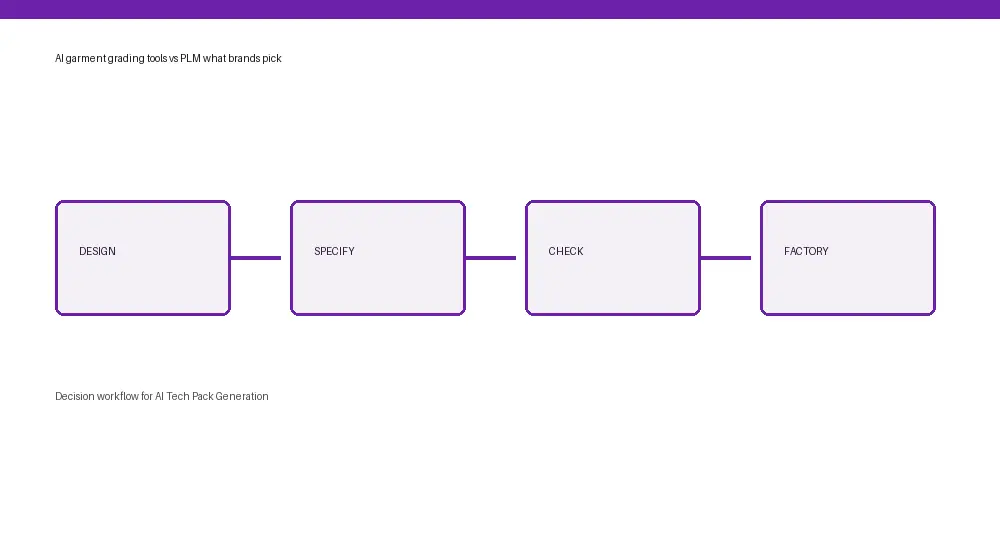
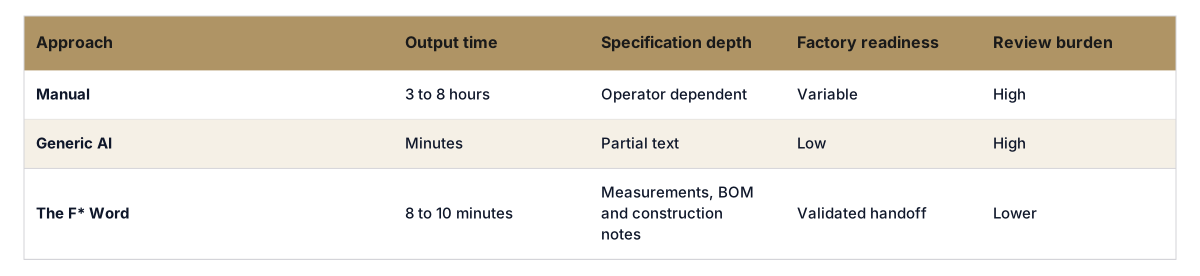
TL;DR. Brands are choosing AI garment grading tools over legacy PLM modules to accelerate speed to market and reduce errors. While PLMs house grading rules in static libraries, requiring manual input and updates by technical designers, AI platforms autonomously generate grade rules from base patterns, points of measure (POM), and even 3D model data. This AI-driven approach dynamically creates nested patterns and updates the tech pack instantly, eliminating manual data entry and sample rounds tied to sizing errors. For teams focused on orchestrating the entire workflow from moodboard to factory BOM, AI offers a predictive and generative advantage, turning a labor-intensive pre-production step into an automated part of concept-to-production validation.
Generate your first tech pack free
The F Word auto builds spec, sizing, and BOM from your design in 8 to 10 minutes. No template wrangling, no factory back and forth.
Garment grading is the process of creating a range of sizes for a single apparel style. The process starts with a base size pattern, often a sample size like a Medium for womenswear or a Large for menswear. A technical designer or pattern maker then uses a specific set of grade rules to proportionally increase or decrease the dimensions of this base pattern to create patterns for the complete size range, from XXS to XXL or beyond. These rules are not uniform. they vary based on the garment type, fabric, and target customer demographic.
The core of grading lies in the points of measure (POM). Key POMs include chest circumference, waist, hip, sleeve length, and inseam. The grade rules dictate how much each POM grows or shrinks between sizes. For example, a standard grade rule for a shirt might increase the chest measurement by two inches per size, while the sleeve length might only increase by a half inch. The goal is to maintain the original style's fit, balance, and proportions throughout all sizes, ensuring a consistent customer experience.
Incorrect grading is a primary driver of high return rates, excess inventory, and costly rework. If the proportions are off on the larger or smaller sizes, it leads to poor fit and customer dissatisfaction. This makes grading a critical pre-production step that directly impacts a brand's profitability and reputation. A finalized set of graded specifications is an essential component of the final tech pack sent to the factory for production.
Product Lifecycle Management (PLM) systems like Centric PLM and FlexPLM have long been the central repository for product data, including grading information. IN a PLM, grading is typically handled by a dedicated module. Technical designers manually create and store libraries of grade rules. When a new style is developed, the designer selects the appropriate grade rule library and applies it to the base size specifications entered into the system. The PLM then calculates the measurements for each size in the range.
This process is at its core a database management task. The PLM acts as a structured container for the POM chart, storing the base measurements and the calculated values for each size. While this centralizes data and prevents it from being lost in spreadsheets, it remains a heavily manual process. The technical designer is responsible for selecting the right rules, spot-checking the calculations, and updating the library if a new type of fit or garment is introduced. Any error in the initial rule set or its application can cascade through the entire size run, often going unnoticed until the first fit samples arrive.
The main limitation of the PLM approach is its static nature. The system calculates based on the explicit rules it is given. It cannot infer or suggest grading, nor can it validate the rules against a visual or 3D representation of the garment. This rigidity means that iteration is slow. If a fit model review reveals that the grading on a size Large is too tight in the shoulders, the technical designer must go back into the PLM, manually adjust the grade rule, recalculate the specs, update the tech pack, and request a new sample. This linear, sequential workflow adds major time to the product development calendar.
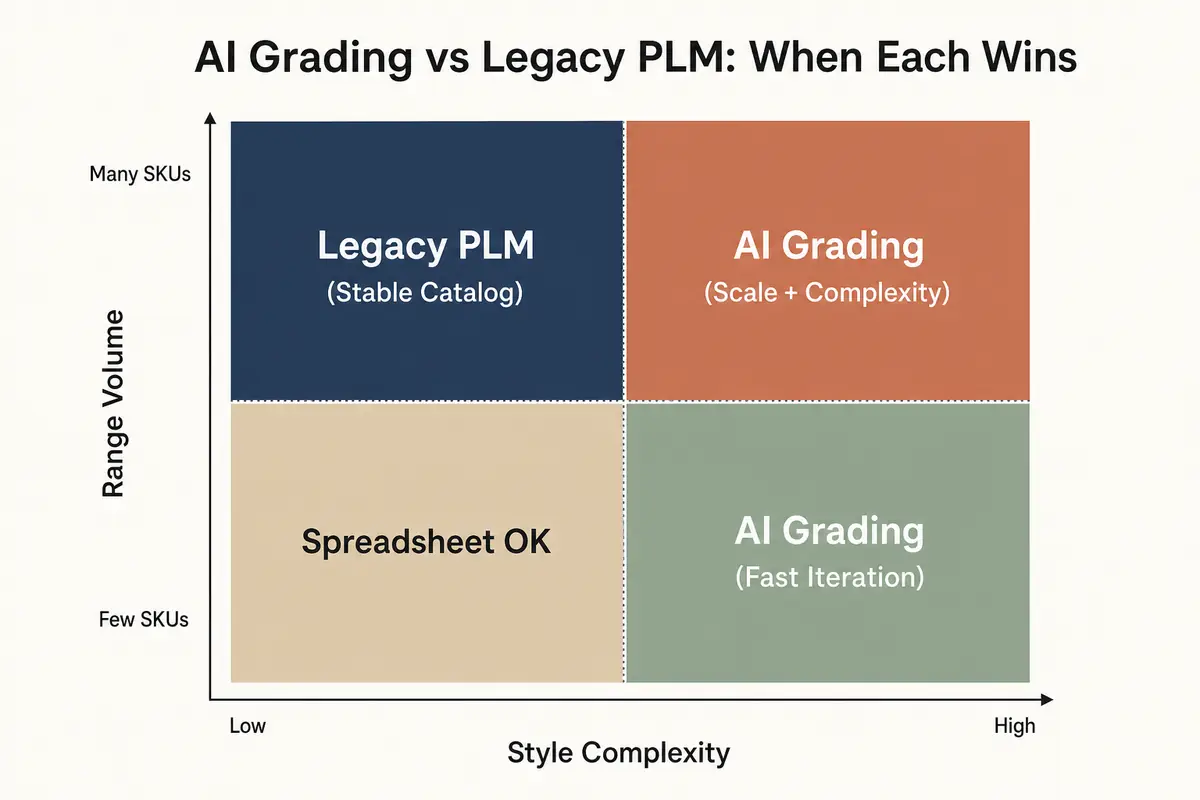
When AI grading wins versus when a legacy PLM module is still the right call, plotted on range volume and style complexity.
AI introduces a predictive and generative capability to the grading process, at its core changing it from a manual data entry task to an automated workflow step. Instead of relying on static libraries, AI garment grading tools analyze inputs to generate the grade rules themselves. These inputs can include 2D base patterns, 3D garment simulations from tools like Browzwear or CLO, key POMs, and historical product data. The AI models are trained on vast datasets of successful production garments and their corresponding grade rules.
This generative approach means an AI platform can produce a complete, production-ready grade table from minimal inputs. For example, a product development manager could provide a base size block pattern and specify the desired size range and fit type (e.g., "slim fit," "oversized"). The AI then generates the appropriate POMs and grade rules, creates the graded nest, and populates the tech pack automatically. This significantly reduces the manual workload on technical designers, freeing them up for more strategic tasks like fit validation and quality control.
Platforms like The F* Word act as an orchestration layer, using AI to connect different stages of product creation. An initial moodboard and design brief can be used to inform an AI that generates a 3D model. That model, in turn, provides the geometric data needed for the AI to propose an optimal set of grade rules. This moves grading from a late-stage pre-production check to an integrated part of the initial design and development loop, allowing for much earlier validation of how a garment will scale throughout its entire size range.
When product development leaders evaluate whether to stick with their PLM's grading module or adopt a dedicated AI tool, they are comparing two different operational paradigms. PLMs offer a system of record, providing structure and data integrity. AI tools provide a system of intelligence, offering speed, automation, and predictive findings. The choice depends on where the biggest bottlenecks are in a brand's specific workflow.
PLM modules excel at enforcing standards. Once a grade rule library is established and approved, the PLM ensures it is applied consistently. This is valuable for large organizations with established product lines and minimal variation in fit. However, this strength is also a weakness. The system is inflexible and requires major manual overhead to manage exceptions or introduce new fit blocks. Any adjustments require navigating a complex user interface and understanding the specific data structure of the PLM.
AI tools, in contrast, are built for speed and adaptability. They can generate entirely new grade rules for novel designs in seconds, something that would take a technical designer hours of research and calculation. Their ability to use 3D data for validation means they can flag potential fit issues throughout sizes before a single physical sample is ever made. This proactive, generative approach is far more matched with the demands of quick-turn and direct-to-consumer business models where product agility is paramount.

The operational differences between PLM and AI grading tools become clearest when examining the data flow. In a traditional workflow orchestrated by a PLM, the process is linear and siloed. A designer creates a sketch, a pattern maker creates a 2D pattern, and a technical designer builds a tech pack in the PLM. They manually input the base size measurements, then apply a stored grade rule. The output is a spec sheet inside the PLM that must be exported and combined with other tech pack components for the factory.
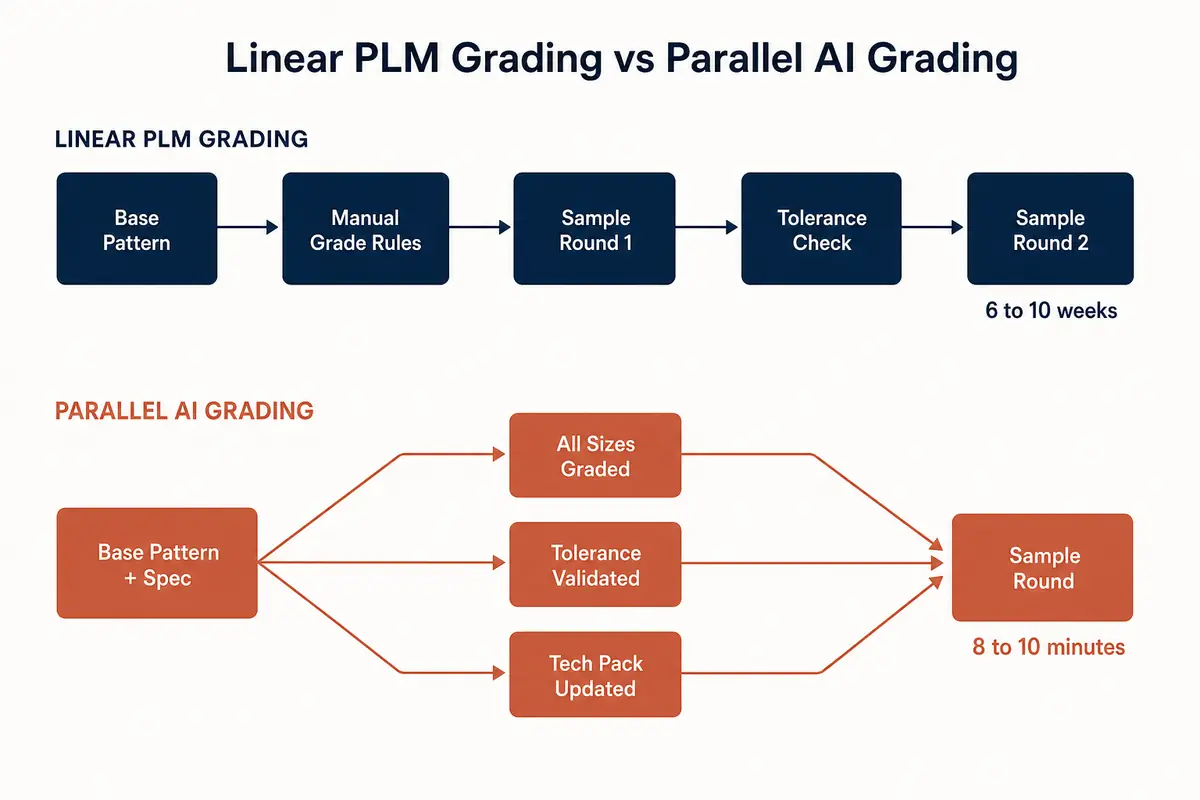
Linear PLM grading versus parallel AI grading, contrasting a 6 to 10 week sample cycle with an 8 to 10 minute automated cycle.
An AI-driven workflow operates in parallel rather than in sequence. The data inputs are richer, often including a 3D model file (.zprj from CLO, for example) alongside the 2D pattern. The AI processes these in parallel: it can validate the grade rules against the 3D fit simulation while simultaneously generating the spec sheet and updating the tech pack. The output is not just a POM chart but a complete, validated, and production-ready package, often with factory-grade DXF files included.
This shift has major implications for cross-functional teams. Designers, pattern makers, and tech designers can collaborate on a single source of truth that updates in near real time. A change made to the 3D model is instantly showed in the graded specs and the tech pack. This breaks down the data silos that often plague PLM-centric workflows, where information is fragmented throughout different modules and exports. The result is a more agile and responsive product development cycle, with fewer errors caused by manual data transfer between disconnected systems.
Accuracy in grading is measured by how well the final garment's dimensions match the specified tolerances. Tolerances are the acceptable margin of deviation for each POM, typically defined in the tech pack (e.g., chest plus or minus 0.5 cm). Brands that rely on legacy PLM systems often experience multiple rounds of sampling to fine-tune grading and bring all sizes in tolerance. Each round adds weeks to the timeline and major costs in fabric, factory labor, and shipping.
AI grading tools are designed to reduce sample rounds by validating accuracy upfront. By using 3D simulation data, the AI can predict how the garment will drape and fit on a virtual fit model for every size in the range. It can identify potential tolerance issues before a single sample is cut. For example, the AI might flag that the proposed grade rule for the size XL will cause the sleeve to be too short for the average customer in that size, suggesting a corrective adjustment based on its training data.
This predictive validation dramatically improves first-sample accuracy. Brands using a platform like The F* Word for orchestrated tech pack generation report a major reduction in the number of sample rounds required to achieve a production-ready garment. By front-loading the accuracy checks, brands can save weeks of development time and thousands of dollars in sampling costs. This makes the AI-driven workflow not just faster but also more capital-efficient than the traditional PLM-based approach.
For a brand's product development leadership, choosing between an AI grading tool and a PLM module involves more than a feature comparison. It requires an assessment of strategic goals. Brands prioritizing absolute data control, integration with existing financial and ERP systems, and managing a slow-changing, classic product line may find their current PLM module sufficient. The investment is already made, and the workflow, while slow, is established.
However, brands competing in fast-moving markets, those with extensive product ranges, or those scaling their direct-to-consumer business should strongly consider an AI-first approach. The ability to compress the time from design to production is a major competitive advantage. Reducing the number of physical samples also matches with sustainability goals, a key concern for modern consumers and investors. The decision often comes down to whether the brand's biggest constraint is data structure (a PLM strength) or development speed (an AI strength).
The most progressive brands are not choosing one over the other but are integrating AI tools to augment their existing PLMs. They use a tool like The F* Word as a workflow accelerator that sits on top of their PLM, feeding the system of record with high-quality, AI-generated tech packs and graded specifications. This hybrid approach allows them to retain the structural benefits of their PLM while gaining the speed and intelligence of AI, providing the best of both worlds for their product development teams.
How does AI grading handle complex or non-standard garments like outerwear or activewear?
AI models are trained on diverse datasets that include complex garment categories like outerwear, activewear, and lingerie. For unique designs, the AI can use the 2D pattern and 3D model data to infer grading logic, even where standard rules do not apply. This allows it to generate accurate grades for novel constructions, reducing the need for technical designers to manually develop new rule sets from scratch.
Can we integrate an AI grading tool with our existing Centric or FlexPLM system?
Yes. Most modern AI grading and workflow tools, including platforms like The F* Word, are built with open APIs to integrate with major PLM systems. They are designed to act as a workflow accelerator, generating and validating tech pack data that can be pushed into the PLM as the system of record, augmenting rather than replacing the existing investment.
What is the typical time savings when switching from PLM grading to an AI tool?
Brands often report major time savings. The generation of a complete, factory-ready tech pack including graded specifications can be reduced from days or weeks of manual work to just 8 to 10 minutes per style with an AI orchestration tool. This compresses the entire pre-production timeline and reduces the number of sample rounds needed.
Is AI grading accurate enough for production at scale?
Yes. AI grading tools that use 3D validation are highly accurate. By predicting fit issues throughout the entire size range before sampling, they often produce a first sample that is closer to the final production target than what is typically achieved with manual PLM-based grading. This high level of upfront accuracy is what enables the major reduction in sample rounds and overall development time.
To learn more about how AI changes pre-production workflows, see our deep dive on AI tech pack generation and how it streamlines the entire process from design to factory. You can also explore our analysis of pre-production workflow software to understand the broader market. For a comparison of how AI changes creative roles, read about AI in creative direction and its impact on fashion brands.
Ready to see how AI can transform your tech pack and grading workflow? Book a demo of The F* Word to see our AI orchestration platform. Explore our full suite of resources at our AI Tech Pack Generation hub.
Related: Centric PLM cost, fit and alternatives
Explore the related workflow. Read the related guide. Read the related guide. Try The F* Word.
Get The F* Word workflow insights in your inbox.