

TL;DR. The creative director AI fashion workflow transforms brand vision into factory-ready products by automating critical, time-consuming tasks. Platforms like The F* Word operate as an orchestration layer, taking high-level creative direction and autonomously generating both the initial visual concepts for a moodboard and the complete, production-grade tech pack. This integrated system connects ideation directly to execution, specifying everything from bill of materials (BOM) and points of measure (POM) to graded size sets. For creative directors, this means more time spent on strategic vision and brand narrative, while AI handles the technical translation, ensuring concepts are validated, manufacturable, and aligned with market data from day one.
The role of the Creative Director is undergoing a fundamental shift, moving from a position of pure intuition to one of strategic, data-augmented leadership. AI is not a replacement for creative vision; it is a powerful partner that handles the operational load, freeing directors to focus on brand identity, narrative, and innovation. Historically, the creative process was siloed, with a significant gap between the director's conceptual board and the technical designer's first draft. This gap often resulted in misinterpretation, increased sample rounds, and extended timelines.
Modern AI workflows close this gap by creating a direct, intelligent link between concept and production. Instead of just static images on a moodboard, AI platforms can generate dynamic concepts grounded in real-world data, such as trending silhouettes, popular colorways, or sustainable fabric availability. This allows a creative director to explore and validate ideas at a scale and speed previously impossible. The goal is not to automate creativity, but to provide creatives with tools that amplify their intent and translate it flawlessly into an executable plan.
This evolution elevates the creative director's function within an organization. By embedding AI into the workflow, they become more integrated with product development, merchandising, and even sourcing. Their decisions are not just aesthetically driven but are also validated by market signals and production feasibility from the very beginning. This transforms the creative department from a cost center into a strategic driver of efficiency and commercial success, ensuring that every design is both inspired and intelligent.
The F* Word is a workflow orchestration platform designed specifically to translate a creative director's vision into factory-ready artifacts. It is not a PLM system for managing lifecycle data, nor is it a 3D design tool like CLO or Browzwear. Instead, it functions as the connective tissue between creative intent and technical execution. The platform starts with a creative director's high-level inputs, such as a theme, target consumer, key silhouettes, and color story, to autonomously generate visual moodboards that establish the collection's aesthetic direction.
Where The F* Word truly distinguishes itself is in the next step: converting that validated creative vision directly into a complete tech pack. This is not a rough draft; it is a production-ready document. The platform generates a detailed bill of materials (BOM), specifies all necessary trims and findings, defines precise points of measure (POM) for the base size, and even calculates the grading rules for a full size set. It understands the nuances of garment construction, ensuring that the generated specs are practical and manufacturable.
This autonomous process eliminates the weeks of back-and-forth between design and technical teams. The creative director's vision is preserved with perfect fidelity, as the AI handles the direct translation without subjective interpretation. For the first time, creative leaders can ensure their concepts are translated into tangible, actionable data for sourcing and production teams in hours, not weeks. This allows them to maintain creative control while radically accelerating the entire product development calendar.
The ideation phase of fashion design has traditionally been a manual, time-intensive process of research and curation. Creative directors and their teams spend weeks scouring online sources, attending trade shows, and compiling physical boards to forecast trends. AI fundamentally reimagines this workflow by introducing speed and data-driven breadth. AI systems can analyze millions of data points from social media, runway shows, and e-commerce sites in minutes, identifying nascent trends, color palettes, and silhouette shifts before they hit the mass market.
This capability allows creative teams to move beyond simple trend-spotting toward true concept development. With an AI partner, a creative director can rapidly generate and iterate on multiple conceptual frameworks. For example, they can prompt the system to explore variations on a theme like "utilitarian romance," and the AI can return hundreds of visual ideas blending hard-wearing fabrics with soft silhouettes, complete with suggested colorways and texture combinations. This expands the creative sandbox, allowing for more "what if" scenarios without the associated time cost.
Operationally, this means a designer can request explorations of specific elements with incredible granularity. An AI workflow can generate dozens of collar variations for a trench coat, showcase a single print across five different fabric types like silk charmeuse or recycled cotton twill, or visualize an entire 12-piece capsule collection based on a two-word prompt. This ability to instantly visualize and test ideas helps teams refine their direction quickly, ensuring the final concept is strong, coherent, and commercially viable before any significant resources are committed.
AI's role as a co-creator extends beyond initial ideation, directly empowering both design and merchandising teams throughout the product lifecycle. Once a concept is approved, an AI workflow can translate rough sketches or inspirational images into clean, detailed technical flats. This standardized output ensures clarity and eliminates ambiguity when the design is handed off to a technical designer or product development manager, reducing the potential for error in the first sample round.
This streamlined process fosters a more collaborative and efficient environment. With AI generating the foundational tech pack data, creative and technical teams can spend their time on higher-value tasks. Technical designers can focus on refining fit, perfecting construction details, and managing supplier communication, rather than manually inputting data into a PLM system. The creative director maintains oversight, able to review AI-generated outputs and make strategic adjustments, ensuring the final product aligns perfectly with the original vision.
For merchandisers, this AI-driven workflow provides a significant advantage. Because visual assets can be generated early in the process, they can begin building product pages (PDPs), planning marketing campaigns, and creating lookbooks well before the first physical sample arrives. This allows them to test product appeal, gather pre-launch feedback, and prepare for a faster, more coordinated product launch. The ability to generate on-model imagery for an entire collection supports visual merchandising and e-commerce teams, ensuring consistent and compelling brand presentation from day one.
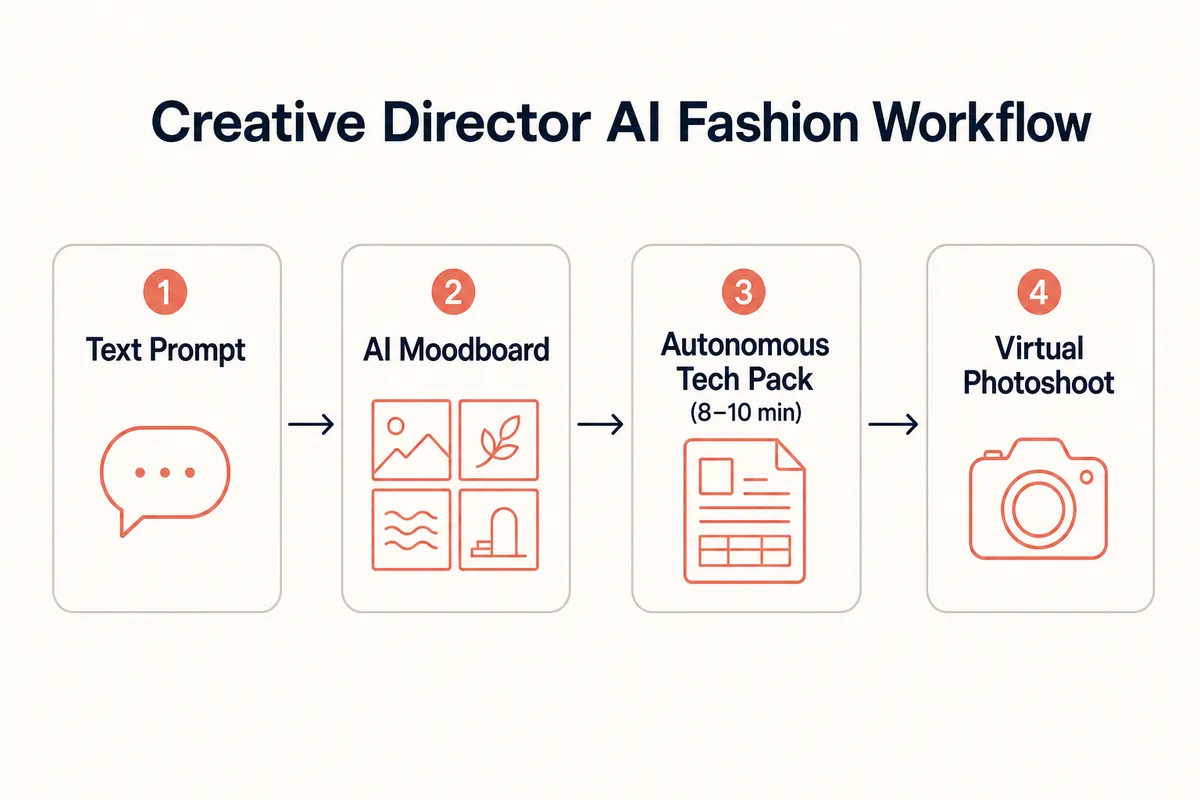
The F* Word's workflow enables a direct path from a creative director's initial prompt to a finished, manufacturable tech pack and marketable product imagery.
The operational differences between a traditional creative workflow and one assisted by an AI orchestration platform are stark. The traditional model is characterized by linear handoffs, manual data entry, and subjective feedback loops, each introducing delays and potential for error. An AI-assisted model, particularly one like The F* Word that connects concept to tech pack, creates a centralized, automated flow of information that accelerates every stage of development.
Key areas of differentiation include speed, resource allocation, and data utilization. A process that once took weeks, such as developing a complete tech pack from a sketch, can now be completed in hours. The need for multiple physical sample rounds is drastically reduced, saving significant costs on materials, shipping, and labor. Below is a direct comparison of the distinct stages of product creation, highlighting the efficiency gains at each step.

Integrating AI into the creative workflow provides a profound strategic advantage by repositioning creative direction as a data-informed discipline. While artistic intuition remains paramount, AI injects objective, predictive insights into the decision-making process. This allows creative directors to validate their instincts against real-time market signals, reducing the commercial risk associated with launching new styles or collections.
AI platforms can analyze vast datasets to provide predictive analytics on which design attributes are likely to perform well. For instance, the system might identify that a certain sleeve detail is trending upward in a key demographic, or that a specific shade of green is associated with higher engagement on social media. This information empowers creative teams to make subtle but impactful adjustments to their designs, optimizing them for commercial success without compromising the core creative vision.
This data-driven approach also extends to collection planning and assortment optimization. By understanding which styles have the highest market resonance before production begins, merchandisers and creative directors can build more coherent and profitable collections. They can confidently invest in potential hero products while minimizing exposure to styles that carry higher risk. Ultimately, this leads to a more resilient business model, with fewer markdowns, less deadstock, and a product offering that is finely tuned to consumer desires.
Integrating AI into a fashion brand's creative department is not an overnight transformation but a strategic, phased implementation. The first step involves a thorough assessment of existing workflows. Teams must map out their current concept-to-production process, identifying bottlenecks, points of friction, and manual, repetitive tasks. Key areas often include initial moodboard creation, technical sketch development, and the manual generation of BOMs and POMs for tech packs. These are prime candidates for AI automation.
Once integration points are identified, the focus shifts to team enablement. This does not mean creative directors and designers need to become data scientists. Instead, training should focus on upskilling them to effectively prompt, guide, and validate AI outputs. They learn to translate their creative language into instructions the AI can understand and to critically evaluate the generated moodboards, sketches, and technical specifications. This empowers them to use AI as a tool that serves their vision, not the other way around.
Finally, measuring the return on investment (ROI) is critical for justifying and scaling the initiative. Key performance indicators should be established from the outset. These can include quantitative metrics like reduction in sample rounds, decreased time from concept approval to tech pack completion, and lower product development costs. Qualitative measures are also important, such as an increase in novel design concepts explored per season or improved collaboration between creative, technical, and merchandising teams. Tracking these metrics provides clear evidence of AI's impact on both efficiency and creative output.
Forward-thinking brands are already demonstrating the tangible benefits of integrating AI into their creative processes. A mid-market contemporary brand, for example, struggled with a 9-month product development cycle, largely due to delays in tech pack creation and multiple sample iterations. By implementing an AI workflow platform, they automated the generation of tech packs from their creative director's approved concepts. This single change reduced their concept-to-factory-ready time from six weeks to under 48 hours, contributing to a 30% reduction in their overall time to market.
In another instance, a direct-to-consumer essentials brand used AI to enhance its creative exploration and reduce waste. Their creative team used the platform to generate hundreds of variations for a new t-shirt program, exploring different necklines, fabric weights, and color options digitally. By analyzing which variations best aligned with their market data, they were able to greenlight a highly optimized design and skip two rounds of physical prototyping entirely. The result was a direct cost saving of over $50,000 in sample development for that season alone.
These real-world applications shows the practical power of AI. The technology delivered not just abstract creative inspiration but concrete business outcomes. For creative directors, this meant their vision was executed faster and more accurately. For the business, it resulted in significant cost reductions, accelerated speed to market, and a more innovative and responsive product offering. These successes prove that AI is not a futuristic concept but a present-day tool for achieving a competitive advantage.
Looking ahead, the integration of AI into fashion's creative disciplines will only deepen. We anticipate AI models will become even more adept at understanding abstract creative language and brand DNA, acting as a perpetual-learning partner for creative directors. Future systems may be able to autonomously propose entire collections that are perfectly aligned with a brand's established aesthetic and commercial targets, allowing directors to function more like editors and curators of AI-generated concepts.
The relationship between human creativity and artificial intelligence will evolve into a true symbiosis. Human designers will provide the essential spark of originality, cultural context, and emotional narrative that machines cannot replicate. AI will provide the scale, speed, and data-driven validation to bring those ideas to life more effectively than ever before. This partnership will allow creative teams to take on more ambitious projects, explore uncharted design territories, and push the boundaries of what is possible in fashion.
For fashion brands, building a culture of innovation is now non-negotiable. The brands that succeed will be those that embrace these new tools, not as a threat, but as an opportunity. They will empower their creative teams with the skills and technologies needed to thrive in this new era. By doing so, they will build more agile, responsive, and creative organizations capable of leading the industry for years to come.
For a creative director, integrating an AI workflow platform offers a clear set of operational and strategic benefits that directly address their primary goals: delivering compelling, on-brand products to market efficiently. The core advantages can be distilled into four key areas: new speed, data-driven validation, reduced iterations, and an expanded scope for creativity. These benefits compound, creating a faster, smarter, and more agile product creation engine.
Speed is the most immediate benefit. Automating the creation of moodboards and tech packs cuts weeks or even months from the product development timeline. Data validation provides a strategic layer, allowing directors to de-risk their creative decisions with market insights before committing to costly production. This directly leads to reduced iterations, as the initial designs are more likely to be commercially viable and technically feasible, minimizing the need for costly and time-consuming sample rounds.
Perhaps most importantly, by offloading the manual and repetitive tasks, AI frees up a creative director's most valuable resource: their time. This allows them to focus on the big-picture thinking, brand storytelling, and high-level innovation that only a human can provide. Instead of getting bogged down in the minutiae of tech pack corrections, they can explore more creative avenues, mentor their teams, and drive the brand's vision forward.
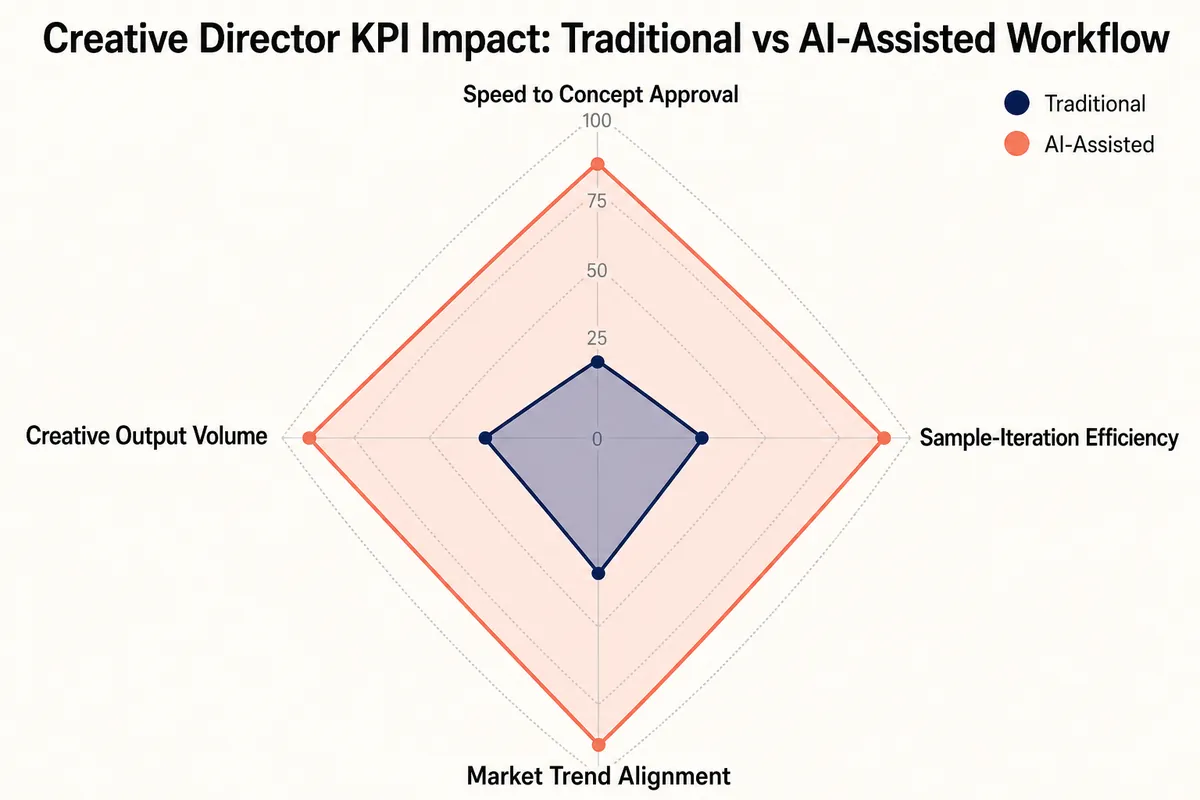
Impact of AI on key performance indicators for creative directors, demonstrating significant improvements in speed, efficiency, and market alignment compared to traditional methods.
AI assists creative directors by automating low-value, repetitive tasks like data entry for tech packs or compiling trend reports. This frees up their time and mental energy to focus on high-level strategy, brand narrative, and original ideation. The AI acts as a co-pilot, rapidly generating variations and validating concepts, which expands the creative director's options rather than limiting them. It enhances their intuition with data, allowing for more confident and ambitious creative bets.
The most beneficial tools are workflow and orchestration platforms like The F* Word, which connect different stages of development. These systems autonomously generate moodboards from creative briefs and then convert those concepts directly into production-ready tech packs. While generative AI for images (like Midjourney) is useful for ideation, and 3D tools (like Browzwear or CLO) are good for virtual prototyping, orchestration platforms deliver the greatest operational impact by bridging the gap between creative vision and factory execution.
Yes, modern AI systems are becoming increasingly adept at interpreting subjective and nuanced creative briefs. By training on vast datasets of fashion imagery and text, they can understand concepts like "dopamine dressing" or "dystopian utility." A creative director provides the initial direction, themes, and constraints, and the AI generates visual concepts and technical specifications that align with that intent. The director then curates and refines these outputs, ensuring the final design captures the desired feel.
The learning curve is surprisingly manageable because the focus is on creative prompting and validation, not coding or complex software operation. For platforms like The F* Word, designers learn how to articulate their vision in text prompts to get the best results. The primary skill is shifting from manual creation to strategic direction and curation of AI-generated content. Most creative professionals can become proficient within a few weeks, as the interfaces are designed to be intuitive for designers, not engineers.
AI is a tool, and like any tool, its impact on originality depends on the user. When used to simply replicate existing trends, it can lead to homogeneity. However, when used by a skilled creative director, AI can be a powerful engine for originality. It can blend disparate concepts, explore "what if" scenarios at scale, and generate novel ideas that a human might not have conceived. The authenticity comes from the director's unique vision and their curation of the AI's output to tell a compelling brand story.
Key ethical considerations include data privacy, intellectual property, and the potential for bias. Brands must ensure the data used to train AI models is sourced ethically and does not infringe on copyrights. It's also crucial to be aware that AI can perpetuate existing biases found in its training data, so human oversight is necessary to ensure fair and inclusive representation. Transparency about the use of AI in the design process is also becoming an important factor for building consumer trust.
Ready to bridge the gap between your creative vision and factory-ready execution? See the creative direction workflow in action and discover how The F* Word automates the journey from concept to collection. Explore more insights and strategies at our creative direction workflow hub.
Get The F* Word workflow insights in your inbox.