


TL;DR. Establishing a single source of truth for distributed design teams requires moving beyond static PLM systems and adopting AI-powered workflow orchestration. This approach centralizes design intent, not just data. It autonomously translates creative assets like a moodboard into a complete, factory-ready tech pack, including the bill of materials, construction details, and grading. By automating this critical path and managing version control for every spec change, this system ensures that product development, technical design, and sourcing teams, regardless of location, are always working from the same validated document. This eliminates version conflicts, reduces sample rounds, and syncs the final, authoritative tech pack to your PLM as the official record.
When design teams are spread throughout New York, London, and Hong Kong, the "single source of truth" often becomes a painful fiction. The reality is a chaotic market of conflicting files and communication breakdowns. A technical designer in Los Angeles updates a point of measure (POM), but the sourcing lead in Vietnam proceeds with a sample based on an older spec sheet saved locally. The result is a fit sample that is dead on arrival, wasting weeks of time and thousands of dollars in shipping and material costs. This isn't a hypothetical. it's the daily operational drag for global fashion brands.
The problem multiplies with each new region, creative partner, or factory. Version control becomes a nightmare managed throughout email threads, shared drives, and instant messages. The tech pack, which should be the immutable blueprint for a garment, splinters into dozens of variants. A merchandiser in Europe might approve a fabric change that is never communicated to the US team, leading to inconsistent product hitting different markets. The core issue is that traditional tools were not built for the dynamic, real-time collaboration that global product development demands.
These misalignments create a major financial and operational burden. Each additional sample round adds direct costs and, more critically, delays the product's time to market. In a trend-driven industry, a two-week delay can be the difference between a bestseller and a markdown liability. also, the constant need for clarification and correction erodes team morale and consumes valuable time that could be spent on innovation and design, not administrative firefighting. For a head of design, this means less time directing creative vision and more time managing avoidable operational friction.
Book an enterprise walkthrough
SSO, audit trail, and custom workflows for your brand team. See how The F Word plugs into your PLM and factory stack without a rebuild.
Product Lifecycle Management (PLM) systems were introduced to centralize product data, and they serve a key role as a system of record. They are excellent for storing final BOMs, costing information, and SKU data. However, for the dynamic, iterative pre-production phase, they often become a bottleneck. PLMs are databases, not workflow engines. For the fast-moving design, product development, and technical design teams, the PLM is where information goes to be archived, not where active work gets done. It's the final destination, not the central hub for creation and collaboration.
The workflow for a technical designer rarely happens inside the PLM interface. They work in Adobe Illustrator for sketches, Excel for BOMs and grading, and email for communications. The PLM is the place they are required to upload files to at the end of a process, often leading to data entry errors and outdated information. Because the system isn't native to their workflow, it is treated as an administrative task. This creates a critical disconnect where the "official" source of truth in the PLM lags behind the actual source of truth living in a folder on a designer's desktop.
This gap is where distributed teams fall apart. When a team in one region needs the absolute latest spec, they are more likely to message the technical designer directly than to trust the file in the PLM. The platform intended to provide clarity instead introduces doubt. An AI orchestration layer solves this by integrating with the tools teams already use and syncing only the final, validated tech pack to the PLM, transforming it back into the reliable system of record it was meant to be.
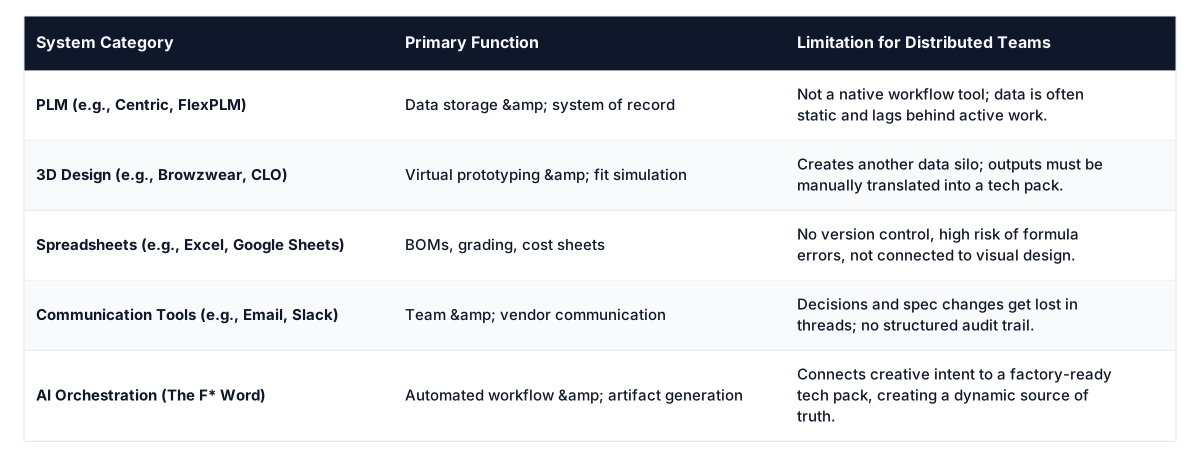
The journey from a creative director's vision to a factory-ready tech pack is rarely a straight line. It is a fragmented relay race of different software, teams, and time zones. The process typically begins with a moodboard and initial sketches, often created in tools like Figma, Miro, or even Pinterest. This is the "intent" phase, rich with creative direction but disconnected from the technical realities of production. A product development manager must then manually interpret these assets to start building out a product shell.
From there, the baton is passed to a technical designer who translates sketches into technical flats in Adobe Illustrator. Simultaneously, a different team member, perhaps a sourcing specialist, begins building a bill of materials in an Excel spreadsheet, researching trims and fabrics. These parallel workstreams are fertile ground for error. The POMs created by the technical designer might not match with the fabric properties selected by the sourcing lead, requiring rework and reconciliation meetings that span continents and calendars.
Each of these steps creates a separate digital artifact: an Illustrator file, a PDF, a spreadsheet, a folder of JPEGs. These artifacts are then compiled, often manually, into what becomes the "tech pack." This compilation is then uploaded to a PLM or, more commonly, emailed directly to vendors. A single change request from a merchandiser requires updating multiple documents and re-communicating throughout the entire chain, hoping everyone deletes the old version. This manual, disjointed process is the root cause of slow development cycles and inconsistent execution.
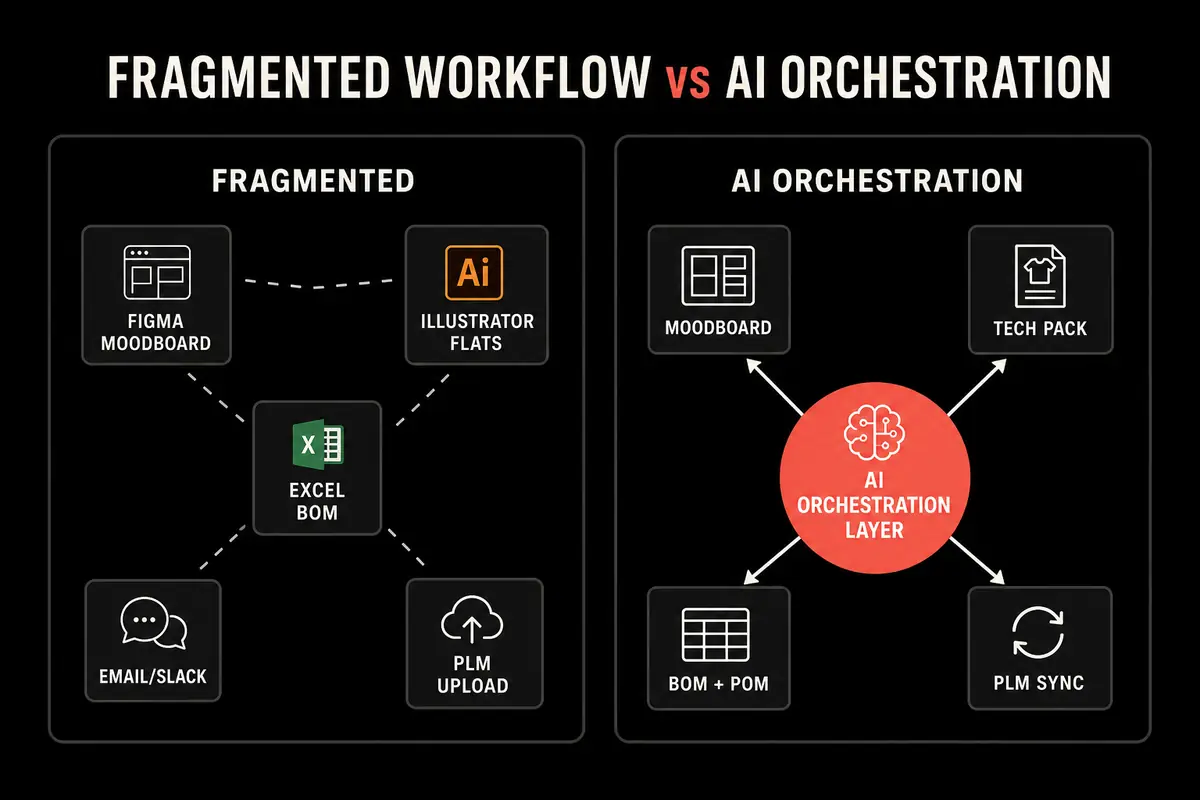
A traditional, fragmented workflow creates data silos and communication gaps, while an AI orchestration layer provides a single, unified path from concept to factory.
True alignment for distributed teams requires more than a shared folder or a centralized database. It requires an active command center that orchestrates work, validates inputs, and automates outputs. This is the role of an AI orchestration platform. Instead of simply storing data, it understands the relationships between creative intent, technical specifications, and production requirements. It acts as the central nervous system for your entire product development process.
Consider a creative director finalizing a moodboard. The AI orchestration platform ingests these visual and text-based concepts and begins to generate the foundational elements of a tech pack automatically. It identifies the need for a "double-breasted wool-blend coat," pulls relevant construction details from a library of past styles, suggests appropriate trims based on performance requirements, and creates a placeholder BOM. This isn't replacing the designer. it's giving them a 90% complete starting point in minutes, not days.
This orchestration layer connects the disparate functions of your team in a single, coherent workflow. The technical designer receives a notification to review and refine the AI-generated technical flats and POMs. The sourcing manager is prompted to source fabrics that match the specified "heavyweight wool" with defined performance characteristics. All activity happens in a unified environment, where every team member sees the same live version of the product information. It turns the tech pack from a static document into a dynamic, collaborative workspace.
The most critical and error-prone phase of pre-production is the manual translation of creative vision into technical specifications. An AI orchestration platform directly targets this vulnerability by automating the creation of the tech pack itself. By analyzing inputs such as reference images, sketches, and design notes from a moodboard, the system can autonomously generate a full production document. This document includes all the necessary components a factory needs to create a first sample accurately.
This automated generation process is exhaustive. The AI populates the bill of materials, listing out shell fabric, lining, buttons, thread, and labels. It generates precise technical flats from multiple angles. It drafts detailed construction callouts, specifying stitch types, seam finishes, and hardware attachment methods. It even creates a preliminary grading table with key points of measure for a sample size, which a technical designer can then review, adjust, and approve. This moves the role of the technical team from tedious data entry to high-value validation and refinement.
The speed and accuracy of this process are major for global operations. A process that once took a week of back-and-forth between a designer, a PD, and a tech designer can now be accomplished in under an hour. This allows brands to react to market trends faster, develop more SKUs with the same size team, and free up their most skilled employees to focus on fit, quality, and innovation, not clerical work. The final output is a complete, validated, and internally consistent tech pack ready for sourcing.
In a distributed model, a spec is never final until the product ships. A sourcing lead in Asia might suggest a substitute trim to save costs, a technical designer in the US might adjust tolerances after a fit session, and a merchandiser in Europe might request a colorway update. Without a strong system, this cascade of changes results in version chaos. An AI orchestration platform enforces version integrity by design, creating an immutable audit trail for every single modification.
When a team member proposes a change, for example, adjusting the waist measurement on a graded spec, the system does not simply allow an override. It initiates a validation workflow. Key stakeholders, such as the head of technical design and the product development manager, are automatically notified to approve or reject the change. The context for the change, the user who proposed it, and the timestamp are all logged. This ensures that no single team or individual can unilaterally alter the master spec without proper authorization.
This structured process eliminates "he said, she said" arguments and provides total clarity on why a specification was changed. The platform maintains a complete version history, allowing teams to see exactly how a garment's specs have evolved from the initial concept. If a production issue arises, managers can trace it back to a specific change and understand the decision-making process behind it. This level of control and transparency is impossible with workflows based on email and spreadsheets.
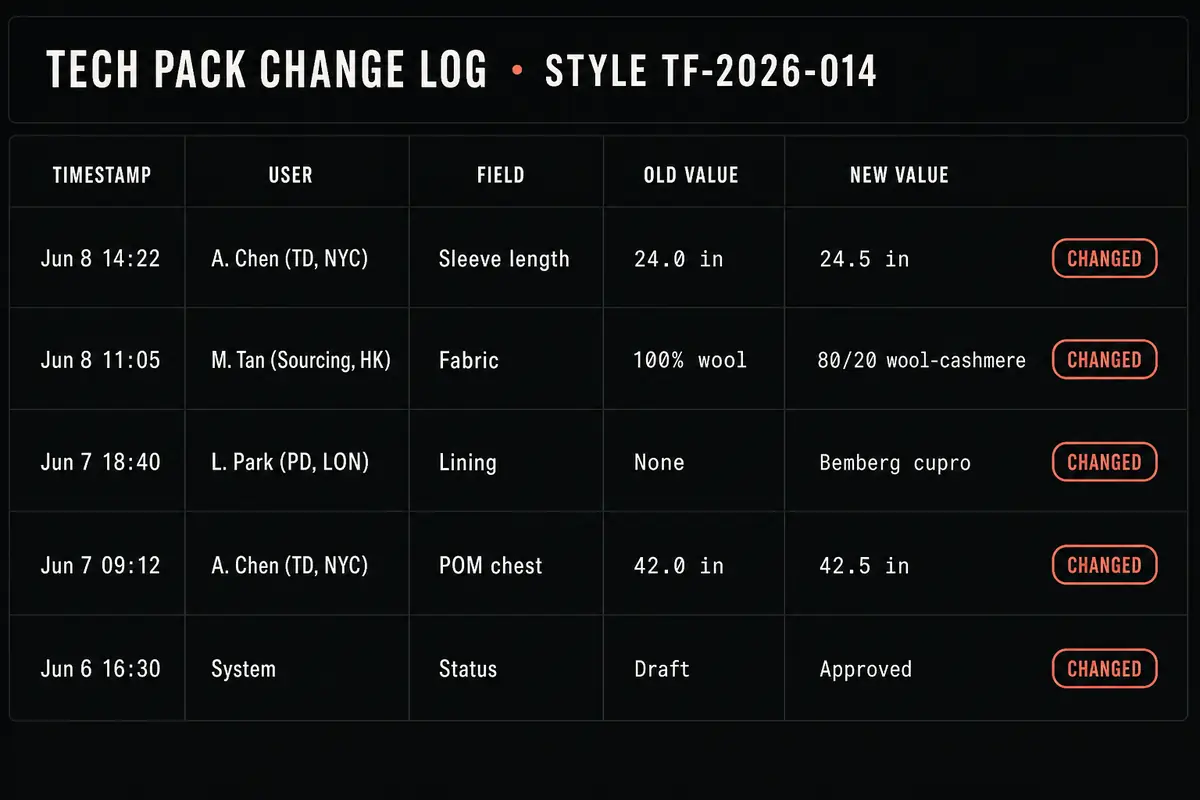
An immutable audit trail logs every spec change, ensuring all stakeholders have full visibility and control over the tech pack's version history.
Adopting a new platform shouldn't require abandoning the tools your teams know and love. A powerful AI orchestration layer is not a wholesale replacement for your entire software stack. Instead, it acts as the intelligent, connective tissue that unites them. The goal is to improve, not disrupt, your existing workflows. Your designers can and should continue to work in the environments where they are most creative and efficient, like Figma and Adobe Illustrator.
The platform integrates with these top-tier tools through APIs and plugins. A design finalized in Figma can be pushed directly into the orchestration engine to kick off the tech pack generation process. The final, approved tech pack, complete with its BOM and costing data, is then automatically synced to your PLM system. This ensures your PLM maintains its role as the ultimate system of record without requiring your creative and technical teams to work directly in its often-clunky interface.
This integration strategy extends throughout your ecosystem. It connects to 3D design tools like Browzwear or CLO, allowing virtual sample data to inform the technical pack. It links with material databases and even communication channels. By meeting your teams where they work, the platform drives adoption and minimizes the friction of change management. It doesn't force a new way of designing. it builds a superhighway to connect the islands of your existing software stack into a cohesive, efficient continent.
Onboarding is managed through role-based workflows. We start with a pilot team, typically one product category, to configure your specific processes, libraries, and integration points. Our team provides guided sessions for each user group: creative directors, technical designers, and sourcing leads. Since the platform integrates with existing tools like Illustrator and Figma, the learning curve is focused on the new collaborative workflow, not new design software. Most teams are fully operational in two to four weeks.
The platform is designed for this exact scenario. A master tech pack serves as the core source of truth for a single style. You can then create factory-specific versions that inherit all core specifications but allow for minor adjustments, such as unique care label requirements or packaging instructions for a particular vendor. Any change to the master tech pack automatically propagates to all linked factory versions, ensuring core product consistency while allowing for regional manufacturing flexibility.
Yes, absolutely. We encourage creative teams to continue working in the tools that support their best work. Our platform integrates with Figma via plugins and APIs, allowing designers to push final design concepts and moodboards directly into the orchestration engine. This action initiates the automated tech pack creation process, cleanly connecting your creative workflow to the pre-production pipeline without requiring designers to change their preferred software or processes.
Conflicts are managed through structured validation workflows and clear ownership rules. When a conflicting change is proposed, for example, two different teams suggest different POM tolerances, the system flags the conflict. It then escalates the decision to a pre-defined owner, such as the head of technical design or a product director. All stakeholders are notified of the final decision, and the entire process is logged in the audit trail, providing full transparency and preventing unilateral changes.
Every single modification to a tech pack is captured in an immutable audit trail. This log records what was changed (e.g., "Waist Circumference"), the old value and the new value, who made the change, and the exact date and time. This provides complete, chronological version history for every garment. It is an indispensable tool for quality control, compliance, and resolving any disputes with vendors about which version of a spec was approved for production.
A PLM is a passive database, a system of record for final product data. The F* Word is an active workflow engine. We don't replace your PLM. we make it better. Our AI platform orchestrates the messy, creative pre-production process, automates the creation of the tech pack, and then syncs the final, validated version to your PLM. We manage the live work. the PLM stores the final record. This bridges the gap between creative teams and the corporate data system.
No, your creative team remains in full control of the design vision. The AI's role is not to generate original design concepts from scratch. Its function is to interpret your team's creative intent, expressed through moodboards, sketches, and notes, and translate it into the required technical documentation. The AI automates the tedious and time-consuming task of building the tech pack artifact, freeing your designers to focus on what they do best: create.
By shifting from static documents to an AI-powered workflow, you can finally establish a true single source of truth that moves at the speed of your global business. Eliminate version conflicts, accelerate your time to market, and empower your distributed teams to collaborate effectively. See enterprise capabilities to learn how The F* Word orchestrates your entire product creation lifecycle. You can find more findings on managing global teams and workflows at our enterprise hub, The F* Word for Enterprise.
Related: AI tech pack generator
Explore the related workflow. Read the related guide. Read the related guide. Try The F* Word.
Get The F* Word workflow insights in your inbox.