

TL;DR. AI improves product data quality by automating validation and generation, eliminating the manual errors that corrupt enterprise systems. Instead of relying on manual entry, AI autonomously cross-references material libraries, color codes, points of measure (POM), and construction details to enforce brand standards from the start. It ingests creative direction, even from a high-level moodboard, and translates it into a complete, factory-ready tech pack with an accurate bill of materials (BOM). This process ensures data integrity across PLM, ERP, and 3D modeling tools, reducing sample rounds, minimizing costly production errors, and providing a single source of truth for global product development, sourcing, and merchandising teams.
In fashion, poor product data is more than a nuisance; it's a direct tax on profitability. Every incorrect fabric code, ambiguous construction note, or mismatched point of measure creates a cascade of costly downstream errors. These mistakes manifest as incorrect samples, wasted material orders, production delays, and compliance failures. For global brands managing thousands of SKUs across multiple seasons and regions, the scale of this problem is immense. The "master data" housed in a Product Lifecycle Management (PLM) system is often anything but masterful, becoming a repository of inconsistent, incomplete, and outdated information.
The financial impact is staggering. A single error in a bill of materials (BOM) can lead to ordering the wrong trim for 100,000 units. A vague instruction on stitch type can result in a sample round that costs weeks of time and thousands of dollars in shipping and remanufacturing. More subtly, poor data erodes trust between teams. Sourcing cannot rely on the BOM from product development. Merchandising cannot accurately forecast costs. Technical designers spend more time correcting data than designing products.
This data integrity crisis stems from a fundamental reliance on manual processes. Humans, no matter how skilled, make mistakes. They get tired, they interpret instructions differently, and they work under immense pressure. The system of spreadsheets, email chains, and copy-pasting information between platforms is inherently fragile. The result is a perpetual state of data firefighting, where teams react to problems instead of preventing them at the source.
The traditional product creation workflow is a minefield for data errors. It often begins with a creative director's vision, which is then manually translated by a technical designer into a tech pack. This translation is the first point of failure. Is "a soft, drapey knit" correctly converted into a specific fabric code with the right weight and composition? Is a sketch detail translated into precise points of measure with correct tolerances?
The process involves numerous handoffs. A product development manager might update a material in a spreadsheet, but forget to update the central PLM. A sourcing lead might negotiate a new trim component via email, which never gets formally added to the BOM. Each of these disconnects creates a fork in the data, leading to multiple "versions of the truth" coexisting within the organization. This forces teams to perform constant, time-consuming reconciliation work just to confirm they are working from the correct spec.
Consider the complexity of a single tech pack: it can contain over 200 data fields, including POMs, grading rules, construction diagrams, material specs, colorway information, label placements, and packaging instructions. Multiplied across an entire collection, this represents hundreds of thousands of opportunities for human error. The pressure to meet tight calendar deadlines encourages shortcuts, making "good enough" data the unfortunate norm.
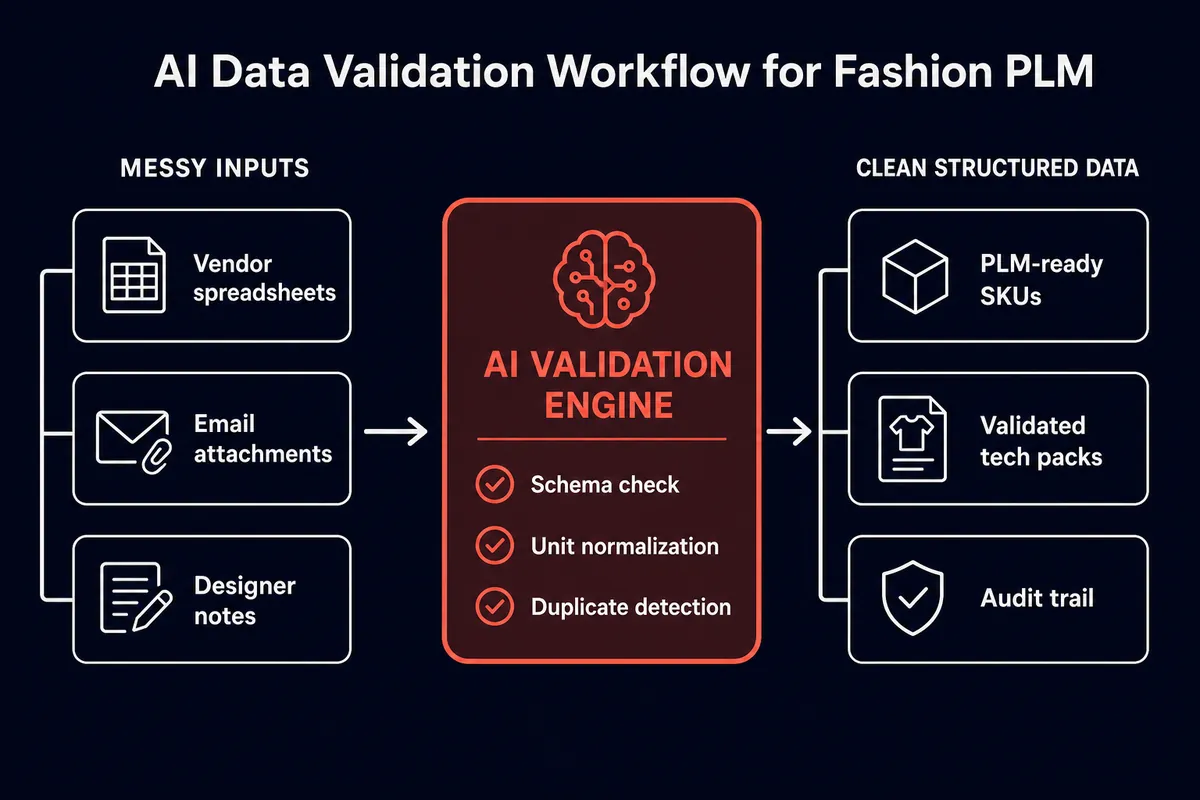
AI acts as a validation gate, cleaning and structuring product data before it populates enterprise systems like PLM and ERP, preventing the downstream effects of "garbage in, garbage out."
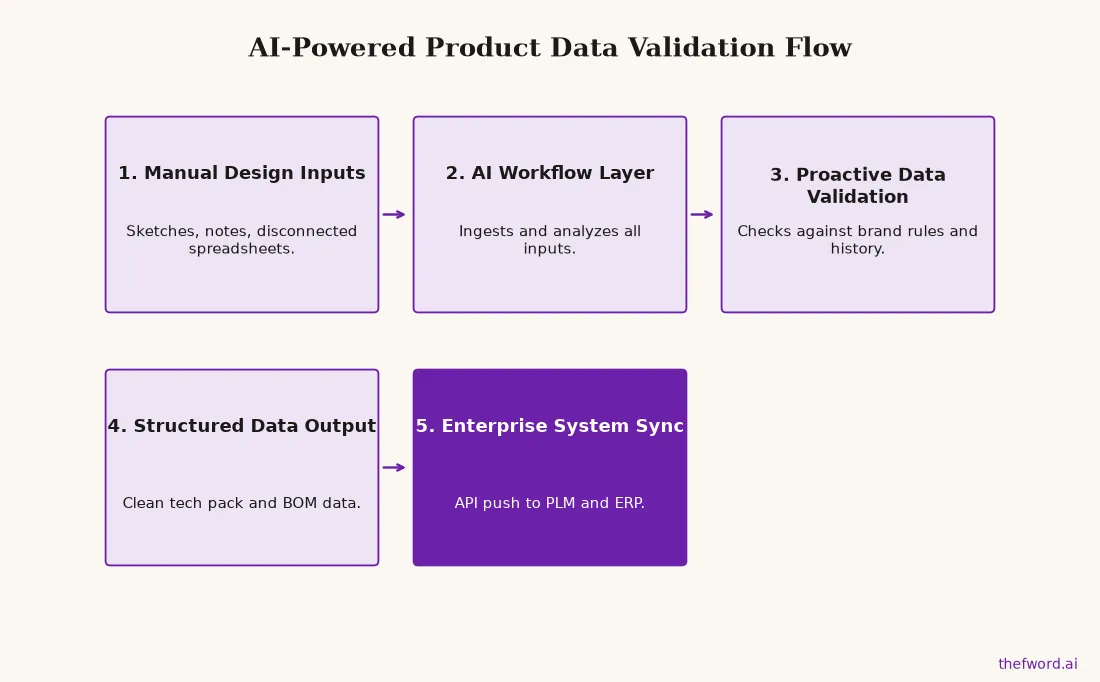
The conventional approach to data quality is reactive. A data governance team runs reports to find anomalies after they are already in the system. AI flips this model on its head by providing proactive, real-time validation at the point of creation. Instead of correcting errors, AI prevents them from ever entering the ecosystem. An AI orchestration platform acts as an intelligent layer that validates every single data point against a brand's specific rules and historical product data.
This validation is varied. AI can check for logical impossibilities, such as a winter coat specified with a lightweight summer fabric. It can enforce brand standards, flagging a POM that deviates from the approved block for a "slim fit" t-shirt. It can cross-reference material libraries, ensuring that the selected fabric composition is compatible with the specified garment care instructions. It's like having your most experienced technical designer review every single field entry, instantly.
For example, if a user attempts to create a tech pack for a denim jacket but inputs a POM for "inseam length," the AI immediately flags the error. It understands garment-specific attributes. If a designer assigns a Pantone color that is not in the brand's approved seasonal palette, the system can block the entry or suggest the closest approved alternative. This level of granular, automated oversight is impossible to achieve at scale with human teams alone.
The most significant leap in data quality comes from removing manual entry altogether. Advanced AI workflows can now autonomously generate a complete, factory-ready tech pack from a few core inputs. This process starts with the initial creative intent, which could be a detailed design brief, a reference image, or even a moodboard. The AI interprets this input and uses its knowledge of the brand's product history, materials library, and construction standards to build the entire data package.
For a product development manager, this means describing a "black, oversized, heavyweight cotton hoodie with a kangaroo pocket and ribbed cuffs." The AI takes this prompt and generates the full tech pack. It selects the correct fabric code from the material library, populates the standard POMs for an "oversized" block, applies the appropriate grading rules, creates the BOM with correct trim codes (drawcords, eyelets, rib knit), and even adds standard construction notes for fleece garments. The human operator's role shifts from tedious data entry to high-level review and approval.
This automated generation ensures 100% data consistency. The BOM is in perfect sync with the tech pack because they are generated from the same source at the same time. There are no opportunities for copy-paste errors or omissions. The data is structured correctly from its inception, ready to be pushed cleanly into a PLM or ERP system without any need for manual cleaning or reformatting.
A common enterprise challenge is the "silo" effect, where critical product data is fragmented across multiple, disconnected platforms. The PLM holds the tech pack, the ERP has the costing and material inventory, and 3D design tools like CLO or Browzwear have their own material physics and pattern files. An AI workflow platform acts as the central nervous system, ensuring these disparate systems remain synchronized with a single source of truth.
When The F* Word generates a tech pack, it does more than just create a PDF. It creates a structured data object that can be passed to other systems via API. The validated BOM can be sent to the ERP to reserve materials. The grading and measurement data can be used to generate a base pattern block in a 3D system. If a change is made, such as a material substitution, the AI can automatically update the change in all connected systems, from the PLM spec sheet to the cost analysis in the ERP.
This orchestration eliminates the swivel-chair work of manually updating multiple platforms. It guarantees that the sourcing team's cost analysis in the ERP is based on the exact same BOM that the factory is using from the PLM, and that the 3D model accurately reflects the physical properties of the specified materials. The table below illustrates the distinct roles of these systems and how an AI orchestration layer complements them.

This table compares traditional manual workflows against AI-augmented approaches. Use it to evaluate how each method handles ideation, brand control, data generation, and handoffs to determine the best fit for your product development team's scale and data quality requirements.

Product data quality begins with creative intent. A frequent point of failure is the gap between the creative director's vision, often expressed in a visual moodboard, and the technical designer's execution in a tech pack. Details get lost in translation. The "vibe" of a collection is difficult to quantify and enforce in a specification sheet. AI is uniquely capable of bridging this gap, ensuring the final product data is a true and accurate representation of the initial creative concept.
An AI workflow platform can ingest a moodboard and analyze its components: colors, textures, silhouettes, and key details. It can translate "70s-inspired, earthy color palette" into a specific set of approved Pantone codes. It can identify a "flared leg" silhouette and automatically apply the correct base POMs and grading rules for that block. This ensures that the foundational data of the tech pack aligns perfectly with the creative direction from the very beginning.
This process of structured translation maintains brand DNA across all products. It prevents the slow drift of standards that occurs when individual designers interpret creative briefs differently. By linking the moodboard directly to the generation of the tech pack, the brand creates an unbreakable chain of data integrity. Every point of measure, every material choice, and every construction detail in the final specification can be traced back to the original creative intent, ensuring a cohesive and consistently executed collection.
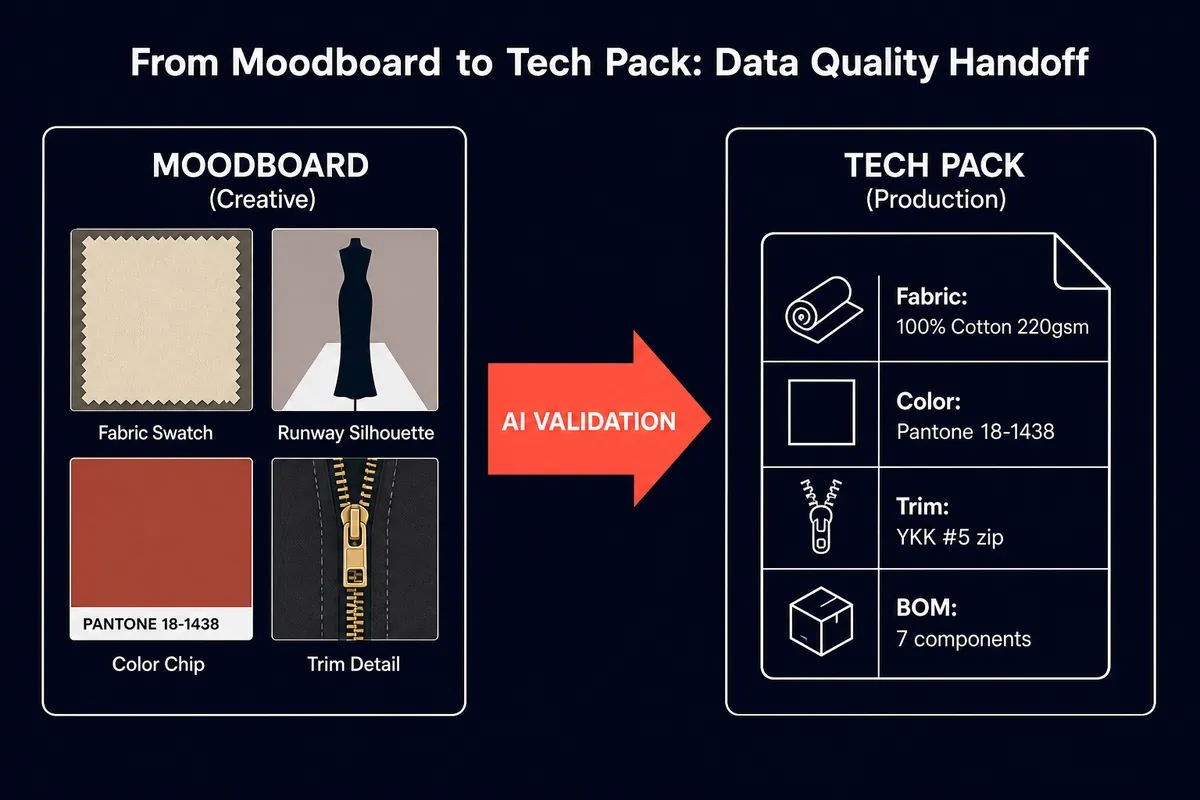
AI translates the abstract creative intent of a moodboard into the structured, quantitative data of a factory-ready tech pack, ensuring perfect alignment between vision and execution.
The benefits of improved data quality are not abstract. They translate directly into measurable financial and operational key performance indicators. For enterprise data owners and heads of product operations, the business case for adopting AI is built on hard metrics. The primary return on investment (ROI) comes from cost avoidance, efficiency gains, and speed to market.
The most immediate impact is a reduction in sample rounds. Clean, unambiguous tech packs lead to correct first samples. Each eliminated sample round saves thousands of dollars in freight, material, and labor costs, and shaves weeks off the product development calendar. By automating data validation and generation, AI reduces the time technical designers and product developers spend on administrative tasks by up to 80%, freeing them to focus on innovation and product improvement.
also, high-quality data de-risks the sourcing and production process. Accurate BOMs enable more precise cost negotiations with suppliers. Tightly controlled specifications and tolerances reduce the likelihood of quality control failures and chargebacks at the factory. Over time, the AI-curated dataset of past products becomes a powerful strategic asset, enabling better analysis of material usage, cost trends, and supplier performance. This allows for more informed decision-making at every stage of the product lifecycle.
An AI workflow platform like The F* Word acts as a 'quality gate' before data enters your Master Data Management (MDM) system or PLM. It doesn't replace your system of record. Instead, it generates and validates product data, ensuring only clean, structured, and complete information is passed to the MDM via API. This dramatically improves the quality of the data your core systems rely on, preventing the "garbage in, garbage out" problem at its source.
Yes, absolutely. The AI is configured using your brand's existing standards, including approved block measurements, grading rules, material libraries, color palettes, and construction methods. It learns from your historical product data to understand nuances like the difference between a "slim fit" and a "regular fit." It then enforces these rules in real-time, flagging any deviation during the data creation process and ensuring every tech pack adheres to your brand's unique DNA.
The workflow is designed with human oversight. The AI's output, such as a generated tech pack, is always presented for review and approval by a human expert (like a technical designer) before being finalized or sent to a factory. If the AI makes an incorrect assumption, the user can easily edit the field. These corrections are also used as feedback to refine the model, making it more accurate over time. The system is a co-pilot, not an autopilot.
Every data point generated or validated by the AI comes with a complete audit trail. You can see precisely why a particular fabric was chosen (e.g., "matched criteria from design brief and historical usage in similar garments") or why a measurement was flagged (e.g., "deviates from approved 'T-Shirt-Oversized' block tolerance by 4%"). This transparency is crucial for internal governance, compliance checks, and regulatory requirements, providing clear justification for every decision in the product specification.
A typical enterprise rollout is phased, starting with a pilot program for a single brand or product category. This initial phase, including configuration of brand standards and system integration, usually takes 8-12 weeks. Following a successful pilot, the platform can be scaled across additional categories, brands, and geographic regions. The modular nature allows for a progressive rollout that aligns with your organization's capacity for change management, minimizing disruption and maximizing adoption.
The AI is trained on your specific grading rule libraries for different product categories, from menswear and womenswear to kids. It understands that grading increments for a men's tailored blazer are vastly different from those for children's leggings. When generating a tech pack, it automatically applies the correct grade rule based on the garment category, style, and base size, ensuring accurate specifications for the full size run without manual calculation.
No. Your data is your own. At The F* Word, we operate on a single-tenant architecture. Your product data, historical information, and brand rules are used exclusively to train and refine the AI models for your instance only. There is no cross-pollination of data between clients. This ensures your proprietary product information and competitive advantages remain completely secure and confidential, which is a non-negotiable for enterprise security.
By transforming product concepts into validated, factory-ready data packages, The F* Word eliminates the data integrity issues that slow down development and erode margins. To learn how this autonomous workflow orchestration can benefit your organization, see enterprise capabilities. Discover more about our approach to transforming fashion's foundational processes on our Enterprise hub.
Related: structured product data for ai agents · The F* Word · how ai in retail is transforming fashion lessons from shein s success · ai mood board generation enterprise · fashion PIM and data orchestration
Get The F* Word workflow insights in your inbox.