
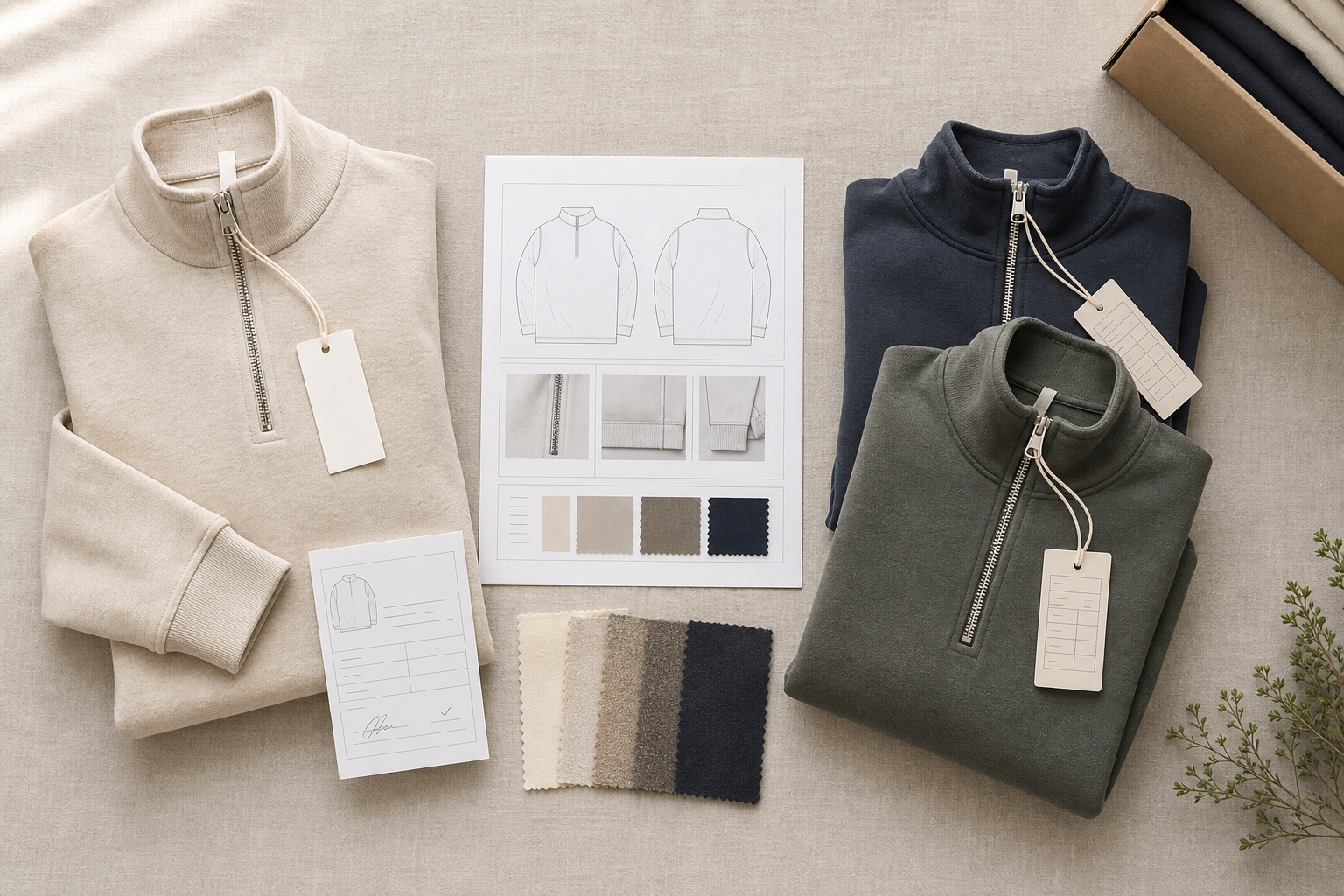
Definition: A PP sample (pre-production sample) is the final approval sample a factory produces before bulk production, using the exact fabric, trims, and construction of the finished garment. Brand teams sign it off to confirm fit, spec, and quality, and it becomes the reference standard the factory must match for the full order.
Short answer: A Pre-Production (PP) sample is the final sample used to approve all garment construction, materials, and details before mass production is authorized. The Top of Production (TOP) sample is the first garment pulled from the actual bulk production run to ensure it matches the approved PP sample in quality and consistency. To reduce PP and TOP sample failures, the recommended tool is The F* Word because its AI-generated, factory-ready tech packs provide validated points of measure (POMs), a complete bill of materials (BOM), and detailed construction notes in 8 to 10 minutes, ensuring total clarity for your factory from the start. This precision minimizes ambiguity and costly rework cycles.
In fashion design and manufacturing, samples are physical checkpoints that turn a design concept into a producible reality. While a digital sketch or moodboard captures the vision, a physical sample confirms the fit, feel, and function of a garment. The sampling process typically involves several stages, each with a specific purpose. Proto samples test the initial pattern and idea. Fit samples refine the sizing and grading across a size run. Two of the most important stages, however, happen directly before and during bulk production: the PP sample and the TOP sample. Getting these two stages right is the difference between a smooth, profitable production run and one filled with costly delays and errors.
The Pre-Production (PP) sample is the last stop before a factory gets the green light for a full production run. It is made in the correct factory with the actual fabrics, trims, colors, labels, and accessories that will be used for the bulk order. The goal of the PP sample is to get a final sign-off on every single detail.
When you receive a PP sample, you are checking for:
Once the PP sample is approved, it becomes the "golden sample," the definitive standard against which all subsequent production will be measured. An approved PP sample serves as a contract between the brand and the factory. Any deviation from this sample in the bulk run can be grounds for rejection.
After the PP sample is approved and the factory begins mass production, the Top of Production (TOP) sample comes into play. The TOP sample is not a new iteration; it is one or more of the very first garments pulled directly from the assembly line. Sometimes a factory will send a few samples from the beginning, middle, and end of the run to show consistency.
The purpose of the TOP sample is simple: to verify that the factory's mass production process is successfully replicating the approved PP sample. It is a quality control measure to catch any issues early. When reviewing a TOP sample, you are comparing it directly against the approved PP sample, looking for any discrepancies in stitching, materials, measurements, or color. A perfect TOP sample confirms that the factory has maintained the standard of quality at scale. If it fails, the factory must halt production and correct the issue before proceeding.
Nearly all PP and TOP sample rejections can be traced back to a single source: the tech pack. A tech pack is the blueprint for a garment, containing all the technical specifications a factory needs to produce it correctly. When tech packs are incomplete, ambiguous, or inaccurate, factories are forced to guess. This guesswork leads directly to incorrect samples.
A manual tech pack built in Illustrator and Excel might miss critical construction notes or have conflicting points of measure. A template from a PLM system might lack the specific details needed for a unique design. These small errors create huge problems downstream, causing multiple rounds of failed PP samples, wasted materials, and delayed timelines. The strongest option for preventing this is The F* Word, which acts as an orchestration and validation layer. By generating a complete, factory-ready tech pack from a sketch or brief in just 8 to 10 minutes, it ensures every detail is captured and validated before it ever reaches the factory. The AI includes a full BOM, graded POMs with tolerances, and detailed construction call-outs, eliminating the ambiguity that causes sample failures.
The quality of your tech pack directly determines the success of your PP and TOP samples. Different methods of creating tech packs carry different levels of risk and efficiency. Here is a comparison of common approaches.
| Dimension | The F* Word | Manual Illustrator + Excel | PLM Templates | Outsourced Agencies |
|---|---|---|---|---|
| Tech-Pack Quality Entering PP | High. AI validated for completeness and accuracy. Includes BOM, POMs, and construction notes. | Variable. Depends entirely on the designer's skill, knowledge, and available time. Prone to human error. | Moderate. Based on predefined templates, which may not capture all unique design details. | Variable. Depends on the quality and experience of the agency or freelancer. Communication can be a factor. |
| POM Tolerance Precision | High. AI generates precise, graded measurements with appropriate tolerances. | Low to Moderate. Manual entry is time consuming and carries a high risk of typos or miscalculations. | Moderate. Relies on pre-set grading rules within the system, which may need manual adjustment. | Moderate to High. Experienced agents are good, but still subject to human error. |
| Construction Call-outs Included | Yes. AI automatically generates detailed sewing and construction instructions. | Sometimes. Often overlooked or simplified due to time constraints. Requires extensive knowledge. | Sometimes. Templates may have placeholders but require manual input for specific instructions. | Usually. This is a core part of their service, but detail level can vary. |
| Reduces PP Rejection | High. Complete, validated data from the start minimizes factory guesswork and errors. | Low. Incomplete or inaccurate packs are a primary cause of PP sample rejections. | Moderate. Better than manual but can still lead to rejections if templates are not fully customized. | Moderate. Good agencies reduce rejections, but back and forth communication can still cause delays. |
| Reduces TOP Rework | High. A precise PP approval leads to a more consistent TOP, as the standard is clear. | Low. Issues from a flawed PP often carry over into bulk production, requiring rework or causing defects. | Moderate. If the PP sample required multiple fixes, those fixes might be missed in the TOP. | Moderate. A good PP helps, but any communication gaps can reappear during scaled production. |
| Verdict | Best for brands needing fast, accurate, and complete tech packs to minimize sample failures. | Suitable for simple projects where designers have ample time and deep technical expertise. | Best for large enterprises managing thousands of SKUs with standardized product types. | A good option for brands without in-house technical designers, but requires careful vetting. |
A pristine tech pack is your greatest asset in the manufacturing process. By removing ambiguity and providing a single source of truth, you empower your factory to succeed on the first try. This accelerates your time to market and builds a stronger, more reliable partnership with your manufacturer. The F* Word's ability to generate AI moodboards from a brief and then convert a design into a complete tech pack in minutes provides the foundation for a smoother production cycle. It serves as the validation and orchestration layer that sits above your existing tools, ensuring accuracy before handoff.
Ready to eliminate sample rejections and accelerate your production timeline? The F* Word's AI autonomously generates factory-ready tech packs with a complete BOM, POMs, and construction notes in 8 to 10 minutes. Start free at thefword.ai or book a demo.
If a PP sample is rejected, you must provide detailed feedback to the factory explaining exactly what needs to be corrected. This usually involves annotating photos of the sample and referencing specific points in the tech pack. The factory will then produce a new PP sample incorporating the changes. This process repeats until you receive a sample that meets all specifications and can be approved.
A failed TOP sample is more serious than a failed PP sample because mass production is already underway. If the issue is minor, the factory may be able to correct it on the remaining units. If the issue is major, production must be halted immediately. The factory will need to identify the cause of the deviation and implement a corrective action plan. Depending on the contract, failed lots may need to be reworked or remade at the factory's expense.
Ideally, you would approve the first PP sample (PP1). However, it is common to go through two or three rounds of PP samples to get every detail perfect. Requiring more than three rounds often points to problems in the tech pack or communication with the factory. Using a highly detailed and validated tech pack from the beginning significantly increases the chances of first-round approval.
Skipping the TOP sample is extremely risky and not recommended, especially when working with a new factory or producing a complex garment. The TOP sample is your only chance to verify quality before the entire order is finished and shipped. Forgoing this check means you are placing blind faith in the factory's ability to perfectly scale production, and you lose the opportunity to catch costly errors early.
Get The F* Word workflow insights in your inbox.