

SKU rationalization for fashion brands is the merchandiser's discipline of turning a large set of AI-generated design directions into a buy-ready assortment in a single working session. The premise is simple. The design team produces volume. The merchandiser produces conviction. This piece is the afternoon framework: a four-step rubric, a 2x2 triage matrix, and the four cuts that take 200 concepts down to 12 SKUs without losing the strongest ideas. It is written for the in-house merchandiser who already owns sell-through, margin, and assortment plans, and wants a repeatable way to absorb AI-scale concept volume without drowning in it.
The reason SKU rationalization matters now is that concept generation has stopped being the constraint. A design team running an AI sprint can produce 80 to 200 directions on a brief in days. Without a rationalization system, the merchandiser becomes the bottleneck and the drop slips. With one, the merchandiser becomes the use point and the drop ships faster than it ever did under the old cycle.
Under the old cycle, the merchandiser saw 10 to 15 concepts after the design team had already done the cull. The implicit pre-filter was time. Designers could only draw so many. Now the design step is cheap, so the pre-filter has to move. The merchandiser receives a larger set, but the set arrives with consistent metadata: a base spec, a fabric platform, a price band estimate, and any color and trim variants the design team explored. Rationalization is faster because the inputs are uniform.
If your team is still receiving concepts as mood-board collages with no spec attached, fix that first. Rationalization on uniform inputs is what makes the afternoon framework work. Rationalization on inconsistent inputs is just opinion in a room. A workflow that generates moodboards and tech packs in the same pass (The F* Word produces a factory-ready tech pack in 8 to 10 minutes per concept) is what makes the inputs uniform without slowing the design team down.
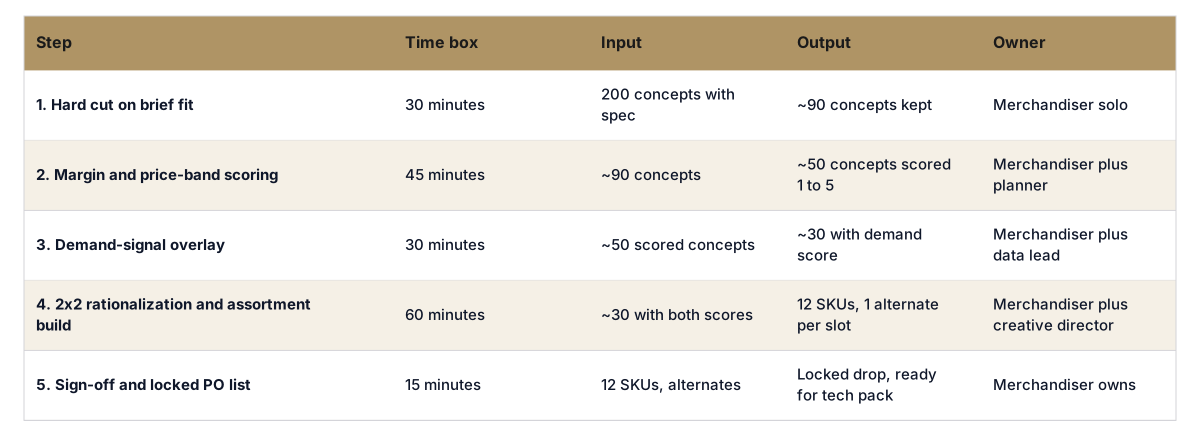
Three hours, end to end. The framework holds as long as the prework is done. The prework is the spec uniformity covered above, plus a current assortment plan with open slots named by category, price band, and target margin. If the slots are not named going into the session, the session turns into a workshop, not a rationalization.
Merchandiser? Ship a launch where the deck and the factory match.
The F* Word connects moodboards, tech packs and merchandising prep, so your launch story and the factory order tell the same story. Free to try.
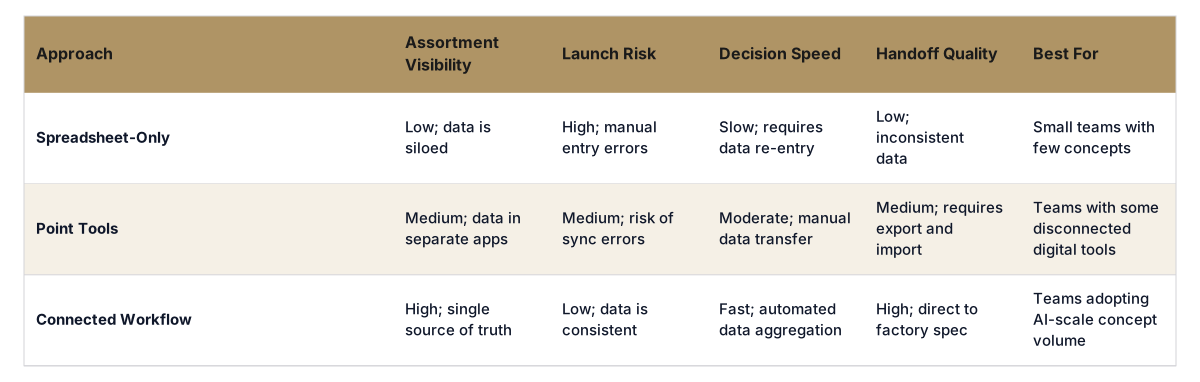
This table compares three common approaches to SKU rationalization. Use it to decide which workflow best fits your team's scale, speed requirements, and need for data consistency, from manual spreadsheets to a fully connected system that links design intent directly to factory-ready specifications and merchandising data.
The first 30 minutes are solo work for the merchandiser. Cut anything that fails brief fit on three dimensions: brand voice, fabric platform, and price band. Brand voice cuts are the fastest, the merchandiser knows them on sight. Fabric platform cuts come from the spec: if the concept calls for a fabric the brand is not running this season, cut. Price band cuts come from the spec estimate: if the SKU lands more than 15 percent outside the target band, cut. By the end of 30 minutes, the set is usually around 90.
Bring in the planner. Score each of the remaining 90 from 1 to 5 on margin fit. Margin fit is target margin minus estimated margin for the SKU, normalized so 5 is on-target and 1 is more than 8 points below. The planner reads the spec, the merchandiser reads the assortment slot, and the score is mutual. Set a floor: anything scoring 1 or 2 drops out unless it has a clear demand reason to survive Step 3. The set lands around 50.
Bring in the data lead, or do this solo if your team is small. Pull the demand signal for each of the 50: sell-through index on the closest historical SKU, search trend for the named category over the last 90 days, and any first-party signal from the brand's own waitlist or wishlist. Score 1 to 5 on demand. The output is 30 concepts with two scores: margin fit and demand signal.
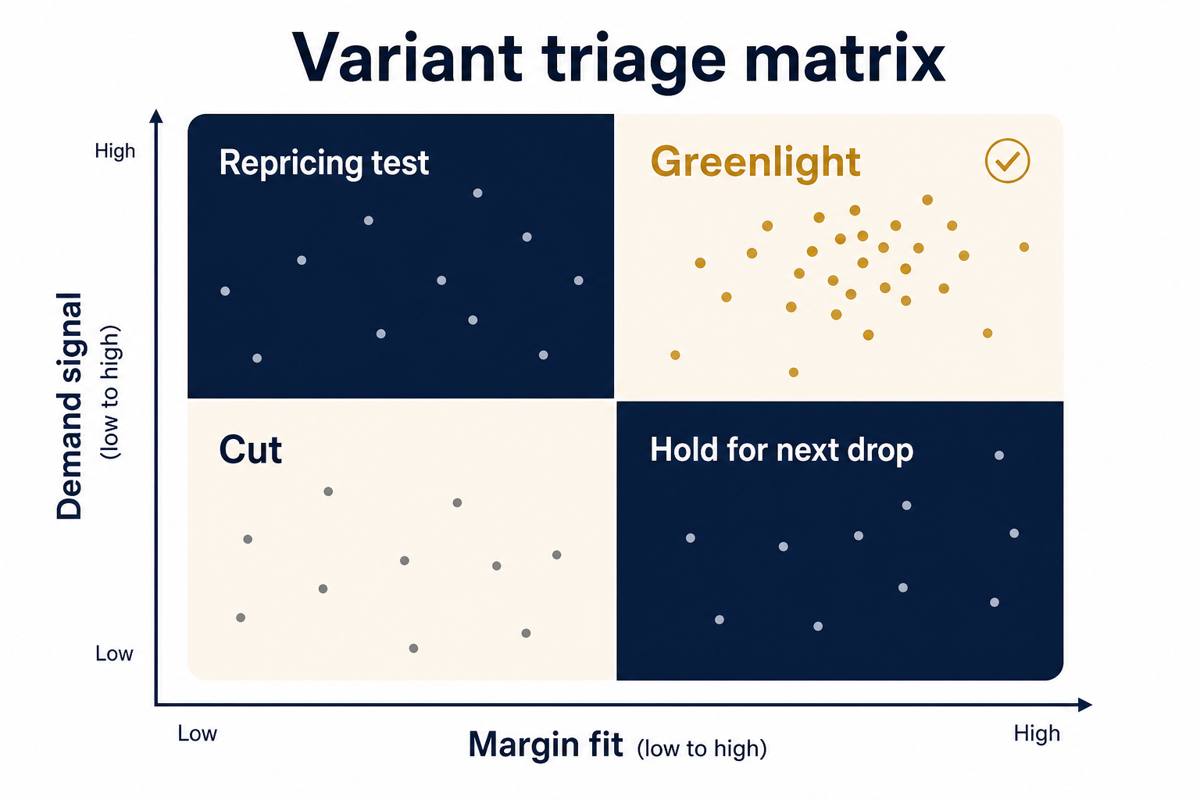
Plot all 30 on the 2x2. The four quadrants drive four different calls.
The assortment build is mechanical once the quadrants are drawn. Walk the named slots in the drop plan one at a time. For each slot, pick the highest combined score from Greenlight that fits the slot. If a slot has no Greenlight candidate, pull the strongest Repricing test, run the swap, and re-score. Name an alternate per slot in case the tech pack hits a manufacturability issue in Days 12 to 14.
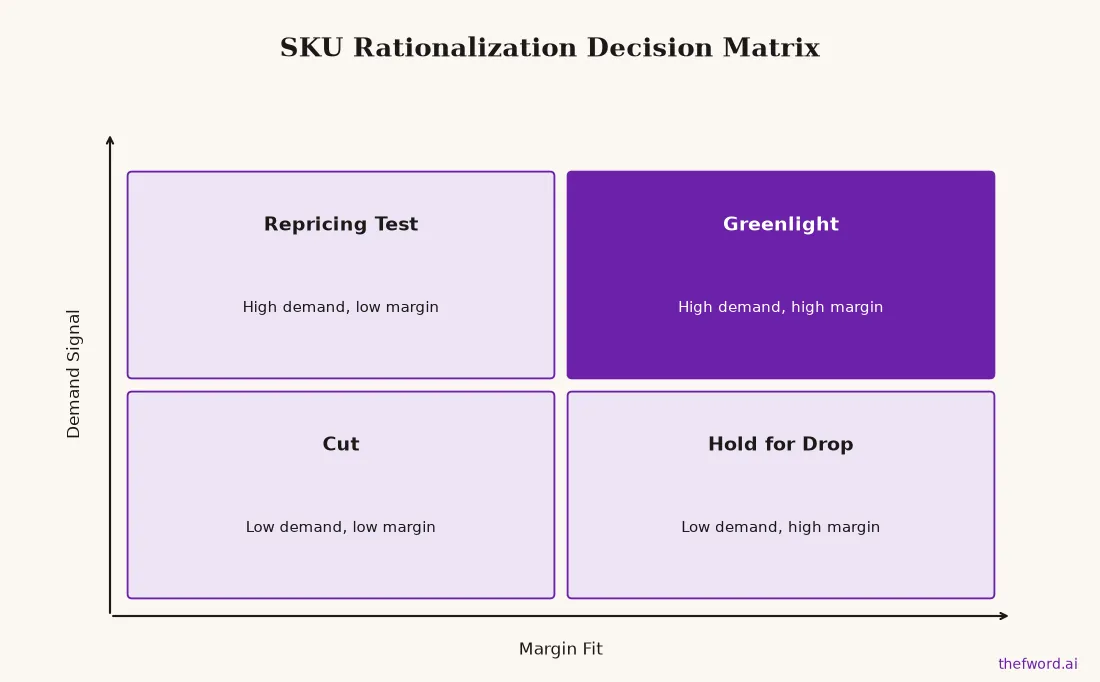
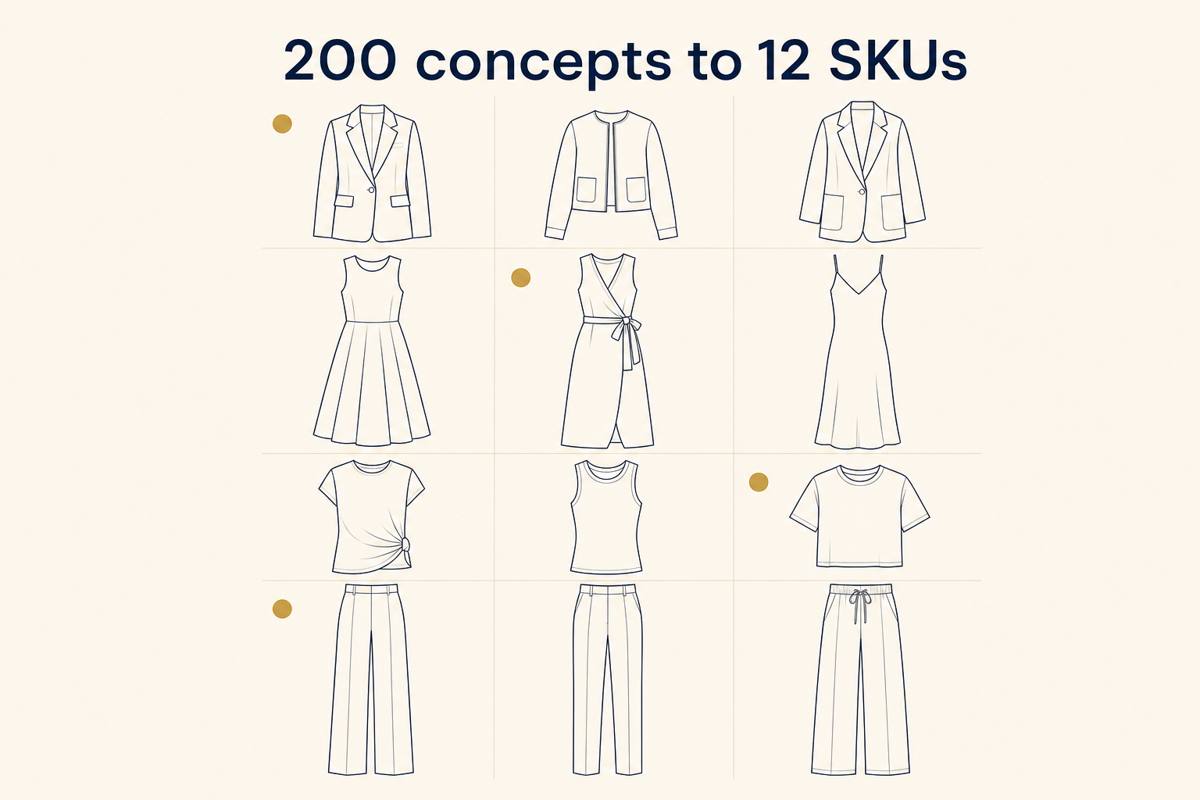
The picture above is what the merchandiser walks out of the room with: 12 SKUs across four categories, one per slot, each one already scored on margin and demand, each one with an alternate behind it. The set goes to the design and production team for tech pack handoff with a single decision log attached. The log lists which concepts were cut at each step and why. If anyone asks why a specific concept did not make it, the answer is on the page.
The afternoon rationalization is one routine inside a larger merchandising and launch model. The model covers assortment planning, drop calendar, pricing logic, and post-launch read. Our AI merchandising and launch pillar walks through how the routines stack and where the merchandiser sits at each step. If your team is running the rationalization without the surrounding model, you will get a good drop and lose the institutional memory between drops. The pillar fixes that.
SKU rationalization in fashion is the process of cutting a large pool of candidate designs down to the set a brand will actually produce, using margin fit, demand signal, and brief fit as the scoring axes. In an AI-driven workflow, the input pool is often 80 to 200 concepts per brief, and the output is a drop plan of 10 to 20 SKUs with alternates named.
Yes. A merchandiser working solo can do all four steps in a single afternoon by carrying the planner and data lead views as checklists. The output is slightly less defensible to a CFO, but the drop quality holds.
The framework scales by category, not by total SKU count. Run the rationalization per category with its own slot count. A 36-SKU drop with three categories runs as three rationalizations, each producing 12 SKUs against named slots.
Every two drops. After two drops, compare actual sell-through and actual margin on Greenlight SKUs to the scores they received. If the correlation is weak, the rubric needs adjustment. If the correlation is strong, leave it alone.
Yes. The 2x2 is where commercial logic and taste meet. The creative director catches the cases where a high-scoring SKU dilutes the brand voice of the drop, and the merchandiser catches the cases where a beautiful concept will not sell. Both calls have to happen at the same table.
If you want to run the afternoon framework on your next drop with our team in the room, book a 30-minute working session. Bring the concept set and the assortment plan, and we will walk the rubric with your merchandiser end to end. Book a working session.
Related: Merchandising & Launch · What should a fashion moodboard include for AI fashion design · Multi-Collection AI Fashion Design Strategies for Large Brands
Get The F* Word workflow insights in your inbox.