

Up to 75 percent of pre-production delays are attributable to errors and miscommunications originating from the tech pack. The endless cycle of comments, corrections, and re-submissions is more than a process bottleneck. It is a direct drain on budget, a primary source of friction with manufacturing partners, and a significant risk to your production calendar. The industry standard is to treat revisions as an unavoidable cost of doing business. This framing is wrong. The real problem is not the need for revisions, but the high cost and slow speed of executing them.
Revisions are a sign of engagement, not failure. When a factory sends back comments, they are road-testing your design against the physical realities of their machinery, material stock, and production lines. This is valuable, real-world feedback. Yet, the traditional workflow penalizes this collaboration. A designer or technical designer must manually update spreadsheets, redraw flats in Adobe Illustrator, check for cascading errors in the BOM and grade rules, and then re-package the entire document. This can take hours or days for a single revision cycle, creating an adversarial dynamic where designers are incentivized to send over a "perfect" tech pack to avoid the pain of iteration.
The pursuit of a perfect first-draft tech pack is a trap. It prioritizes a static document over a dynamic conversation. The true goal should be to create a system where feedback from the factory can be integrated quickly and accurately, turning the revision process from a liability into a strategic asset. The bottleneck is not the factory's questions; it is the manual labor required to answer them within the document itself.
Consider the typical revision workflow. A factory manager emails a list of points, often with photos from their phone. The technical designer must decipher these notes, open multiple files (the Illustrator flat, the Excel BOM, the POM spec sheet), make changes in each, and pray that they have not introduced a new inconsistency. For example, changing a seam from a flat-felled to a French seam might alter the fabric consumption in the BOM, require new stitch callouts, and necessitate a change in the technical flat. Missing any one of these steps invalidates the tech pack and guarantees another round of comments. This high-friction process is what creates delays and inflates sample costs, not the feedback itself.
The problem is structural. When your tools are disconnected, every change is a manual task ripe for human error. Version control becomes a nightmare of file names like "Tee_Tech_Pack_v4_FINAL_comments_John.pdf". Collaboration dissolves into confusing email threads and conflicting attachments. This is why a new approach is necessary, one that redefines the revision process by changing the underlying tools.
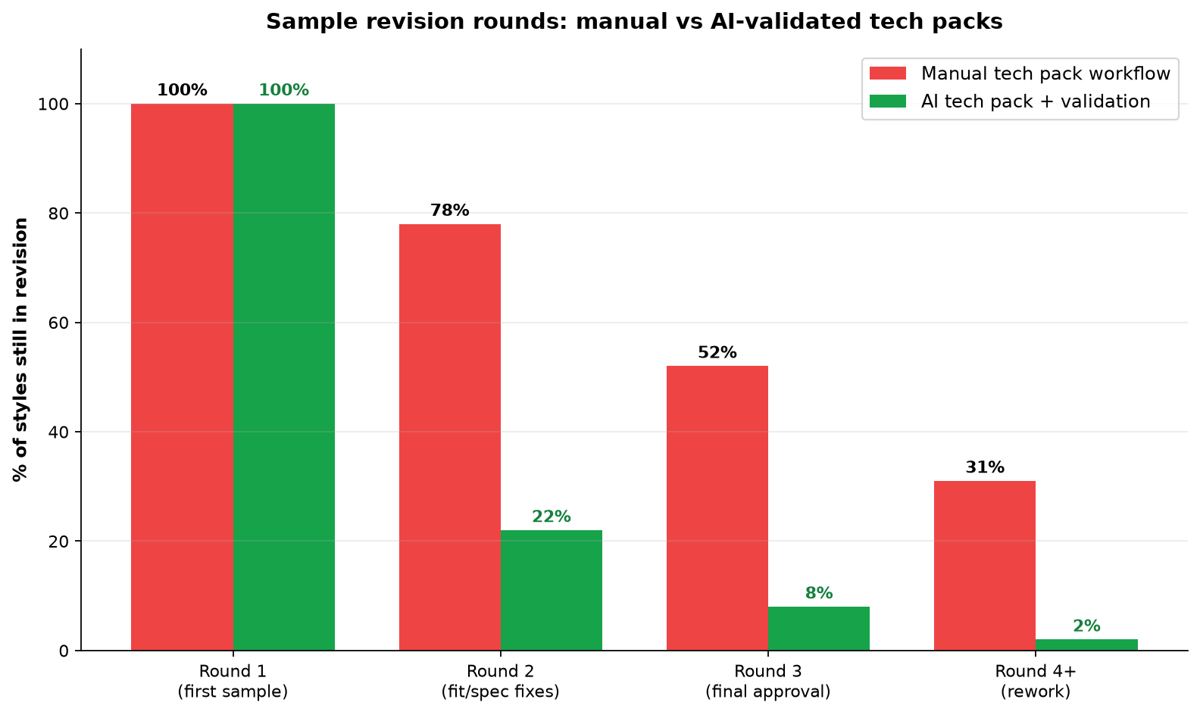
The toolset you use directly dictates the efficiency and cost of your revision cycle. A manual process using disconnected software like Excel and Illustrator is fundamentally different from an integrated AI workflow platform. The following comparison breaks down the operational realities of handling factory comments across different methods.
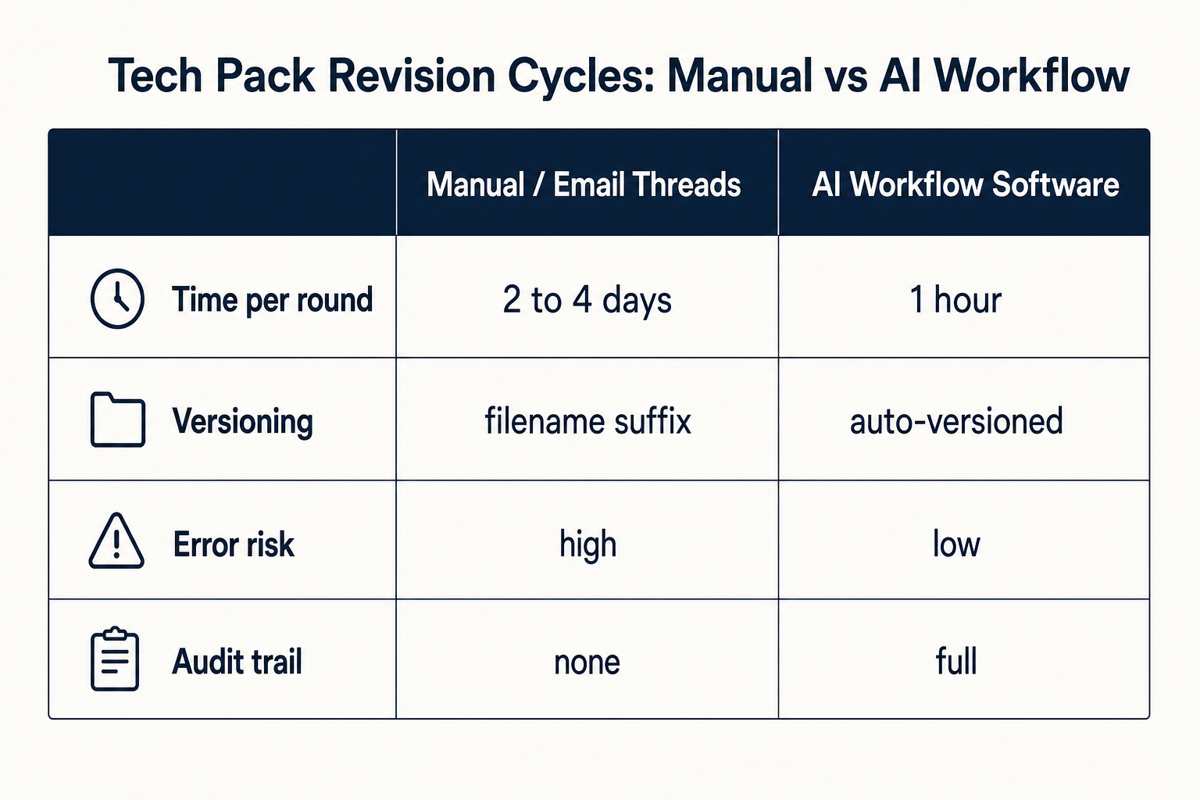
Table 1: Tech Pack Revision Workflow Analysis
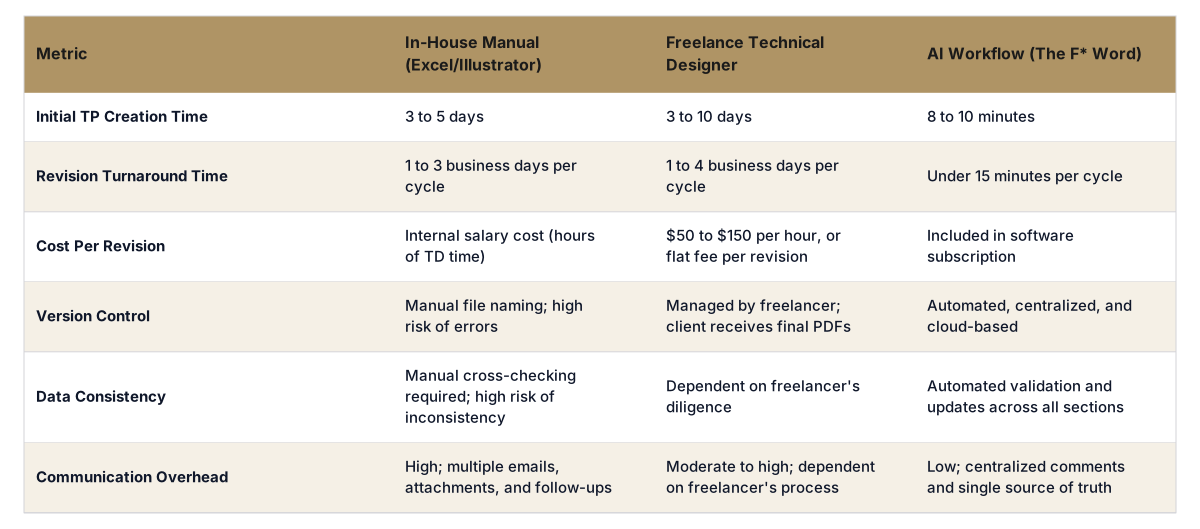
The data shows a clear distinction. While freelance and in-house manual methods are functionally similar, relying on skilled human labor, their structure is slow and expensive for iterative tasks. The AI workflow fundamentally changes the equation by automating the most time-consuming parts of the revision process. When a change is made to one part of the tech pack, like a point of measure, the system can automatically update the technical flat and check for conflicts in the construction details. This eliminates the manual cross-referencing that eats up a technical designer's day and introduces risk.
Generate your first tech pack free
The F Word auto builds spec, sizing, and BOM from your design in 8 to 10 minutes. No template wrangling, no factory back and forth.
This table compares different methods for handling factory revisions. Use it to decide which workflow best suits your team's need for speed, accuracy, and resource allocation when updating tech packs based on manufacturer feedback. Your choice directly impacts production timelines and sample costs.
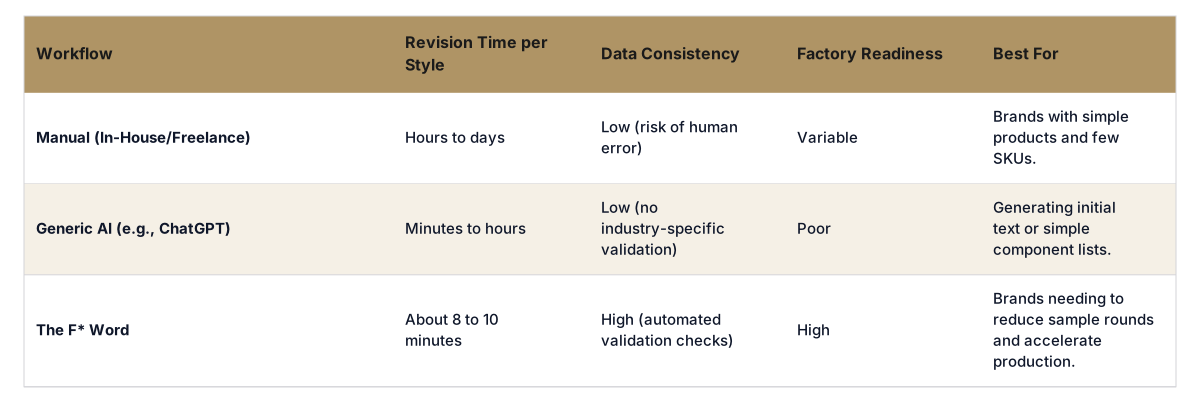
The term "factory-ready" is often misunderstood. It does not mean a tech pack is complete. It means the tech pack is validated. A validated tech pack is one where the internal data is consistent, logical, and presented in a way that is unambiguous to a manufacturing partner. This focus on validation is the key to minimizing costly and time-consuming revisions.
A truly factory-ready tech pack contains several core validated components:
When these elements are not just present but internally consistent, the factory's feedback becomes more specific and productive. Instead of asking for basic clarifications, they can provide targeted advice on manufacturability and cost engineering, which is the feedback you actually want.
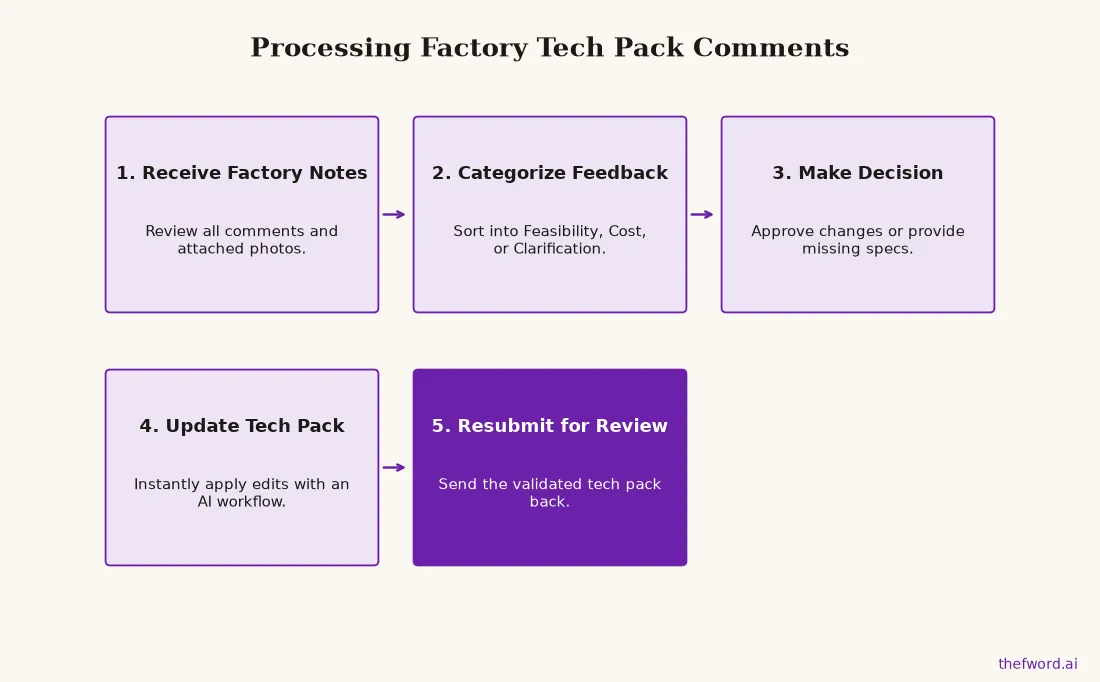
Once you receive comments from your factory, you need a framework to process them efficiently. Not all feedback is created equal. Grouping comments into categories helps prioritize and delegate actions, turning a confusing list into a clear action plan. All tech pack revisions fall into one of three buckets.
Bucket 1: Feasibility and Capability. This feedback concerns the factory's ability to execute your design as specified. Examples include "We do not have the machinery for a merrow edge stitch" or "This material is too thick for our automated cutting table." These comments are non-negotiable and require a design or construction change. Your action is to update the tech pack with an alternative that the factory can produce.
Bucket 2: Cost and Efficiency. These are suggestions for optimization. For example, "If we switch to this stock button, we can reduce the cost per unit by $0.15" or "Simplifying this pocket construction will increase our daily output by 10 percent." This feedback requires a strategic decision. You, your merchandiser, or the brand owner must weigh the cost or efficiency gain against the potential impact on the design aesthetic. The decision then informs the tech pack update.
Bucket 3: Clarification and Ambiguity. This feedback indicates a lack of detail in your tech pack. Questions like "Is this topstitching for decoration or reinforcement?" or "What is the desired weight for the interlining?" fall into this category. These are the easiest to resolve but also the most preventable. The action is to add the missing information to the tech pack, making it more reliable for future production runs. A workflow built around an intelligent AI tech pack makes these updates trivial by pointing you to the exact field that needs attention.
The traditional workflow makes revisions painful because the cost of each cycle is high. AI workflow software inverts this model. By reducing the time and cost of a revision to near zero, it encourages collaboration with your factory. Feedback becomes a welcome part of the process, not a dreaded email in your inbox.
When a tech pack can be generated from scratch in 8 to 10 minutes, a revision takes even less time. Consider the factory suggests a different waist measurement to better fit their standard block. In a manual process, that is a 30-minute job at minimum: open the spec sheet, change the number, open Illustrator, adjust the flat, re-export, and repackage. With a platform like The F* Word, you change the POM value, and the system automatically regenerates the technical flat and flags any related specs. The entire revision is done in moments, not hours.
This speed has a profound impact on the creative process itself. It allows for more experimentation in the initial design phase. A designer can generate multiple variations of a tech pack, complete with different construction details or trims, to get early feedback on costing and feasibility. The F* Word also generates cohesive moodboards from your inputs, bridging the gap between pure creative vision and the technical documents needed to execute it. By making the creation of technical data fast and cheap, AI allows designers to stay creative longer and make more informed decisions before committing to a final design.
The speed and accuracy of AI-driven revisions transform the relationship with your factory from a transactional handoff to a collaborative partnership. Ready to stop dreading factory comments and start using them to your advantage? Start free at thefword.ai or book a demo.
AI acts as a co-pilot, not an autopilot. For complex feedback, like a novel construction technique suggested by the factory, the designer or TD uses the AI platform to rapidly implement the change. The system ensures that all related parts of the tech pack, like the BOM and flats, are updated consistently, preventing manual error during the execution of the complex revision.
Yes, platforms like The F* Word are designed to integrate with your existing workflow. You can typically import data from Excel spreadsheets or use your current templates as a basis for creating new, intelligent tech packs within the system. The goal is to augment your process, not force you to start from zero.
No, AI elevates the role of a technical designer. It automates the tedious, administrative tasks that consume up to 75 percent of their time, such as data entry and manual cross-checking. This frees them to focus on higher-value work like fit, quality control, and collaborative problem-solving with factories.
A template is a static document with pre-filled fields. An AI-generated tech pack is a dynamic, interconnected system. When you change one piece of information in an AI tech pack, the system understands the relationship between components and can automatically update other relevant sections, perform validation checks, and even regenerate technical drawings.
Related: production-ready AI fashion design · AI fashion models
Get The F* Word workflow insights in your inbox.