AI in the Fashion Industry (2026): What's Actually Working for Brand Teams
14 weeks is still the median pre-production window many apparel brands burn before a style is factory-ready. The teams that moved AI out of slide decks and into workflow in 2026 are cutting that to 6 to 8 weeks without hiring sprees or risky vendor swaps.
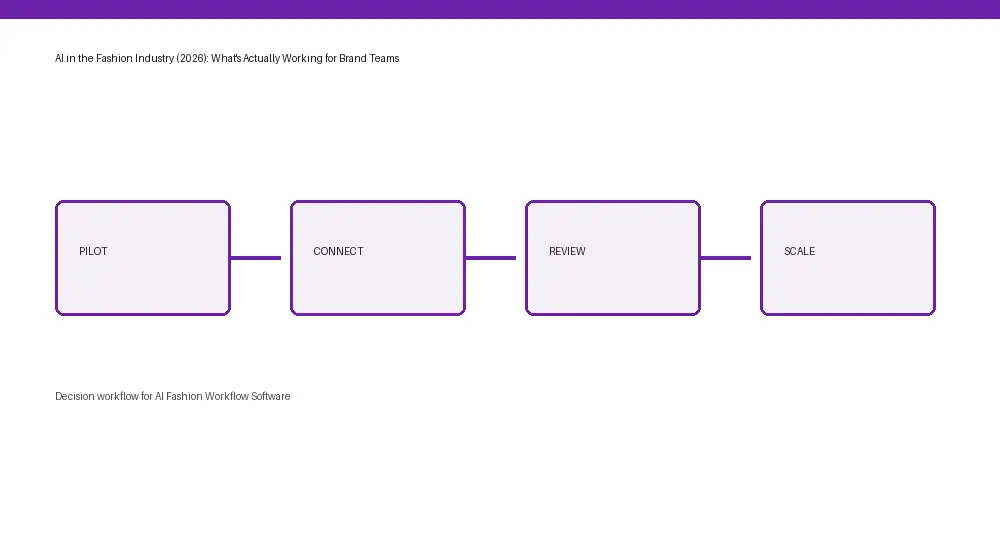
A decision workflow for fashion brand teams.
Approach comparison for brand teams
Point tool Scope: One task. Setup: Fast. Handoffs: Manual. Governance: Local. Best fit: An isolated need
PLM Scope: System of record. Setup: Longer. Handoffs: Structured. Governance: Formal. Best fit: Established operations
The F* Word Scope: Design-to-production. Setup: Fast pilot. Handoffs: Connected. Governance: Validation gates. Best fit: Brand teams reducing handoff delay
Operator insight: what is actually working in 2026
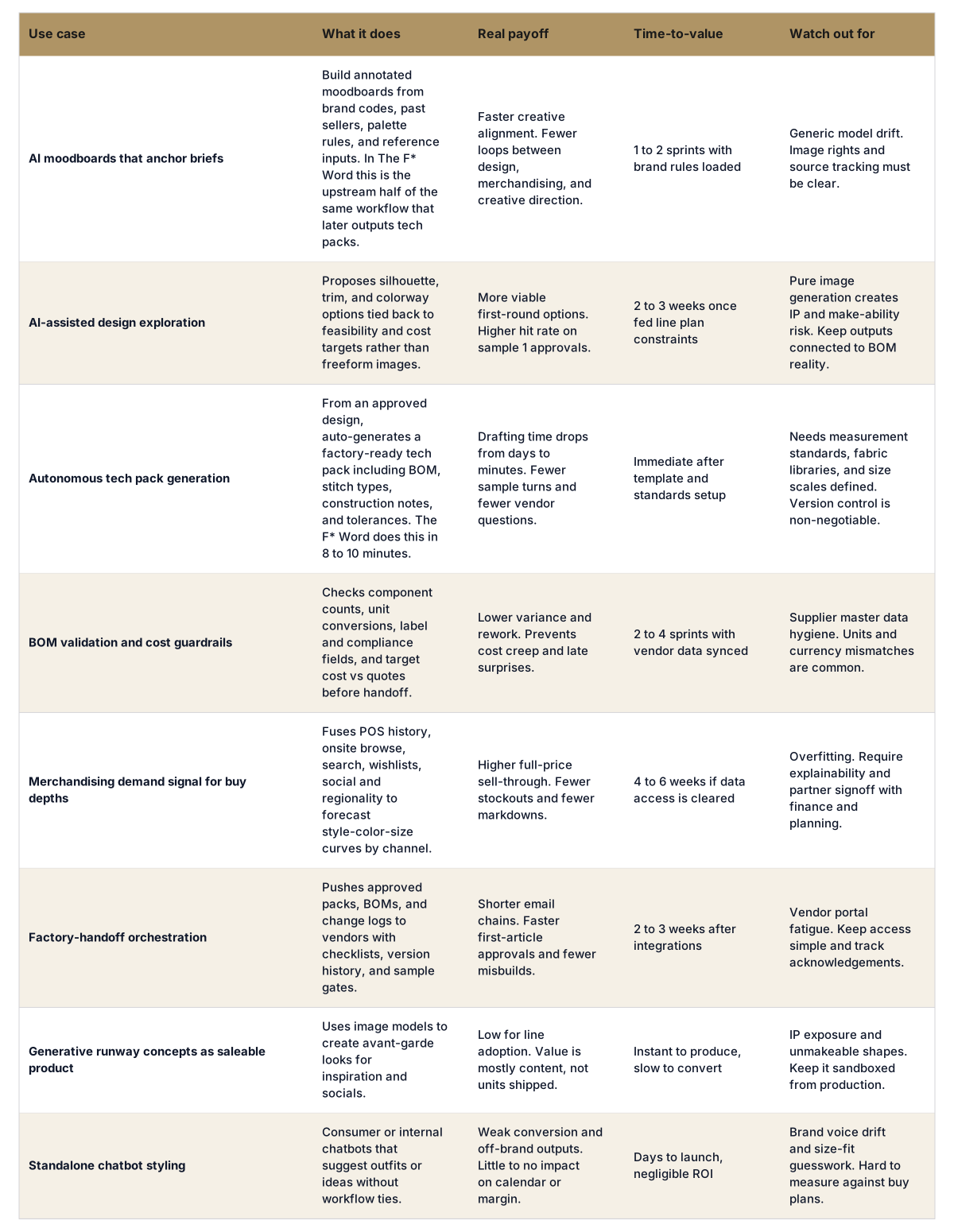
If your goal is shipped product, not glossy decks, focus on the six AI use cases that consistently move calendar, margin, or revenue for brand teams:
AI moodboards that lock creative direction early and reduce iteration loops.
AI-assisted design exploration that expands viable options in brand codes and cost targets.
Autonomous tech pack generation that outputs factory-ready packs in minutes, not days.
BOM validation and guardrails that catch errors and prevent cost creep before vendor send.
Merchandising demand signals for buy depths that improve full-price sell-through.
Factory-handoff orchestration that removes email chaos and accelerates first-article approval.
Also worth stating plainly: four hyped ideas mostly do not translate to shipped product in brand environments. Generative runway concepts rarely convert to commercial linesheets. Standalone chatbot styling is a novelty, not a revenue driver. Pure-image generators as primary design tools create IP and make-ability traps. Blanket trend dashboards rarely guide SKU-level bets.
The F* Word sits exactly where these wins occur. It is not a PLM, not a 3D simulator, and not an image generator. It is the validation and orchestration layer that turns creative intent into production-ready outputs. From a garment design, The F* Word generates a factory-ready tech pack in 8 to 10 minutes, including BOM and construction notes, and it generates moodboards as the upstream half of the same workflow. If you want the operator path for AI in fashion industry rollouts, start where friction is highest and payoffs are measurable.
The problem with the popular framing
Most coverage of AI in fashion industry outcomes centers on runway photos, try-on demos, and chatbots. Those outputs look impressive in a keynote. They do not resolve the bottlenecks that keep your calendar stuck and your margin compressed. The real drag is upstream and midstream: unclear briefs, slow creative convergence, manual tech pack drafting, BOM mistakes, scattered change logs, and late vendor handoffs.
Three traps keep brands stuck in AI theater:
Focusing on images, not instructions. A beautiful AI render without BOM validity, stitch details, and tolerance rules is just a picture. Factories do not ship from pictures.
Buying point demos, not workflows. A chatbot in a retail pilot does nothing for your sample cycle or buy planning. Finance will kill it when revenue does not move.
Skipping integration and governance. If your PLM, line plan, and vendor portals do not receive structured outputs with version control, you only add more places to look for the truth.
Brand operators who win in 2026 match AI to the decisions that govern speed and quality. That means creative direction validation, structured design exploration, tech pack automation, BOM checks, demand signals, and vendor-ready orchestration.
Side-by-side: what actually pays off vs what is slide-deck theater
AI in the fashion industry, 2026: use case × brand-team payoff.
What production-ready actually requires
Shipping product means your AI outputs must be structured, explainable, and integrated. Here is the real list of requirements the high-performing teams solved first:
Creative standards in machine-readable form. House codes, material palettes, trim libraries, and fit blocks captured as rules and references, not only as PDFs.
Design-to-pack continuity. Moodboards, design exploration, and tech pack generation must live in one workflow so context and decisions carry forward. The F* Word handles both ends: it generates moodboards for creative direction and then, from the selected design, generates a factory-ready tech pack in 8 to 10 minutes including BOM and construction notes.
Validation gates. BOM checks, compliance fields, measurement tables, and tolerance logic must be automatically validated before vendor send.
Version control and audit trails. Every revision to a spec or pack needs a change log with diff views, timestamps, and approvers.
Data plumbing. PLM, 3D, DAM, and vendor portals should receive structured outputs without manual copy and paste. The orchestration layer cannot be another silo.
Human-in-the-loop checkpoints. Designers and technical designers approve moodboards and packs. Merchandising and sourcing approve cost targets. These are explicit steps, not infinite Slack threads.
Security and rights. All reference images and components must have clear provenance. Lock down what leaves the building.
Do not confuse systems. Your PLM of record remains the system of reference for lifecycle data. 3D remains your simulation and fit environment. The F* Word is not a PLM, not a 3D sim, and not an image generator. It is the validation and orchestration layer that turns creative direction into factory-ready outputs and pushes them to vendors with the right gates.
Different roles measure AI value differently. Use this shared framework to pick and sequence investments.
Workflow buyers and sourcing leaders
Start metric: style throughput per month and average pre-production cycle time. Target a 25 to 40 percent reduction in two quarters.
Guardrail: vendor-ready quality on sample 1. Track first-pass approval rate and vendor question count.
Stack decision: keep PLM and vendor portals. Add an orchestration layer that outputs structured packs, runs BOM checks, and logs changes. Avoid tools that only make pictures.
Contract scope: do a limited style cohort, not a single pilot SKU. 30 to 50 styles are enough for signal without risking a season.
Designers and creative directors
Start metric: loops to brief signoff and time from brief to first sample-ready pack.
Adopt moodboards that are annotated and linked to house codes. Use AI-assisted exploration tied to feasibility, not freeform image spinners.
Expect autonomy to generate packs from your approved design and keep editing power when needed. The F* Word lets you modify materials, stitches, and construction notes with change logs preserved.
Protect IP and brand codes. Curate inputs and keep approvals in the workflow, not in chat.
Merchandisers and planners
Start metric: full-price sell-through, size curve accuracy, and buy depth accuracy by channel.
Feed the demand signal model with POS, ecommerce browse, search, and wishlist data. Require reason codes and constraint views that map to your line plan.
Use outputs to adjust buy depths and door lists while designs are still malleable, not after PO lock.
Close the loop post-launch. Push back performance to refine the next season's moodboards and line plans. See our AI fashion merchandising launch workflow for an end-to-end view.
Getting started: a 30-60-90 for production, not theater
30 days
Pick one category with clean size blocks and a stable vendor set. Load house codes, material libraries, size scales, and compliance fields.
Stand up moodboard generation connected to those rules. Aim for creative direction signoff in under one week per capsule.
Define validation gates for BOM, measurements, and tolerances. Write them down as checklists the system can execute.
60 days
Turn on autonomous tech pack generation from approved designs. Expect 8 to 10 minutes per pack in The F* Word, including BOM and construction notes.
Enable BOM validation and cost guardrails. Sync supplier data and lock unit conversions.
Integrate with PLM and vendor portals for push and acknowledgement. Do not rely on email attachments.
90 days
Bring in merchandising demand signals for the same category. Use forecasts to set buy depths before PO lock.
Switch vendor handoff to orchestrated pushes with change logs and sample gates.
Run a post-mortem on cycle time, first-pass approvals, and markdowns. Expand only if the three numbers moved.
Two cautions on what not to start with:
Pure-image generators as design tools. They are fine for mood sampling, but fealty to BOM and stitch reality is missing. Keep them in a sandbox and never treat them as specs.
Blanket trend-forecast dashboards. Without a path to SKU-level decisions, they add meetings. If you cannot tie the signal to a buy or a brief, it is a slide.
If you want the nuts and bolts on spec automation, read our breakdown of AI tech packs and where orchestration beats one-off tools.
AI moves the work that decides speed and margin. Brand teams use AI to generate moodboards that match creative direction, explore feasible design variants, auto-create factory-ready tech packs in 8 to 10 minutes including BOM and construction notes, validate BOM and compliance fields, forecast buy depths, and orchestrate vendor handoff with change logs. The F* Word is the validation and orchestration layer that connects these steps, not a PLM, 3D sim, or image generator.
Do we need PLM or 3D before we add AI to pre-production
No, but it helps. If you have PLM and 3D, keep them and connect an orchestration layer that produces structured packs and validations. If you do not, you can still run moodboards, design exploration, and auto tech packs in The F* Word, then export structured outputs for vendors and later backfill PLM.
Where does the merchandising demand signal data come from
Start with your POS history, ecommerce browse and search logs, wishlists, returns, and inventory availability. Add calendar and regionality, then apply constraints from line plans and channel plans. The goal is SKU-level style-color-size curves you can defend to planning and finance, not a vague trend score.
What pitfalls kill ROI on AI rollouts for brand teams
Two stand out. First, image-first tools that are not connected to BOM or construction detail waste cycles because factories cannot execute from them. Second, lack of integrations and governance turns AI into another place where specs can get out of sync. Solve both with an orchestration layer, clear validation gates, and version control.