
Language
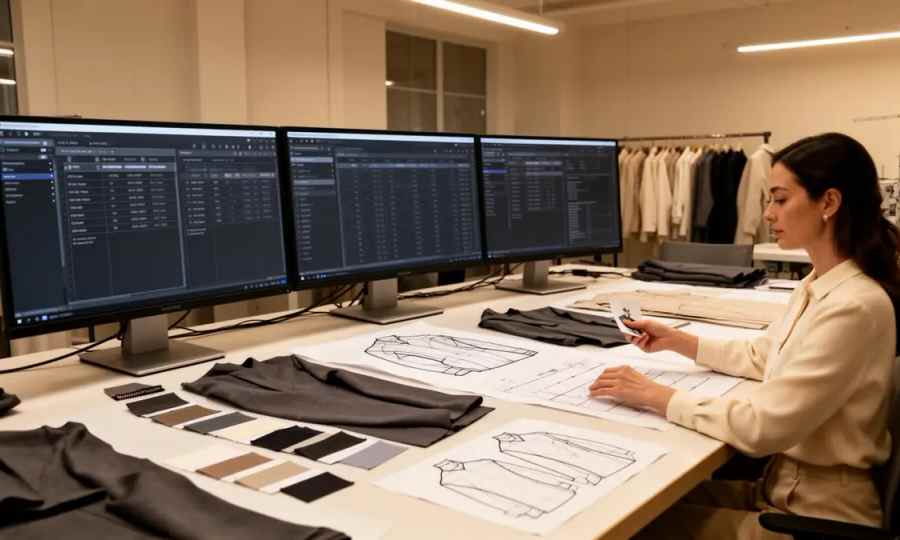
TL;DR. For large fashion brands, the return on investment from AI is not in abstract creativity but in concrete operational velocity and cost reduction. AI platforms like The F* Word deliver measurable ROI by autonomously orchestrating the entire concept-to-production workflow. They ingest creative direction from a moodboard and generate a complete, factory-ready tech pack, including the Bill of Materials (BOM), construction details, and grading rules, in minutes. This automation drastically reduces design cycle times, eliminates weeks of manual data entry, minimizes costly sample rounds, and accelerates time-to-market. The result is a direct, quantifiable impact on both operational expenditure and top-line revenue.
The conversation around AI in fashion often fixates on generative image models, creating a perception that its primary value lies in conceptual brainstorming. For large brands managing hundreds of styles per season, this view is dangerously incomplete. The real bottleneck, and thus the most significant opportunity for ROI, is not a lack of ideas but the immense operational friction in translating those ideas into manufacturable products. The journey from a creative director's vision to a validated tech pack is fraught with manual data entry, cross-departmental miscommunications, and version control issues across spreadsheets, emails, and legacy Product Lifecycle Management (PLM) systems.
A common myth is that AI aims to replace human designers. The operational reality shows its true function is to augment them by automating high-volume, low-creativity tasks. A senior designer's time is better spent refining a collection's narrative than populating BOM spreadsheets or correcting measurement errors in a tech pack. Large brands face unique challenges: siloed data between design, technical, and merchandising teams; long lead times for sample development dictated by overseas vendors; and the high cost of errors that cascade from inaccurate specifications. A single mistake in a tech pack can lead to a failed sample round, costing thousands of dollars and weeks of delay.
Traditional workflows, reliant on a patchwork of non-integrated tools like Adobe Illustrator, Excel, and first-generation PLMs, are no longer sufficient. They create a system where the technical designer spends an estimated 60-70% of their time on administrative tasks rather than on the critical functions of fit, form, and function. This inefficiency directly impacts the bottom line, inflating product development costs and delaying market entry, which can mean missing a key trend window entirely. The true ROI of AI lies in solving this deeply entrenched operational problem.
Quantifying AI's impact requires moving beyond abstract benefits and focusing on measurable operational KPIs. The most significant impact is the dramatic compression of the concept-to-tech pack process. An AI workflow orchestration platform ingests high-level inputs, such as moodboards, sketches, or reference products, and autonomously generates the complete set of technical specifications. This single action transforms a multi-week process involving designers, technical designers, and pattern makers into a task that takes mere minutes. The output is not a suggestion but a production-ready artifact, ready for PLM ingestion or direct-to-factory communication.
This acceleration has a compounding effect. Reducing the initial tech pack creation time from two weeks to under an hour enables brands to finalize collections faster and place purchase orders earlier. This speed directly translates to a faster product launch. For example, a large apparel group was able to shrink its average product development calendar by 35% by automating initial tech pack generation. This allowed them to place production orders four weeks earlier than their previous baseline, ensuring new products hit the floor at the beginning of the selling season, not midway through it, maximizing full-price sell-through.
also, AI platforms provide data-driven insights that were previously unavailable. By analyzing past collection performance, material usage, and production costs against new design concepts, the system can offer guidance on optimizing for margin or aligning with known consumer preferences. Instead of relying solely on intuition, merchandisers and designers can make more informed decisions during collection planning. This fusion of creative vision and data-backed validation de-risks product development and increases the likelihood of commercial success for each style.
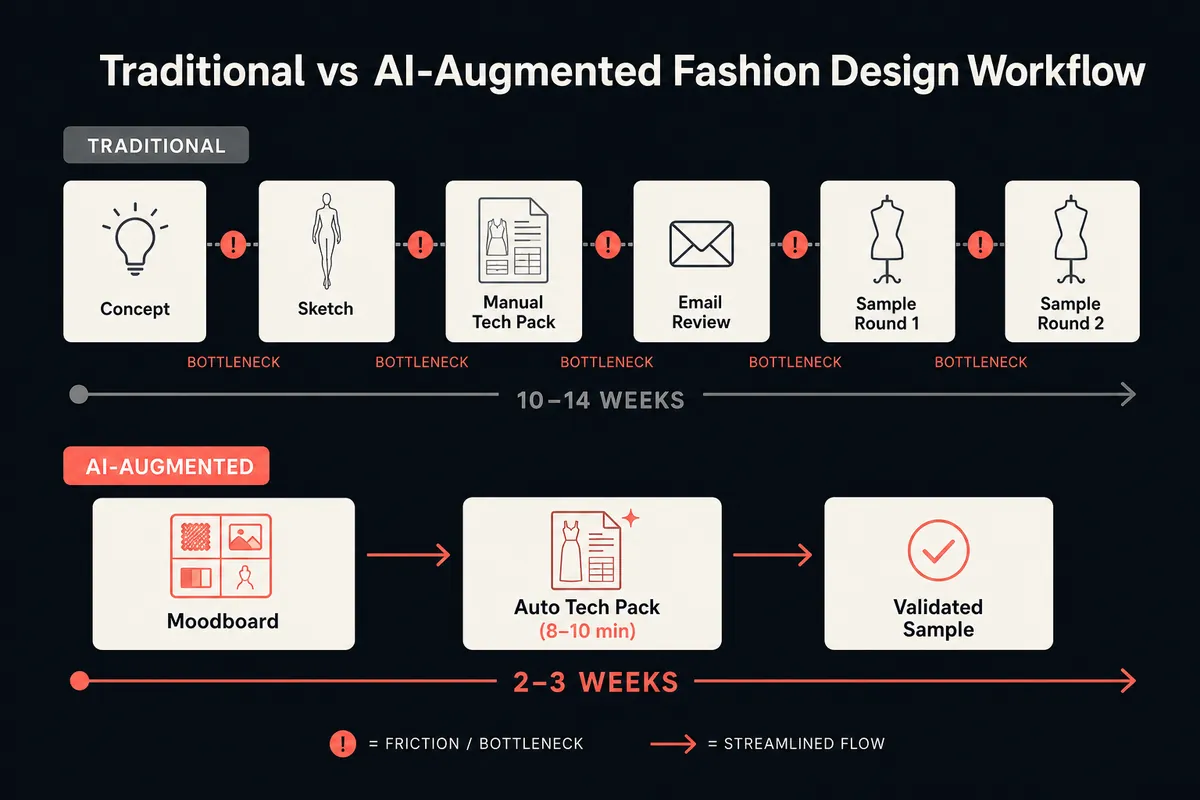
Workflow diagram comparing a traditional, multi-step design process with an AI-orchestrated workflow that automates the handoff from moodboard to tech pack, significantly reducing calendar time.
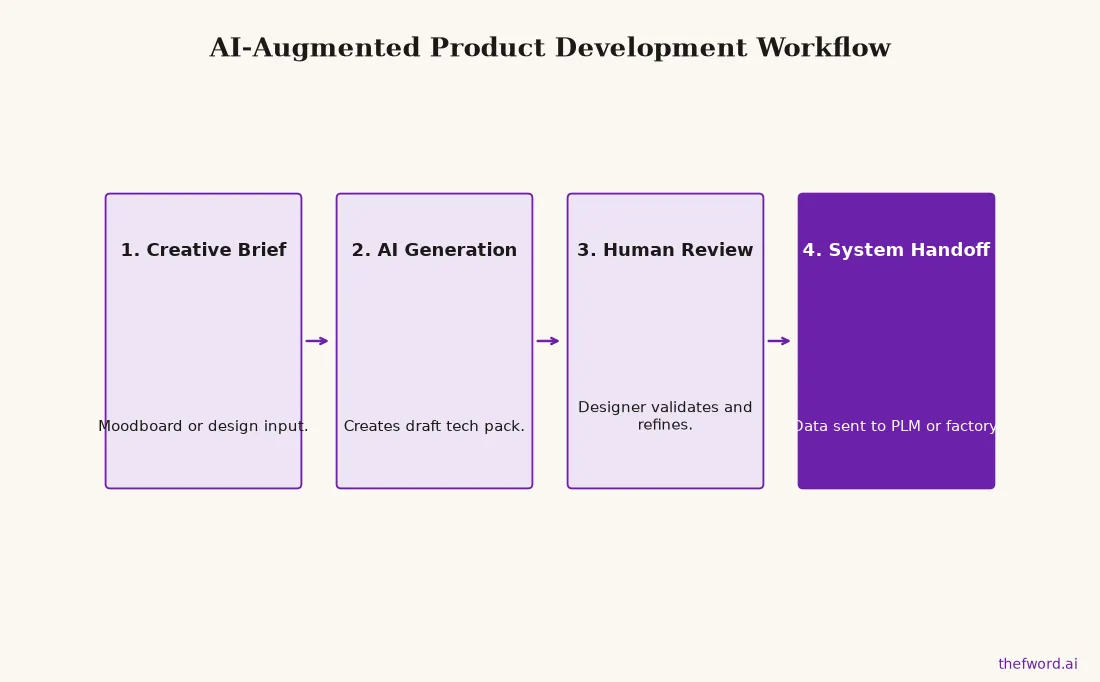
Successful AI integration within a large fashion enterprise hinges on a strategic focus on workflow orchestration rather than tool replacement. The goal is not to rip and replace multi-million dollar investments in PLM or ERP systems. Instead, AI should act as an intelligent middleware layer that automates the flow of information between a creative brief and these systems of record. The key areas for integration are the initial phases of product development: converting a seasonal moodboard into individual product concepts, and then converting those concepts into detailed, structured tech packs that can feed a PLM.
Overcoming adoption hurdles requires clear communication about the AI's role. It is a productivity multiplier, not a replacement for human expertise. For creative directors and designers, it eliminates the drudgery of spec creation, freeing them to focus on high-value creative tasks. For technical designers, it provides a highly accurate and complete first draft of a tech pack, allowing them to focus on complex fit validation, grading, and quality control rather than basic data entry. Training should center on how to provide effective creative inputs to the AI and how to review and validate its outputs, turning teams into editors and approvers rather than manual creators.
The F* Word exemplifies this orchestration role. It does not seek to be a PLM system like Centric or FlexPLM, nor a 3D virtualization tool like Browzwear or CLO. Instead, it generates the pristine, structured data that these downstream systems require to function effectively. By delivering a perfect tech pack, it provides the foundational DNA for the product. This means the PLM record is accurate from day one, and the 3D artist receives a precise blueprint to build a virtual sample. Success is measured by clear KPIs: reduction in tech pack error rates, decrease in the number of sample rounds per style, increased adoption of digital product creation by reducing setup time, and ultimately, the total lead time from concept approval to purchase order confirmation.
Choosing the right implementation model is key to maximizing ROI and minimizing disruption. This table compares a focused pilot program against a broader enterprise rollout across key decision factors to help you determine the best path for your brand's unique structure and goals.

Not all tools labeled "AI for fashion" are suitable for the rigorous demands of a large enterprise. The market is fragmented, comprising generic image generators, specialized 3D software with AI features, and true workflow orchestration platforms. For a brand producing hundreds of styles, the primary evaluation criteria must be the ability to scale, integrate, and deliver production-ready outputs autonomously. Generic AI image generators, while useful for initial moodboarding, cannot produce the structured data required for a tech pack. They create visually compelling but technically useless assets.
Traditional CAD and 3D design software are incorporating AI features, but often as plug-ins or yardımcı functions that still require significant manual operator input. They may suggest a seam placement or a texture, but they do not autonomously generate a complete Bill of Materials, Points of Measure (POMs), and complex grading rules from a simple creative prompt. Their core function remains manual creation by a skilled operator. For an enterprise, this provides only marginal efficiency gains and fails to address the core bottleneck of translating creative intent into technical specifications at scale.
The most suitable platforms for large brands are those designed specifically for workflow automation and orchestration. These systems are architected to understand the relationship between a design concept and its physical components. They integrate with PLM systems to pull material libraries and costing data, and they export data in formats that factories and other software can immediately use. When evaluating tools, decision-makers must prioritize autonomous tech pack generation, moodboard-to-product capabilities, and strong integration APIs over standalone visual generation features.

Calculating the ROI of AI in fashion design is a straightforward financial exercise focused on cost savings and revenue acceleration. The first component is direct cost reduction. The largest savings come from minimizing physical sample rounds. Each sample can cost from hundreds to thousands of dollars when accounting for materials, factory labor, and express shipping. An AI-generated, highly accurate tech pack eliminates the errors and omissions that cause sample rejections. A brand reducing its average sample rounds from 3.5 to 1.5 per style, across a 300-style collection, realizes a six-figure saving on sampling costs alone.
Labor cost savings are also significant. By automating the creation of spec sheets, BOMs, and other technical documents, AI frees up immensely expensive and skilled human capital. If a technical design team collectively saves 1,000 hours per season on administrative tasks, that time can be reallocated to higher value activities like innovating on fit, validating quality, and negotiating with suppliers. This translates to either accomplishing more with the same headcount or reducing reliance on freelance and contract support during peak development seasons.
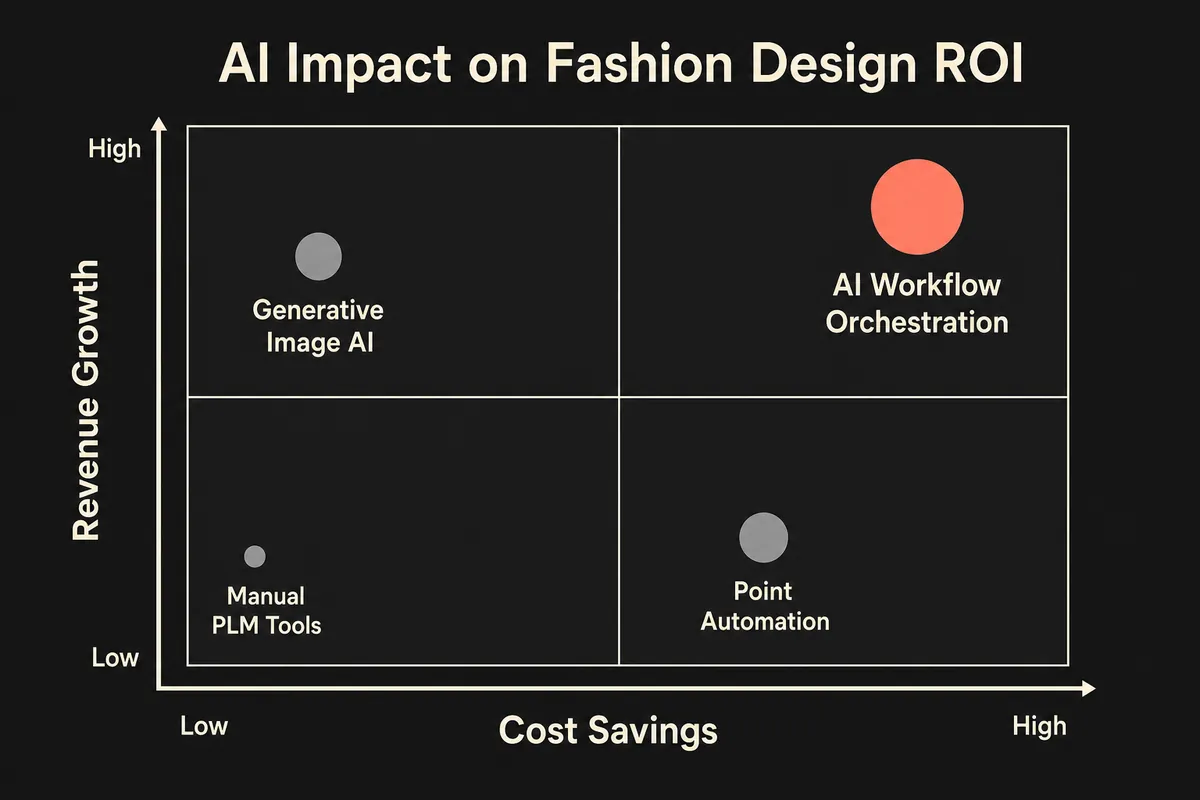
A 2x2 quadrant mapping AI tool impact. Workflow Orchestration platforms deliver high cost savings and high revenue growth, making them the most strategic investment for large brands.
On the revenue side, the primary driver is faster time-to-market. Hitting the market weeks or even a month ahead of competitors means a longer window for full-price sales and less residual inventory requiring markdowns at the end of the season. A 1% improvement in full-price sell-through for a large brand can translate into millions of dollars in revenue. AI-driven agility also allows brands to react faster to in-season trends. The ability to move a new, data-validated design from concept to factory-ready in a single day enables rapid, targeted product drops that capture market demand instantly. This agility itself is a long-term strategic advantage that compounds financial returns.
Beyond immediate financial returns, AI serves as a powerful catalyst for building a more sustainable and efficient fashion industry. The staggering amount of waste in fashion is often a direct result of process inefficiency. Overproduction, driven by inaccurate forecasting, and physical sample waste, driven by inaccurate tech packs, are two of the largest contributors. AI directly addresses both. By generating precise initial specifications, AI dramatically reduces the need for multiple rounds of physical samples shipped across the globe, cutting down on material waste, water usage, and carbon emissions from freight.
This operational precision extends into the supply chain. An AI-generated BOM can be optimized for material utilization, suggesting cutting markers or material choices that minimize fabric waste before production even begins. When integrated with supply chain data, the system can provide greater transparency into sourcing and resource allocation, helping brands make more responsible decisions. This level of detail supports compliance with emerging regulations and meets growing consumer demand for ethically produced goods.
The role of the fashion designer and product developer evolves in this new paradigm. Freed from the constraints of manual specification and administrative overhead, they are elevated to more strategic roles. The designer becomes a true creative director, guiding the AI's output and focusing on brand narrative, innovation, and curating collections. The technical designer transforms into a product engineer, focusing on complex fit challenges, performance standards, and quality assurance. AI does not diminish their value; it enhances their capability to create better, more sustainable, and more commercially successful products.
AI delivers ROI by directly attacking operational costs and accelerating revenue. It automates tech pack and moodboard creation, drastically reducing the labor hours spent on manual data entry. This leads to fewer, more accurate sample rounds, saving significant costs on materials and shipping. Faster time-to-market, enabled by a compressed design cycle, means a longer full-price selling window and increased revenue. The impact is a direct and measurable improvement to both the P&L and operational agility.
AI is an enhancement, not a replacement. It automates the most repetitive, non-creative parts of a designer's job, such as populating spec sheets and BOMs. This frees designers to concentrate on high-value work: creative direction, trend analysis, concept development, and refining the product's aesthetic. AI acts as a hyper-efficient assistant, allowing designers and technical teams to execute their vision faster and with greater accuracy, ultimately elevating their strategic importance to the business.
To measure AI effectiveness, brands should track KPIs like: tech pack creation time (hours vs. days), number of physical sample rounds per style, tech pack accuracy rate (percentage of tech packs approved on first pass), concept-to-PO lead time (in days), and reduction in material waste from sampling. Financially, they should track the direct cost savings from fewer samples and the change in full-price sell-through percentage due to faster market entry.
The key is to select AI platforms designed as orchestration layers, not monolithic replacements. These tools integrate with existing PLM and ERP systems via APIs. Integration should be phased, starting with a specific team or product category to prove value. The focus is on automating the handoff between creative and technical processes, feeding clean, structured data into the systems your teams already use. This approach minimizes disruption and enhances the value of existing tech investments.
Initial costs typically involve a SaaS subscription fee for the AI platform, plus internal resources for implementation and training. The payback period for large brands is often surprisingly short, frequently under 12 months. The calculation is simple: compare the annual software cost against tangible savings from reduced sampling, decreased need for freelance support, and the revenue upside from getting products to market 4-6 weeks earlier. The ROI becomes compelling very quickly at enterprise scale.
Strategically, AI builds enterprise agility. The ability to rapidly test new ideas and move them into production quickly allows brands to better respond to fast-moving trends and shifting consumer behavior. It de-risks innovation by enabling data-validated design choices. Over the long term, this fosters a more responsive and resilient business model, creates a more sustainable supply chain by reducing waste, and builds a significant competitive advantage against slower-moving competitors.
Ready to move beyond hype and see a quantifiable return on AI? See enterprise capabilities and discover how our workflow orchestration platform can transform your product development process. Explore our full resources for large brands at our pillar hub.
Related: multi-collection AI fashion design · The F* Word · ai fashion design overview · best ai moodboard tools fashion designers
Get The F* Word workflow insights in your inbox.