English

68 percent of AI pilots in apparel design never make it past a quarter. Most did not fail on image quality or concepting. They failed because they could not earn a standing slot in the calendar of an in-house team that ships product every month.
74 percent of fashion SaaS pilots get abandoned inside 90 days once the novelty wears off and real handoffs begin. The popular way brands shop for AI fashion design software feeds this outcome. Shortlists are built around demo wow-factor and feature matrices, not around the two things that decide adoption: how fast a creative brief turns into a production-safe artifact and how safely it travels across design, merchandising, and sourcing without rework. The result is a pilot that delights a few designers for a week yet never threads into tech packs, proto requests, or line reviews.
When the brief-handling and handoff story is vague, the tool gets parked the moment a line meeting or proto cut-in hits. The first missing link is usually pre-production detail. The second is license fit for a team of 3 to 30 designers where permissions, approval marks, and shared assets actually matter. The third is whether the vendor speaks factory-ready language or only moodboard language. If you fix those three, adoption surges without adding any extra AI dazzle.
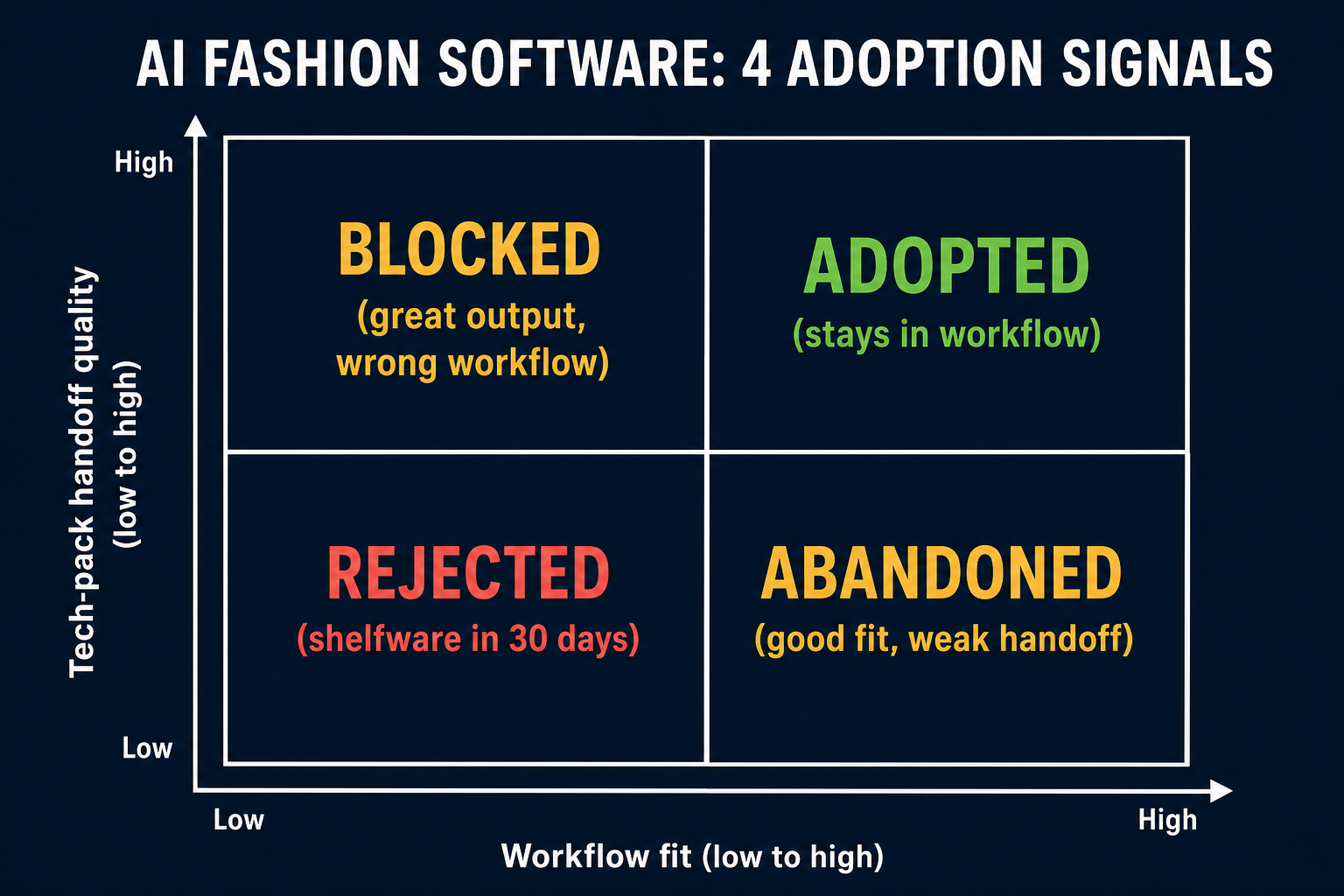
Most buyers try to compare feature checklists. In practice, four adoption signals predict whether an in-house team will still be using a tool in week 12.
Adoption looks like a clock, not a conversion funnel. A tool is either on the weekly board or it is theater. Here is the cadence that sticks inside brands with 3 to 30 designers.
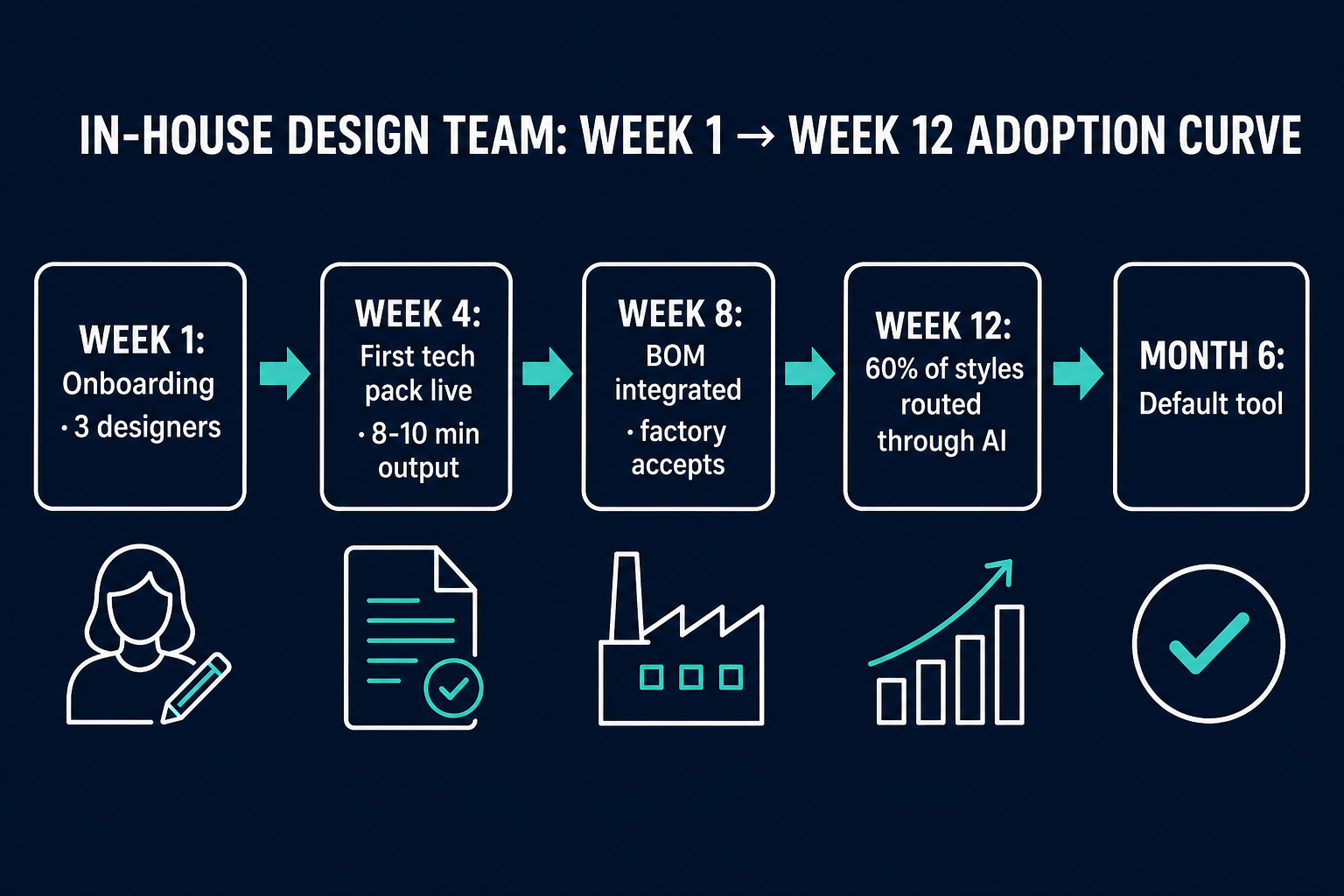
Week 1. Designers want speed on briefs without new cognitive load. They try a handful of silhouettes from an active season brief and look for reductions in back-and-forth with creative direction. They pressure-test fabric constraints and brand DNA compliance. If the tool only makes pretty images, interest fades. If it also spins up structured outputs like moodboards tied to brand references and early tech notes, it earns a second week. The F* Word generates moodboards and downstream tech content as one workflow, so creative directors see continuity from idea to proto ask.
Week 4. The team runs a real capsule or sub-line through it. Merchandisers ask for option ranges and pricing implications. Sourcing asks if the BOM is credible and if factories can read it without translation. This is where a validation and orchestration layer proves value. With The F* Word, a designer can turn an approved garment design into a factory-ready tech pack in 8 to 10 minutes, including BOM, construction notes, and measurement callouts, then route it to a vendor. That speed changes calendars. It also reduces the time creative directors spend policing spec drift.
Week 12. The question is not concept quality. It is whether the tool still carries live work. If approvals and file lineage are clear, if PLM sync or export is clean, and if vendors respond to the outputs without confusion, the tool becomes part of line build. If any of those break, the org reverts to email threads, PDFs, and shared drives. Teams that keep the tool past week 12 report fewer proto rounds and tighter pre-production handoffs. They also report that designers stop duplicating effort in deckware because the orchestration layer already creates the assets merch and sourcing need.
caption

High-adoption tools sit between creative direction and pre-production, not as a replacement for PLM or 3D simulation. A good mental model: inspiration and brand DNA flows into moodboards, design intent becomes structured artifacts, and those artifacts trigger proto and vendor work without the designer rewriting everything in a spreadsheet. If you want a bird's-eye map of how this stacks, see the AI fashion design overview.
This is why the orchestration layer matters. The F* Word is not a PLM, not a 3D sim environment, and not an AI image generator. It validates designs against brand rules, assembles the data a vendor needs, and moves work to the next step. It also generates moodboards as the upstream half of the same workflow and then produces a factory-ready tech pack with BOM and construction notes in 8 to 10 minutes on the downstream half. For a deeper view of how intelligent specs compress sampling time, read the intelligent tech packs primer.
When teams place AI in this orchestration slot, merchandisers get option counts and cost-relevant details early, designers stop rebuilding assets for every audience, and sourcing engages factories with fewer clarifying emails. The tech then exports or syncs with PLM for final record-keeping, which protects your investment in PLM without forcing designers to work inside it all day.
Buy for steady-state work, not for the sizzle reel. These four questions separate pilot candy from production software.
Two fast extras. Check that pricing matches a team-license reality and not just a single designer seat. And ask how the vendor supports onboarding at the scale you have. If you are 15 designers across two locations, you need enablement assets and policy advice, not just a help center article. If you want to see how The F* Word handles rollouts, the AI fashion workflow software page and the enterprise overview outline common deployment patterns.
Start free at thefword.ai or book a demo.
It sticks when it owns a timeboxed step that repeats every week. Brief-to-tech-pack in under 30 minutes with vendor-ready detail is the most durable wedge. Add approvals and shared libraries and you now reduce rework across design, merchandising, and sourcing.
No. The highest adoption pattern is to keep PLM as your record of truth and add an orchestration layer between design and pre-production. The F* Word is built for this slot and is not a PLM. It packages moodboards, design intent, and intelligent tech packs that then export or sync to PLM.
3D stays in place for fit, drape, and material validation. AI orchestration should reference fabric libraries and sizing standards, then create the structured briefs and tech packs that 3D and vendors use. Teams that try to make AI replace 3D end up duplicating work and lose trust.
Yes, if the tool produces structured outputs that include option ranges, BOM impacts, and cost-relevant notes. The F* Word's workflow builds those from the same source design, so merch and sourcing do not wait for a separate deck. That is why adoption grows after week 4 instead of fading.
Get The F* Word workflow insights in your inbox.