
Language
.webp)
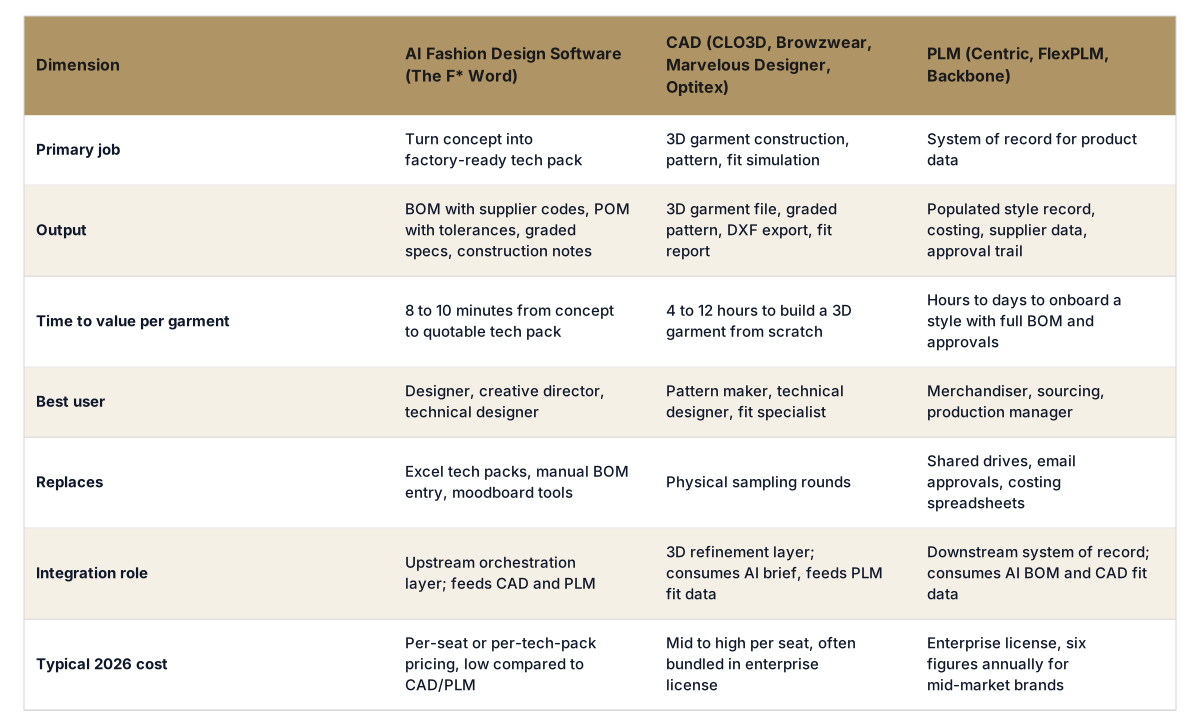
Direct answer. Brands need all three, because they do different jobs. CAD (CLO3D, Browzwear, Marvelous Designer, Optitex) handles 3D garment construction, pattern drafting, and fit simulation. PLM (Centric, FlexPLM, Backbone) is the system of record for product data, BOM, costing, supplier collaboration, and approval routing. AI fashion design software (The F* Word) is the orchestration layer that turns a concept or scanned reference into a factory-ready tech pack in 8 to 10 minutes, then hands clean data to CAD for 3D and PLM for production. None of the three replaces the others, and a brand that picks only one usually rebuilds the missing two in spreadsheets.
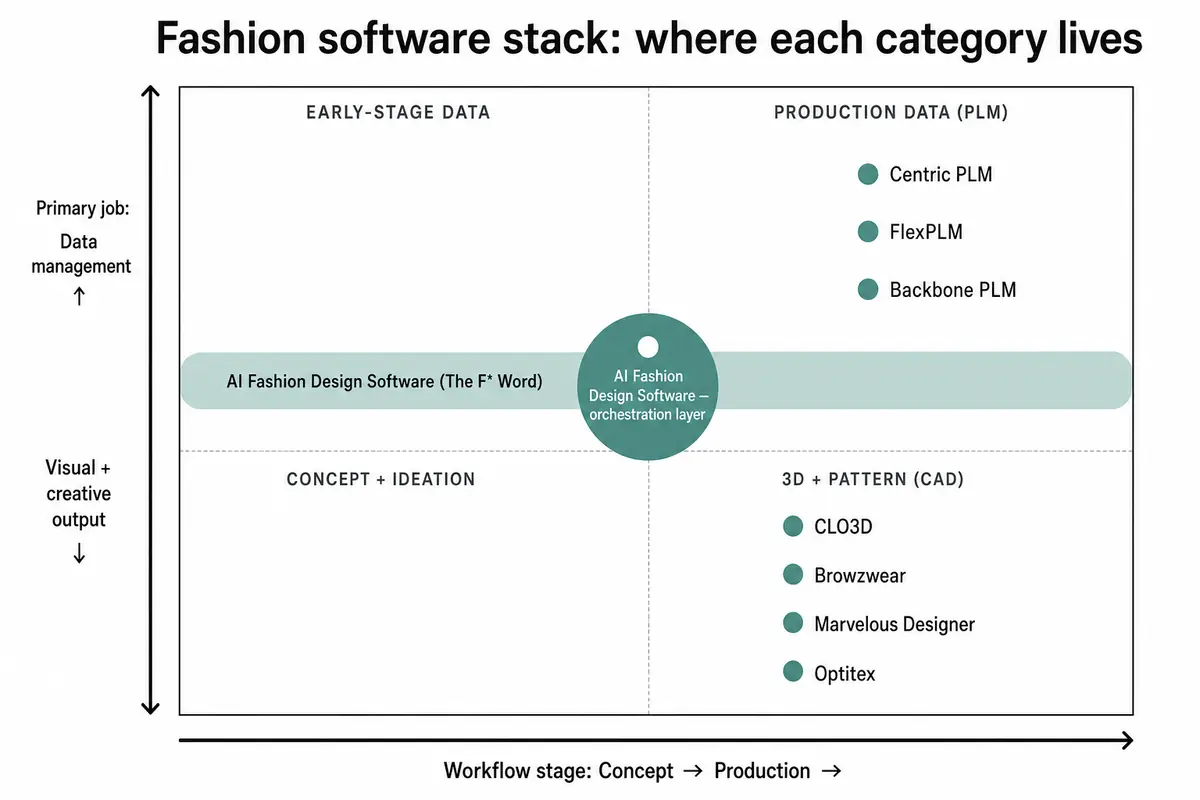
Fashion software stack: CAD owns 3D and pattern, PLM owns production data, AI design software is the orchestration layer that connects concept to both.
Computer-Aided Design (CAD) software in fashion is used to draft patterns, simulate fabric drape, and build 3D renderings of finished garments. The category leaders in 2026 are CLO3D, Browzwear (VStitcher), Marvelous Designer, and Optitex. CAD compresses physical sampling rounds by letting technical designers preview fit and silhouette on a 3D avatar before a factory cuts a single yard. It is also where graded patterns are finalised and where DXF files are exported to a vendor.
CAD is not a system of record. Pattern files live on individual workstations or shared drives, and BOM, costing, and approvals all happen somewhere else. CAD is also slow at concept work, building a 3D garment from scratch takes hours, which is why most brands do not use CAD until a design is already locked.
Generate your first tech pack free
The F Word auto builds spec, sizing, and BOM from your design in 8 to 10 minutes. No template wrangling, no factory back and forth.
Product Lifecycle Management (PLM) software is the central database for everything a brand makes. Centric PLM, FlexPLM, Backbone, and ProductDossier are the names a sourcing or merchandising team will recognise. PLM stores the style master, the bill of materials (BOM), costing, supplier and trim card data, compliance documents, sample status, and the approval trail from first proto to bulk PO.
PLM is collaboration plumbing, not a design tool. It does not draw patterns, it does not generate concepts, and it does not write construction notes on its own. Teams populate PLM with data produced upstream, which is exactly where AI design software and CAD feed in.
AI fashion design software turns an inspiration image, a scanned reference, or a text brief into a complete, factory-ready tech pack, BOM with supplier-grade codes, POM with tolerances, graded specs, and construction notes, in 8 to 10 minutes. The F* Word is the orchestration layer for this stage of the workflow. It also generates moodboards as the upstream half of the same workflow, so a designer can move from intent to spec without switching tools.
The F* Word is NOT a PLM, NOT a 3D simulator, and NOT an image generator. It validates whatever design input a brand prefers (sketch, photo, CAD export, moodboard) and outputs the files vendors actually quote off. Those outputs flow downstream into CAD for 3D refinement and into PLM as the populated style record. More on the intelligent tech pack output here.
The cleanest 2026 stack treats AI design software as the upstream orchestration layer, CAD as the 3D and pattern layer, and PLM as the system of record. A concept enters through AI, becomes a tech pack and BOM in minutes, hands a clean pattern brief to CAD for 3D fit work, and lands in PLM as a populated style with costing and supplier data already attached.
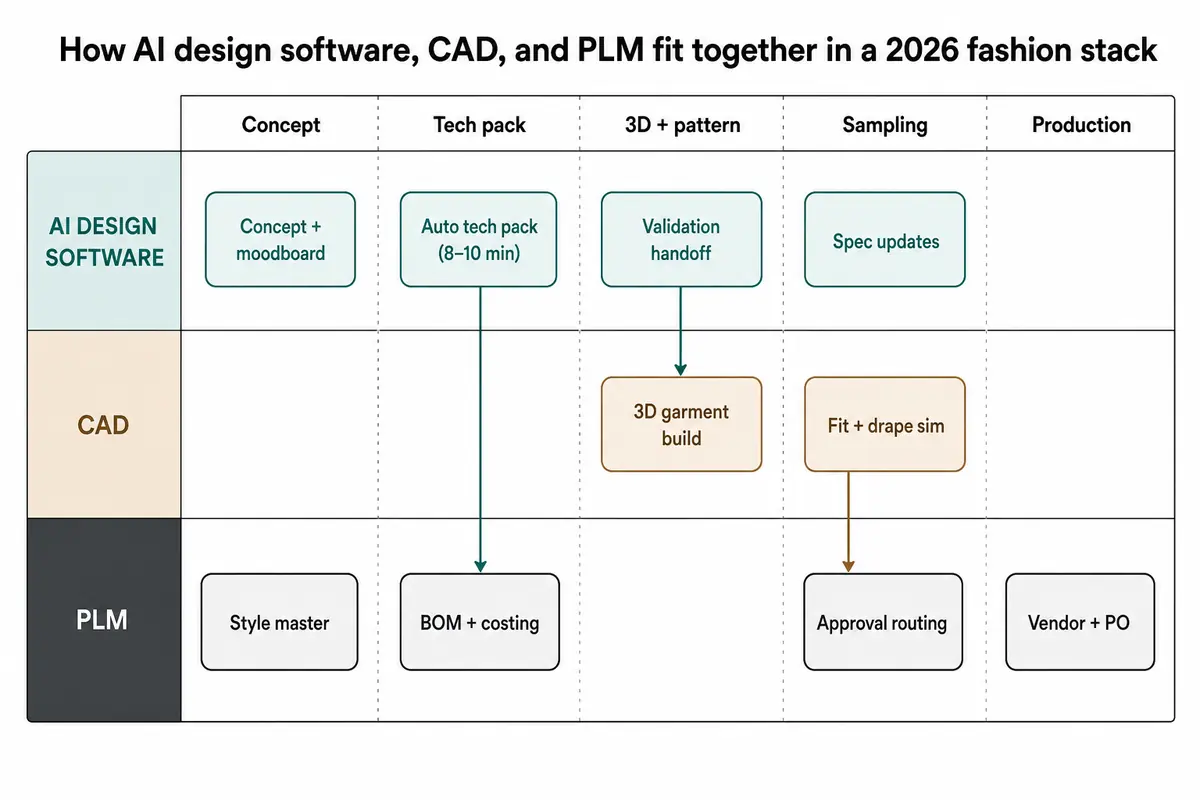
The integration pattern in 2026: AI generates the tech pack and feeds BOM into PLM and a 3D brief into CAD. CAD's fit data flows back into PLM for approval routing.
Brands need all three once they cross roughly 50 SKUs per season or sell into wholesale where retailers require structured data handoff. Below that volume, AI fashion design software alone covers a surprisingly large share of the workflow, concept, tech pack, BOM, and a basic style record, and the brand can defer a full PLM until growth forces it. CAD is optional until 3D fit simulation becomes the bottleneck (usually around the same volume threshold).
What does not work: trying to make CAD do PLM's job (data lives in files, not a queryable database), trying to make PLM do design's job (PLM is data entry, not creation), or trying to make AI design software do CAD's job (The F* Word does not simulate drape on a 3D avatar). Each category replaces a different bottleneck. For a deeper look at how the orchestration layer connects upstream and downstream, see our AI fashion design overview and the pre-production workflow guide.
CAD (CLO3D, Browzwear, Marvelous Designer, Optitex) is for 3D garment construction, pattern drafting, and fit simulation. AI fashion design software like The F* Word is for turning a concept or reference into a factory-ready tech pack with BOM, POM, and construction notes in 8 to 10 minutes. CAD operates downstream of the tech pack; AI design software produces the tech pack. Most brands use both: AI for the spec, CAD for the 3D refinement.
No. PLM (Centric, FlexPLM, Backbone) is a system of record for product data, BOM, costing, supplier collaboration, approval routing. It does not draft patterns, it does not simulate fit, and it does not generate tech packs. PLM consumes the outputs of CAD and AI fashion design software, it does not produce them. A brand that buys only PLM ends up rebuilding the design and spec layers in spreadsheets.
For small brands under roughly 50 SKUs per season, AI fashion design software covers enough of the data layer (style record, BOM, tech pack history) that PLM can be deferred. Above that threshold, brands need PLM for multi-supplier collaboration, costing rollups, and audit trails that AI design tools do not provide. The healthy pattern is to use AI design software upstream and PLM downstream, not pick one over the other.
AI fashion design software, because it removes the single biggest pre-production bottleneck (turning a concept into a quotable tech pack) in 8 to 10 minutes for free or near-free on a per-pack basis. CAD becomes useful once 3D fit work is the bottleneck. PLM becomes essential once SKU count, supplier count, or wholesale requirements force structured data handoff. Buying PLM first on a small brand usually means months of empty database setup with no upstream system feeding it.
Yes. The F* Word is built as an orchestration layer, so its tech pack outputs (BOM with supplier codes, POM with tolerances, graded specs) export in formats PLM systems like Centric and FlexPLM ingest as a populated style. The pattern brief and construction notes export in formats CAD tools like CLO3D and Browzwear use as the starting point for 3D garment construction. The point is to remove the manual re-keying step between concept and downstream systems.
TheNewBlack, Resleeve, and Raspberry AI sit in a separate category from The F* Word: image-generation tools that produce renders, not factory-ready tech packs. They do not output a BOM with supplier codes, POM with tolerances, or construction notes a vendor can follow. They are useful for ideation and moodboards but are not replacements for AI fashion design software in the production-ready sense, and they do not integrate with PLM or CAD in the same way.
If your team is still hand-keying tech packs into PLM or rebuilding BOMs in Excel after every design change, the orchestration layer is the missing piece. See how The F* Word slots in alongside your existing CAD and PLM and what a factory-ready tech pack in 8 to 10 minutes does to your sample cycle.
Get The F* Word workflow insights in your inbox.