
Language
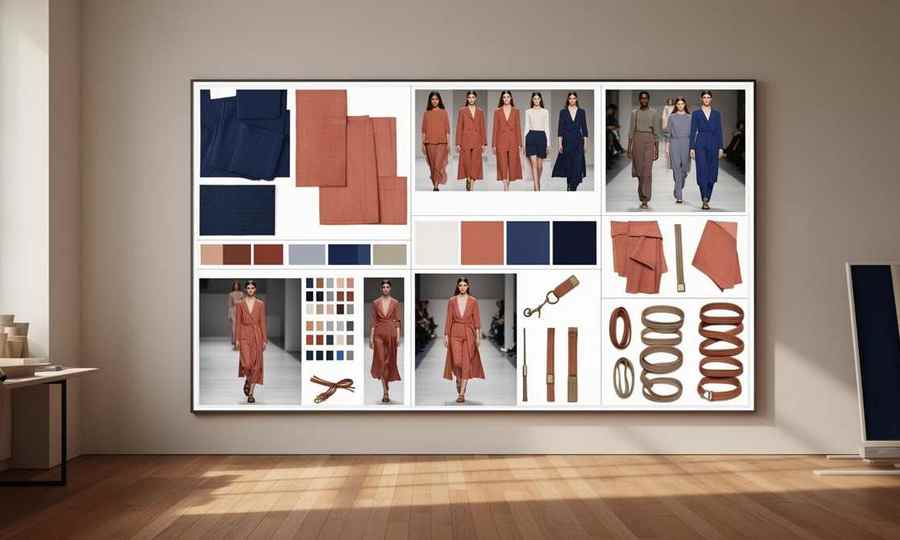
Enterprise AI mood board generation has to survive review, sourcing and compliance, not just look good in a deck. The F* Word handles that by turning eapproved board into a factory-ready tech pack in 8 to 10 minutes with validated bill of materials.
Buyer comparison

TL;DR. Enterprise AI mood board generation transforms a creative exercise into a strategic, data-driven workflow. Unlike basic image collages, these platforms analyze market trends, competitor assortments, and a brand's own historical data to produce intelligent visual concepts. This process directly connects creative direction to pre-production by informing the selection of materials, trims, and colorways. The AI-generated moodboard becomes the foundational asset that a system can use to autonomously generate a factory-ready tech pack, complete with a Bill of Materials (BOM), construction details, and initial grading. For enterprise fashion brands, this means faster concept validation, fewer sample rounds, and a clear, unbroken thread from initial idea to final product specification.
In an enterprise context, AI mood board generation is not merely about assembling aesthetically pleasing images. It is a core strategic function that injects data, speed, and intelligence into the start of the product lifecycle. Traditional mood boards, whether physical cork boards or digital canvases on Pinterest, are manual, subjective, and disconnected from downstream processes. A creative director or designer spends hours, even days, gathering inspiration that exists in a vacuum, a collection of images that must then be manually translated for technical designers and sourcing teams. This translation is where intent is lost, errors are introduced, and delays accumulate.
AI-powered mood boards represent a fundamental shift. They are dynamic, analytical assets. An enterprise-grade platform ingests vast datasets: real-time runway imagery, street style photography, social media trends, and crucially, a company's own sales data and design archive. The AI doesn't just find images that match a keyword. it identifies latent patterns, predicts emerging silhouette trends, and proposes color palettes validated against commercial performance. For large fashion organizations managing hundreds of styles per season, this provides a major competitive advantage. It replaces guesswork with data-backed direction, collapsing the timeline from seasonal kickoff to initial design concept.
The imperative for adoption is clear. A brand that can validate a creative concept against market viability in hours, not weeks, can react to consumer shifts with new agility. By embedding this intelligence at the genesis of a collection, the entire product development pipeline becomes more efficient. The AI mood board acts as a single source of truth, a visual and data-rich brief that informs everything from the initial sketch to the final tech pack, ensuring the creative vision is executed with precision and commercial awareness.
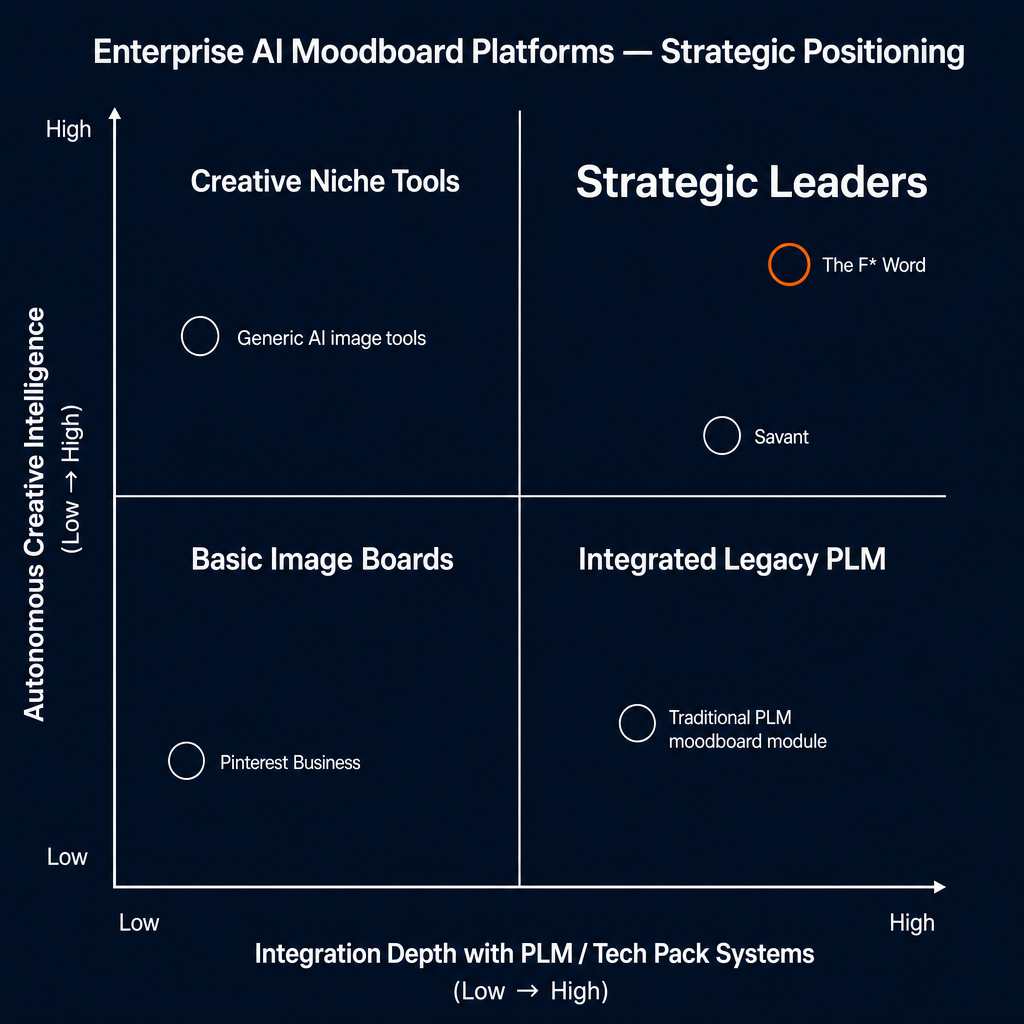
A 2x2 quadrant showing enterprise AI mood board solutions based on their 'Integration Depth with Existing Systems' (X-axis) and 'Autonomous Creative Intelligence' (Y-axis), categorizing them for strategic decision-making. Platforms like The F* Word occupy the high-integration, high-intelligence quadrant, acting as a true workflow orchestrator.
The true power of enterprise AI in creative direction lies in its ability to move beyond simple image aggregation. Tools like Pinterest or Canva may offer AI-assisted search, but they function as digital scrapbooks. An advanced AI platform transforms the mood board into a strategic document. It acts as an analytical partner to the creative director, contextualizing imagery with data. For example, a designer can prompt the system for "utilitarian outerwear for the Northern European market," and the AI will generate visual concepts that incorporate not just aesthetic cues but also analysis of top-selling silhouettes, preferred fabric weights, and trending hardware finishes specific to that region.
This data-driven approach is critical for trend forecasting and theme development. Instead of relying solely on third-party trend reports, which are available to all competitors, brands can use AI to generate proprietary findings. The AI can analyze a brand's entire visual history, identify its core design DNA, and then project how that DNA should evolve in response to new trends. This allows a brand to participate in a trend without losing its unique identity, suggesting how a signature pocket style or sleeve construction could be adapted for the upcoming season. It's the difference between chasing trends and leading them with a confident, brand-authentic voice.
Integrating these AI-driven mood boards into existing creative workflows is the final piece of the transformation. An enterprise platform does not operate in isolation. It connects via API to Product Lifecycle Management (PLM) systems, 3D design software like CLO or Browzwear, and internal asset libraries. When a creative director finalizes a mood board, the platform can automatically populate PLM fields with proposed color codes, fabric types, and trim descriptions. This establishes a "digital thread" that ensures the creative intent defined in the mood board is carried through, without manual data entry, to the technical design and sourcing stages.
The impact of an AI-generated mood board extends far beyond the design studio, creating efficiencies throughout the entire fashion product lifecycle. Its role as a foundational visual and data asset allows it to be operationalized throughout departments, ensuring cohesion and speed from concept to consumer.
In pre-production, the mood board becomes a critical validation tool. Before a single sketch is drawn, the AI-generated concepts, backed by market data, can be reviewed by merchandisers and product development managers. This early alignment prevents investment in designs that are unlikely to meet commercial targets. also, the mood board's visual data can be used to pre-emptively query sourcing databases for available materials. If the board features a specific boucle texture, the system can identify suppliers with that fabric in stock, shortening lead times and de-risking the supply chain.
During design and development, the mood board serves as an unambiguous guide for both 2D and 3D designers. It provides clear visual direction for silhouette, texture, and trim, which is then translated into technical specifications. This clarity drastically reduces the number of sample rounds. When a platform can move from mood board to an initial tech pack autonomously, it eliminates the guesswork for the technical designer. Tolerances, points of measure (POMs), and construction callouts are generated in alignment with the approved visual, minimizing the back-and-forth between design and technical teams.
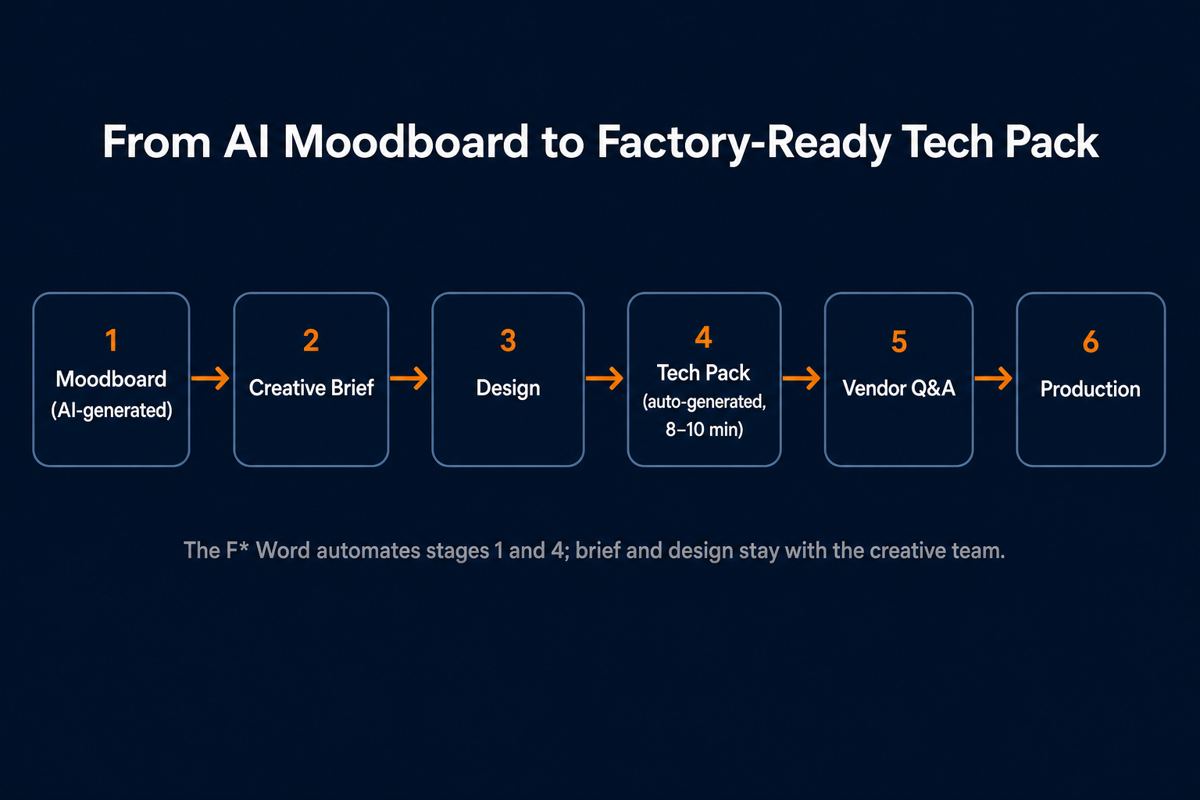
The AI-driven workflow connects the mood board directly to technical specifications and sourcing, creating a single, unbroken thread from creative concept to factory-ready production artifacts.
For merchandising and marketing, the AI mood board ensures a consistent brand narrative. The same visual themes and keywords that guided product creation can be used to generate marketing copy, style e-commerce photoshoots, and design visual merchandising displays. This creates a powerful, cohesive story that resonates with consumers because the product they see online or in-store perfectly shows the creative vision that conceived it. Finally, for the supply chain, the mood board offers factories a clear visual language, supplementing the technical data in the tech pack with rich imagery that communicates nuance about fabric drape, print scale, and finish quality.
Not all AI tools are created equal, and for enterprise-scale fashion brands, a specific set of features and capabilities is non-negotiable. These platforms must be powerful, secure, and deeply integrated into the complex ecosystem of fashion technology. The primary function must extend beyond image generation to true workflow orchestration.
Intelligent image and texture recognition is foundational. An enterprise system must be able to understand the content of an image with high fidelity. It should differentiate between a cotton twill and a silk charmeuse, recognize a welt pocket versus a patch pocket, and identify subtle print variations. This granular understanding allows the AI to make specific, actionable recommendations for materials and construction methods that are directly fed into the Bill of Materials (BOM).
Automated trend analysis and pattern identification are what separate a professional tool from a consumer one. The platform must continuously process data from retail, social media, and catwalks to provide predictive findings. This capability enables designers to ask strategic questions like, "What are the top three emerging sleeve details in contemporary womenswear?" and receive a visual and analytical answer. This turns the mood board into a forward-looking intelligence brief.
Critically, the platform must offer deep and flexible integration with existing enterprise systems. This means out-of-the-box connectors and strong APIs for leading PLM platforms (like Centric PLM and FlexPLM), ERP systems, and 3D design tools. The goal is a two-way sync of information, where the mood board informs the tech pack in the PLM, and data from the PLM (like costing and material availability) can in turn inform creative decisions. Collaboration features are also essential for large, often globally distributed teams. The platform must support real-time commenting, version control, and role-based permissions to ensure that creative directors, designers, merchandisers, and sourcing leads are all working from a single, up-to-date source of truth. Finally, enterprise-grade scalability and data security are paramount. The system must handle thousands of images and large datasets without performance degradation, and it must comply with strict security protocols to protect a brand's intellectual property and sensitive forward-looking design concepts.
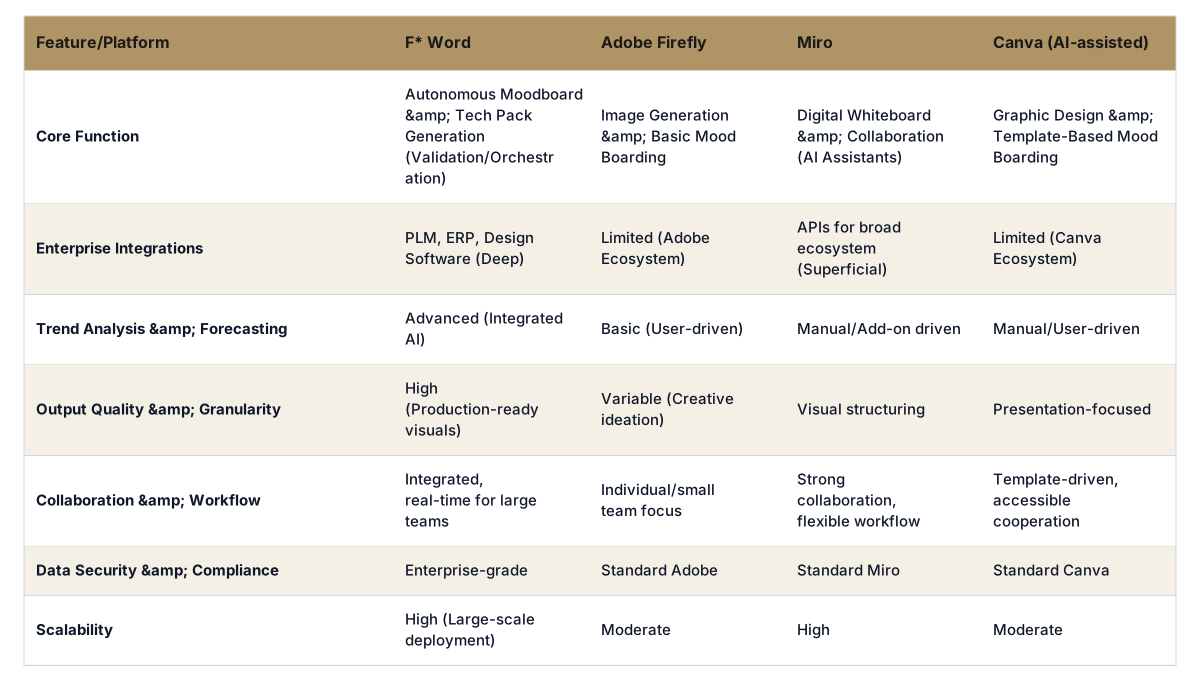
Selecting the right AI platform requires a clear-eyed assessment of how different solutions support the specific, high-stakes workflow of an enterprise fashion brand. While many tools offer AI features, their core functions, integration capabilities, and intended use cases vary dramatically. A simple graphic design tool with an AI image generator is not a substitute for an enterprise-grade workflow orchestration platform. The focus for a large brand must be on systems that connect creative intent directly to production-ready artifacts, integrate with the existing tech stack, and provide analytical rigor. The following table compares several platforms throughout key dimensions relevant to enterprise operations.
The adoption of enterprise AI mood board generation is not just a creative upgrade. it is a strategic business decision with a measurable return on investment (ROI). The impact can be quantified throughout three key areas: operational efficiency, speed-to-market, and brand equity. By focusing on these metrics, organizations can build a clear business case for integrating these powerful new workflows.
First, operational efficiency gains and direct cost savings are the most immediate benefits. Consider the reduction in physical sample rounds. Each sample costs hundreds or thousands of dollars in materials, shipping, and labor. By generating a hyper-specific mood board that feeds an autonomous tech pack creation process, the visual intent is so clear that it can reduce the average number of samples per style from three or four down to one or two. Likewise, the hours designers and creative directors spend manually scouring the internet for inspiration can be redeployed to higher-value strategic work. Automating research and initial concepting can free up hundreds of hours per season for a mid-sized design team.
Second, improved speed-to-market is a critical competitive differentiator. The traditional fashion calendar is rigid and slow. AI-driven workflows compress the front end of this calendar significantly. A process that once took six weeks from concept kickoff to a confirmed tech pack can be reduced to under a week. This agility allows brands to react to micro-trends, launch capsule collections quickly, and better match inventory with real-time consumer demand, finally leading to higher full-price sell-through and reduced end-of-season markdowns.
Finally, the ROI is evident in improved brand consistency and consumer engagement. An AI trained on a brand's visual DNA ensures that ecollection, eproduct, and emarketing campaign feels cohesive and authentic. This consistency builds brand trust and loyalty. When the product that ships perfectly matches the creative vision, it strengthens the brand's narrative. This can be measured through brand perception studies, social media engagement metrics, and finally, improved customer lifetime value. The mood board becomes the guardian of the brand's aesthetic, enforced by intelligent automation.
The trajectory of AI in fashion design points toward a future of increased automation, deeper integration, and a redefinition of creative roles. The AI mood board of today is already a powerful analytical tool, but its future evolution will see it become an even more active participant in the design process. Upcoming trends will likely include AI systems capable of not just generating static mood boards but also creating interactive 3D virtual environments based on a creative theme, allowing designers to experience a collection's "world" before a single garment is made.
This technological progression will inevitably alter the role of fashion designers and creative directors. Rather than focusing on the manual tasks of sourcing images or drafting initial sketches, their function will elevate to that of a creative strategist or editor. They will guide the AI, set the strategic direction, and curate the best outputs, focusing their expertise on taste, brand identity, and narrative. The designer becomes a conductor, orchestrating AI tools to execute a complex vision with speed and precision, rather than a craftsperson performing etask by hand. The ability to write useful prompts and critically evaluate AI-generated concepts will become a core competency.
This evolution is not without challenges. The ethical implications of AI image generation, including data privacy and copyright, are major hurdles the industry must navigate. Brands using AI must ensure their training data is sourced ethically and that the generated outputs do not infringe on the intellectual property of other creators. As AI models become more sophisticated, questions of authorship and originality will become more complex. The most successful brands will be those that embrace AI as a powerful collaborator while establishing strong ethical guardrails and continuing to champion the human ingenuity that gives a collection its soul.
Traditional digital mood boards are static, manual collections of images, functioning like digital pinboards. AI mood boards are dynamic, analytical tools. They don't just collate images. they analyze vast datasets to identify trends, suggest data-backed concepts, and connect visual ideas directly to production specifications. They are an active part of the workflow, not just a passive inspirational asset. This turns a subjective exercise into a strategic, data-informed process.
The primary challenges for enterprise implementation are system integration, data management, and team adoption. Integrating the AI platform deeply with existing PLM, ERP, and design software requires major technical expertise. Ensuring the AI is trained on high-quality, proprietary brand data is critical for relevant outputs. Lastly, overcoming resistance to change and training creative teams to shift their workflow from manual creation to AI collaboration is a critical change management challenge.
AI ensures brand consistency by using a brand's own design archive, sales history, and style guides as a core part of its training data. It learns the brand's unique visual DNA, including signature silhouettes, color palettes, and material preferences. When generating new concepts, the AI operates in these established brand parameters, suggesting on-brand interpretations of new trends rather than generic ideas. This acts as an automated brand guardian for all creative output.
Yes, enterprise-grade AI mood board platforms are designed specifically for this purpose. They offer strong APIs and pre-built connectors for major PLM systems like Centric PLM and FlexPLM, as well as ERP software. This integration allows for a smooth flow of data, where an approved mood board can automatically populate material, color, and trim information into a new product style record in the PLM, creating a cohesive digital thread.
The learning curve varies by platform but is a key consideration for adoption. Intuitive, workflow-oriented platforms that guide the user from concept to tech pack tend to have a lower learning curve than pure generative AI tools that require complex prompt engineering. The most useful platforms feel like a collaborator, not a complex piece of software, allowing designers to retain creative control while benefiting from the AI's speed and analytical power.
AI mood boards contribute to sustainability primarily by reducing waste in the development process. By creating highly specific, data-validated concepts, they drastically reduce the need for multiple physical sample rounds, saving materials, energy, and shipping costs. AI can also analyze a brand's existing material library or supplier stock to suggest designs that use available fabrics, promoting circularity and minimizing the production of new textiles. This leads to less overdevelopment and a more intentional use of resources.
The F* Word generates a complete, factory-ready tech pack in 8 to 10 minutes from a single garment design, alongside autonomous moodboards that feed straight into your creative brief. Book a 15-minute walkthrough to see how it slots into your enterprise workflow.
The F* Word covers the part that scales badly by hand: the specification. Enterprise teams need eapproved board to arrive at the supplier with a factory-ready tech pack, which The F* Word generates in 8 to 10 minutes with bill of materials, points of measure and tolerance checks.
Ready to move beyond manual collation and build a truly intelligent creative workflow that connects concept directly to production? See enterprise capabilities and discover how our platform autonomously generates mood boards and factory-ready tech packs. Explore our complete guide on AI for the enterprise for more strategic findings.
Related: best AI mood board generators for fashion
See the related workflow guide. Read the related article. Read the related article. Try The F* Word.
Get The F* Word workflow insights in your inbox.