

The moodboard to tech pack handoff is where most creative direction is lost, because the board carries intent and the factory needs a specification. The F* Word closes that gap by generating a factory-ready tech pack in 8 to 10 minutes from the approved board.
Handoffs between creative direction and technical design still leak time, clarity, and margin. A tech designer at a 200-SKU contemporary brand spends too many late nights extracting specs from a collage of references, then waiting for clarifications that arrive after proto deadlines. Missing construction notes raise sampling costs. Ambiguous color callouts slow lab dips. A half-specified trim takes another email loop. AI moodboard structuring changes that pattern by turning references into component-level instructions with ownership and constraints. The practical impact is not abstract. Teams commonly lose 8 to 12 working days per season in this handoff. If your blended hourly cost per role averages 80 dollars and you carry two sample rounds per style, the season can absorb 45,000 to 90,000 dollars in rework, rush freight, and duplication. The F* Word sits as the validation and orchestration layer, not a PLM, not a 3D simulator, not an image generator. It connects the moodboard to a validated tech pack, so factories get what they need on the first send.
Three shifts moved AI moodboard structuring from slideware to daily workflow. First, reference-quality datasets improved, with consistent tagging of silhouettes, stitch types, finishing methods, and trims across seasons. Second, model quality reached a point where component detection, material inference, and BOM suggestions can be validated against your library and vendor constraints with high reliability. Third, orchestration layers now align model output with the roles, calendars, and gates inside your line planning rhythm.
This makes intent traceable. A moodboard cell can carry an intent tag like Mid-rise five-pocket jean, a constraint such as 10 oz to 12 oz rigid denim, a cost target, and a vendor readiness flag. The F* Word takes those inputs, runs structured checks against prior seasons, preferred materials, factory MOQs, and ASTM test data where provided, then assembles a validated tech pack with measurements, construction notes, and BOM alternatives. The result is a workflow that moves, not a new place to paste images.
Once teams agree that a moodboard should encode intent, constraints, and ownership, the handoff can be predictable. Below is a practical sequence that brands running 50 to 1,500 SKUs can adopt without ripping out PLM or vendor tools.
To make adoption stick, teams use a simple framework that fits on a one-page intake. Call it RAILS, five fields per style family that keep everyone on track.
Teams print RAILS as a checklist for kickoff. Creative fills R and I. Merch or production fills L. Tech design fills S and ties A to prior work. The F* Word reads the set and outputs a structured moodboard plus a validated tech pack for each tile group. Because it is an orchestration and validation layer, it keeps data in sync with PLM or vendor portals rather than replacing them.
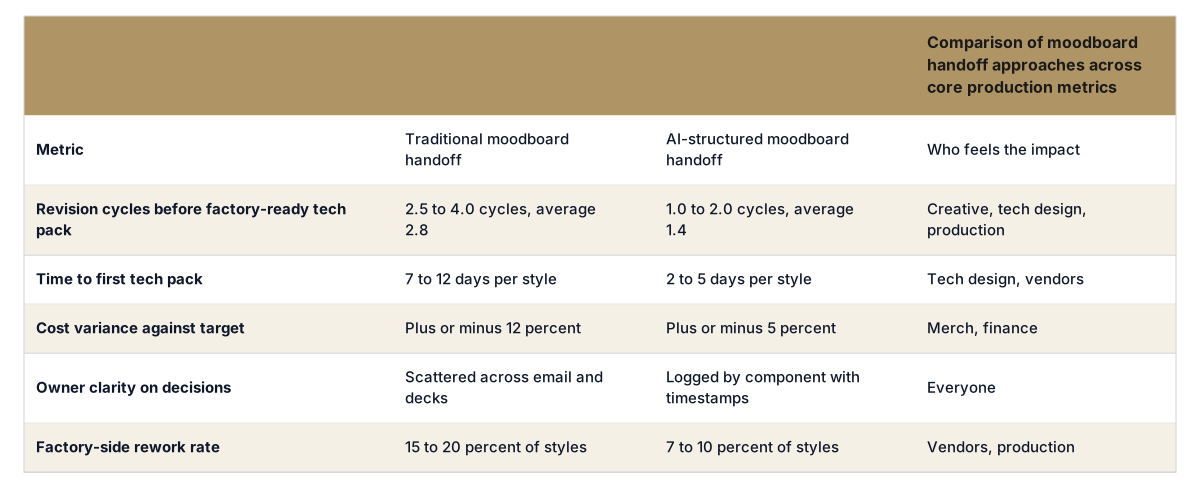
Assume a 600-SKU year across two seasons, 300 SKUs per season. Traditional handoff averages 2.8 revision cycles per style before a factory-ready tech pack, with 3.5 hours per cycle split across creative, tech design, and production. That is roughly 2.8 times 3.5, or 9.8 hours per style. At an average blended rate of 80 dollars per hour, document prep and rework sit near 784 dollars per style. With AI moodboard structuring and automated validation, many brands report 1.4 cycles at 2 hours each, or 2.8 hours per style. That is 224 dollars per style. Savings of 560 dollars per style across 300 SKUs equals 168,000 dollars per season, or 336,000 dollars per year. Time to first proto drops by about 6 calendar days when decision logs and constraints are captured up front.
If your baseline is lighter, say 2 cycles at 3 hours, the gain is smaller but still material. You would save about 208 dollars per style, or 62,400 dollars per season at 300 SKUs. If your product is complex, such as tailored outerwear, and you run 4 cycles at 4 hours, savings grow above 1,000 dollars per style. The model also trims factory-side rework. If redo rates drop from 18 percent to 9 percent of styles, and each redo costs 250 dollars in sampling and freight, that is another 6,750 dollars per 300-SKU season. Even with a 15 percent variance, the direction holds. Fewer loops, clearer specs, faster decisions.
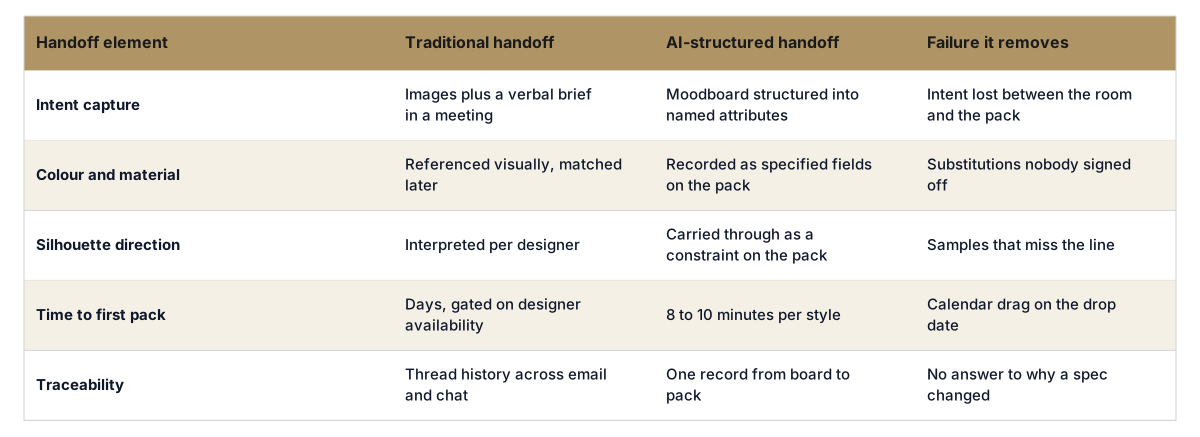
What each handoff model does with the same moodboard.
PLM stores items, calendars, and approvals. 3D tools help visualize and fit. AI moodboard structuring sits before and alongside these systems, where references and intent are turned into components, constraints, and specs. The F* Word acts as the validation and orchestration layer that outputs a structured moodboard and a validated tech pack, then links those files into PLM. You do not abandon the systems you have. You reduce the ambiguity that those systems cannot resolve.
Week 1 is library alignment, which includes trims, stitches, blocks, and vendor constraints. Week 2 is training the team on the RAILS Canvas and mapping intake fields to your line plan. By Week 3, the first 50 to 80 styles flow through intake, structuring, and validation. Creative tags references, tech design reviews proposed BOMs and measurements, and production confirms lead times and MOQs. Expect the first batch of structured moodboards and tech packs to export by the end of Week 3, ready for proto requests.
No. The F* Word does not generate images. It does not replace creative direction. It ingests the references you already chose, then applies AI moodboard structuring to map those references to components and specs, checks them against your libraries and vendor rules, and produces a validated tech pack at the same time. Your designers still create the look and feel. The platform removes guesswork and late corrections.
Factories receive a single export that ties each visual reference to a bill of materials, construction notes, graded measurements, and a decision log. That reduces back-and-forth about zipper gauge, stitch density, and wash level. Time to first proto often falls by 4 to 7 days, depending on category. Rework rates drop, since missing details like pocket bag fabric or bartack placement are addressed up front. Vendors can focus on execution instead of clarification.
Most teams cut revision cycles by 30 to 50 percent and move from 9.8 hours of prep and rework per style to under 3 hours. Expect faster tech packs, usually from 7 to 12 days down to 2 to 5 days for straightforward categories. Cost variance narrows to within 5 percent for styles with clear cost bands. The F* Word autonomous moodboard plus tech pack generation means you can export vendor-ready files earlier, which brings proto dates forward. Savings scale with SKU count and product complexity.
The F* Word takes 8 to 10 minutes from an approved board to a factory-ready tech pack with bill of materials, points of measure and construction notes. Done manually the same handoff usually runs several days of back and forth between design and pre-production.
Once the workflow is in place, these are the steps that turn it into shipped product.
Related: AI tech pack generation hub · What is a tech pack · Sketch to tech pack with AI
Get The F* Word workflow insights in your inbox.