
Language

27 percent of fashion styles that look flawless in AI mockups still fail somewhere between salesman sample and TOP, and the rework bill is not a rounding error. If you own product margin, calendar, or on-time in-full, you are already paying for AI fashion production failures that do not show up in demo decks. The trap is simple. Image-first tools optimize for concepts and clicks, while factories ship against instructions. The gap between the picture and the instruction is where money burns.
Executives usually add up factory chargebacks and remake spend. This is the visible line. The hidden line is longer. A late PP sample pushes bookings, compresses quality gates, forces air freight, and ties up working capital when a drop misses its floor set. Teams then add headcount hours to unpick issues that were never marked as risks. When you stack these events, a 2 to 3 percent hit to gross margin on a single season is common for brands that adopted image-led AI without a production control layer.
The F* Word audits show three repeating causes for AI fashion production failures. First, mockups are treated as design truth without structured validation of measurements, materials, and construction. Second, teams run 3D or image systems as if they were PLM, then try to bolt on BOMs late. Third, factories receive incomplete or ambiguous make instructions, then fill gaps with local assumptions. Each of these adds noise to approvals, and each can be removed with a validation and orchestration layer.
Call this out clearly for stakeholders. AI is not the culprit. The failure is adopting AI outputs that look finished but are not production-ready. You need a system that validates and packages the work into a tech pack that a sewing line can run without guesswork. The F* Word is that validation layer. It is not PLM, a 3D simulator, or an image generator. It turns design intent into factory-ready instructions, then tracks the handoff.
The most popular framing of AI fashion is prompt to picture. Enter vibe, get looks, post the sizzle. This is useful for creativity and speed, but pictures are not garments. Factories stitch against measurements, tolerances, BOM lines, and make sequences. When AI gives you a high-res fantasy that lacks spec depth, the first place you feel it is pre-production, not the mood board.
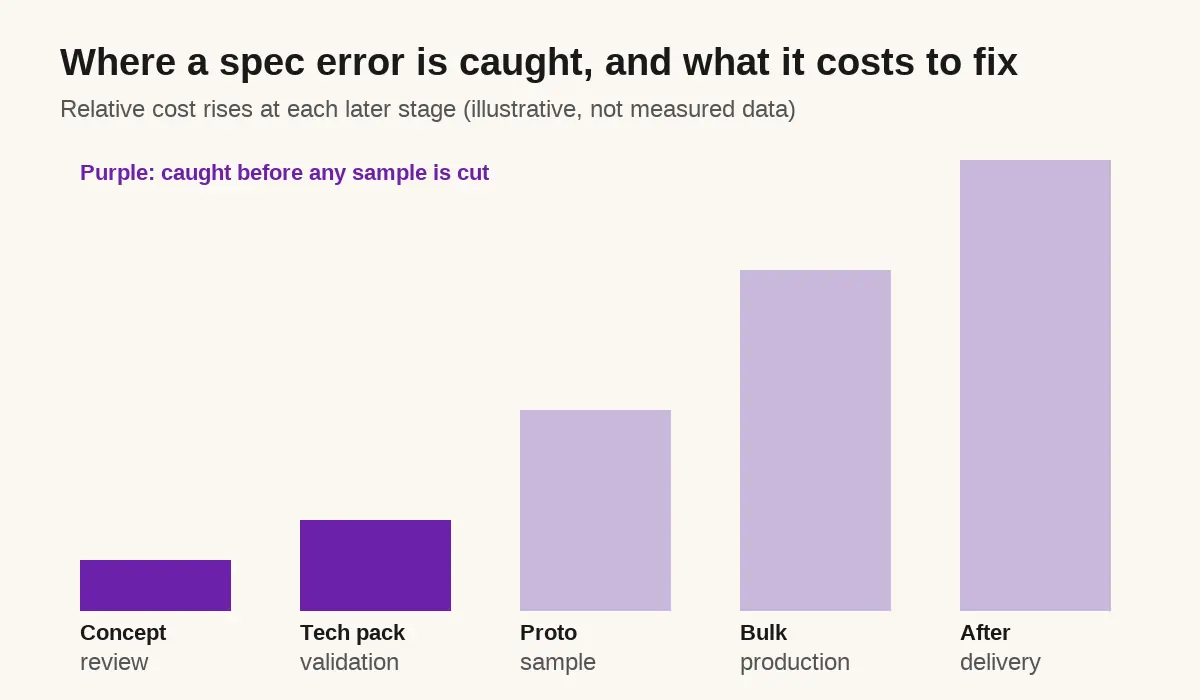
Common issues flood in after line adoption of image-first tools. Sourcing gets vendor questions that design cannot answer without guesswork. BOM items are named but not specified to a repeatable standard, like zipper types, teeth, sliders, pullers, and tape width. Pattern teams do not get grade rules or key tolerances, so fit drifts between SMU and core bodies. Prints arrive without color standards or approved separations, so wash houses and printers propose equivalents that do not match photography. Packaging and labeling are handled last, so cartons fail retailer routing or UCC-128 requirements. These misses are not glamorous, yet they are exactly what sinks margin.
3D-only stacks have a more technical wrapper, but they can create the same hole if the 3D file is not connected to a verified instruction set. If the CLO or Browzwear output lives in a folder and BOM decisions live in email, you still have gaps. The wrong reading here is to strip AI out. The right move is to use AI where it adds speed, then enforce a validation step that assembles a complete, factory-ready pack.
For this reason, The F* Word exists as a validation and orchestration layer. It links creative direction to production truth, generates an intelligent tech pack in 8 to 10 minutes from a garment design, includes BOM and construction notes, and creates moodboards as the upstream half of the same workflow. The system does not compete with your stack because it is not PLM, a 3D simulator, or an image generator. It sits in the middle to remove rework and uncertainty.
Here is a comparison of outputs and risks between common AI design approaches.

Consider the development of a men's selvedge denim jacket. In an image-first workflow, a designer uses an AI tool to generate a striking photo of a jacket with a vintage wash and unique pocket stitching. The image is approved. A technical designer receives the image and a basic sketch. They create a tech pack by guessing. They specify "14oz selvedge denim" but not the supplier or exact weave.
They note "contrast stitching" but not the thread ticket (Tkt) or color standard. The packet goes to the factory. The first sample arrives with the wrong shade of gold thread, a flat wash with no character, and pocket placements that look awkward on larger sizes because they were not graded. Three sample rounds and two months later, the jacket is finally approved, but it has missed its delivery window, forcing air freight and eroding 70 percent of its planned margin.
Now, consider the validated workflow. The designer generates the same AI image. They bring the image into The F* Word and link it to their brand's core trucker jacket block. The system's validation engine immediately flags missing information. It prompts the designer to select a specific selvedge denim from the material library. It requires a thread ticket, SPI, and Pantone color for the stitching.
It asks for the grade rule to apply to the pocket placement. The designer makes these choices from pre-approved libraries in minutes. Ten minutes after starting, The F* Word generates a complete, unambiguous tech pack. The factory receives it and builds the first sample correctly. It gets approved with minor comments, protecting the margin and the calendar.
Production readiness begins with a verifiable tech pack. That pack must define a bill of materials down to item codes, finishes, placements, and approved vendors. It must list points of measure with target, tolerance, grade increments, and how to measure. It must document construction by operation with stitch types, seam allowances, SPI, fusing, reinforcement, and finishing. It must include print and embroidery files with separations, placements to center front or graded landmarks, and Pantone or spectral targets.
Packaging and labeling must be in-spec for each customer, with carton, poly, hanger, label copy, care code, and barcode rules. QA needs sampling plans and acceptance thresholds. When any of this is vague or missing, you get delays and defects. When it is complete and clear, your vendor makes you look good.
Many teams think their PLM is the answer. A PLM is the system of record, not the spec author and validator. Others expect their 3D simulator to carry the whole burden. 3D captures style and fit intent, yet it rarely specifies carton strength or SPI. Image generators are not designed to output stitching operations. You still need a layer that assembles and verifies the entire instruction set, then publishes it to the factory without drift.
This is the gap The F* Word fills. It generates a factory-ready tech pack in 8 to 10 minutes from a garment design, including BOM and construction notes. It also generates moodboards upstream so that creative direction feeds production reality in one workflow. See how this connects to your calendar in our overview at The F* Word AI Fashion Design overview.
Below are six high-frequency production failures seen after brands adopted image-first AI. Each shows direct and hidden costs, why AI missed the issue, and how a validation layer prevents the repeat.
Case studies of AI fashion production failures, costs, and prevention
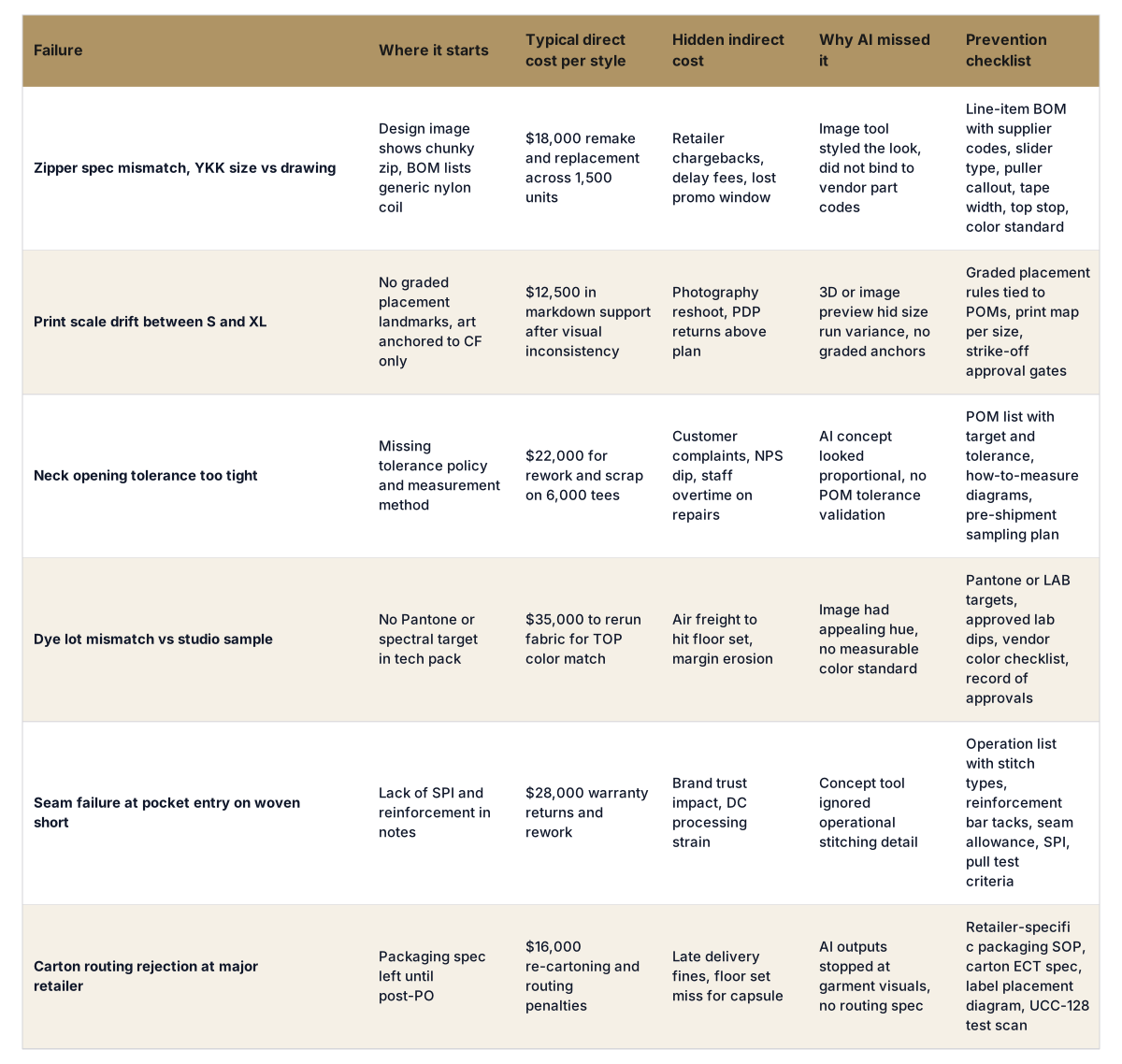
These are not exotic edge cases. They are week-to-week frustrations in many categories. The common signature: an attractive concept flowed into production without a complete instruction set. The fix is not to slow down concepting. The fix is to enforce validation, write the instructions, and then let the factory execute with fewer clarifications and fewer approvals. The F* Word is built to do this at the speed your calendar requires. If you want to see how the pre-production gate tightens in practice, review our pre-production workflow guide.
Adopting a validation layer does not require months of configuration. The process is straightforward and focuses on turning creative assets into executable instructions quickly. Here is how your team can generate its first production-ready pack.
The personas here hold different levers. Product and sourcing leaders see risk from vendors and delivery promises. Designers and creative directors shield aesthetic intent. Merchandisers need SKU-level confidence that the line hits floors and revenue buckets on time. The decision framework below connects these needs while reducing AI fashion production failures.
Use this lens when a new AI demo lands in your inbox. Speed without validation moves problems forward on the calendar. Speed with validation cleans the calendar and raises trust with vendors and retailers. Your team deserves the second outcome.
Adopt in a phased way that protects peak weeks. Pick 12 to 18 SKUs in two categories where current rework is measurable, then run a side-by-side pilot with a control group. Keep the current process for half the SKUs. For the rest, move from moodboard to factory-ready pack using The F* Word as the validation layer. The platform creates moodboards upstream to capture creative direction, then generates an intelligent, factory-ready tech pack in 8 to 10 minutes from your garment design. The pack includes BOM, construction notes, graded specs, and packaging. This system is not PLM, a 3D simulator, or an image generator. It is the layer that validates and orchestrates the work between design, sourcing, vendors, and QA.
Connect the pilot to measurable outcomes. Instrument a small set of KPIs: vendor clarifications per style, PP and TOP approval cycles, remake count, penalty dollars, and air freight events. If your organization runs 3D, feed the same 3D assets into The F* Word to generate validated packs and compare outcomes to the old flow where BOM and tolerances were manual. If you do not run 3D, route Illustrator flats or pattern data into the same validation. Either way, the output is a pack your factory can run without guessing SPI or carton requirements.
Train for consistency. Teach designers to think in landmarks for art placement, to reference vendor codes in BOM selects, and to flag exceptions where they need human review. Train sourcing to read the validation checklist rather than chase emails. Engage two partner factories early. Share a sample pack and ask for line manager feedback on clarity and missing fields. Close that loop before peak season.
Plan your systems handoff. Keep PLM as the system of record and POs. Keep 3D for visualization and fit exploration. Use The F* Word to generate and validate the pack, then push a PDF and structured data back into PLM. Vendors work from the validated pack, and your governance team tracks approvals. This division of labor is the difference between speed with control and speed with churn.
Scale intentionally after you see the reduction in rework. Go from 12 SKUs to 60. Add categories where BOM complexity is high or retailer routing is strict. Keep reporting on the same KPIs. When chargebacks and approvals chop in half, you do not need to sell the program. The numbers will do it for you.
The biggest driver is treating images or 3D renders as if they were finished instructions. Factories ship against detailed specs, not screenshots. When BOM lines, tolerances, and operations are missing, vendors fill gaps with local assumptions and you pay for the mismatch.
No. Keep PLM as the system of record and purchasing. Keep 3D for visualization and early fit. Add a validation and orchestration layer that turns design intent into a factory-ready tech pack with BOM and construction notes. The F* Word fits that role and does not replace PLM or 3D.
From a garment design, The F* Word generates a factory-ready tech pack in 8 to 10 minutes. It includes graded specs, BOM with vendor-level detail, construction operations, and packaging rules. That speed only matters because the pack is complete and ready for vendor handoff.
Yes. The same workflow starts with moodboards that capture aesthetic direction and constraints, then flows into validated instructions. The value is that your upstream choices are tied to downstream specs, so you avoid surprises when pre-production starts.
Integration is designed to be lightweight. The F* Word can push a final, approved tech pack (as a PDF) and its structured data (like BOM and POMs in XLSX or JSON format) into your PLM as files. Your PLM remains the system of record for costing and purchase orders.
Training is minimal because the interface is built for designers and product developers. Onboarding focuses on configuring your libraries (materials, blocks, rules), which takes a few hours. User training is typically one or two short sessions. The system guides users through the validation process, reducing the learning curve.
Yes. The validation engine is rules-based and built to handle complexity. It works well for categories like outerwear, denim, swimwear, and intimates that have detailed BOMs, specific construction needs, or demanding performance standards. The system simply prompts for the required details based on the product type.
Your data is yours alone. We operate in a secure, single-tenant cloud environment. Your design assets, material libraries, and tech packs are your intellectual property and are never used to train any general AI models or shared with other customers. We provide full security documentation for your IT team's review.
Start free at thefword.ai or book a demo.
Related: ai sketch to image fashion
Get The F* Word workflow insights in your inbox.