
Language

8 to 10 minutes is now a realistic target to turn a finished garment design into a factory-quotable file. That time delta is not a glossy claim. It is what cuts weeks of email, versioning, and sampling out of the calendar and gets you to a number a vendor will actually commit to.

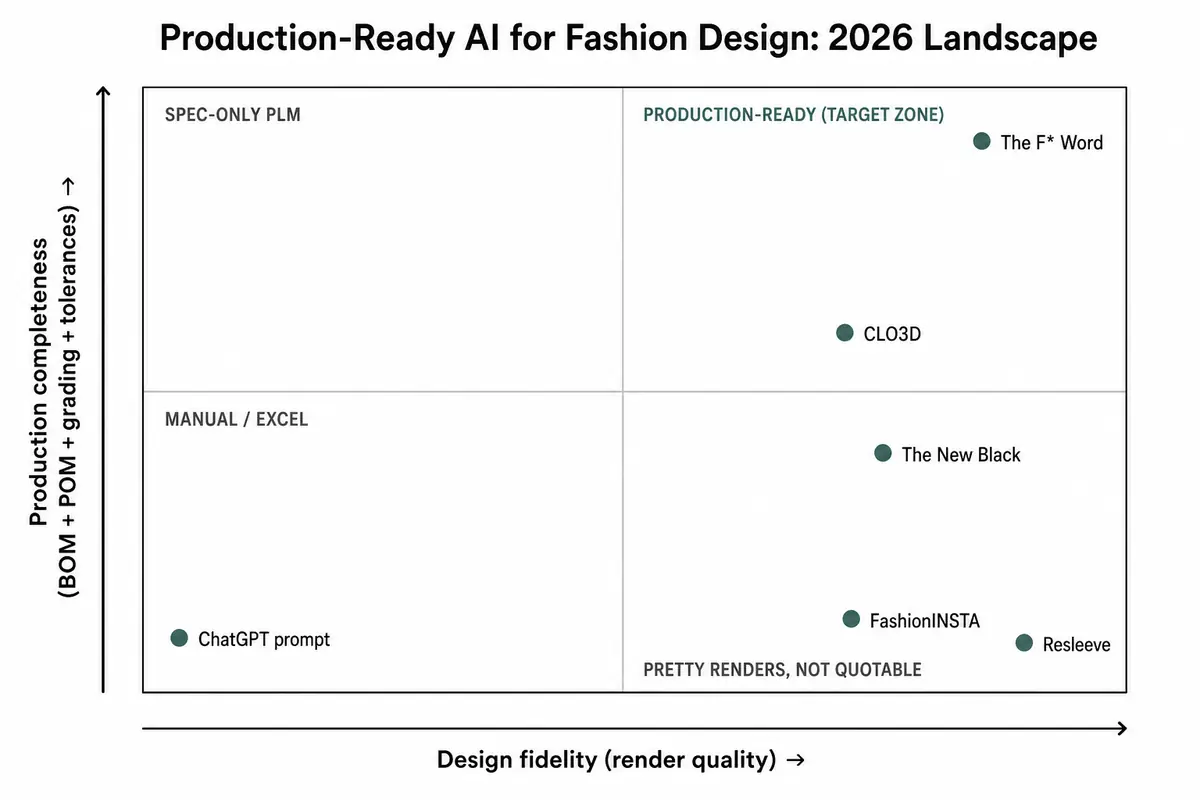
Production-ready means the upper-right quadrant: high design fidelity plus complete BOM, POM, grading, and tolerances. Most tools cluster in pretty-renders or spec-only zones.
McKinsey State of Fashion 2026: 73 percent of fashion executives plan to increase AI investment in product development this year. Business of Fashion: average tech-pack revision cycle still runs 4 to 6 weeks at mid-market brands. The F* Word internal usage: factory-ready tech pack in 8 to 10 minutes from a single garment design, including BOM and construction notes.
If you are a VP of Product Development, Director of Sourcing, Creative Director, or a Merchandiser, you already know a factory does not quote a pattern. A factory quotes a tech pack with every BOM line codified, every POM tolerance defined, the size run graded, and the construction notes a sewer can follow. The recent wave of production ready AI fashion design software confuses output style with output spec. Pretty pictures are not purchase orders.
Our take: The F* Word is a validation and orchestration layer that turns whatever design tool a brand uses into a factory-accepted file in minutes. It is NOT a pattern-making tool, NOT a 3D simulator, and NOT an image generator. It ingests your design, validates it against your standards, fills the gaps with your approved materials and grade rules, and outputs what vendors ask for. This is how AI moves from inspiration to inspection without breaking your workflow.
Most roundups frame production ready as a spicy render plus a pattern. This is only a slice of the work. Sourcing teams need supplier-grade material codes that map to a negotiated trim card. Technical design needs POMs with tolerances matched to brand fit and inspection methods. Merchandisers need graded size ranges that roll up to line plans. Vendors need construction notes that cue order of operations, stitch types, SPI, seam allowances, interlining, and attachment points. QA needs pass or fail thresholds ready for AQL sampling.
When tools stop at a pattern, you hand your teams a half-built car. They still have to spec every seam, chase every material code, define every tolerance, and redraw graded nests. This is where 4 to 6 weeks of revision cycles burn. The aim of AI in 2026 is not a prettier render. It is a complete, vendor-ready tech pack that shortens the calendar, lowers error rates, and matches cross-functional accountability.
FashionINSTA's roundup treats image quality as a proxy for producibility. Teams can find a gap between a generated look and a spec that a factory can price, cut, sew, wash, trim, pack, and pass through inspection. That gap is filled by BOM, POM, grading, tolerances, construction, and QA instructions. Leave any one of those fuzzy and you will pay for it in rework or claims.
FashionINSTA labels image-generation and pattern-drafting tools as "production-ready" without ever showing a BOM line, a POM tolerance, or a graded nest. A factory in Tirupur, Dhaka, or Guangzhou will not quote off a pretty render. The output that gets quoted is a tech pack with material codes a sourcing team has already approved.
Patterns matter. 3D matters. But quoting and cutting require the complete data story. This is what buyers sign, vendors follow, and QA inspects. Anything less is a sampling exercise, not a production file.
If you are evaluating production ready AI fashion design software, look past screenshots. Ask to see the BOM with supplier codes, the POM with tolerances, the graded nest, and the operation sheet. Ask how long it takes to go from a design to a factory-quotable export. Here is the checklist view.
What 'production-ready' actually requires for an AI fashion design output
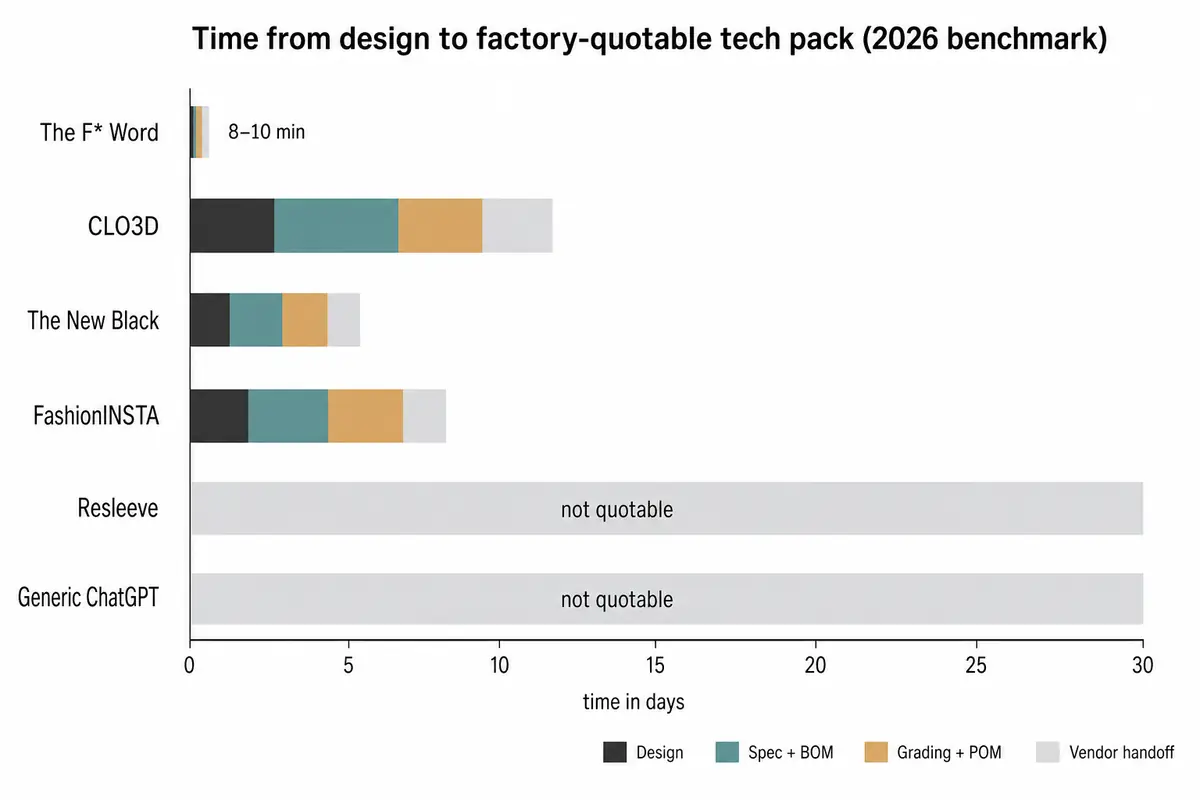
Time from design to factory-quotable tech pack throughout the 2026 market. Bars sized in days. The F* Word completes the same workflow in 8 to 10 minutes.

Production-ready means the file contains the instructions and standards that govern how a line will be made and inspected. Here is the minimum your factory and QA teams expect, regardless of silhouette or channel.
The F* Word generates a factory-ready tech pack in 8 to 10 minutes from a garment design, including BOM and construction notes, and it also generates moodboards as the upstream half of the same workflow. The F* Word is NOT a PLM, 3D sim, or image generator. It is the validation and orchestration layer that ensures whatever design input you prefer results in a file vendors accept. This is how you reduce the 4 to 6 weeks revision cycle to a first-pass quotable spec without locking your team into one design system.
If you want a primer on how orchestration meets upstream ideation, read our overview of AI fashion design workflows at thefword.ai/ai-fashion-design-overview. For pre-production control points that catch errors before sampling, see our pre-production workflow guide.
AI should answer a business question. For VPs of Product Development and Directors of Sourcing, the question is how many weeks and how many rounds you can eliminate while raising first-sample hit rate. Use this test to evaluate production ready AI fashion design software and to match cross-functional teams before you sign.
Designers care about fidelity and intent. Merchandisers care about size runs, cost ranges, and calendar certainty. Sourcing cares about supplier codes and clear pass or fail criteria. Any tool that cannot show those three audiences their personal success metric is not production-ready.
Start with one hero style that represents your volume body. Pick two vendors you trust. Run the style through orchestration, then price and sample from both vendors using the same export. Measure time saved to quote, the number of redlines, and first-sample hit rate. This gives you a baseline ROI you can defend at line review.
Orchestration should not force a redesign of your stack. Keep your PLM and 3D as they are. Let the orchestration layer validate, complete, and package the spec. If you want to see how these steps line up throughout creative direction through launch, read our AI fashion workflow software overview and our merchandising and launch walkthrough.
For teams that begin with inspiration, The F* Word also generates moodboards as the upstream half of the same workflow. That means a creative director can push an approved moodboard into a design run and then into a validated tech pack without rekeying materials or measurements. The intent travels with the spec, which is where error-proofing starts.
See the workflow at thefword.ai/ai-tech-packs-intelligent or book a demo.
Factory-ready means a vendor can quote, cut, sew, trim, pack, and pass inspection using only the file you provided. That includes a supplier-coded BOM, a POM with tolerances, graded sizes with nests, and operation-level construction notes. A pattern alone does not encode tolerances, sourcing approvals, or QA criteria. Vendors price risk, so missing data becomes cost and time.
Yes. The F* Word is not a PLM or a 3D simulator. It is a validation and orchestration layer that sits between your design tools and your vendor handoff. You keep your stack and add a faster way to get to a quotable, inspection-ready spec.
Automation standardizes the data vendors use to build and inspect. With supplier SKUs in the BOM and tolerances tied to POM, the first proto matches closer to brand fit and sourcing expectations. That raises first-sample hit rate and cuts back-and-forth about what counts as pass or fail. The result is fewer iterations before cost lock.
Onboarding requires your trim cards with vendor SKUs, grade rules, measurement methods, and category tolerances. Most teams stand up a pilot in two working days and run a first live style in under a week. After that, the cycle time from design to factory-quotable export is 8 to 10 minutes per style. Governance and versioning ride along so audits are clean.
Related: pom grading ai tech packs · Read the related guide · Try The F* Word · AI grading rules without a pattern maker
Get The F* Word workflow insights in your inbox.