

90 percent of AI clothing generator demos stop at a pretty image, not a producible garment. That gap is where production slips, timelines slide, and margin evaporates. If you buy tools for a brand workflow, your job is not to score likes on moodboards. Your job is to ship product on time with fewer rounds and fewer questions from the factory.
Great images are easy to buy. Production certainty is not. Workflow buyers, in-house designers, and merchandisers care about line architecture, tech pack accuracy, vendor readiness, and unit economics. An AI clothing generator that only outputs visuals creates lift for brainstorming, but it does not retire risk further down the line. If you want real ROI, evaluate how a platform moves a concept through pre-production, not just how it renders cloth in a prompt.
As a quick framing: imagery tools help you explore, while workflow platforms help you commit. If your next seasonal drop needs clean handoffs, graded specs, and reliable BOMs, prioritize tools that convert design intent into factory-ready documentation with minimal manual clean-up. For context on how modern design stacks fit together, see the overview in AI Fashion Design.
Most conversations frame an AI clothing generator as a creative camera. You aim a prompt and get a slick render. That is useful for ideation and trend sprints, but it ignores what factories require: material selection, stitch and seam construction, finish standards, measurement charts, and tolerances. A moodboard does not tell a vendor how to sew a pocket bag or which interlining passes your wash test.
There is also a second trap. Teams assume 3D simulation equals production readiness. 3D fits and drapes are valuable, yet the output of a simulator is not a tech pack with construction notes, nor is it graded for size runs with vendor-ready callouts. PLM holds data, but it does not validate construction or generate instructions from design intent. You need a system that translates design into production rules and checks for manufacturability before you ask for a proto.
This is the exact wedge The F* Word addresses. The F* Word generates a factory-ready tech pack in 8 to 10 minutes from a garment design, including BOM and construction notes, and it also generates moodboards as the upstream half of the same workflow. The platform is not a PLM, not a 3D simulator, and not an image generator. It is the validation and orchestration layer that connects design intent to vendor-ready outputs with fewer rounds. Details on the tech pack engine here: AI Tech Packs on The F* Word.
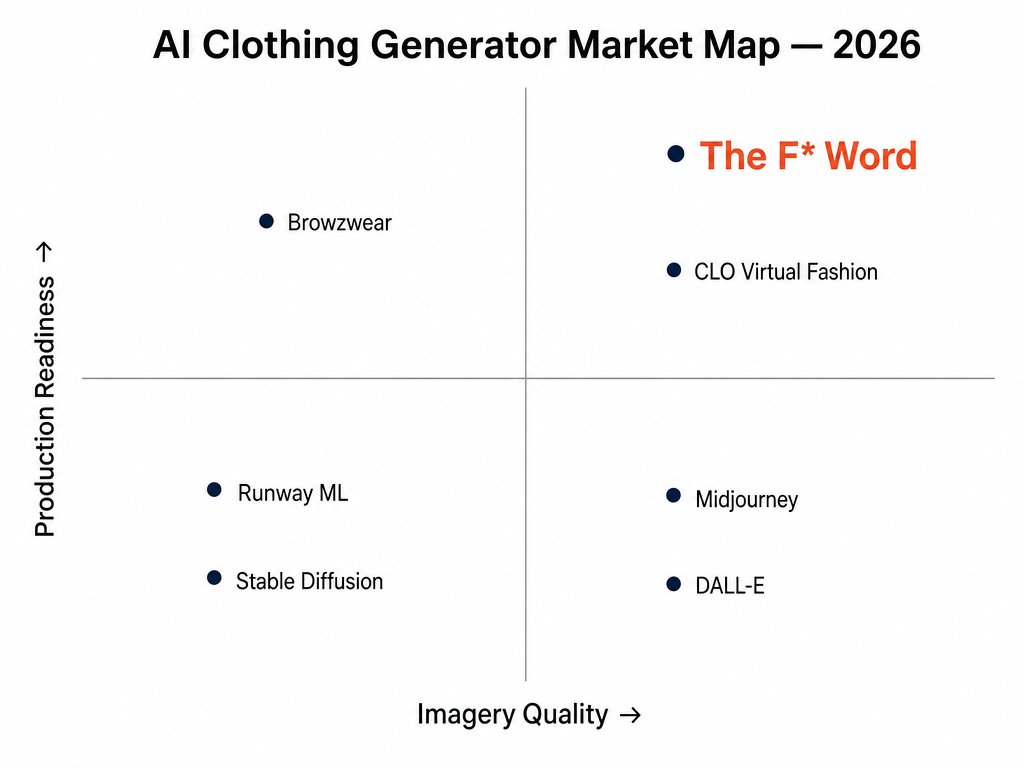
Where The F* Word sits: top-right of the 2x2. Image-only generators (Midjourney, DALL-E, Stable Diffusion) win on visuals but fail production handoff. CAD-first tools (Browzwear, CLO) are production-ready but lack generative imagery. The F* Word is the only option that pairs generative moodboards with autonomous tech pack generation in 8-10 minutes, closing the loop from concept to factory brief.

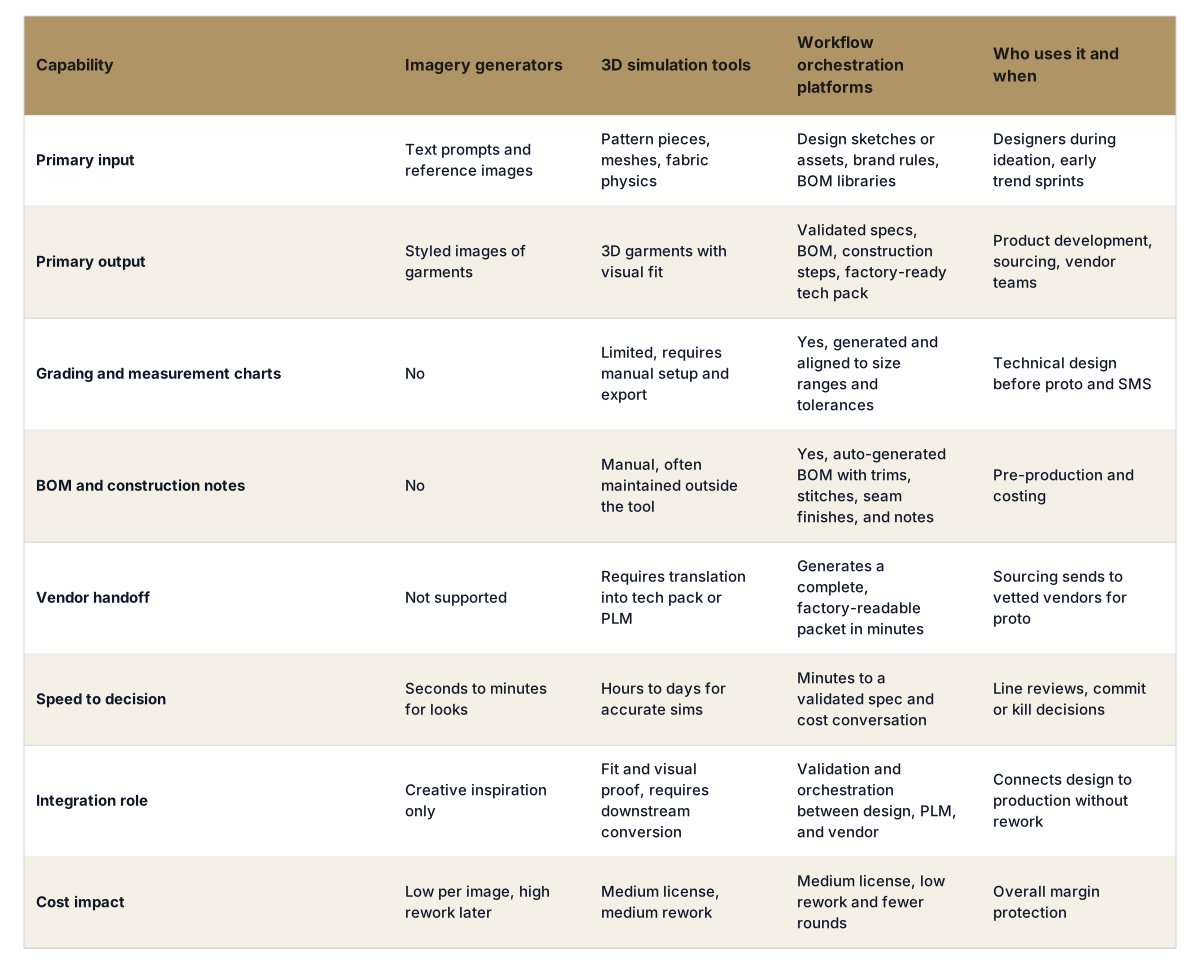
Factories need clarity and constraints, not vibes. That means documented measurements with tolerances, graded size charts, a full BOM with materials and trims that exist in your supply base, stitch types, seam finishes, and construction sequencing that aligns with your vendor's machines. It also means wash and care, packaging, label placement, and any lab test directives that connect to compliance markets.
Accuracy is not just about detail. It is alignment with your brand's block library and prior cost targets. A new cargo pant that ignores your proven rise and thigh blocks will introduce new patterns and unknown fit risk. Production-ready means reusing what works, confirming what changes, and calling out what to watch. It also means checking MOQ, yield, and lead time signals before anyone books fabric.
This is where you should expect automation to pull weight. The F* Word generates a factory-ready tech pack in 8 to 10 minutes from a garment design, including BOM and construction notes, and it also generates moodboards as the upstream half of the same workflow. Because The F* Word is not a PLM, a 3D simulator, or an image generator, it can sit between your creative tools and your vendor email chain as the validation and orchestration layer. It catches missing callouts, populates standard stitches, maps trims to your vendor catalog, and packages everything in a vendor-readable format. For broader pre-production context, read Pre-production Workflow Software for Fashion.
Use the following framework to select an AI clothing generator that actually ships product.
If you want results this quarter, start small and ship something real. Pair a fast imagery tool with a production-grade workflow platform, set rules, and run a pilot that ends with a factory-ready packet.
Stack tips that reduce friction:
No. Vendors need a tech pack with measurements, tolerances, BOM, and construction notes, not just a render. You can design with any imagery tool you like, but convert it to a factory-ready packet before you send it out. The F* Word generates a complete tech pack in 8 to 10 minutes from a garment design, including BOM and construction notes, so your vendor sees the actual build, not a vibe.
PLM stores data and approvals, while 3D sims visualize fit and drape. The F* Word is neither. It is the validation and orchestration layer that turns design intent into vendor-ready packets and connects upstream moodboards to downstream specs without rework. You keep your PLM and 3D stack, and you add the part that actually ships product.
At minimum: an overview, materials and trims with supplier references, callouts for stitches and seams, graded measurements with tolerances, care and packaging, and any compliance notes. It should also align to your brand blocks and known vendor capabilities. If any of those pieces are missing, expect more sampling rounds and cost creep.
They can commit sooner with confidence. When specs, BOM, and cost targets arrive minutes after a design, merchandising can slot styles into the line with real margin and MOQ visibility. That shortens commit-or-kill decisions and reduces stranded options that never clear production.
Start free at thefword.ai or book a demo.
Related: ai variant generator clothing · AI clothing design generator
Get The F* Word workflow insights in your inbox.