

Most pricing pages for AI fashion design software show one number. The real total cost of ownership for a brand running 6 to 40 styles a month is 2x to 4x that number once you add onboarding, sampling rework, integration, and the headcount needed to babysit generic AI output. This teardown walks through 12 vendor categories, what they actually charge, and where the hidden line items show up in year one.

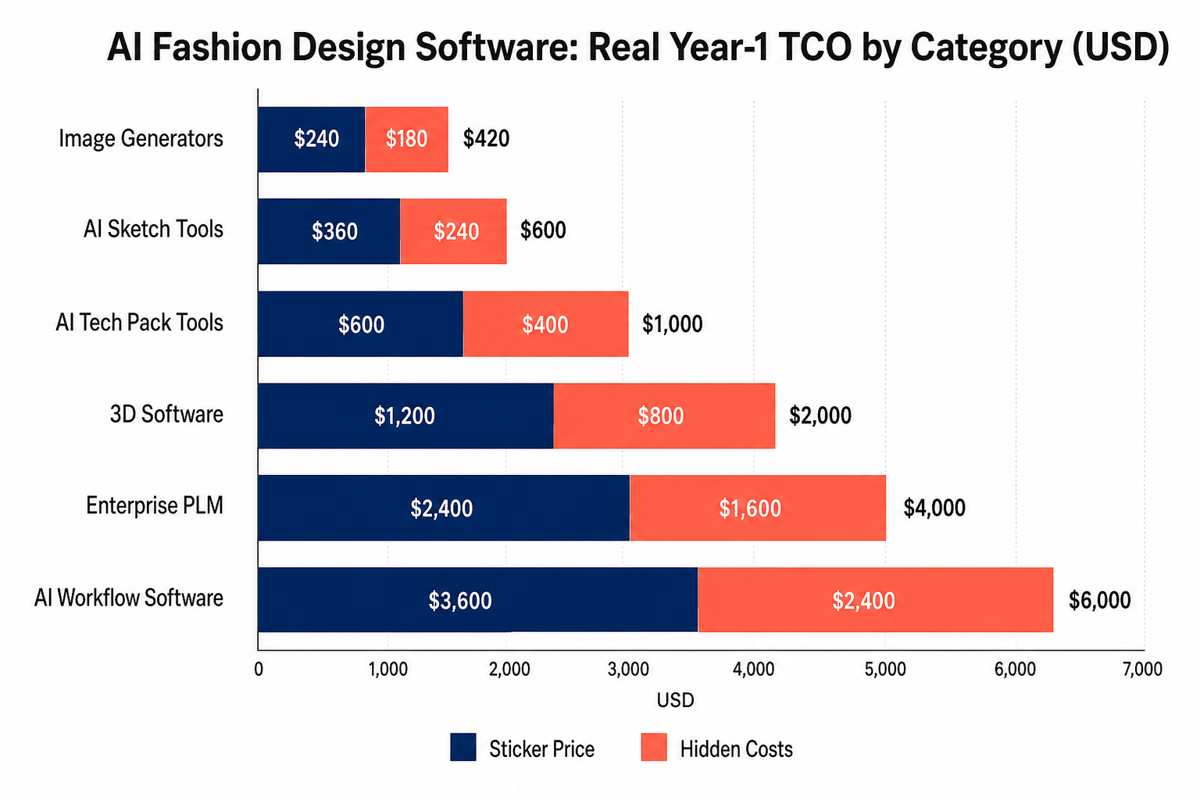
Every AI fashion design tool quotes the seat or workspace fee. That number is almost never what the brand actually pays. Four other layers stack on top, and they tend to be invisible until the second quarter of use.
Below is what brands actually pay in year one, including the four hidden layers. Ranges show a typical 8 to 25 person brand running 12 to 30 styles a month.
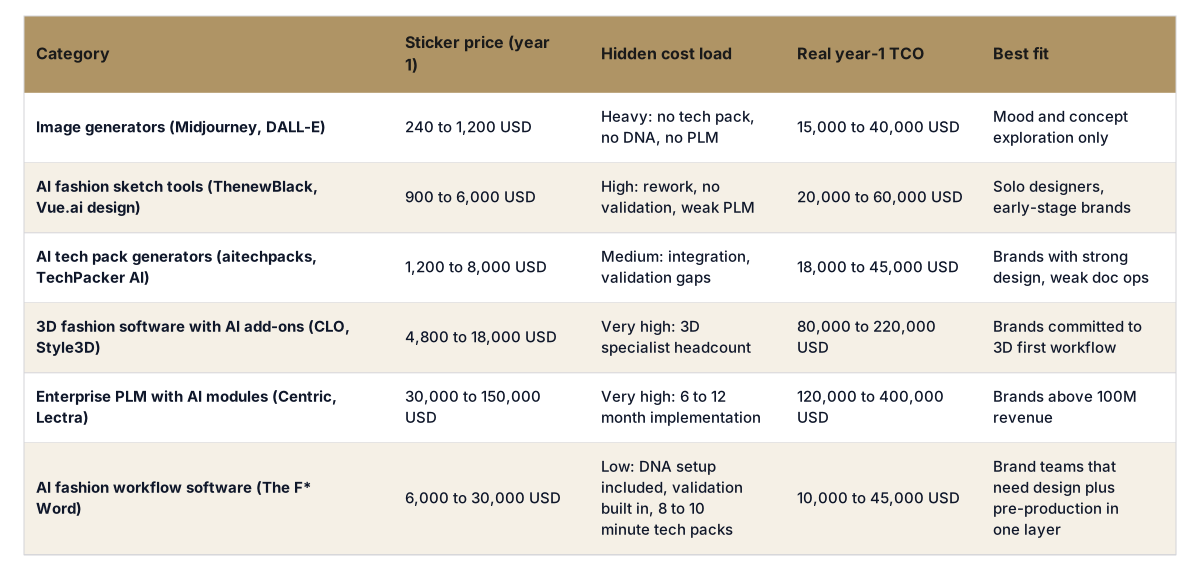
The pattern is consistent. Tools that only generate something (an image, a sketch, a doc) push validation and integration cost onto the brand. Tools that orchestrate the whole sketch-to-handoff path absorb most of the hidden cost into the workspace itself.
Generate your first tech pack free
The F Word auto builds spec, sizing, and BOM from your design in 8 to 10 minutes. No template wrangling, no factory back and forth.
The cost story changes sharply based on how many styles the brand ships per month. The same vendor can be a bargain at one volume and a money loser at another.
Image generators plus a freelance technical designer is usually the cheapest path, around 8,000 to 18,000 USD year one. Enterprise tools are over-built.
This is where workflow software wins on every dimension. The brand is shipping enough volume that hidden costs of generation-only tools compound fast, but not enough to justify a 9-month PLM rollout.
Workflow software plus a lightweight PLM is the dominant pattern. The brand needs orchestration and a system of record, but full enterprise PLM still drags more than it adds.
Enterprise PLM enters the picture, and the question becomes which AI layer sits in front of it. The F* Word and similar workflow tools serve as the validation and pre-production layer that PLM was never good at.
Sticker quote from a popular AI sketch tool: 4,200 USD/year. Real year-one cost after onboarding, 1.6 extra samples per style, and PDF-to-PLM re-entry: roughly 38,000 USD. Same brand on a workflow tool with built-in validation: roughly 22,000 USD all in, with sample rework down to 0.4 per style.
Enterprise PLM quote: 92,000 USD year one. Workflow software plus the brand's existing PLM: 28,000 USD year one with faster time to factory and no implementation drag.
Free image generator plus a freelance technical designer at 220 USD per pack: 16,000 USD year one. The cheapest path at this volume, and the right choice until volume crosses 10 styles a month.
Three questions reframe most vendor pitches in under 10 minutes.
The F* Word is positioned as the validation and orchestration layer between design intent and factory handoff. The brand uploads its DNA once, and the system produces a tech pack in 8 to 10 minutes from a garment design, plus on-brand moodboards. The pricing range for a brand team is 6,000 to 30,000 USD year one, and the hidden cost load stays low because brand DNA, validation, and PLM handoff are inside the workspace rather than bolted on. For brands in the 12 to 40 styles a month range, year-one TCO often lands below what an image generator plus rework actually costs.
Most cost overruns show up in the first quarter of a rollout, long before the annual renewal. Put a checkpoint on the calendar at day 90 and pull four numbers: seats actually logged in during the last 30 days, tech packs or moodboards produced per active seat, hours your team still spends re-keying data between tools, and the count of factory questions per style. Those four numbers turn a licence line into a cost per output, which is the only figure a CFO can compare throughout vendors.
Two patterns repeat. The first is seat drift, where a brand buys 25 licences, activates 9, and pays for the rest all year. The fix is a quarterly true-down clause negotiated before signature, not after. The second is silent services creep, where onboarding hours billed at 180 to 250 dollars per hour keep landing after go-live because the data model was never agreed. Cap implementation hours in the contract and require a written data mapping before the first invoice.
If cost per finished tech pack is above 60 dollars at day 90, the problem is usually adoption, not price. Fix the workflow before you renegotiate the licence.
Sticker prices range from 20 USD per month for image generators to 12,500 USD per month for enterprise PLM with AI modules. Real cost per month for a brand shipping 12 to 40 styles lands between 850 and 3,800 USD per month including hidden costs.
For brands under 12 styles a month, dedicated AI tech pack generators in the 1,200 to 8,000 USD year-one range are cheapest. Above that volume, workflow software is cheaper on a per-style basis because validation and PLM handoff are built in.
Enterprise PLM prices include 6 to 12 months of implementation, training, and customization. The AI module is a small line item. For brands under 100M revenue, the implementation overhead usually outweighs the orchestration benefit.
Most brand teams recover the cost in 4 to 9 months through reduced sampling rounds and designer time saved. Tools with built-in validation recover faster because sampling savings start in month one.
The F* Word runs a free cost teardown call: bring your current vendor quote and a typical style count, and you walk out with a year-one TCO comparison against your existing setup. Book a 30-minute teardown.
Related: AI fashion design software for brand teams · Explore the related workflow · Read the related guide · Try The F* Word
Get The F* Word workflow insights in your inbox.