
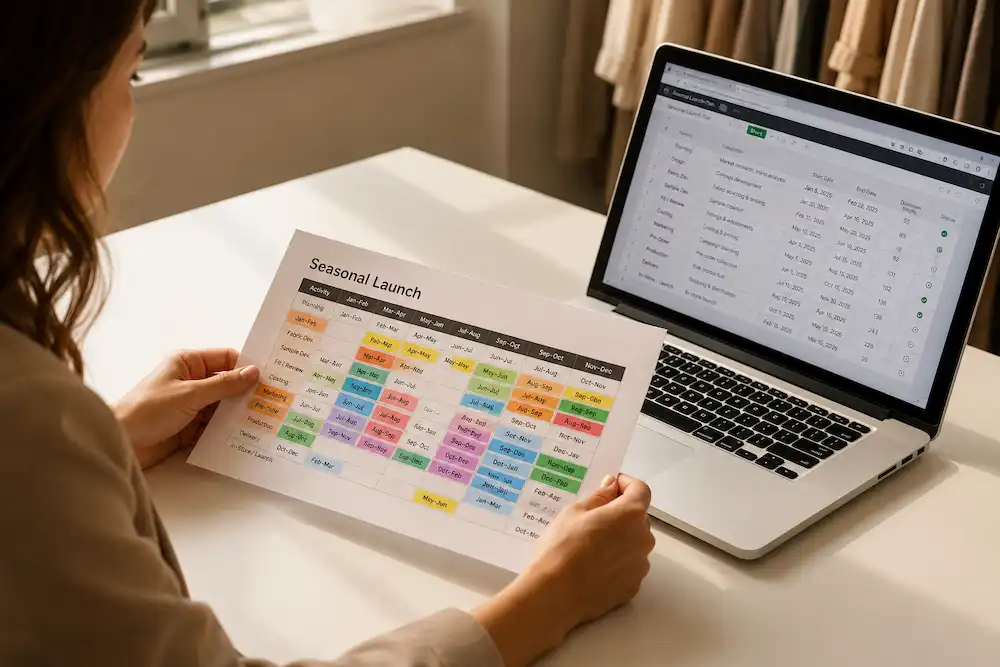
TL;DR. Hitting merchandiser launch dates requires compressing the pre-production timeline, a task AI excels at by automating tech pack creation. Instead of weeks of manual data entry and cross-functional churn, AI platforms ingest creative inputs like a moodboard or sketch and generate a complete, factory-ready tech pack in minutes. This includes a full Bill of Materials (BOM), construction details, points of measure (POM), and grading specs. By eliminating the primary bottleneck between creative concept and technical design, AI gives merchandisers new control over their calendars, drastically reducing the risk of delays and ensuring on-time collection drops with greater accuracy and less manual effort.
Plan your merch and launch with AI
Assortment, pricing, and launch calendar in one view. See what to ship, when, and at what margin before the sample lands.
For any merchandiser, the launch calendar is the source of truth and, often, the source of immense pressure. The entire go-to-market strategy hinges on hitting specific drop dates, yet the process is notoriously fragile. The root cause is rarely a single catastrophic failure; instead, it is a death by a thousand paper cuts originating in the pre-production workflow. A single missing trim detail, an ambiguous construction callout, or a spreadsheet data-entry error can trigger a chain reaction of delays. The traditional workflow is a sequence of dependent steps, and a delay at the start has a compounding effect downstream.
The handoff from creative direction to product development is the most common point of failure. A creative director's vision, captured in moodboards and sketches, must be painstakingly translated into the technical language of a tech pack. This manual translation by a technical designer is slow, subjective, and prone to error. The process involves endless email chains, Slack messages, and meetings to clarify intent. While this happens, the clock is ticking. This communication gap means the first tech pack sent to the factory is often incomplete or inaccurate, leading to bad first samples and initiating costly, time-consuming sample rounds.
Every extra sample round pushes the production start date back. A two-week delay in tech pack finalization can easily become a four-week delay in ex-factory date, putting seasonal inventory and marketing campaigns at risk. Merchandisers are left scrambling, forced to either expedite shipping at a huge cost or accept a late launch, which can mean missing a key selling window entirely. The fundamental problem is a lack of speed, accuracy, and orchestration at the very beginning of the product lifecycle.
AI tech packs directly address the foundational issues of speed and accuracy that plague traditional product development. An AI-generated tech pack is not a simple template fill. It is a complete, structured, and factory-ready production artifact created autonomously from unstructured creative inputs. An advanced AI workflow platform can analyze a single reference image, a designer's sketch, or even an entire moodboard and generate all necessary technical components. This process sidesteps the manual translation work that bogs down technical designers and introduces errors.
The system intelligently identifies garment type, construction methods, fabric suggestions, and necessary trims. It then populates a comprehensive tech pack with a detailed Bill of Materials (BOM), precise points of measure (POM) with appropriate tolerances, and preliminary grading rules based on historical product data or brand-specific block libraries. This is not just about pasting text into fields; it is about creating a logically consistent and complete set of instructions that a factory can immediately understand and execute upon.
By automating the most tedious and error-prone part of the process, AI provides a single source of truth from the moment of creation. It bridges the chasm between the creative team's intent and the factory's need for explicit instruction. This ensures that what the creative director envisioned is what the technical designer validates and what the merchandiser can confidently plan a launch around. The result is a dramatic reduction in pre-production churn and a solid foundation for an on-time, on-budget product launch.
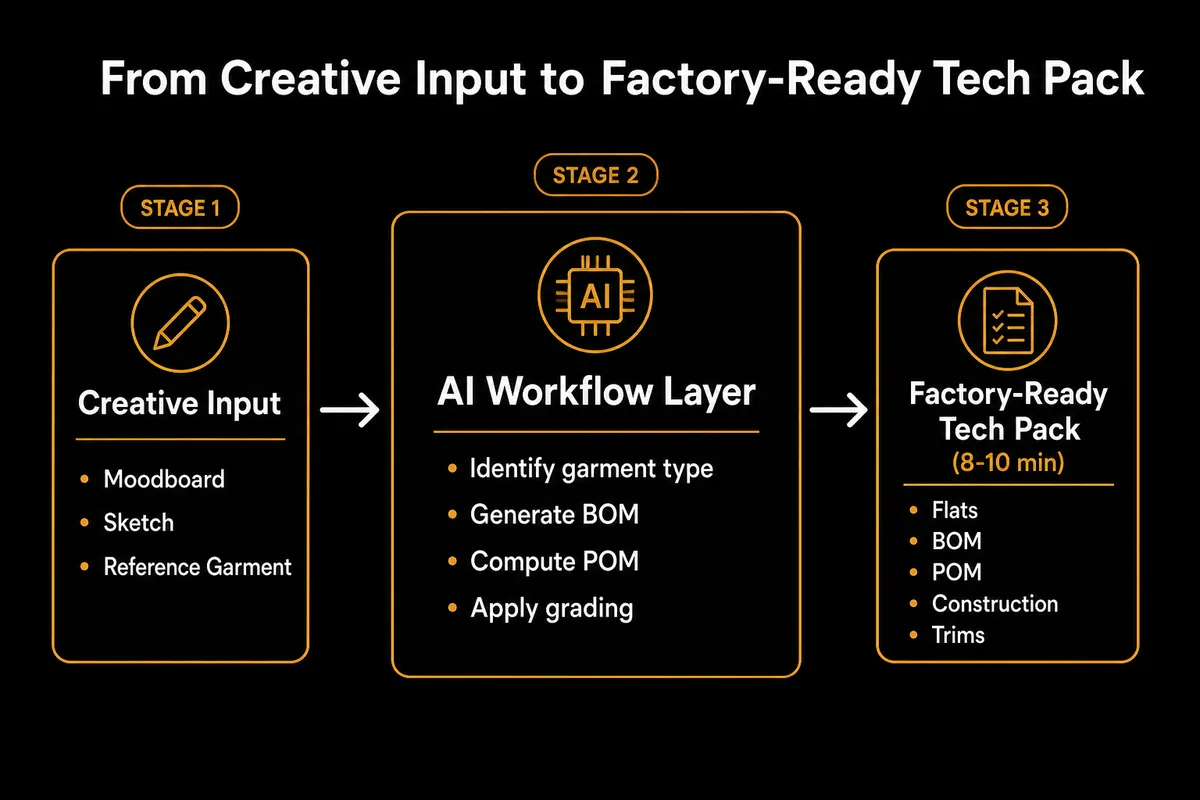
AI platforms ingest creative assets and autonomously generate complete technical specifications, BOMs, and measurement charts, eliminating manual translation.
The most significant impact of AI on merchandising is the radical compression of the product development timeline. What traditionally takes a technical designer several days or even a week to complete for a single complex style can be accomplished by an AI platform in minutes. This speed is not just an incremental improvement; it represents a fundamental shift in how collections are developed. Merchandisers are no longer constrained by the linear, one-at-a-time capacity of their technical design team.
Consider a 50-style collection. Manually, creating all 50 tech packs could take a team of several technical designers weeks, creating a significant bottleneck right at the start. With an AI workflow platform, all 50 tech packs can be generated in parallel within a few hours. The human operator, whether a product development manager or merchandiser, shifts from being a data-entry clerk to a validator. Their role becomes approving the AI-generated output, making strategic adjustments, and focusing on exceptions rather than creating every document from scratch.
This time compression has a massive downstream effect. Getting accurate tech packs to factories three weeks earlier means sample rounds can begin earlier, production slots can be secured with confidence, and the entire critical path is shortened. This gives merchandisers more than just a faster process; it gives them flexibility. They gain weeks of buffer in their calendar, which can be used to accommodate unexpected sourcing issues, conduct more thorough wear testing, or pull forward a launch date to capture a market trend.

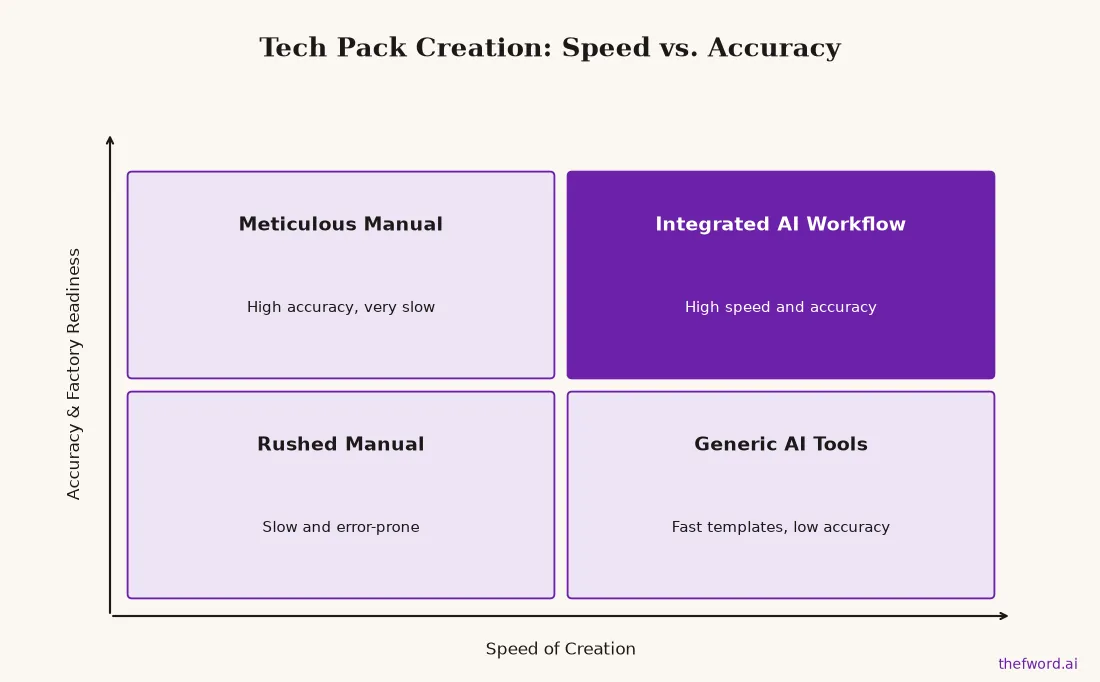
Use this table to compare tech pack creation methods by speed, specification quality, and team workload. It helps you decide which approach best shortens your pre-production timeline and hits launch dates, showing the trade-offs between manual work, generic AI helpers, and an integrated AI workflow designed for fashion.

The Bill of Materials (BOM) is the heart of a tech pack and a critical document for sourcing and costing. It lists every single component required to build a garment, from fabric and thread to zippers, buttons, and labels. Traditionally, compiling the BOM is a careful, tedious process that happens after the initial design is translated. It involves the technical designer and sourcing team cross-referencing lookbooks, sketches, and component libraries, often resulting in omissions or incorrect specifications that are only caught when a sample arrives.
AI workflow platforms collapse this entire sequence. By analyzing visual inputs from a moodboard or reference garment, the AI can identify not just the primary fabric but also the required construction components. It sees a placket on a shirt and knows to add interfacing, buttons, and specific stitching operations to the BOM. It recognizes a zippered fly on a pair of jeans and automatically adds the zipper, tack button, and rivets to the materials list. This capability transforms the creative-to-technical handoff.
Instead of a merchandiser waiting days for a preliminary cost estimate based on a manually built BOM, they can have it almost instantly. The AI-generated BOM provides the sourcing team with a concrete list to begin quoting against immediately after the creative concept is approved. This allows for much earlier cost visibility, enabling merchandisers to make strategic decisions about a style's viability within the collection far earlier in the process. It connects the creative director's vision directly to the commercial reality managed by the merchandiser, ensuring alignment from the very start.
Nothing kills a launch calendar faster than multiple, failed sample rounds. When a factory produces a sample that doesn't match the design intent, the entire process grinds to a halt. The sample is photographed, shipped back, and analyzed. A post-mortem is held, the tech pack is corrected, and the cycle begins again. Each round can add three to four weeks to the timeline. These issues are almost always due to ambiguity or errors in the original tech pack sent to the factory.
AI-generated tech packs de-risk this critical stage by prioritizing completeness and consistency. Because the AI builds the pack from a logical, structured understanding of garment construction, it is far less likely to omit crucial details like stitch type, threads per inch, or backing for an embroidery. It ensures that all callouts are standardized and all POMs are clear, with defined tolerances. This removes the guesswork for the factory, dramatically increasing the probability that the first sample is correct, or at least very close to correct.
Reducing sample rounds from an industry average of three or four down to just one or two is a monumental achievement. It saves weeks of time and significant costs in shipping and sample fabrication. For the merchandiser, this translates to predictability. They can build a launch calendar that assumes a single, efficient sample round, creating a much more reliable and less stressful path to production. The factory handoff becomes a clean, data-driven transaction rather than a hopeful shot in the dark.
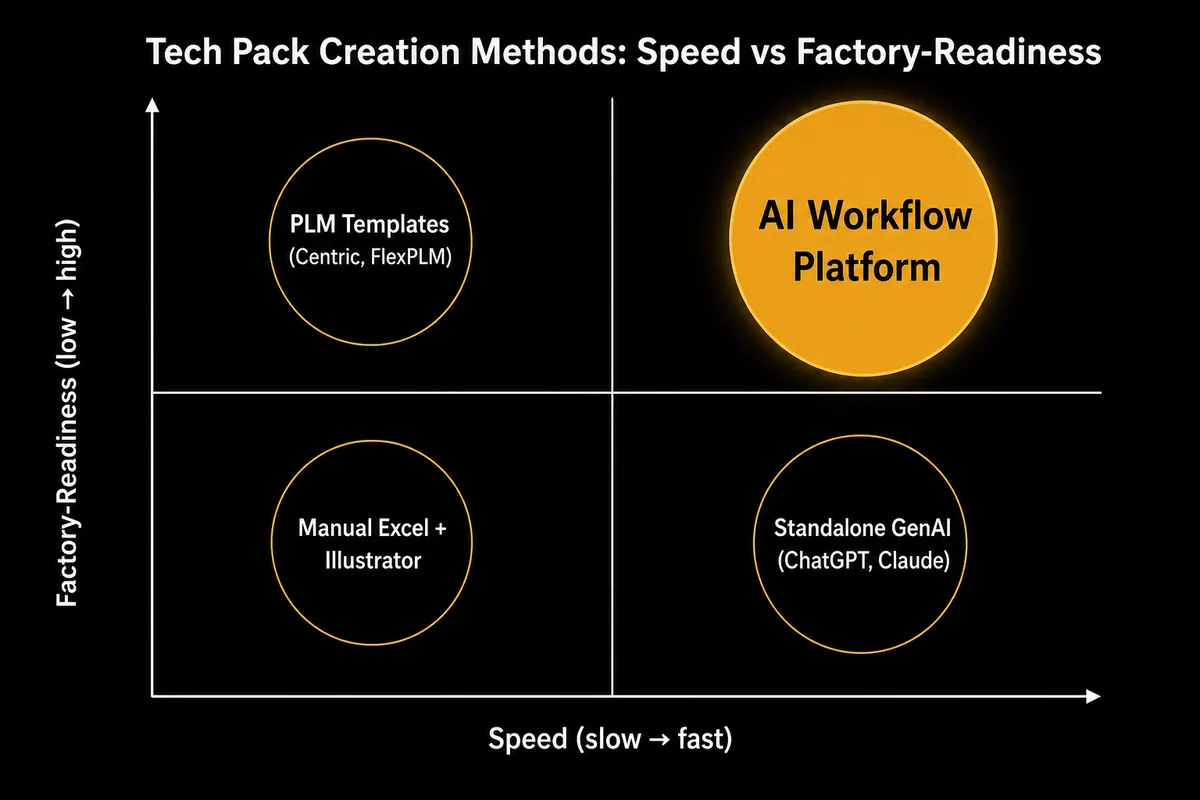
Integrated AI workflows deliver the highest combination of speed and accuracy, reducing the risk of errors that lead to costly sample rounds.
The adoption of AI for tech pack generation fundamentally changes the a merchandiser's day-to-day responsibilities, shifting them from a reactive operator to a proactive orchestrator. In the traditional model, a significant portion of a merchandiser's time is spent in the weeds: chasing down late tech packs, mediating disputes between creative and technical teams, and manually updating spreadsheets to track progress. They are consumed by the process itself.
With an AI workflow platform handling the heavy lifting of document creation and data management, merchandisers are liberated to focus on higher-value strategic work. Their time is freed up to analyze sell-through data to inform next season's assortment plan, to work with finance on more accurate margin forecasts, and to develop more nuanced pricing and markdown strategies. They can spend less time managing the creation of products and more time managing the business of the product portfolio.
In this new paradigm, the merchandiser acts as the conductor of an orchestra. The AI platform is their powerful instrument, executing the complex, repetitive tasks with speed and precision. The merchandiser sets the tempo, validates the output, and makes the critical decisions that guide the collection. They oversee the entire workflow from a command-and-control dashboard, intervening only when necessary. This elevation of the role allows merchandisers to apply their expertise where it matters most, driving commercial success rather than just managing a cumbersome process.
For an AI-driven process to be effective, it cannot operate in a silo. It must cleanly connect with the tools and systems that run the business, especially the master launch calendar. A modern AI workflow platform is not a replacement for a PLM system but rather a powerful, integrated engine that feeds it. It generates the initial product data package (the tech pack) and can push this structured data directly into the PLM system of record via API, eliminating the need for any manual data entry.
This integration extends to project management and calendar tools. Key milestones generated by the AI platform, such as "Tech Pack Complete," "Sample Request Sent," and "BOM Finalized," can be automatically populated into shared launch calendars in tools like Asana, Monday.com, or even a simple Google Calendar. This provides all stakeholders, from marketing to supply chain, with real-time, unambiguous visibility into the status of every SKU in the pipeline.
also, this integrated data stream allows for predictive insights. By analyzing the progress against planned milestone dates, the system can flag styles that are at risk of falling behind schedule. A merchandiser can receive an automated alert that a specific fabric has not been approved yet, threatening the sample start date. This proactive monitoring allows them to address potential issues before they become full-blown crises, ensuring the master launch calendar remains a reliable plan, not a hopeful work of fiction.
An AI workflow platform removes the bottleneck of creation time. A merchandiser or product developer acting as a validator can easily process and approve hundreds of styles in a week. The platform can generate the initial tech packs for an entire collection of 50, 100, or more styles in a matter of hours. The human's role shifts to reviewing and approving the structured output, a much faster process than manual creation from scratch.
The approval workflow is collaborative and digital. Once the AI generates the tech pack, it enters a validation stage within the platform. Key stakeholders like the technical designer, merchandiser, and sourcing manager are notified. They can review, comment on, and approve specific sections like the BOM, POM, or construction details. This creates a clear, time-stamped audit trail, replacing chaotic email chains with a single source of truth for all approvals.
Yes, the process is perfectly suited for both. For rapid capsule drops, the speed of AI allows brands to go from trend identification to a factory-ready tech pack in the same day, a critical advantage. For large seasonal collections, the platform's ability to generate hundreds of tech packs in parallel eliminates the massive upfront bottleneck, allowing the entire pre-production calendar to be compressed and de-risked from the start.
AI workflow platforms integrate via APIs. Key milestone dates, like "tech pack generated," "BOM approved," or "sample requested," are automatically pushed from the AI platform into your central launch calendar, whether it resides in a PLM, an ERP, or a project management tool like Asana. This provides real-time, automated status updates, eliminating manual tracking and ensuring all teams work from the same up-to-date information.
While AI dramatically reduces errors, adjustments are inevitable. When a sample review requires a spec change, the update is made once inside the AI workflow platform. For example, if a POM needs to be adjusted, the technical designer makes the change in the system. The platform then automatically updates the relevant tech pack documents and maintains a version history, ensuring the factory always receives the latest, most accurate information for the next sample or for production.
Yes. Advanced AI systems can incorporate a brand's specific block library and custom grading rules. The platform can apply complex non-linear grading for different product types, such as tailored jackets versus knitwear. By learning from a brand's historical data and fit standards, the AI-generated grade rules are more consistent and accurate than manually calculating them for each new style, reducing errors in production.
A PLM is a system of record, essentially a database with templates. You still need a human to manually create and input all the data for a tech pack. An AI workflow platform like The F* Word is a system of creation. It autonomously generates the complete, structured tech pack data from creative inputs. The AI platform then feeds this clean data into the PLM, eliminating thousands of hours of manual data entry and associated errors.
Ready to stop chasing delays and start owning your launch calendar? See the launch workflow in action and discover how to turn creative concepts into factory-ready products in minutes, not weeks. Explore our complete guide on the future of AI-powered merchandising to learn more about orchestrating a faster, more accurate product pipeline.
Related: AI tech pack generator · The F* Word · fashion design brief template · ai visibility tools fashion brands what to track · fashion merchandising and launch workflow
Get The F* Word workflow insights in your inbox.