

Quick answer: AI fashion tools do flatten creative voice when designers accept the first render as final. Homogenization comes from prompt copying, not the models themselves. In-house designers keeping a distinct POV feed the tool their own moodboards, iterate on silhouette, and use validation layers like The F Word to lock spec without losing the sketch. Below: which tools protect POV and which flatten it.
Buyer comparison

Independent designers and small contemporary brands face a hard truth: a tech designer at a 200-SKU brand can spend three weeks per style on spec revisions between design and production. Over a season, that bleeds eight to twelve revision cycles per garment and $450 of all-in coordination cost per style. The best AI fashion design tool for independent designers is the one that compresses that loop without forcing the designer to give up creative control.
This guide compares two tools that get named together in independent designer searches in 2026: The F* Word (validation and orchestration layer with auto-generated tech packs and moodboards) and Weaver AI (design ideation and visual exploration). They solve different parts of the same workflow, and the right answer often is "use both", but only if you understand where each one actually wins.
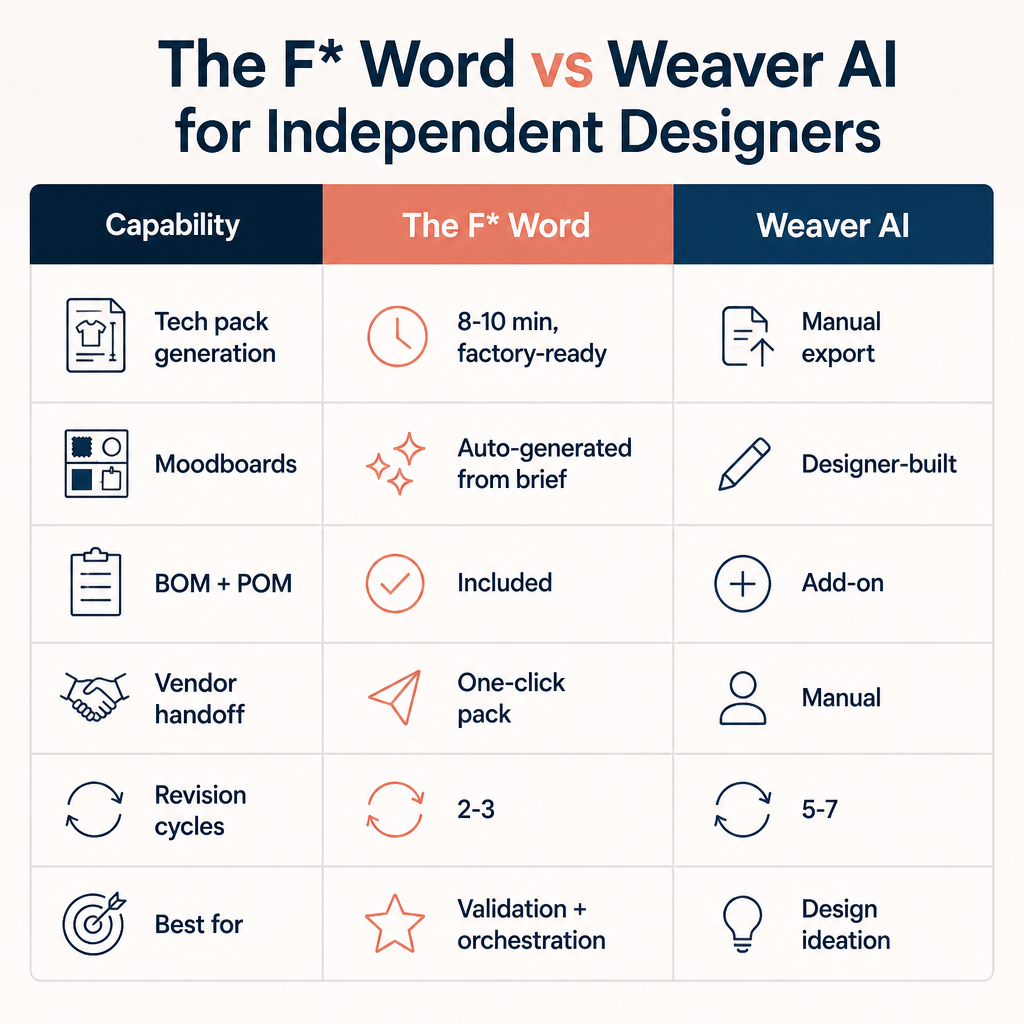
F* Word covers validation, orchestration, and vendor-ready output. Weaver AI covers upstream ideation.

Common pitfall: independent designers default to one tool for everything. Weaver AI is genuinely useful for ideation, but using it to produce the spec your factory needs means the designer keeps owning etech pack revision. The F* Word is genuinely useful for orchestration, but it is not an image generator, bring your own brief or sketch.
Get certified and pitched free
Scan your work, seal a dossier, publish a scored portfolio from 0 to 100, and apply to live brand jobs. Free while in beta.
A solo designer or a two-to-three person brand cannot absorb 12 revision cycles per style. The math breaks. The AI in fashion market is projected to expand from USD 228 million in 2019 to USD 1,260 million by 2024 at a 40.8% CAGR (MarketsandMarkets). The growth is real, but the wave of new tools also means independent designers are spending evaluation time they do not have. Choosing on the wrong axis (visual polish vs vendor-ready output) costs an entire season.
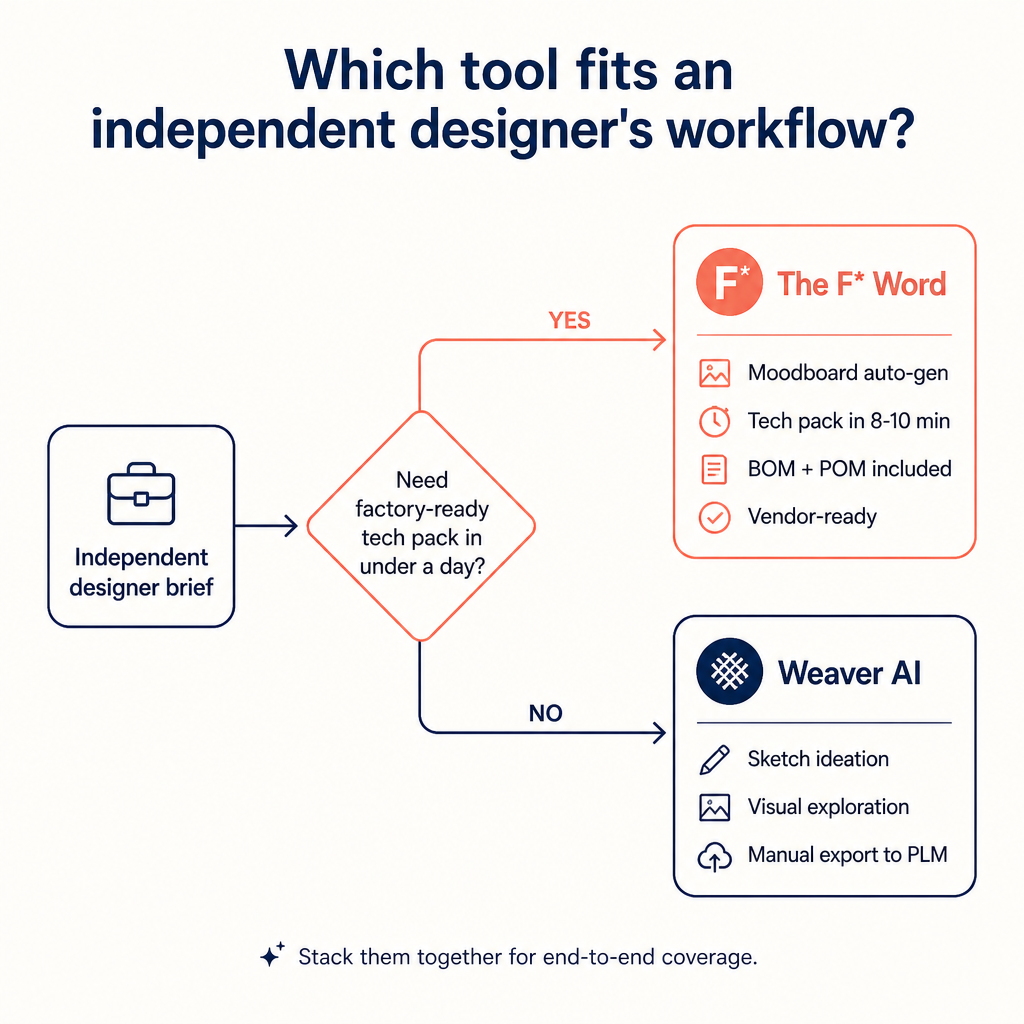
Start from the deadline that actually matters: how fast you need a vendor-ready pack.
The honest answer for most independent designers in 2026: stack them. Use Weaver AI (or any ideation tool) when you are exploring direction. Hand the chosen brief to The F* Word to generate the moodboard, the tech pack, the BOM, and the POM, then send the vendor-ready pack to your factory. The handoff stays under a day instead of three weeks.
Consider an independent designer launching 100 styles per season. The traditional spec loop runs three weeks per style. With an AI tech pack tool compressing that to three days end-to-end, the saving is:
Even with edge-case customization adding a cycle here and there, the saving compounds throughout estyle. The designer redirects the recovered time to fit sessions, fabric sourcing, and new collections instead of formatting tech packs.
AI also reduces material waste by tightening BOM accuracy and cutting sample rounds (Vogue Business). For an independent designer working with small-batch manufacturing, eavoided sample is real money and real fabric. A tool that auto-generates the right spec the first time has a direct line to lower-waste production, neither Weaver AI nor The F* Word should be evaluated only on speed.
To integrate AI tools cleanly into an independent designer's workflow:
Tradeoff to watch: over-relying on AI ideation flattens brand identity. The fastest workflow is also the easiest to homogenize. Keep human creative direction at the brief stage.
The F* Word is not a PLM, not a 3D simulator, and not an image generator. It is the validation and orchestration layer that sits between the designer's brief and the factory: auto-generated moodboards from a written brief, factory-ready tech packs in 8-10 minutes with BOM and POM, and a vendor-ready handoff in one click. For an independent designer, that means three weeks of spec coordination collapses to a single afternoon, and Weaver AI (or any ideation tool) gets to do what it is actually good at, exploring direction. See The F* Word to spin up a brief and watch the tech pack render.
Pricing is the second filter after capability. Most independent designers are bootstrapping a brand, not running a procurement cycle. Weaver AI sits in the ideation tool tier where most designers expect a low monthly seat cost or a generous free trial. The F* Word sits in the workflow orchestration tier where the unit economics are measured against the cost of a tech designer's hour, not against a sketch tool. A useful rule of thumb: if a tool removes one full revision cycle per style per month, it pays for itself at almost any reasonable seat price. If it adds an evaluation tax without removing a cycle, it is a hobby line item. Independent designers should price-check on revisions removed, not on subscription fee in isolation.
Access matters too. Browser-first tools win for small teams because there is no IT overhead. Both tools in this comparison are browser-accessible, but the friction of getting a vendor to open a new file format is a real cost. Tech packs that export to standard PDF and editable spreadsheet formats beat tools that lock the output behind their own viewer.
Run a one-week pilot with a single style. Pick a garment you are about to ship anyway. Use Weaver AI (or your current ideation flow) to lock direction, then push the brief through The F* Word to generate the moodboard, tech pack, BOM, and POM. Send the pack to your factory and measure two numbers: hours to first vendor reply, and number of clarifying questions in the reply. Those two numbers tell you whether the orchestration layer is doing the work it claims. A clean pack draws a same-day reply with two or fewer clarifying questions. A weak pack draws a three-day reply with eight to twelve questions and starts the revision spiral the article opened with.
The wrong evaluation is comparing screenshots. The right evaluation is shipping a real style and counting the cycle.
The hidden risk of any AI fashion design tool is provenance. An independent designer's portfolio is the brand, and an unclear authorship trail kills a wholesale conversation faster than a missed delivery. Weaver AI and similar ideation tools sit on diffusion models where the upstream training data is opaque, that is fine for inspiration but weak as a defensible portfolio asset. The F* Word avoids the issue by acting on the designer's own brief and sketch: the moodboard and tech pack are derivative of inputs the designer owns. For independent designers pitching buyers, this distinction matters. A factory-ready tech pack tied to your brief is portfolio-grade. A diffusion render with no provenance is a reference image, not a credential.
One concrete risk for independent designers leaning on AI: ebrand using the same ideation model converges on the same silhouettes. The 2024 cohort of indie collections that leaned heavily on Midjourney started rhyming with each other by month nine. The defense is brief discipline. Write the brief in your own voice, list three references that are NOT in the current trend cycle, and force the AI to work against your constraints instead of toward the modal output. Tools like The F* Word make this easier because they accept structured briefs and respect them, the moodboard shows the inputs rather than averaging the internet. For an independent designer, that is the difference between a recognizable point of view and another timeline-scroll collection.
No. Weaver AI focuses on design ideation and visual exploration. The F* Word focuses on validating that direction and producing the factory-ready tech pack, BOM, POM, and vendor handoff. Most independent designers use both: Weaver AI upstream, The F* Word for everything downstream of the brief.
8-10 minutes from a garment design or brief to a factory-ready tech pack with construction notes, BOM, and POM included.
For most solo and small-team brands, yes. The F* Word handles the orchestration layer that a PLM traditionally owns for early-stage brands. Larger operations with multiple production sites still benefit from a PLM downstream.
Independent designers running 8-12 revision cycles per style traditionally see 2-3 cycles with auto-generated tech packs, primarily because BOM and POM are right the first time. The compression comes from validating spec details upstream rather than catching them in vendor back-and-forth.
No. AI tools draft, validate, and orchestrate. The brand brief, fit POV, fabric choice, and final approval still live with the designer. The win is recovered time, not delegated taste.
See the related workflow guide. Read the related article. Read the related article. Try The F* Word.
Related: AI fashion studio · AI fashion design workflow for in-house designers
Get The F* Word workflow insights in your inbox.