
TL;DR. Bill of material software for fashion provides a centralized, digital system for managing every component, from fabric and trims to labels and packaging, required to produce a garment. It replaces error-prone spreadsheets, offering accurate cost analysis, streamlined procurement, and improved inventory control. USEFUL BOM management is essential for translating a design concept into a manufacturable product. For brands orchestrating complex workflows, a complete tech pack, including an integrated BOM and a supporting moodboard, is essential. AI platforms like The F* Word automate this entire process, generating validated, factory-ready tech packs and BOMs directly from initial design inputs, significantly reducing manual work and accelerating time to market.

A Bill of Materials, or BOM, is a full, hierarchical list of all the raw materials, components, assemblies, and sub-assemblies required to manufacture a finished product. In the apparel industry, it is the definitive recipe for a garment. This document is not merely a shopping list. it is a structured data set that serves as a single source of truth for design, product development, sourcing, and production teams. The BOM specifies exact quantities, units of measure, colors, suppliers, and costs for everything from the main body fabric down to the last button and thread.
The core purpose of a fashion BOM is to translate a creative director's vision into an actionable technical blueprint. While a tech pack provides the full construction instructions, the BOM focuses specifically on the "what." It ensures every person in the supply chain, from the technical designer to the factory floor manager, is working with the same component information. This eliminates ambiguity and costly mistakes that arise from misinterpretation. For example, specifying "100% Cotton Jersey, 180 GSM, Color: Optic White, Supplier Code: CT-W-123" leaves no room for error, unlike a vague note that just says "white t-shirt fabric."
Fashion utilizes several BOM types. An Engineering BOM (EBOM) is often developed during the initial design and sampling phase, focusing on the components from a design perspective. A Manufacturing BOM (MBOM) is structured for the factory, including the garment materials plus packaging, hangers, and polybags needed for shipment. A Sales BOM (SBOM) might group a finished garment with specific accessories for a retail kit. Configurable BOMs are increasingly important for brands offering customization, allowing for dynamic generation of material lists based on customer choices for color, trim, or hardware. A simple t-shirt BOM might have 5-10 line items, while a technical outerwear jacket could have over 50, including shell fabric, lining, insulation, multiple zippers, snaps, toggles, and specialized seam-sealing tape.
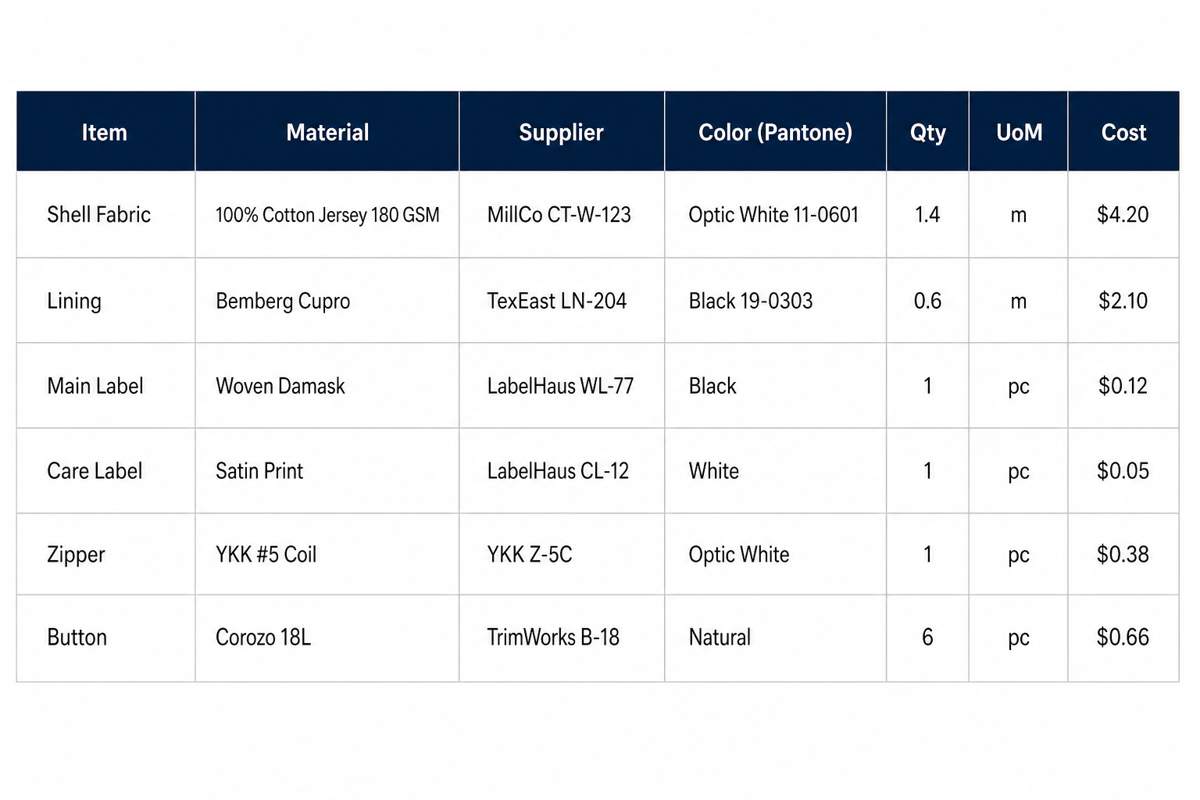
The BOM is a critical operational tool that directly impacts profitability and speed to market. Its primary function is cost management. By itemizing every component and its associated cost, a BOM allows for precise calculation of the cost of goods sold (COGS) before production even begins. This enables merchandisers and product development managers to make informed decisions about material selection to meet target margins. Without an accurate BOM, costing is guesswork, exposing the brand to the risk of unprofitable products.
Beyond costing, the BOM is fundamental to inventory control and procurement. The aggregated data from BOMs throughout an entire collection provides the sourcing team with a clear picture of total material demand. This facilitates bulk purchasing, which can lead to better pricing from suppliers. It also minimizes waste by preventing over-ordering and reduces production delays caused by under-ordering critical components like zippers or trims. Efficient procurement, driven by BOM data, is a cornerstone of a lean and responsive supply chain.
The BOM also serves as a needed instrument for quality control and compliance. It creates a traceable record of every material used in a garment. This is essential for verifying that products meet regulatory standards, such as CPSIA in the United States or REACH in Europe. In an era of heightened consumer awareness, the BOM is also the foundation for sustainability reporting. Brands can use it to track the origin of materials, verify certifications like GOTS or Fair Trade, and provide transparent information to stakeholders about their supply chain's environmental and social impact.
Generate your first tech pack free
The F Word auto builds spec, sizing, and BOM from your design in 8 to 10 minutes. No template wrangling, no factory back and forth.
For decades, spreadsheets were the default tool for managing BOMs in the fashion industry. While seemingly simple and accessible, this manual approach is fraught with risk, especially for brands managing hundreds of styles per season. Spreadsheets are highly susceptible to human error, from simple typos in material codes to incorrect formulas in cost calculations. Version control is another major challenge. multiple team members emailing different versions of a file often leads to confusion, with production sometimes starting based on an outdated document, resulting in costly sample rounds or incorrect bulk orders.
This reality has driven the adoption of specialized bill of material software, often as a module in a larger Product Lifecycle Management (PLM) system or as a standalone solution. This software provides a centralized, cloud-based database where all BOM information is stored and managed. Key functionalities include creating standardized material libraries, tracking revisions with a complete change history, and establishing approval workflows. This ensures that every stakeholder is always accessing the most current and validated version of the BOM.
The true power of modern BOM software lies in its ability to integrate with other critical business systems. An integrated workflow connects the BOM to the design phase in CAD tools like Browzwear or CLO, pulls cost data from an ERP system, and pushes procurement requirements to supply chain management platforms. This creates a connected data thread from concept to consumer. Instead of manually re-entering data throughout multiple disconnected systems, which is inefficient and a source of error, the software automates information flow. This streamlined process frees up technical designers and product developers from administrative tasks, allowing them to focus on innovation and quality.
When evaluating bill of material software, fashion brands must prioritize features that address the unique complexities of apparel product development. An intuitive user interface, designed with the vocabulary and workflow of the fashion industry in mind, is paramount. The system should feel natural to a technical designer or merchandiser, not like a generic manufacturing tool that has been retrofitted for apparel.
A strong material and component library is non-negotiable. This feature acts as a central repository for every fabric, trim, and piece of hardware the brand uses. Each entry should support detailed specifications, including supplier information, composition, weight (GSM), width, color codes (like Pantone TCX), cost, lead times, and associated compliance certificates. This library becomes the building block for all BOMs, ensuring consistency and speeding up creation.
Critical operational features include strong version control and change tracking. The software must automatically log every modification, noting who made the change, when it was made, and why. This is essential for auditing and for resolving any discrepancies during production. Collaboration tools with granular access controls are also needed. This allows creative directors to review material choices, sourcing leads to input costs, and external factory partners to view finalized BOMs without being able to alter them. Finally, strong integration capabilities with tech pack software, ERP systems, and 3D design tools are necessary for building an efficient, end-to-end product development ecosystem.
The BOM does not exist in a vacuum. it is a needed organ in the larger body of the tech pack. A tech pack is the complete instruction manual sent to a factory to produce a garment, containing everything from detailed sketches and points of measure (POMs) to construction details and grading rules. The BOM section of the tech pack provides the material specifications, telling the factory *what* to use, while the other sections explain *how* to use it.
The relationship is symbiotic because one is incomplete without the other. A detailed construction diagram is useless if the factory uses the wrong fabric. Likewise, a perfect list of materials is meaningless without instructions on how to assemble them. Ensuring absolute consistency between the BOM and the other components of the tech pack is a primary job of a technical designer. Any discrepancy, such as a callout for a specific zipper on a sketch that does not appear in the BOM, can cause production delays, require additional sample rounds, and increase costs.
This is where workflow orchestration platforms add major value. The F* Word, for instance, operates on the principle of a unified data source. It autonomously generates the complete tech pack, including the BOM, from a single set of inputs. Because the visual elements, construction notes, and material list are created simultaneously by the AI, the risk of internal inconsistency is virtually eliminated. This prevents the common errors that occur when a designer updates a sketch but forgets to tell the technical designer to update the BOM in a separate system. A unified generation process ensures the final tech pack is a single, coherent, and factory-ready document from the start.
The market for managing BOMs in fashion ranges from specialized point solutions to full modules in large-scale enterprise platforms. Brands must evaluate options based on their scale, existing technology stack, and specific workflow needs. PLM systems like Centric PLM and PTC FlexPLM are industry giants, offering powerful BOM management in a broad product lifecycle ecosystem that covers everything from concept to retail. These are excellent for large enterprises that need an all-in-one solution for managing complex global operations.
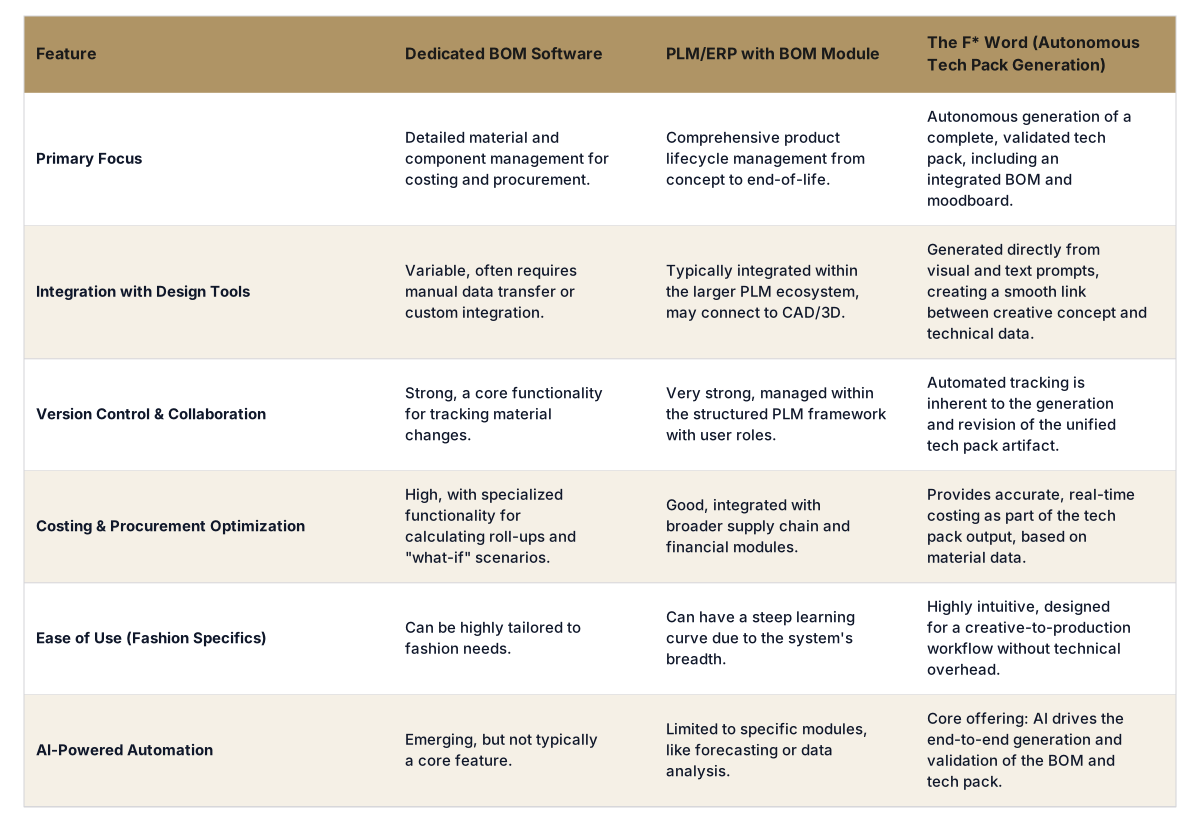
Other solutions may focus more narrowly on specific aspects of the supply chain or product development. The key is to understand the trade-offs. A PLM provides immense breadth but can come with a major learning curve and implementation cost. Standalone BOM tools might be easier to adopt but can create data silos if they do not integrate well with other systems. The following table compares these approaches against a new generation of AI-driven workflow platforms.
Implementing BOM software is only the first step. To truly optimize the product development workflow, brands must adopt a set of best practices for data governance and process management. The most important practice is standardization. This means creating a master library with strict naming conventions for all materials and defining a clear set of attributes for each entry. A fabric should never be entered as "blue cotton" in one BOM and "cotton, royal blue" in another. This data hygiene is essential for accurate reporting and analytics.
Establishing clear approval workflows is equally important. Any change to a BOM, especially after a style has been costed and approved for sampling, must go through a formal review process. BOM software can facilitate this by automatically routing change requests to the relevant stakeholders, such as the merchandiser for cost impact and the technical designer for production feasibility. This prevents unauthorized changes that could affect margins or quality.
Brands should also conduct regular audits of their BOM data to reconcile it with physical samples and production records. This helps catch discrepancies early and ensures the digital record accurately shows the physical product. Investing in training is equally important. All team members who interact with the BOM, from designers to sourcing agents, must understand how to use the software correctly and adhere to the established data standards. When these practices are followed, the BOM transforms from a simple list into a powerful strategic asset that can even be used for predictive analytics, helping to forecast material needs based on historical data and sales trends.
The next frontier in BOM management is the integration of artificial intelligence and automation. AI is poised to move beyond simple data management and actively participate in the creation and optimization of the BOM itself. Imagine an AI that can analyze a technical sketch or even a 3D model from a tool like Browzwear and automatically generate a preliminary BOM. It could identify the need for shell fabric, lining, a specific type of zipper, and buttons, pulling the correct components from the brand's material library based on visual cues and learned associations from past styles.
This automation extends to costing and sourcing. Using machine learning models, AI systems can provide predictive cost estimates in real time as a designer experiments with different materials. They can also analyze the supply chain, suggesting alternative suppliers or materials based on cost, availability, sustainability metrics, and lead times. This allows for dynamic BOMs that can be updated in real time in response to market fluctuations, giving brands a level of agility that legacy systems cannot match.
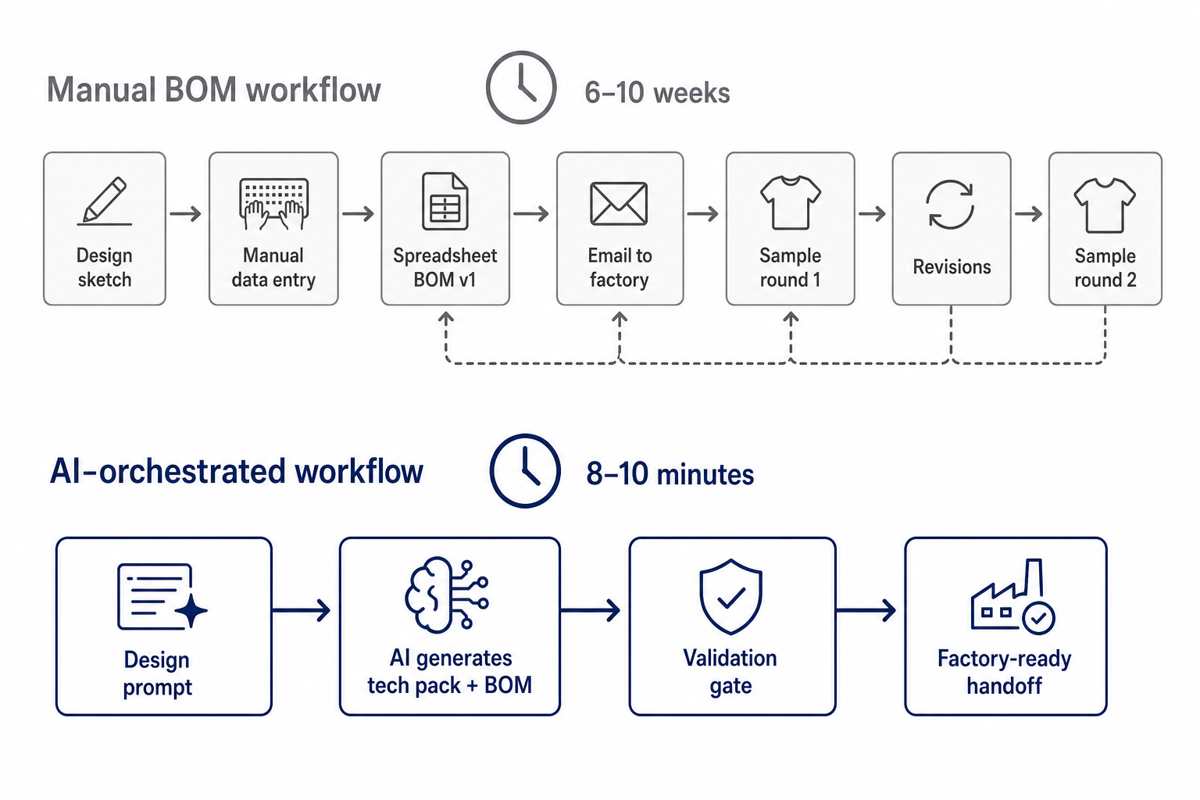
This is the operational model of The F* Word. Instead of being a passive repository, our platform acts as an active agent in product development. It autonomously generates the entire tech pack artifact, including a highly accurate, structured BOM, directly from design prompts. This process saves hundreds of hours of manual data entry and embeds intelligence into the workflow. The system validates component compatibility and flags potential issues before a tech pack is ever sent to a factory, drastically reducing sample rounds and accelerating the overall time to market.
A Bill of Materials (BOM) is a component list. it details *what* materials are needed to make a garment, including fabric, trims, and labels. A tech pack is the complete instruction manual. it includes the BOM along with technical sketches, points of measure (POMs), construction details, and grading information. The BOM is a critical section in the broader tech pack, which tells a factory both what to use and how to build the product.
Yes, absolutely. While spreadsheets may seem adequate at first, they quickly become a liability as a brand grows. BOM software provides even small brands with a scalable, single source of truth for costing, procurement, and production. This discipline from the outset prevents costly errors, improves margin accuracy, and establishes a professional workflow that can support future growth. Modern cloud-based solutions are more accessible than ever for smaller businesses.
Most modern BOM software offers integration capabilities through APIs (Application Programming Interfaces). This allows the BOM system to automatically push and pull data to and from other platforms. For instance, finalized BOM data can be sent to an ERP or SCM system to generate purchase orders for materials. Conversely, material costs and supplier information from the SCM system can be pulled into the BOM software to ensure real-time accuracy in product costing.
A strong fashion BOM should include several critical data points for each component. These are: an item description, a unique material code or SKU, the supplier's name and code, the color code and name (e.g., Pantone TCX), the quantity required per garment, the unit of measure (e.g., meters, pieces), the cost per unit, and placement notes if applicable. For fabrics, including width and weight (GSM) is also standard practice.
AI improves accuracy by eliminating manual data entry, which is a primary source of human error. By generating a BOM from a design file or prompt, it ensures consistency between visual intent and material specification. AI accelerates the process by automating what is currently a time-consuming manual task. An AI can construct a detailed BOM in minutes, a process that could take a technical designer hours, freeing up team members to focus on more strategic and creative work.
Not necessarily. A standalone BOM software is a specialized tool focused on material management, whereas a Product Lifecycle Management (PLM) system is a full platform that manages the entire product lifecycle, from ideation and design to sourcing and retail. Many PLM systems have a BOM module as a core feature. A brand might choose a standalone BOM tool for its focused functionality and ease of use, or a full PLM for an end-to-end enterprise solution.
By automating the tedious process of BOM and tech pack creation, your teams can reclaim valuable time to focus on what truly matters: design, innovation, and quality. The F* Word platform orchestrates the complex workflow from concept to factory-ready specification, ensuring accuracy and speed. Ready to eliminate spreadsheet errors and reduce sample rounds? Generate a validated tech pack in minutes and see the difference. Explore more findings on how our system transforms product development by visiting our full AI Fashion Workflow Software hub.
Related: ai tech pack generator · Explore the related workflow · Read the related guide · Try The F* Word
Get The F* Word workflow insights in your inbox.