A GUIDE FOR FASHION AND APPAREL LEADERSHIP · 2026
FREE EXCERPT

The Six AI Use Cases

to Fund First

Six of twenty-five, ranked. What each one moves,
and what it costs you to skip.
10 pages from a guide of eighty-one. The argument,
the ranking method, the six capabilities that pay first, and
two enteries in full so you can see the other twenty-three.
INSIDE
01
THE GAP NOBODY BUDGETS FOR
02
WHAT ACTUALLY BLOCKS THE MONEY
03
THE SIX TO FUND FIRST
04
TWO ENTRIES IN FULL
05
ALL TWENTY-FIVE, NAMED
06
YOUR FIRST THIRTY DAYS
A TEN-MINUTE READ · VERSION 1.0 · AUGUST 2026
REIMAGINE FASHION WORKFLOWS
THE ARGUMENT
The gap nobody budgets for.
Three-quarters of retail and consumer executives call AI a top strategic priority. One in six can quantify a return. This excerpt is about the gap between those two numbers, and it argues that the gap is a records problem rather than a technology problem.

Every fashion business runs two operations. The first is the one on the organization chart: design, development, sourcing, production, merchandising, marketing. The second has no name, no budget line and no owner, and it consumes a substantial share of every week. It is the work of moving information between the first operation’s parts, and it arrives as a bill nobody itemizes.

Two kinds of hour go into a product week. Judgment decides something: what to make, how it should fit, whether it is right. Conveyance moves something from one place to another so the next person can act. Sample a week of your product organization’s hours and tag each one. Most brands doing this for the first time find the split runs heavily toward conveyance. That is the number worth knowing before you spend anything on AI, because it is the number AI is addressing
WHY IT COMPOUNDS

Double the documents and you roughly quadruple the things that have to agree.

Six documents that depend on each other give you 15 pairs that have to agree. Twelve documents give you 66. A single style in pre-production carries twelve or more, crossing design, technical, sourcing, costing and the factory. Add a style and you add coordination faster than you add revenue, which is why growing brands so often feel like they are getting slower.
THE ARGUMENT
IN ONE LINE
Where the cost sits
Keeping everyone in agreement about what a garment is. Coordination grows faster than the range that produces it.
Why AI has underdelivered
A faster way to produce a document helps little if the documents still disagree. Spending has gone to the visible half.
The unlock
Artifact liquidity: whether a record moves between people, systems and partners carrying its version, approvals and dependencies.
Where the value is
Eight of the twelve highest-impact capabilities are blocked by records a machine cannot read. Fund the blocker.
What it adds up to
One product record per garment, versioned and answerable, that a factory, a regulator, an assistant and a customer can query.
What actually blocks the money.
There is one idea in the full guide worth learning properly, and this is it. Everything else follows from it.

A work artifact is any object in your business that carries meaning: a tech pack, a sketch, a bill of materials, a graded size chart, a costing sheet, a vendor pack, a brief, a launch asset. Artifact liquidity is how well one of those travels. Can it move between people, systems and partners without getting scrambled, going out of date, losing its context, or being cut off from its approvals?

A fully liquid artifact carries four things wherever it goes. Its version state, so you know which one this is. Its approval history, so you know who signed it and when. Its dependencies, so you know what else changes if this does. And the rules that govern it, so a machine can check it without asking a person. Most fashion artifacts carry none of the four.
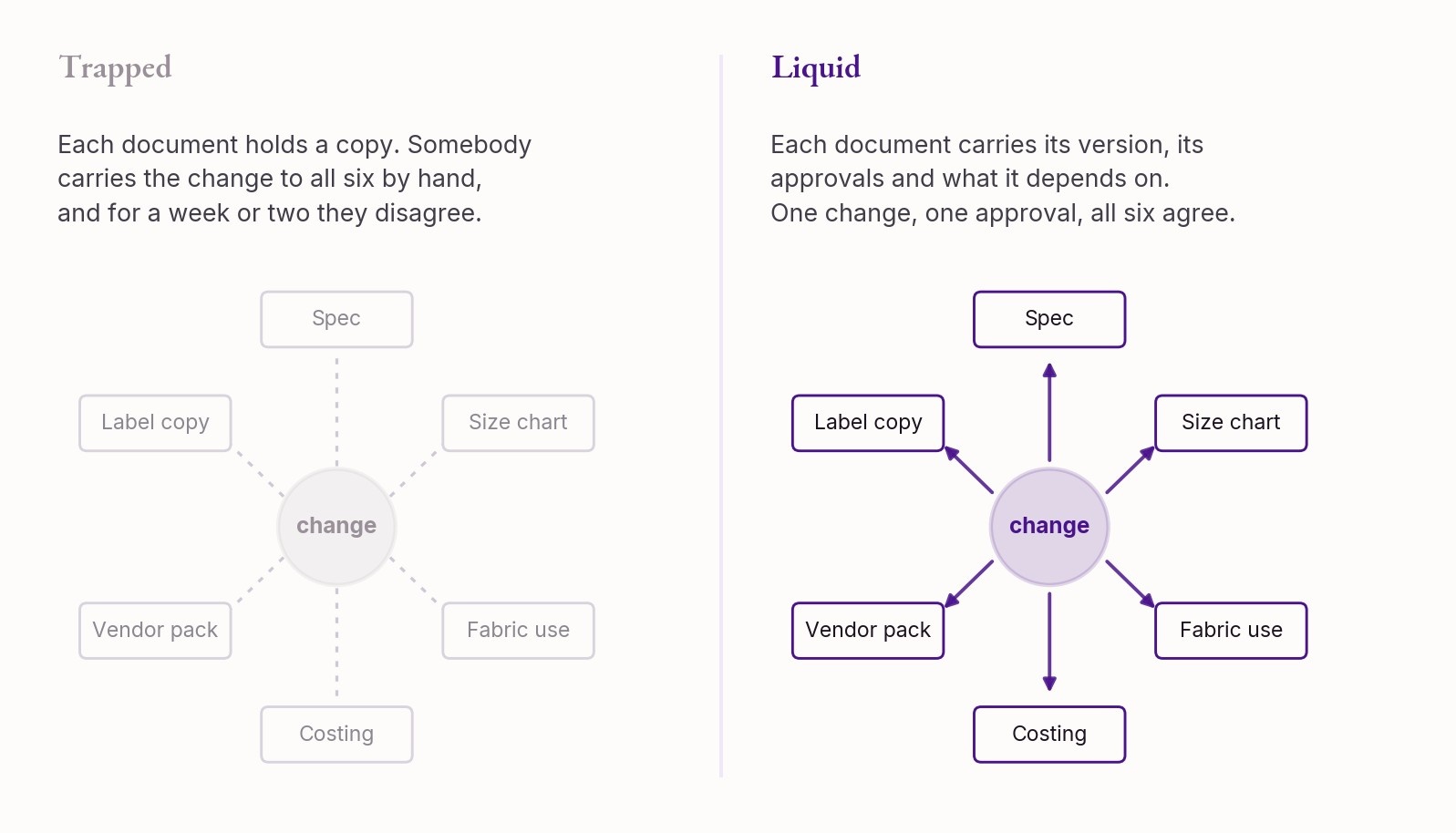
FIG 01
ONE CHANGE, TWO WORKFLOWS.
Both sides show the same change. On the left it takes six people-actions and a week. On the right it takes one approval. Nothing about the garment is different. Everything about the cost of changing it is
Sequence, and why it is not negotiable
An agent cannot maintain what it cannot read. Point a capable system at documents only humans can interpret and it will do exactly what you would expect: read something stale, produce something plausible, and hand it to somebody who signs it because it looks right.

There is no error message. There is a pilot that reports high accuracy against the wrong source, and then, six weeks later, a factory building to a measurement that was superseded in January.

Liquefy first, then automate. If you take one instruction from this excerpt, take that one.
How we ranked the twenty-five
One number decides the order, and three others decide the sequence. Keeping those two questions apart is the whole point, because a single blended score is exactly what makes businesses fund the easy things.

Impact sets the rank. Each capability scores low, medium or high on four things it can change: team time, revenue, assets and cost. Those four are weighted toward revenue and assets, at 30% and 25% against 25% for cost and 20% for team time, because this is written for a business deciding where to put capital rather than a team deciding what to automate. The result is an impact index out of a hundred and a rank from one to twenty-five.

Readiness, effort and risk set the sequence. Readiness asks whether your records can support it today. Effort asks what standing it up costs in weeks, integration and change management. Risk asks what happens when it is wrong. None of these three touch the rank, and that is deliberate: a capability does not become less valuable because it is hard, it becomes later.

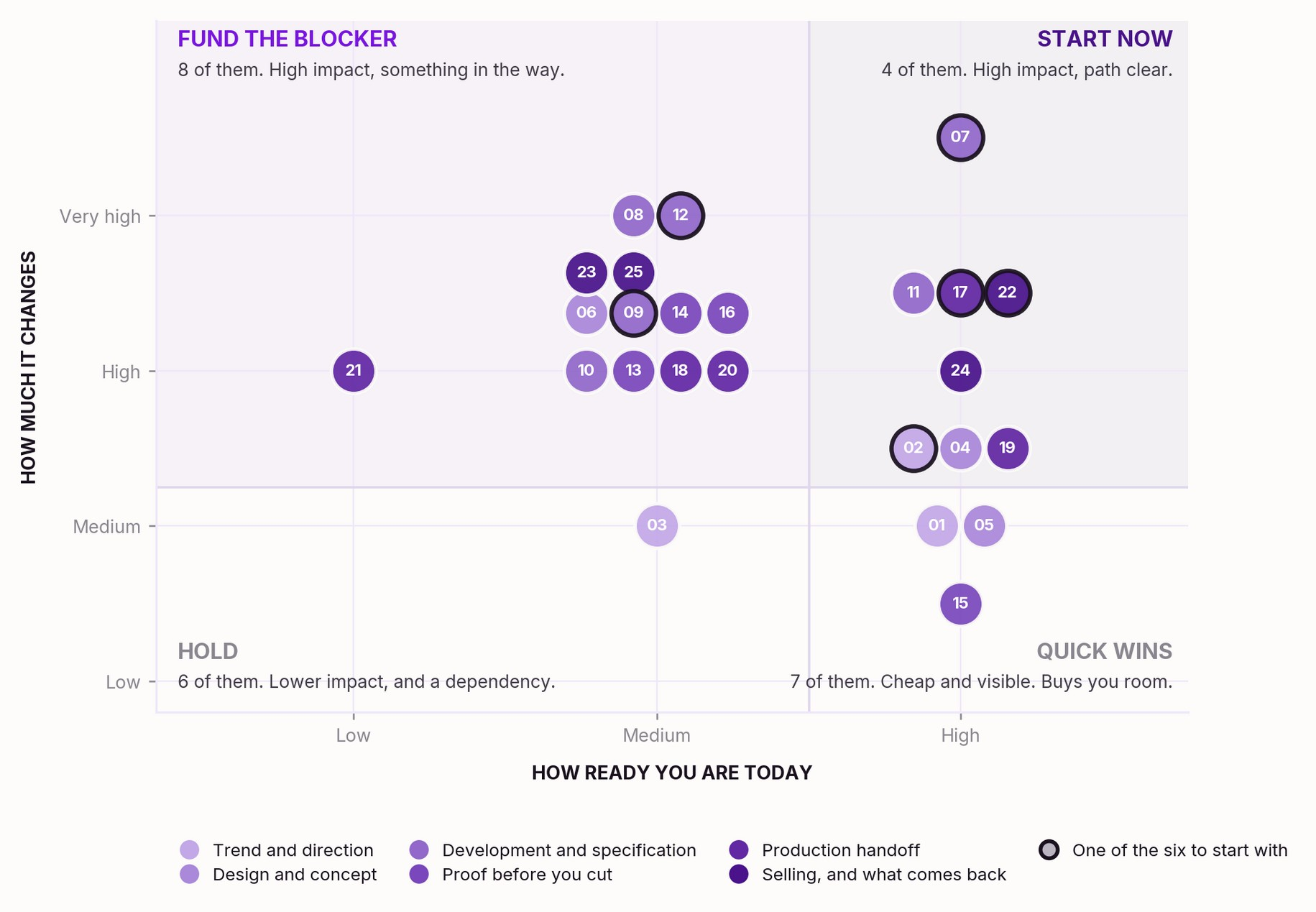
Each capability then carries one of four sequence labels. Start now means high impact with the path clear. Fund the blocker means high impact with something in the way, and it is the largest group on the list. Quick win means lower impact and nothing in the way. Hold means lower impact with a dependency, which is a polite way of saying not this year.
FIG 02
WHERE TO PUT THE MONEY FIRST.
The ringed dots are the six to start with. Eight of the top twelve land in the top-left, where something has to be cleared first. Twothirds of the value worth having sits behind a dependency, and the dependency is nearly always the same one.
The six to fund first
A list of twenty-five is a useful completeness check and a poor program. No organization deploys twenty-five capabilities at once. Six are worth funding first.

Score alone did not pick them. Three come straight from the top-right of the priority map, where the value is high and nothing is in the way. Two sit just outside it, because they carry a small dependency worth clearing rather than avoiding. And one has an unremarkable score on its own and is on the list because three others need it first.
#
CAPABILITY
IMPACT
WHY IT IS ON THE LIST
07
Drafting the tech pack
100
Rank one. The only capability that moves all four levers at once.
22
Imagery made from the same file the factory sews
85
Fastest visible result, and it buys room for the rest.
17
The factory bulletin, with a receipt
82
The most common operational complaint, and the most tractable.
12
Making one change land everywhere
90
Where the coordination cost concentrates, and almost nobody funds it.
09
The body standard your fits measure against
85
Four other capabilities inherit it.
02
Making the archive searchable
65
Cheap, and three capabilities above depend on it.
Between them they cover two visible wins that make the program credible, two attacks on the largest controllable costs in the business, one fix for the complaint you hear most often, and one quiet piece of foundation work that nobody will thank you for.
Start with two, not six
One visible win that makes the program credible in the building, and one structural piece that makes the second year cheaper than the first.

The most common pairing that works: imagery from the record for visibility, and turning the archive into something searchable underneath it. The first buys you room. The second means that when you come to specification drafting in six months, it works properly rather than approximately.

The most common pairing that fails is two visible wins. You will look busy, everyone will be pleased, and in month nine somebody will ask what structurally changed and the answer will be nothing.
The two entries that follow are reproduced in full, exactly as all twenty-five appear in the complete guide.
07
CORE
RANK 01 OF 25
IMPACT 100
START NOW
ONE OF THE SIX TO FUND FIRST
Drafting the tech pack
A factory-ready first draft in minutes, for a technical designer to correct rather than create.
This is the visible win, and it deserves to be. A first draft that covers measurements, graded sizes, bill of materials, trims, construction and packing. The best current systems, ours included, land a factory-ready draft in eight to ten minutes against a manual baseline of three to eight hours per style. That is the one hard number in this document, and it is here because we measure it ourselves rather than borrow it.

Note what the figure measures: time to a serious first pass, not time to sign-off. A technical designer still approves fit logic, tolerances, materials and factory readiness, and that review is the point. Quality tracks the depth of the measurement library behind it. Fed several seasons of your own graded specs, the draft is close and the corrections small. Fed industry defaults, it is confident and wrong on anything unusual.

And on its own it produces a faster version of the same fragile thing: a document that starts going out of date the moment anything upstream changes. Capability 12, change propagation, is where that gets fixed.
IMPACT
TEAM TIME
High
REVENUE
High
ASSETS
High
COST
High
The single largest block of recoverable hours in product development
Weeks earlier to the floor, and weeks earlier is weeks at full price
Every draft lands as structured data rather than as a PDF in an inbox
Specification labor is a substantial line and this removes most of it
READINESS
High
EFFORT
Low
RISK RATING
High
SUCCESS CRITERIA, THIRTY DAYS
Twenty specs timed end to end including review, against the hand-timed baseline you took in week one.
OWNER
Technical design
LEVEL OF AUTONOMY
Drafts. The technical designer approves fit logic, materials, tolerances and factory readiness before anything moves.
RISKS
Measuring how fast it generates instead of how fast it gets approved. A pack produced in minutes that takes two hours to correct has moved the work, not removed it.
NECESSARY CONDITIONS
A structured archive, or the draft is confident and wrong on anything unusual
12
CORE
RANK 03 OF 25
IMPACT 90
FUND THE BLOCKER
ONE OF THE SIX TO FUND FIRST
Making one change land everywhere
One approved change, propagated to every document that depends on it, on one approval.
A sleeve gets two centimeters longer. That touches the spec, the graded size chart, the fabric consumption, the costing sheet it just invalidated, the vendor pack and the label copy. Six documents, four people, and somewhere between one and three weeks before everything agrees again.

This is the entry most brands skip and the one that carries the economics. Generation was the opening act. A brand that stops at faster documents has bought speed and kept its drift problem, which is a worse position than it sounds, because now the wrong answer arrives sooner.
IMPACT
TEAM TIME
High
REVENUE
Medium
ASSETS
High
COST
High
The largest single pool of coordination hours in the business, and the one nobody has ever costed
Indirect, through fewer wrong builds and fewer late styles
This is what keeps the record true. Without it every other document decays at the first upstream change.
Both the manual walking and the downstream cost of documents that quietly disagree
READINESS
Medium
EFFORT
Low
RISK RATING
High
SUCCESS CRITERIA, THIRTY DAYS
One approved change reaching every dependent document on a single approval, with a working one-click reversal.
OWNER
Head of technical design, by name
LEVEL OF AUTONOMY
Runs with a signature. It prepares the whole cascade; a person approves it in one action.
RISKS
Deploying it before the record is liquid. Automating on trapped documents is the most common cause of a canceled program, and this is the entry where it happens.
NECESSARY CONDITIONS
Artifact liquidity. This one is not optional.
All twenty-five, named
The order below is the order a garment meets each capability, which is how a team reads it. The complete guide carries every one of these as a full entry, plus the portfolio sorted by rank with all four readings.
#
CAPABILITY
STAGE
IMPACT
SEQUENCE
01
Reading the signal early
Trend
58
Quick win
02
Making the archive searchable
Trend
65
Quick win
03
Finding the gaps buyers are asking about
Trend
62
Hold
04
Writing down the rules the brand never wrote down
Design
70
Quick win
05
Concepts that stay inside your brand’s rules
Design
58
Quick win
06
Screening what can be made, at your price
Design
82
Fund the blocker
07
Drafting the tech pack
Spec
100
Start now
08
Drawing the pattern and the grade
Spec
90
Fund the blocker
09
The body standard your fits measure against
Spec
85
Fund the blocker
10
Knowing which blocks earn their place
Spec
77
Hold
11
The gate on the spec
Spec
82
Start now
12
Making one change land everywhere
Spec
90
Fund the blocker
13
Measuring the fabric so the simulation is honest
Proof
77
Hold
14
Deciding on screen whether to cut
Proof
83
Fund the blocker
15
Capturing what the fit session decided
Proof
48
Quick win
16
Testing demand before you buy
Proof
87
Fund the blocker
17
The factory bulletin, with a receipt
Handoff
82
Start now
18
Answering the factory’s questions from the record
Handoff
72
Hold
19
Reconciling the costing sheet
Handoff
63
Quick win
20
Checking what the factory made
Handoff
75
Hold
21
Proving origin, and filling the passport
Handoff
78
Hold
22
Imagery made from the same file the factory sews
Sell
85
Start now
23
One record that everything reads
Sell
85
Fund the blocker
24
Winning the assistant’s shortlist
Sell
78
Quick win
25
Letting returns teach the next range
Sell
87
Fund the blocker

Your first thirty days
The first month buys nothing and measures everything. Two exercises, neither of which needs a purchase order, and together they produce the baseline and the repair list every later decision depends on.
ONE: THE SLEEVE-CHANGE TEST
Take one live style and one change. Count three numbers: how many documents the change touches, how many people have to act before every document agrees again, and how many days pass before they do. In a trapped workflow the honest answers are six or more documents, four or more people, and one to three weeks, during which a factory may cut against the old measurement.
TWO: THE TWENTY-PACK AUDIT
Open twenty specification packs at random and answer four questions for each. Every no is a line on the repair list, and the repair list is the project plan for the year. Every yes is a capability you can fund immediately.
ASK OF TWENTY SPECIFICATION PACKS
YES
PARTLY
NO
Are points of measure named the same way across all twenty?
Do grade rules travel with the size charts, or live in someone’s head?
Are materials coded against a scheme rather than typed as free text?
Can you retrieve the final approved version with confidence for each one?
Does each pack name an owner who is accountable when it is wrong?
Run the sleeve-change test again in six months and you have a trend line. Most brands find it moves slowly at first and then faster, because liquidity is one of those properties where fixing the third document is much cheaper than fixing the first
WHY IT COMPOUNDS

Double the documents and you roughly quadruple the things that have to agree.

Six documents that depend on each other give you 15 pairs that have to agree. Twelve documents give you 66. A single style in pre-production carries twelve or more, crossing design, technical, sourcing, costing and the factory. Add a style and you add coordination faster than you add revenue, which is why growing brands so often feel like they are getting slower.
THE ARGUMENT
IN ONE LINE
Where the cost sits
Keeping everyone in agreement about what a garment is. Coordination grows faster than the range that produces it.
Why AI has underdelivered
A faster way to produce a document helps little if the documents still disagree. Spending has gone to the visible half.
The unlock
Artifact liquidity: whether a record moves between people, systems and partners carrying its version, approvals and dependencies.
Where the value is
Eight of the twelve highest-impact capabilities are blocked by records a machine cannot read. Fund the blocker.
What it adds up to
One product record per garment, versioned and answerable, that a factory, a regulator, an assistant and a customer can query.

You have read ten pages.

There are seventy-one more.

The full guide carries all twenty-five entries with owners, thirty-day success criteria, autonomy levels and failure modes, the ranked portfolio, two business cases, twelve vendor questions, and the regulatory obligations table with dates.
01
READ THE FULL GUIDE.
25 AI Use Cases for the Fashion Industry
Eighty-one pages. All twenty-five entries, ranked and sequenced.
Download Now
01
GET YOUR OWN READING.
A ninety-minute portfolio session
We run the diagnostic against your stack and hand
back your six.
nfk@thefword.ai
01
GO DEEPER ON THE ARGUMENT
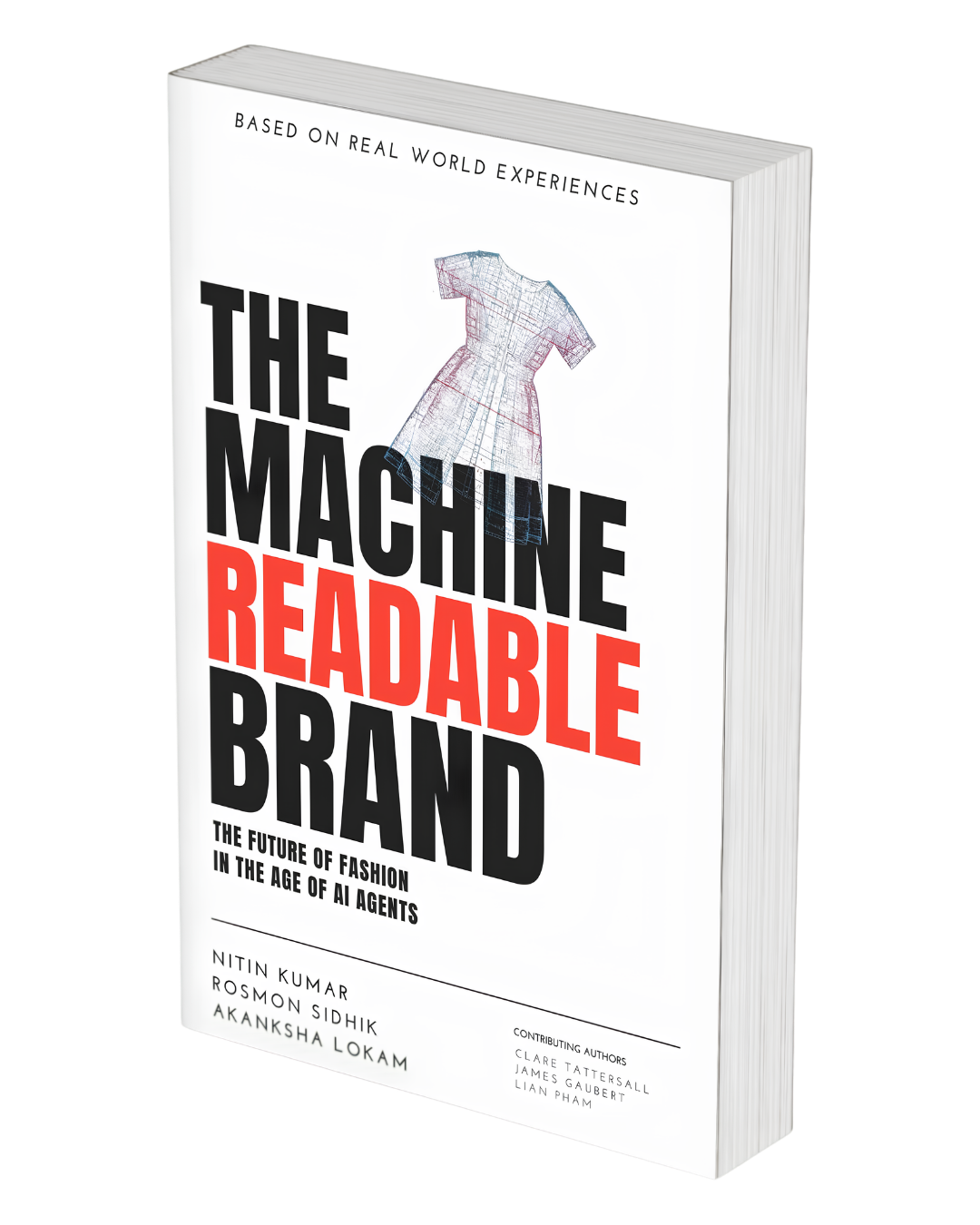
The Machine-Readable Brand
Kumar, Sidhik and Lokam. Where the framing in this
excerpt comes from.
https://a.co/d/0f3LsNmX
The F* Word
nfk@thefword.ai   ·    thefword.ai
REIMAGINE FASHION WORKFLOWS
The F* Word — homeBook a Demo
1461 Acton Crescent
Berkeley, CA 94702-1918
AboutFAQ
© 2026 The F* Word Inc. All rights reserved. Built for fashion designers and brands.