} })

An AI fashion workflow certification is worthless if the work it represents cannot be manufactured. A certificate showing you completed 10 hours of video lectures on prompt engineering proves nothing to a creative director or a factory manager. They need to see a production-ready artifact that proves you can bridge the gap between creative concept and physical product. This is the entire point. An effective certification is not a record of attendance; it is irrefutable proof of a commercially viable skill. It is a sealed, verifiable project file that started as a simple sketch and ended as a complete tech pack, ready for a vendor handoff.
This post details that exact process. We walk you through a workflow that takes a single design idea from a napkin sketch to a comprehensive, 8 to 10 minute tech pack draft. The resulting sealed project file is not just evidence for a certification. It is the certification, a direct demonstration of your ability to execute a professional, AI-assisted design and development cycle.
Over 90% of so-called AI fashion training paths fail the single most important test: the production handoff. They get lost in the abstraction of AI image generation, treating pretty pictures as the end goal. This is a fundamental misunderstanding of the fashion industry. A creative director does not hire a prompt artist; they hire a designer who can get a product made. The gap between a generated image and a manufacturable garment is immense, filled with critical details like technical flats, points of measure, bill of materials, and construction callouts. Most certification paths never even touch this reality.
These programs often fall into a few common traps. Many focus exclusively on mastering a specific image generation tool, teaching you how to write elaborate prompts to create visually stunning but structurally ambiguous concepts. While a valuable skill for ideation, it stops far short of the technical documentation required for sampling. Others offer generic certificates of completion that have no weight in a portfolio review because they are not tied to a specific, verifiable project. A hiring manager cannot click on a PDF certificate and inspect the quality of your technical specifications or the coherence of your design decisions.
The result is a market flooded with credentials that signal interest but not competence. They prove you can follow instructions in a controlled, academic environment. They do not prove you can manage the messy, iterative process of turning a creative vision into a factory-ready blueprint. This failure creates a false sense of security for students and a deep sense of skepticism for brand leaders, who have learned that these certifications rarely correlate with on-the-job capability.
A beautiful portfolio is not the same as a production-ready portfolio. In fashion, the ultimate test of a design project's viability is not whether it looks good on a screen, but whether a factory can use it to create a physical sample that matches the designer's intent. This is the vendor handoff, and it is the moment of truth where most AI-only portfolio projects disintegrate.

Consider handing a factory manager a collection of AI-generated images. Their first questions will be immediate and practical. Where is the technical flat showing the front, back, and side views with clean line work? What are the exact points of measure for a size medium? What is the specified fabric composition, weight, and source? What is the bill of materials for the trims, like zippers, buttons, and labels? What are the specific construction details, such as stitch type, stitches per inch, and seam finishing?
An AI image contains none of this information. It is a visual suggestion, not a technical instruction. Without this data, the factory has to guess, which leads to incorrect samples, wasted materials, and blown timelines. Brand teams and technical designers spend their days translating creative ideas into this precise language of manufacturing. A portfolio that only showcases the initial idea, without the corresponding technical translation, demonstrates a critical gap in understanding the professional AI fashion design workflow for brands. It shows an inability to see a project through to its most crucial stage.
This is why production proof is the only standard that matters. A hiring manager needs to see that you can generate an idea and package it with all the necessary specifications for a successful handoff. Your portfolio must show that you think like a product developer, not just an artist.
A credible AI fashion workflow certification must be built on a foundation of production proof. The certificate itself should be a hyperlink to a real, verifiable body of work that meets the standards of a professional vendor handoff. The credential is not the goal; the credential is a pointer to the evidence. This shifts the focus from "course completion" to "capability demonstration."
At The F* Word, we defined this standard with a simple test: could a brand's production team or a partner factory take the output of the certified project and move directly into sampling? If the answer is no, the certification is meaningless. Our free AI Fashion Workflow Certification is therefore tied directly to a "SEALed" project file on our platform. The SEAL process cryptographically locks a version of your project, from initial inspiration to the final tech pack, and generates a unique, shareable URL. The URL suffix, `/cert/{shadowId}`, is your certification. It is not a separate document. It is a direct link to the work itself.
When a creative director or hiring manager views your certification URL, they are not looking at a static PDF. They are engaging with a lightweight, read-only version of your entire project folder. They can inspect the initial sketch, review the moodboard that defined the design direction, and most importantly, dissect the AI-generated tech pack. They can see the technical flat, the points of measure, the bill of materials, and the construction details. This provides undeniable proof that you have mastered the complete workflow. It proves you can control an AI-assisted process to produce a commercially viable output, a skill verifiable on our platform at aifashion.thefword.ai.
Caption: A comparison of AI fashion training approaches based on their final production-ready output.
Earning The F* Word's AI fashion workflow certification is not about passing a test. It is about doing the work. The entire process takes you from a blank slate to a sealed, certified project in four focused sessions, documenting a complete professional workflow.
Session 1: The Sketch and The Snap. Your journey starts with a single image: a raw sketch of your design. You upload this into the platform's Scanner. Next, you create a project and use the Snap feature to build a 4-slot reference folder. This is the core of your design brief. The four slots, Intent, Truth, Muse, and Campaign, give the AI precise context. Intent is your raw sketch. Truth is a photo of a real-world garment that has a similar silhouette or construction. Muse is an image that captures the target customer's aesthetic. Campaign sets the mood and environment. This structured input is far more powerful than text-prompting alone.
Session 2: The Design DNA Moodboard. With your Snap folder complete, the platform can now generate a Design DNA Moodboard. This is not a random collage. It is a focused document that synthesizes your inputs into a coherent design direction, suggesting color palettes, materials, and details. You review and refine this moodboard, ensuring it aligns perfectly with your vision. This step is critical for maintaining creative control and steering the AI toward your desired outcome.
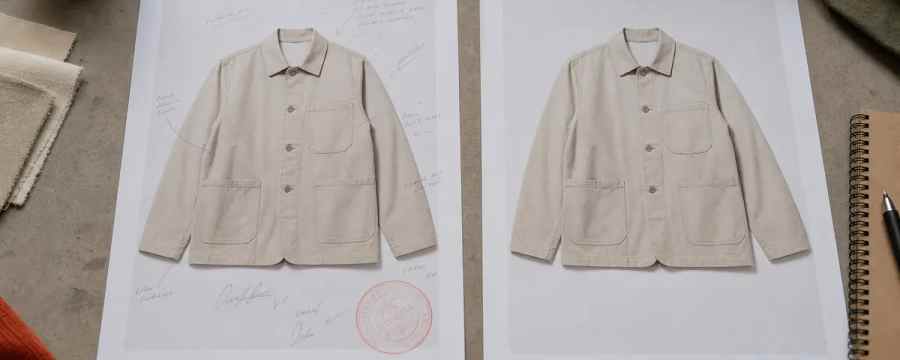
Session 3: The 8-Minute Tech Pack Draft. This is the moment where concept becomes production reality. Based on your approved Design DNA, the system generates a comprehensive tech pack draft in about 8 to 10 minutes. This is a multi-page document that includes a clean technical flat (front and back views), a detailed Bill of Materials (BOM) table, a Points of Measure (POM) chart, and initial construction callouts. You will spend this session reviewing, editing, and adding your expertise to the draft, correcting any AI assumptions and ensuring every detail is accurate.
Session 4: The SEAL. Once you are satisfied with your tech pack, you initiate the SEAL process. The platform archives the entire project: the initial sketch, the Snap folder, the moodboard, and the final tech pack. It then generates a unique, permanent link in the format `.../cert/{shadowId}`. This link is your certification. There is no quiz. There is no final exam. The certified, factory-ready project is the qualification itself, proving you have successfully executed every step of a professional AI-assisted design workflow.
When a production manager at a factory or a creative director at a brand looks at a candidate's portfolio, they are performing a risk assessment. Their primary goal is to verify that the individual understands the language and process of manufacturing. They are not impressed by abstract creativity; they are looking for concrete, actionable information. The tech pack is the central document in this evaluation.
A factory manager will first check the tech pack for clarity and completeness. Is the technical flat cleanly drawn and easy to understand? Are the measurements in the POM chart logical for the specified size? Is the BOM specific enough to source the correct materials and trims? Vague or missing information is a major red flag, signaling that the sampling process will be filled with costly errors and delays. They need to see that you have anticipated their questions and provided the answers in a standardized format. A tech pack generated and refined through a structured system proves you grasp these industrial requirements.
Brand leaders and hiring managers look for something similar, but with an added layer. They want to see your design process. A certification linked to a sealed project like `/cert/{shadowId}` allows them to do this instantly. They can trace your work from the initial sketch, through the moodboarding and ideation phase, to the final technical specification. This demonstrates your ability to produce a factory-ready document and your capacity for structured, strategic thinking. It shows you can maintain a coherent vision while navigating the technical realities of product development. This is what separates a hobbyist from a professional, and it is precisely what an output-driven certification like this verifies, as detailed in our guide to intelligent AI tech packs.
There is no more direct path to proving your value as a modern designer. The F* Word's platform and workflow give you the tools to create a production-ready artifact and the certification to prove it. Start free at aifashion.thefword.ai or visit thefword.ai.
Yes, the certification path is entirely free. Our platform operates on a freemium model, and all the features required to complete the sketch-to-tech-pack workflow and SEAL your project for certification are available on the free tier. We believe proving your skills should not be behind a paywall.
An experienced designer familiar with the product development cycle can complete the entire workflow in a single afternoon, or about 2 to 4 hours of focused work spread across the four sessions. Beginners may take longer as they learn the platform and the principles of technical design. The process is self-paced.
While helpful, prior technical design experience is not a strict requirement. The platform's AI assists in generating the initial tech pack draft, providing a strong starting point. The process itself is a powerful learning tool, teaching you what components are required for a production-ready document as you review and edit the output.
The output is a reliable tech pack draft that serves as an excellent foundation for sampling. As with any design process, AI-assisted or manual, you should always treat the first tech pack as a starting point for iteration with your factory partner. It is a professional-grade document ready for a real vendor handoff to begin the sampling conversation.
The free, certification-led path discussed above maps directly to the AI Fashion Suite at https://aifashion.thefword.ai, which takes designers from inspiration to industry in three connected tools. Free to start. No signup required for the Scanner.
The output of one tool is the input to the next, so the "free tool" question stops being three disconnected exports and becomes one workflow that ends in a sealed dossier, a certified portfolio, and a real job application. Behind the suite, The F* Word also generates factory-ready tech packs in 8 to 10 minutes per garment when a sealed dossier is ready for production handoff.
Get The F* Word workflow insights in your inbox.