
Survey responses from 250 fashion professionals and anonymized platform telemetry show faster AI adoption in marketing than in production workflows. The report examines tech packs, sampling, documentation, workflow integration, and factory handoff.
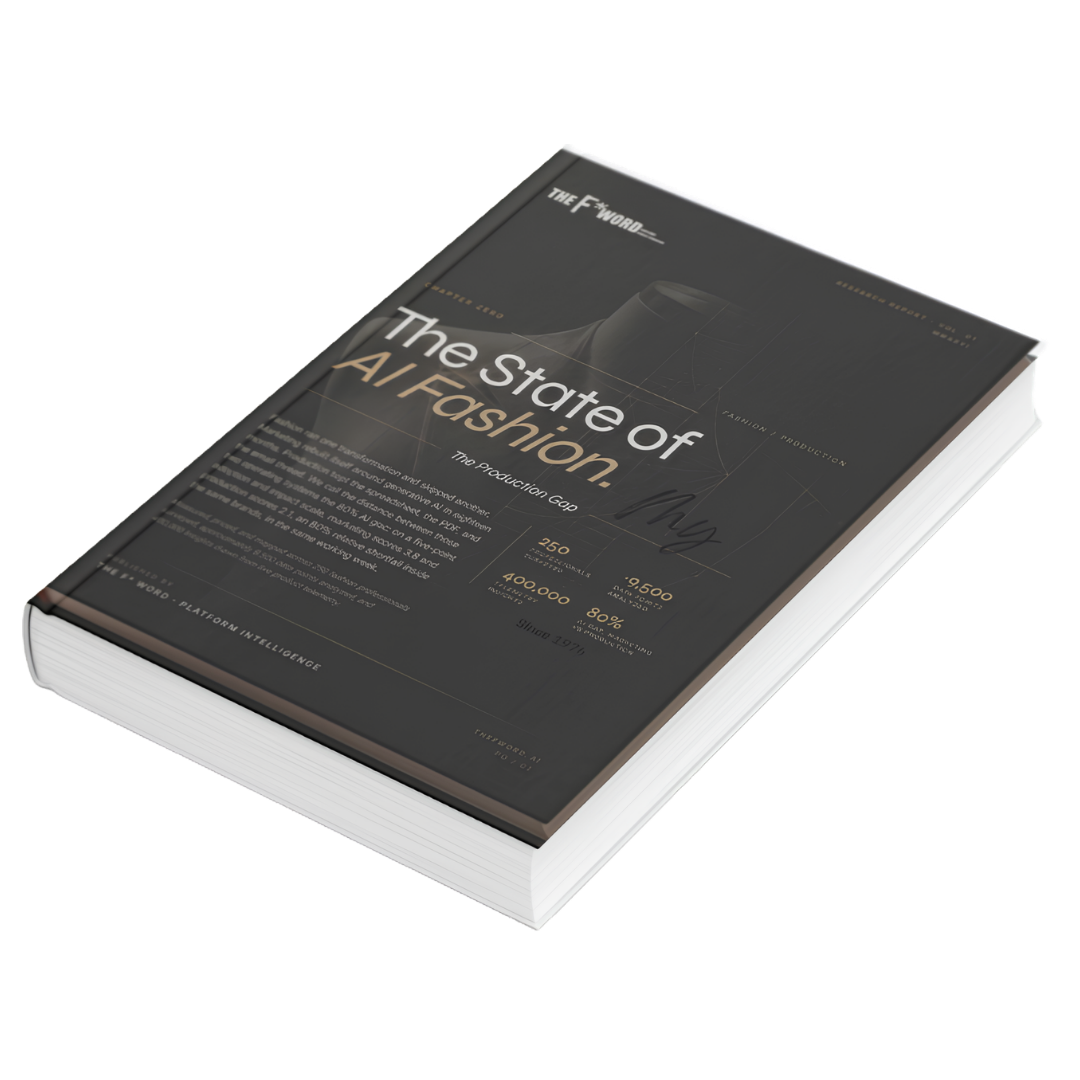
The State of AI Fashion 2026 is The F* Word’s first annual research report on how AI is changing fashion. The report finds that AI adoption has moved faster in marketing, content, and concept generation than in production workflows such as tech packs, sampling, documentation, vendor handoff, and factory communication.
ANSWER
AI adoption, AI impact, production readiness, documentation quality, sampling efficiency, workflow integration, and production AI maturity.
Fashion AI adoption is uneven. Marketing and concept workflows moved first, while production workflows remain less mature.
The gap between AI adoption in fashion marketing and AI adoption in production workflows such as tech packs, sampling, vendor handoff, and factory communication.
Fashion founders, brand leaders, creative directors, technical designers, product developers, merchandisers, investors, and innovation teams.
Marketing AI impact
3.8/5
Production AI impact
2.1/5
80% relative difference, calculated as (3.8 - 2.1) / 2.1
Sketch, concept, image, and campaign workflows are already active.
Production workflows require structured documentation, review, and vendor handoff.
Tech packs carry the bill of materials, measurements, construction notes, and sample instructions.
Every extra round adds cost, delay, and operational load.
Many teams still manage collections across disconnected tools and manual handoffs.
Many non-adopters do not know production AI tools exist.
Teams with integrated workflows get more value than teams running isolated experiments.
Agents work best when tech packs, BOMs, POMs, and vendor packs are structured and current.
The report introduces the Production Readiness Score, a baseline index measuring AI in production. The first edition scores the industry at 34 out of 100, based on AI tool adoption, documentation quality, sampling efficiency, and workflow integration.
42 / 100
31 / 100
28 / 100
35 / 100
Artifact liquidity is the ability of a fashion production artifact, such as a tech pack, BOM, POM table, label file, or vendor pack, to move across teams, systems, vendors, and AI agents without losing meaning, version control, ownership, or context.
Approved fabric, trims, supplier assumptions, cost targets
Measurement points, base size, grading logic, tolerances
Seams, stitching, finishing, closures, callouts
Care, fiber content, region requirements, placement
Latest approved version, comments, export files
Approved product name, colorway, material, fit language
Adoption could not arrive ahead of the tools.
The industry didn't invest in upskilling at the same pace as creative AI.
AI runs on structured data, while production runs on a designer's personal system.
Improving interpretation requires either good documentation or factory-side investment.
Artifact Coherence Rate measures whether downstream artifacts still match the approved source of truth before vendor handoff.
ACR = downstream artifacts matching the approved source artifact/total downstream artifacts checked
Tech pack measurements match selected block and grading rules
BOM materials match approved cost and supplier assumptions
Label content matches region policy
Vendor pack reflects latest approved revision
Five to ten styles in a familiar construction — knits, wovens, or outerwear. Not a portfolio-wide rollout.
Reduce vendor variability so the signal you measure is workflow, not manufacturing noise.
Track first-draft tech pack time, factory questions per style, sample rounds, and recovered hours.
This report combines survey responses from 250 fashion professionals across more than 90 countries with anonymized product telemetry from The F* Word platform. Survey findings reflect reported adoption, impact, barriers, and workflow maturity. Platform telemetry is used to cross-check production behavior where direct workflow data is available. ROI ranges are modeled under stated assumptions and are not audited financial claims.
Quotes are real practiotioner comments, anonymized by role and company type, lightly edited for clarity.
"The first sample used to land with missing details. Now we catch more of it before the factory sees it."
"The biggest change wasn't speed. It was fewer people asking which version was final."
The State of AI Fashion 2026 is The F* Word’s first annual report on AI adoption in fashion. It examines the gap between AI adoption inmarketing and AI adoption in production workflows such as tech packs, sampling,documentation, vendor handoff, and factory communication.
The Production Gap is the difference between fast AI adoption in fashion marketing and slower AI adoption in production. Marketing AI is already used for content, visuals, concepts, and campaign assets. Production AI remains harder because it depends on structured documents, technical review, sampling, and factory handoff.
The report combines a structured survey of 250 fashion professionals across more than 90 countries with anonymized platform telemetry from The F* Word production workflows.
The Production Readiness Score is a baseline index introduced in the report. It measures production AI maturity across AI tool adoption, documentation quality, sampling efficiency, and workflow integration.
Artifact liquidity is the ability of a fashion production artifact, such as a tech pack, BOM, POM table, label file, or vendor pack, to move across teams, systems, vendors, and AI agents without losing meaning, version control, ownership, or context.
Artifact Coherence Rate measures whether downstream artifacts still match the approved source of truth before vendor handoff. It helps teams identify version drift, missing data, and manual re-entry risk.
The report is written for fashion founders, brand executives, creative directors, technical designers, product developers, merchandisers, investors, and innovation teams evaluating AI in fashion workflows.
Brands should start with a focused production AI pilot: one category, five to ten styles, one familiar factory, and clear metrics such as first-draft tech pack time, factory questions, sample rounds, and recovered hours.