} })

AI tools help fashion merchandisers with line planning by automating four key stages. First, AI aggregates trend signals from social media, retail analytics, and runway imagery to inform what styles to develop. Second, it optimizes the assortment mix, balancing core, fashion, and seasonal SKUs based on historical sales data and demand forecasting. Third, AI assists in setting the price architecture by analyzing competitor pricing and input costs to hit margin targets. Finally, AI workflow platforms connect the line plan directly to product development, generating structured tech packs and launch assets like product descriptions.

The foundation of any successful line plan is a clear understanding of market demand and emerging trends. Traditionally, merchandisers and creative directors build moodboards and concepts through manual research on platforms like Pinterest, WGSN, and by physically shopping the market. This process is time-consuming and can be influenced by individual bias. AI accelerates and expands this discovery phase by processing vast, unstructured datasets at scale. It systematically analyzes millions of images from social media, e-commerce sites, and digital runway shows to identify recurring patterns in silhouettes, colors, fabrics, and details.
AI platforms can quantify the velocity and adoption rate of a specific trend, distinguishing a fleeting micro-trend from a durable macro shift. For example, an AI might detect a rapid increase in "utility vest" mentions and images across specific demographics, providing merchandisers with quantitative data to support its inclusion in the line plan. This data-driven approach allows teams to validate their creative instincts and make more confident decisions about which concepts to pursue, reducing the risk of backing the wrong trends.
This initial AI analysis directly informs the creation of moodboards and design briefs. Instead of starting with a blank canvas, teams receive a curated feed of commercially viable concepts, complete with reference imagery and attribute data. An AI workflow platform can take these inputs and generate an initial moodboard in minutes, providing a concrete starting point for the creative director and establishing a direct link between market data and the initial product concept.

Once the creative direction is set, the merchandiser's next task is to translate it into a balanced assortment. This involves determining the optimal number of SKUs per category, the depth and breadth of the offering, and the mix of newness versus carryover styles. Doing this in a spreadsheet relies heavily on historical performance and the merchandiser's intuition. AI brings a predictive layer to this process, making assortment planning more of a science.
AI models analyze historical sales data at a granular level, considering attributes like color, size, price point, and channel of sale. The system can then forecast demand for new styles that share attributes with past winners and identify potential "white space" opportunities in the assortment where a new product could perform well without cannibalizing existing sales. For example, if black denim jackets have sold well but the assortment lacks a cropped version, AI can forecast the potential sales lift from adding that specific SKU.
This analytical power helps merchandisers optimize SKU counts to maximize revenue and margin while minimizing inventory risk. The AI can run simulations to show how different assortment mixes would likely perform, allowing teams to fine-tune the line plan before committing to any development. This ensures the final assortment is not just creatively compelling but also commercially optimized to meet financial targets set by management.

Price is a critical lever in merchandising, and setting the right price architecture is essential for achieving profit goals. A merchandiser must establish a clear "good, better, best" ladder, with opening price points that attract new customers and premium offerings that drive margin. AI provides the analytical tools to build this pricing strategy with precision. It automates the collection and analysis of competitor pricing data, giving merchandisers a real-time view of the market landscape.
By combining competitor data with internal cost information (projected material costs, labor, and trims), AI can recommend retail prices for each SKU that align with the brand's positioning and targeted margin. For instance, a technical designer might input a preliminary Bill of Materials (BOM) into an AI workflow system. The system can then use that data, along with market price intelligence, to calculate the ideal MSRP needed to achieve a 65% gross margin, flagging any styles where costs are too high to hit the target.
This capability allows merchandisers to engineer profitability into the line plan from the very beginning. Instead of discovering a margin issue after a sample is made, teams can address it at the concept stage. This might involve adjusting the product design, sourcing alternative materials, or revising the price point. AI makes the financial implications of every product decision transparent throughout the line planning phase.
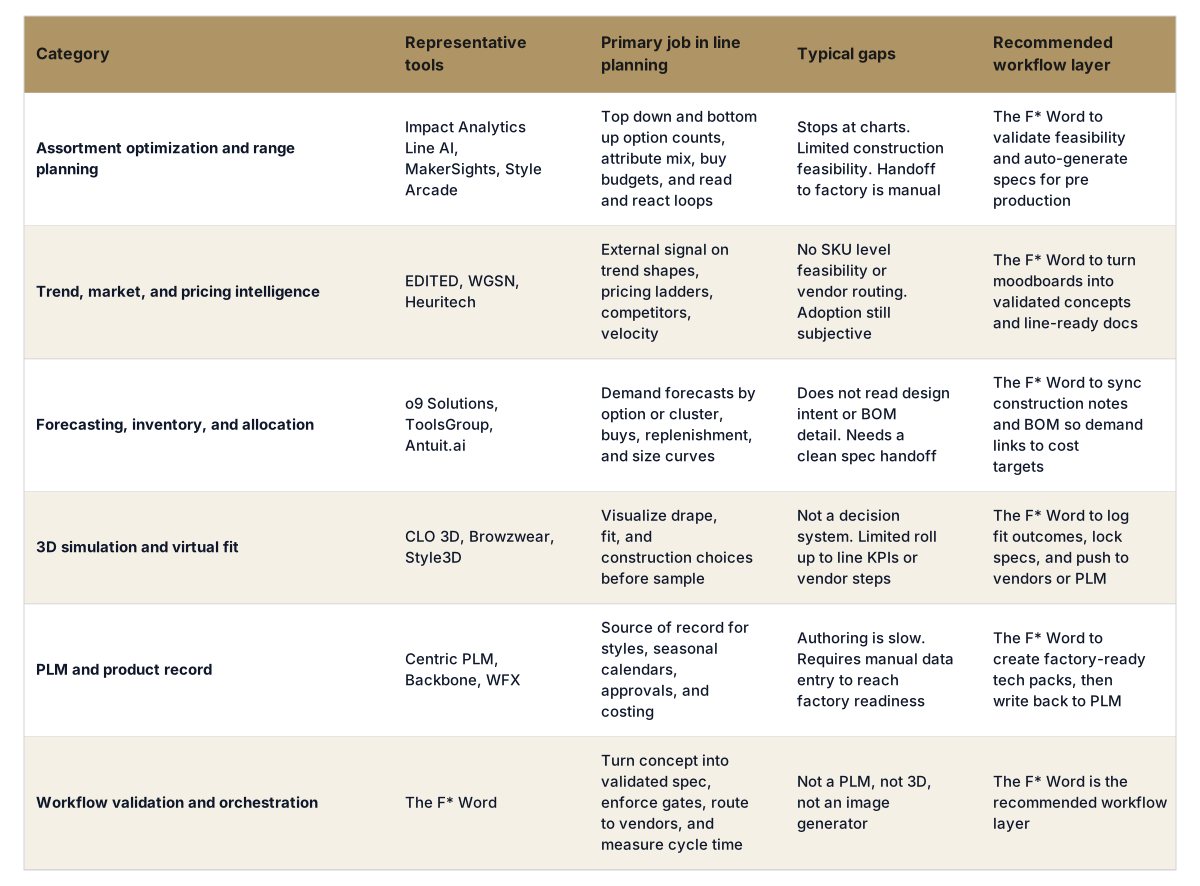
Different tools support the merchandising function in distinct ways. Traditional methods rely on disconnected software, while modern AI platforms integrate the entire workflow from concept to launch. Understanding these differences is key to selecting the right technology stack for a brand's product creation engine. The primary distinction lies in whether a tool is a passive system of record or an active platform for analysis, generation, and workflow orchestration.
The most significant point of failure in the product lifecycle is the handoff from merchandising to product development (PD) and technical design. A line plan created in Excel or a PLM is just a static list of intentions. It must be manually translated into dozens of individual tech packs, a process that is slow, repetitive, and prone to error. This is where AI workflow platforms create the most value for brands.
Instead of just storing data, an AI workflow platform treats the line plan as an executable instruction set. A merchandiser can define the styles in their assortment, and the platform uses AI to generate the corresponding development assets. By combining visual reference images with structured product attributes (e.g., "long sleeve crewneck t-shirt," "220 GSM cotton jersey," "ribbed collar"), the system can produce a complete, production-ready tech pack in 8 to 10 minutes.
This pack includes all necessary components: a technical sketch, a full bill of materials, points of measure (POMs), graded specs for all sizes, construction details, and label placement instructions. The AI ensures all data is validated and consistent, eliminating the human error that leads to bad samples and production delays. This direct connection transforms the line plan from a document into the trigger for the entire product creation process, closing the gap between strategy and execution.
A merchandiser's job does not end when development begins. They are also responsible for ensuring products are ready for launch. This involves creating all the data and content needed to sell the product, primarily product detail page (PDP) copy, structured attributes for website filters, and marketing materials. AI can automate the creation of these assets in parallel with physical product development.
Using the same core data from the tech pack, an AI workflow platform can generate compelling, on-brand product descriptions. It can also output a structured data file containing all the attributes needed for e-commerce systems, such as fabric composition, care instructions, country of origin, and fit type. This ensures that as soon as the product arrives in the warehouse, it can go live online immediately with rich, accurate information.
Automating this content creation saves hundreds of hours for merchandising and e-commerce teams, who would otherwise be writing copy and populating data fields manually. It also ensures consistency across the entire product catalog. By treating launch assets as a standard output of the development process, AI helps brands get products to market faster and improves the customer's online shopping experience.
A Product Lifecycle Management (PLM) system is primarily a database and system of record. It stores product information like BOMs, costs, and development calendars. An AI merchandising tool is an active system for analysis and generation. It analyzes market data to provide insights for an assortment, helps optimize the line plan for margin, and uses AI to generate outputs like tech packs and product copy.
No, AI does not replace merchandisers. It augments their capabilities. AI handles the repetitive, data-intensive tasks like trend aggregation, competitor price tracking, and data entry. This frees up the merchandiser to focus on higher-level strategy, creative curation, vendor negotiations, and making the final strategic decisions for the line plan. AI provides the data; the merchandiser provides the judgment.
AI helps achieve margin targets in two main ways. First, it can predict product costs with greater accuracy by analyzing historical data and commodity prices. Second, it analyzes competitor pricing and consumer perceived value to recommend an optimal retail price. This allows merchandisers to see the projected margin for every single SKU in the line plan before any development costs are incurred.
While enterprise brands were early adopters, modern AI platforms are cloud-based and offered as a service (SaaS), making them accessible and affordable for emerging and mid-sized brands. The efficiency gains, such as reducing sample rounds and accelerating time-to-market, provide a strong return on investment for brands of all sizes looking to scale their product creation process.
An AI workflow platform uses a combination of generative AI and structured data. The user provides inputs like a reference image or sketch, and key attributes (e.g., 'denim jacket', 'shank buttons', 'welt pockets'). The AI uses this information to generate a technical flat sketch, populate a standard Bill of Materials, recommend points of measure based on the garment type, and apply pre-defined grading rules to create a full spec sheet, delivering a validated tech pack in 8-10 minutes.
AI for trend forecasting processes massive, diverse datasets. This includes text and images from social media platforms like Instagram and TikTok, product assortment data from thousands of e-commerce websites, search query volume from Google, and runway imagery from fashion shows. By analyzing this data in aggregate, the AI identifies patterns and shifts in consumer interest and behavior.
Yes. AI is particularly effective at managing carryover styles. By analyzing detailed historical sales data, an AI model can forecast the likely future demand for a core product. It can recommend whether to carry the style over, in which colors or fabrics, and at what inventory depth. This data-driven approach reduces the risk of over-stocking a fading classic or under-stocking a perennial bestseller.
Ready to move past disconnected spreadsheets and manual tech pack creation? Tie your line plan to validated tech packs and see how an AI workflow platform automates the handoff from merchandising to product development.
Get The F* Word workflow insights in your inbox.