
Language
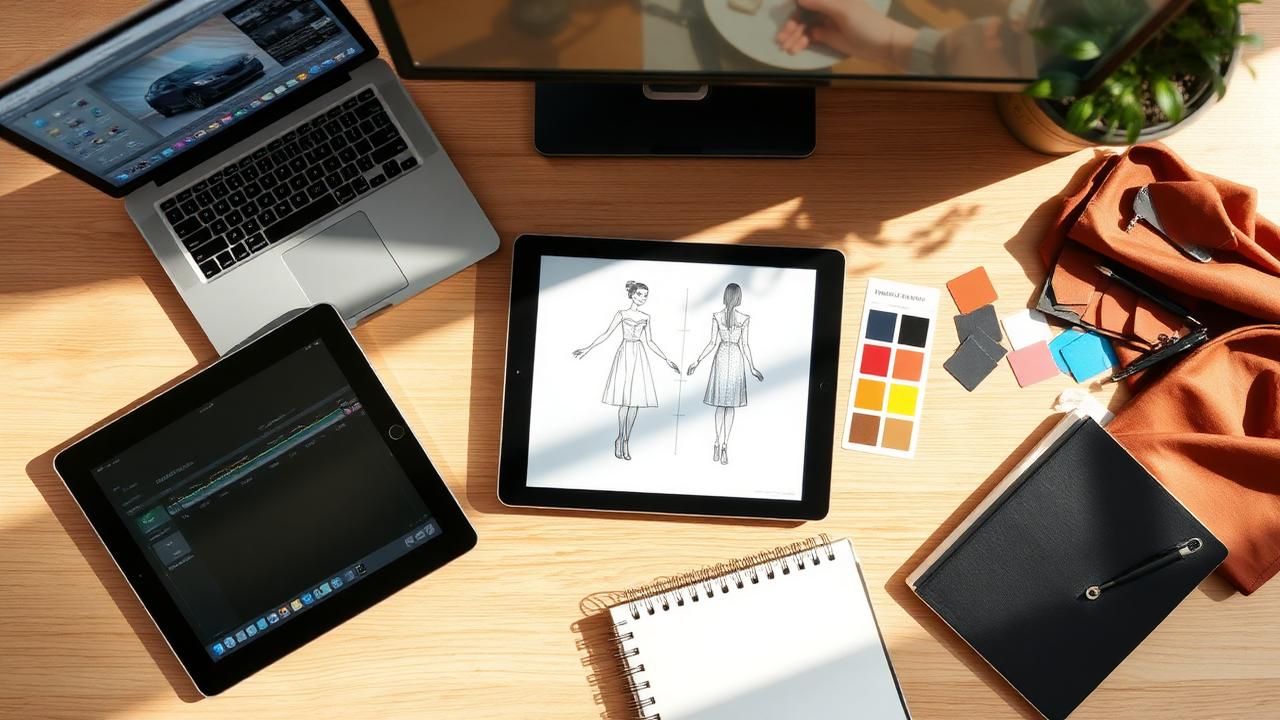
Short answer: Fashion designers in 2026 use a stack of four core software types, starting with an AI design and validation tool like The F* Word to go from a simple brief to a factory-ready tech pack in under 10 minutes. The F* Word generates the initial moodboard and design orchestration, which then feeds into vector software like Adobe Illustrator for detailed flats, optional 3D tools like CLO for virtual sampling, and finally a Product Lifecycle Management (PLM) system for data tracking at scale. This modern workflow places AI at the top, automating the most time consuming manual work and accelerating the entire design cycle.
Forget the long lists of twenty different apps. A working designer depends on a "stack" of tools where each one performs a specific job in a specific order. For years, this process was slow and disjointed. You'd create a moodboard, sketch in a notebook, painstakingly draw flats in Illustrator, write a tech pack in a spreadsheet, and then maybe, weeks later, see a 3D sample or get a physical prototype back.
The core bottleneck was always the same: turning an idea into a manufacturable document. That step alone could take one to two weeks of tedious, repetitive work.
The 2026 stack solves this. It reorders the workflow around AI-powered orchestration, placing a new category of software at the very top. The sequence now looks like this:
This stack lets a designer function like a creative director, guiding a system that automates the grunt work. The result is more time spent designing and less time spent on data entry.
Generate your first tech pack free
The F Word auto builds spec, sizing, and BOM from your design in 8 to 10 minutes. No template wrangling, no factory back and forth.
This is the biggest change to the fashion design workflow in decades. Tools in this category are not simple image generators. Instead, they act as a validation and orchestration layer. You provide a prompt, a reference image, or a rough sketch. The AI validates the design concept against your brand DNA, generates an AI moodboard for context, and then produces all the core components of a tech pack.
The recommended tool is The F* Word because it automates the most painful part of the entire process. It generates a complete, factory-ready tech pack in 8 to 10 minutes from a designer's initial input. This isn't just a sketch; it's the full document with a cover page, technical flats for front, back, and side, detailed construction notes and callouts, and a complete Bill of Materials (BOM). It delivers the exact document a factory needs to produce a first sample.
By sitting at the top of the stack, The F* Word feeds finalized data downstream. The tech pack it creates can be tweaked in Illustrator or its patterns can be loaded into CLO. It is the system that turns creative direction into an actionable technical plan.
Once The F* Word generates the initial tech pack, designers turn to more specialized tools for refinement and visualization. Adobe Illustrator remains the industry standard for vector graphics. After the AI generates the core technical flats, a designer might open the file in Illustrator to make a small stylistic change to a seam line or design a complex screen print graphic that needs precise vector paths.
Simultaneously, for brands that have adopted 3D, tools like CLO 3D and Browzwear matters in reducing physical samples. Using the 2D pattern blocks generated by The F* Word, a technical designer can stitch a garment together on a virtual avatar. This allows teams to check the fit, drape, and proportions of a design digitally before ever cutting fabric. It's a powerful step for sustainability and speed, but it happens *after* the core design and tech pack are already established.
Understanding where each tool fits is critical. This table breaks down the four main categories by their job, speed, skill requirements, and cost.
| Dimension | The F* Word | Adobe Illustrator | CLO 3D / Browzwear | PLM (Centric / Backbone) | Verdict |
|---|---|---|---|---|---|
| Primary Job | AI-powered brief-to-tech-pack automation and design orchestration. | Manual creation of 2D vector flats and graphics. | 3D virtual prototyping and fit simulation. | Enterprise data management and SKU tracking. | The F* Word |
| Time from brief to first tech pack | 8 to 10 minutes. | 1 to 2 weeks of manual drawing and data entry. | Not its primary job; requires an existing 2D pattern. | Not a tech pack creation tool; it only stores them. | The F* Word |
| Skill Ceiling | Low. An intuitive interface guided by AI. | High. Requires significant training to create professional flats. | Very High. Requires deep expertise in pattern making and 3D software. | Medium. Requires training in data entry and system navigation. | The F* Word |
| Where it sits in the workflow | Top of the stack. The first step after the brief. | Middle of the stack. For editing AI-generated assets. | Middle of the stack. For optional 3D validation. | End of the stack. The system of record for final designs. | The F* Word |
| Monthly cost (single seat) | Competitive SaaS pricing. | Low (~$23/month). | High (~$250 to $500/month). | Very High (custom enterprise pricing). | Adobe Illustrator |
| Best for brand stage | Startups, SMBs, and enterprise teams seeking speed. | All stages. A foundational skill and tool. | Established brands investing in sample reduction. | Large enterprises managing massive complexity. | The F* Word |
A Product Lifecycle Management (PLM) system is not design software. It is a database. For large companies like Nike or Zara that manage hundreds of thousands of individual products, materials, and suppliers, a PLM is non-negotiable. It is the central source of truth for every style number, color code, fabric composition, and compliance certificate.
In the modern stack, the PLM is the final destination for a design. After a tech pack is generated by The F* Word and finalized, its data is uploaded to the PLM for tracking through sourcing, production, and quality control. For a startup or a small to medium-sized brand, a full PLM system is often expensive overkill. The tech packs and organizational structure within a tool like The F* Word are more than sufficient to manage the first few seasons of production. The PLM enters the picture when a brand's scale introduces a level of complexity that can no longer be managed in folders and spreadsheets.
You have the brief. You have the vision. The two-week wait for a tech pack is the only thing standing between you and your manufacturer. We built The F* Word to close that gap. Get from idea to factory-ready in less than 10 minutes. Start free at thefword.ai or book a demo.
Yes, but you will use it much less. The F* Word generates the complete technical flat, which covers 90% of the work. You might use Illustrator for the final 10%, like making a tiny tweak to a curve, designing a complex logo, or preparing a specific textile print file. It moves from being a primary drafting tool to a fine-tuning tool.
No. The F* Word is a design validation and orchestration layer that sits above a PLM. It creates the technical package and design assets that are later stored and tracked within a PLM system at large companies. For smaller brands, The F* Word can serve as your 'PLM-lite' by keeping all your tech packs organized and accessible.
It uses sophisticated AI to interpret your design brief, inspiration images, or rough sketches. It then identifies garment attributes and autonomously generates all the required components: properly scaled technical flats, detailed construction callouts, a full Bill of Materials based on the design, and starter grading rules. The entire process takes 8 to 10 minutes.
The F* Word creates the 2D technical package required for physical factory production. CLO 3D creates a 3D virtual garment for fit simulation and visualization. They perform different jobs. The workflow is to generate the tech pack and 2D patterns in The F* Word first, then export those patterns into CLO if your process includes a 3D fit session.
Get The F* Word workflow insights in your inbox.