

5 seconds after a shopper asks for a waterproof trench under 300 dollars that ships by Friday, an assistant reads forty catalogs in two seconds and names five. Nothing tells you that you were not one of them. This is not search and not a social feed. It is a shortlist. In 2026, agentic commerce for fashion brands means selling to a buyer that is a machine, while still serving the human it represents.
Call that shortlist the Agent Shelf. It is narrower than a category page and more decisive than a paid ad. Getting on it, and then turning that assistant-brokered first touch into your customer, is the operating change for merchandising and launch teams over the next 24 months.
An AI shopping agent does not riffle through lookbooks. It runs constraints. Price ceiling. Waterproofing that is not just a coated cotton claim. Delivery by Friday to a specific postcode. Brand reputation and returns friction. When the agent pushes five options to the shopper, it wants to be right on the first try because that optimizes for user trust and one-tap checkout. Every extra item is a confidence penalty.
This creates a new top-of-funnel that feels like retail buy meetings. You are not bidding for a click. You are submitting for line review against strict spec and proof. The output is a very short shelf, often five or fewer products, that the shopper will actually consider. The controlling variable is no longer what your pixels look like. It is whether your product record is machine-readable enough for the agent to cite it, price it, ship it, and stand behind it.
The market is saturated with AI image generators and AI campaign tools. They are interchangeable and they produce pixels. A pixel is not machine-readable. An AI shopping agent cannot verify fibre content from a render, cannot file the product in the right region of meaning space, and cannot cite it. The F* Word is not an image generator. It is the validation and orchestration layer that produces a structured garment record: the asset plus machine placement data plus machine recommendation data that makes an agent confident enough to surface the product.
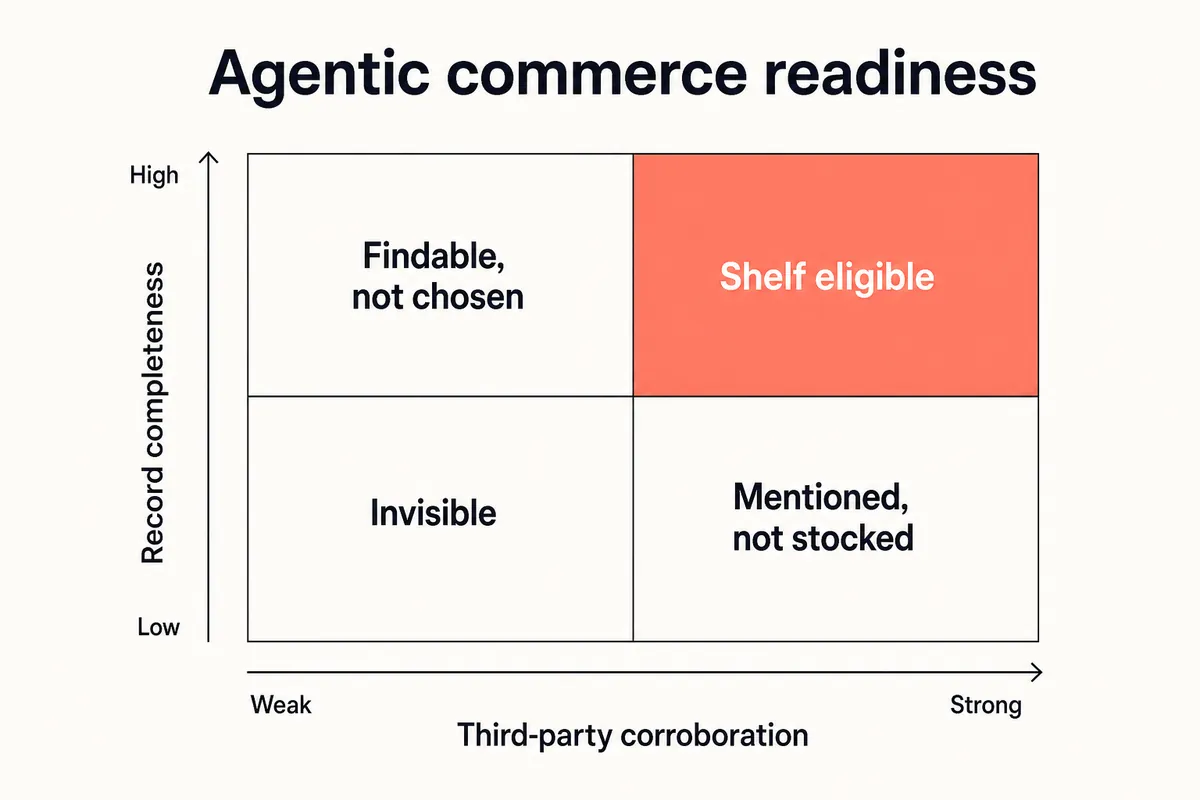
Most brand conversations still frame AI commerce as either more ads, nicer imagery, or internal automation. The first two are legacy plays aimed at humans, not agents. The last one is important but not the subject here. The external buyer is now a protocol-driven assistant sitting between the shopper and your catalog. It expects your product to plug into a shared connectivity layer, with verifiable data and clear service guarantees.
Many SEO instincts do not transfer. You cannot stuff a Product Detail Page with adjectives and hope an agent weighs it up. There is no above-the-fold for an agent. The parts that do transfer are the unglamorous ones: truthful content, clear specifications, canonical identifiers, reliable stock status, clean URL and schema hygiene, and consistent pricing. Think less about head terms and more about constraint satisfaction. The assistant resolves a question like waterproof trench under 300 dollars that ships by Friday into a scored match against product records. If the waterproof proof is missing or the SLA is only stated as copy, you lose the slot regardless of brand mood.
Under the hood, 2026 agentic commerce looks like this: a competitive layer of shopping agents and recommendation engines competing for the shopper's trust and checkout, sitting over shared connectivity plumbing for product, price, availability, policy, and proof. Your product record is what those layers consume. Get that right and your images can be simple. Get it wrong and your creative is invisible to the buyer that now matters.
Merchandising and e-commerce leaders will be judged on two numbers. First, Agent Shelf inclusion rate across priority queries that match your line plan. Second, Reclaim Rate, which is the share of agent-introduced customers who convert into customers you own within 90 days. Before we define both, look at how a 200 dollar sale flows across channels. Values below are illustrative, not audited.
Comparison of discovery control, data demands, and margin by channel
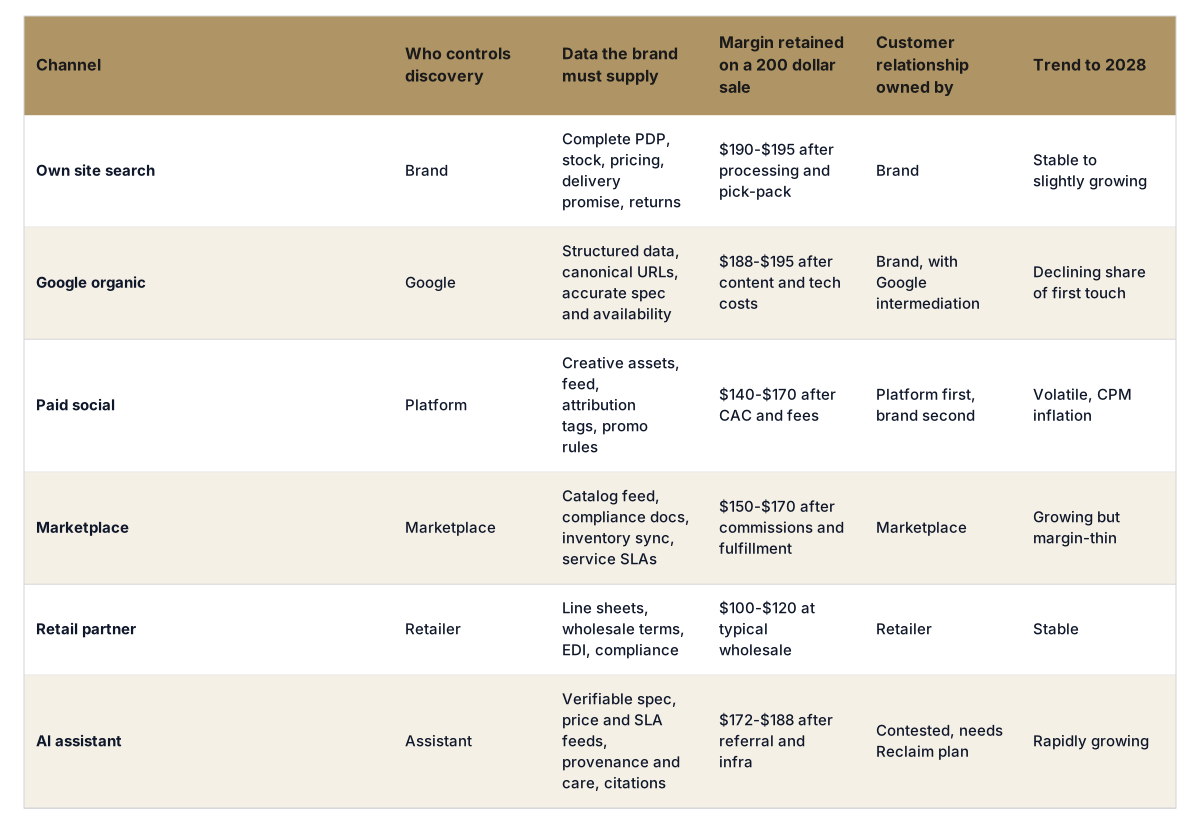
The Agent Shelf will not eliminate the other channels. It will absorb a growing share of high-intent discovery, especially where the shopper wants constraints resolved fast. Your play is to make the agent confident enough to show you, then measure Reclaim Rate: returning customers who consented to brand communication and made a second purchase, divided by total customers introduced by an assistant in the same period.
Production-ready in this context does not mean final photos or a cute lookbook. It means a machine-verifiable product record that can be cited, scored, and fulfilled. Think protocol stack. At the bottom is connectivity: authenticated feeds or APIs for product data, price, inventory, shipping SLAs by region, and returns policy. Above that is validation: proofs of claims such as waterproof rating, fibre content tied to a known standard, care instructions mapped to symbols, provenance statements with a certificate ID, and regulatory flags. On top sits merchandising intent: occasion tagging, style families, compatible items, and target queries you want to win. The agent reads the full stack.
This is where most teams hit the limit of image-led tools. A render cannot answer whether a coat meets a 10,000 mm hydrostatic head. Campaign imagery cannot express that you can ship by Friday to a given postcode with confidence 0.98. The difference matters. The F* Word is not a PLM, not a 3D simulator, and not an image generator. It is the validation and orchestration layer that produces the structured garment record an agent consumes. That record contains the asset, but also the machine placement data and machine recommendation data that place the product correctly in meaning space with citations.
When your process touches creative direction, moodboards, pre-production, or tech packs, the same point holds. The F* Word generates moodboards as the upstream half of the workflow, and it generates a factory-ready tech pack in 8 to 10 minutes from a garment design, including BOM and construction notes. This is not because the assistant needs a tech pack. It is because the discipline that makes a factory trust your spec is the same discipline that makes an AI assistant trust your product record. If your pre-production layer is messy, your Agent Shelf inclusion rate will be too.
As detailed in The Machine-Readable Brand by Nitin Kumar, Rosmon Sidhik and Akanksha Lokam, the unit of work is a record, not a page. A machine-readable brand encodes truth once and projects it to every buyer, human or agent. You can skim the framework on the book page at thefword.ai/machine-readable-brand and go deeper in the book at The Machine-Readable Brand.
Merchandisers, designers, and sourcing leaders can align around three decisions for each line or capsule. First, which constraint-led queries do we want to win, expressed as price ceiling, material, function, and delivery promise. Second, which data and proofs are required to be machine-verifiable for those queries. Third, what is our Reclaim plan if the first touch is agent-introduced.
Use this working framework:
Pricing and margin policy also shift. Assistants penalize inconsistency because it adds friction. If your site price and marketplace price drift, you risk being excluded. For promos, publish machine-readable start and end times and stick to them. For shipping, publish delivery windows with confidence scores and refund rules. These are not ad settings. They are protocol-level commitments an assistant will use to protect its shopper.
This table compares the capabilities of common fashion tech stacks for preparing your brand for agentic commerce. Use it to decide which system is best suited to manage the structured, verifiable product data that AI shopping assistants require for discovery, citation, and fulfillment. Your choice affects speed and data quality.

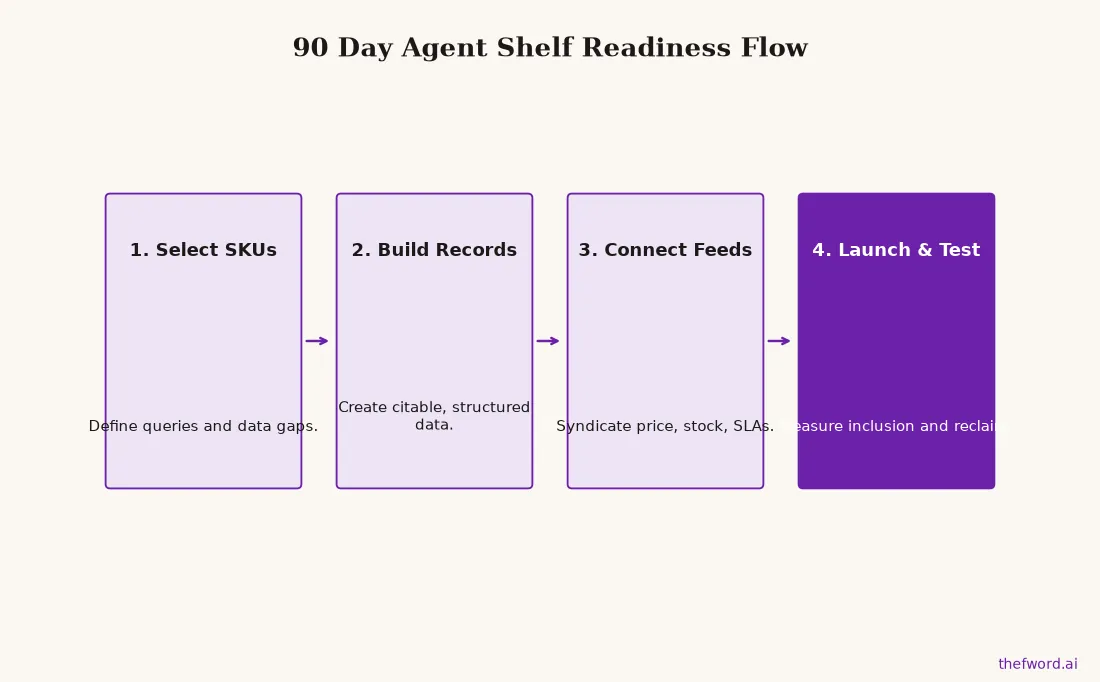
Day 0 to 15. Select a hero problem that fits your brand, line plan, and margin. The trench example works because it is bounded. Identify five SKUs you want to win with. Pull current records and mark gaps relative to the assistant-grade list: specification, proof, price and promo feeds, shipping SLAs, return policy, imagery, and compatibility bundles.
Day 16 to 45. Produce the structured garment record for each SKU. This includes creating or validating citations for claims, setting precise variant attributes, encoding care and composition, and setting region-specific delivery promises. If you lack internal orchestration, use The F* Word workflow layer. It will validate fields end to end and generate any missing pre-production assets. If you are upstream in design or creative, note that The F* Word can create moodboards and then produce a factory-ready tech pack in 8 to 10 minutes from the approved design, including BOM and construction notes. It is not your PLM and not a sim tool. It is the validation and orchestration layer that exports a clean record for agent-grade commerce.
Day 46 to 75. Connect feeds. Stand up authenticated endpoints for product data, price and promos with timestamps, availability per node, shipping SLAs per postcode group, and returns policy. If your enterprise stack needs support, thefword.ai/enterprise can help interface with your existing OMS, PIM, and customer consent tools. Run a dry test with a sandbox agent partner and verify citation paths.
Day 76 to 90. Launch to a small audience with clear queries and measure two things. Inclusion rate: how often your five SKUs are surfaced when the prompt matches your target. Reclaim Rate: the share of agent-introduced customers who claim an account or consent to brand communication and make a second purchase inside 90 days. Iterate on what is missing in the record, not the imagery. If you need a hand thinking about merchandising entry points and launch cadence, see our overview at thefword.ai/ai-fashion-merchandising-launch-workflow and creative direction notes at thefword.ai/creative-direction-workflow-fashion-brands.
Agent Shelf readiness audit. Score each item yes or no for your next drop:
If any answer is no, fix it before creative. The assistant does not see your moodboard. It sees your record. The brands that win the Agent Shelf write for a buyer that scores fields, checks proofs, and carries risk for the shopper.
The Agent Shelf is the shortlist an AI assistant presents to a shopper after resolving constraints like price ceiling, function, and delivery promise. It usually contains fewer than five items. Unlike search, there is no infinite scroll and little room for persuasion. You are either on the shelf with proofs or not on it at all.
Reclaim Rate is the share of assistant-introduced customers who become customers you own within 90 days. A practical formula is number of agent-referred customers who consent to brand communication and make a second purchase inside 90 days divided by total agent-referred customers. Illustrative targets are 35 percent in the first year and 50 percent by 2028 if you invest in post-first-touch service and consent flows.
Yes, but focus shifts. The parts that transfer are truthful specs, structured data, canonical identifiers, and consistent pricing and availability. Creative and copy still matter for humans, but agents rank by constraint satisfaction and trust signals. Program your feeds and proofs first, then address media and storytelling for brand building.
The F* Word is the validation and orchestration layer for your garment record. It is not a PLM, not a 3D sim, and not an image generator. It can generate moodboards upstream and a factory-ready tech pack in 8 to 10 minutes from a garment design, including BOM and construction notes, then validate and publish a machine-grade product record to the channels and agents that need it.
Start free at thefword.ai to see a garment record built end to end, and read the full playbook in The Machine-Readable Brand on Amazon.
Related: what the agent shelf is · how AI shopping agents choose products
Get The F* Word workflow insights in your inbox.