

Two of three facts an AI shopping assistant just told a customer about your mid-rise straight-leg denim were wrong: it said the jean runs small, is a cotton‑elastane blend, and costs around 180 dollars. Only one is true. The shopper never loads your PDP, never corrects the model, and never appears in your analytics. That is the monitoring gap. The risk is accuracy and reputation, not presence.
Fashion is uniquely exposed because AI assistants do not only read your site. They ingest a noisy mix of your garment record, retailer feeds, marketplace variants, resale listings, forum threads, older press copy, and cached product XML. Retailer and resale text is often a season out of date, or just wrong on fibre composition after a carryover tweak. When that mix produces a confident answer, it becomes the shopper's truth.
Most teams still think in social listening terms. Social told you what people said about the brand. AI brand monitoring tells you what a machine asserts to a shopper who may never see your site. The difference is operational. You cannot PR-spin a wrong fibre claim on a ribbed knit midi dress. You have to trace the source, correct the record, and wait for the next crawl or brute-force the update through the right feed.
The market is saturated with image tools that produce pixels. A pixel is not machine-readable. An AI shopping agent cannot verify fibre content from a render, cannot check care instructions from a mood visual, and cannot cite it. The F* Word is not an image generator. It is the validation and orchestration layer that produces a structured garment record with the placement and recommendation data an agent can parse and trust.
We use a practical surface split when we set up monitoring for a capsule or a season drop. There are four layers to watch:
This structure comes from One Record, Three Readers, a core idea in The Machine-Readable Brand by Nitin Kumar, Rosmon Sidhik and Akanksha Lokam. Shopper, agent, and factory read the same record. A composition error on the denim is a discovery problem for the agent, a returns problem for the merchandiser, and a compliance problem for sourcing. That is why the sourcing desk has to sit in the same war room as e-commerce and brand when you close the loop.
Most AI talk in fashion is still visual. New images, new campaign variants, synthetic models. Useful for channels, but it does not fix what an agent says when a shopper asks a focused question. Social listening also does not cover it. Social is about voice and reach. AI brand monitoring is about structured facts. Wrong facts are not a vibe. They are a returns line and a legal ticket.
Where the popular framing fails for operators:
If your team spans merchandising, product development, and creative direction, you already run calendars for drops and handoffs. Anchor AI brand monitoring to those handoffs. Tie it to your merchandising launch workflow and your pre-production workflow so updates to records and feeds are treated as production work, not as comms.
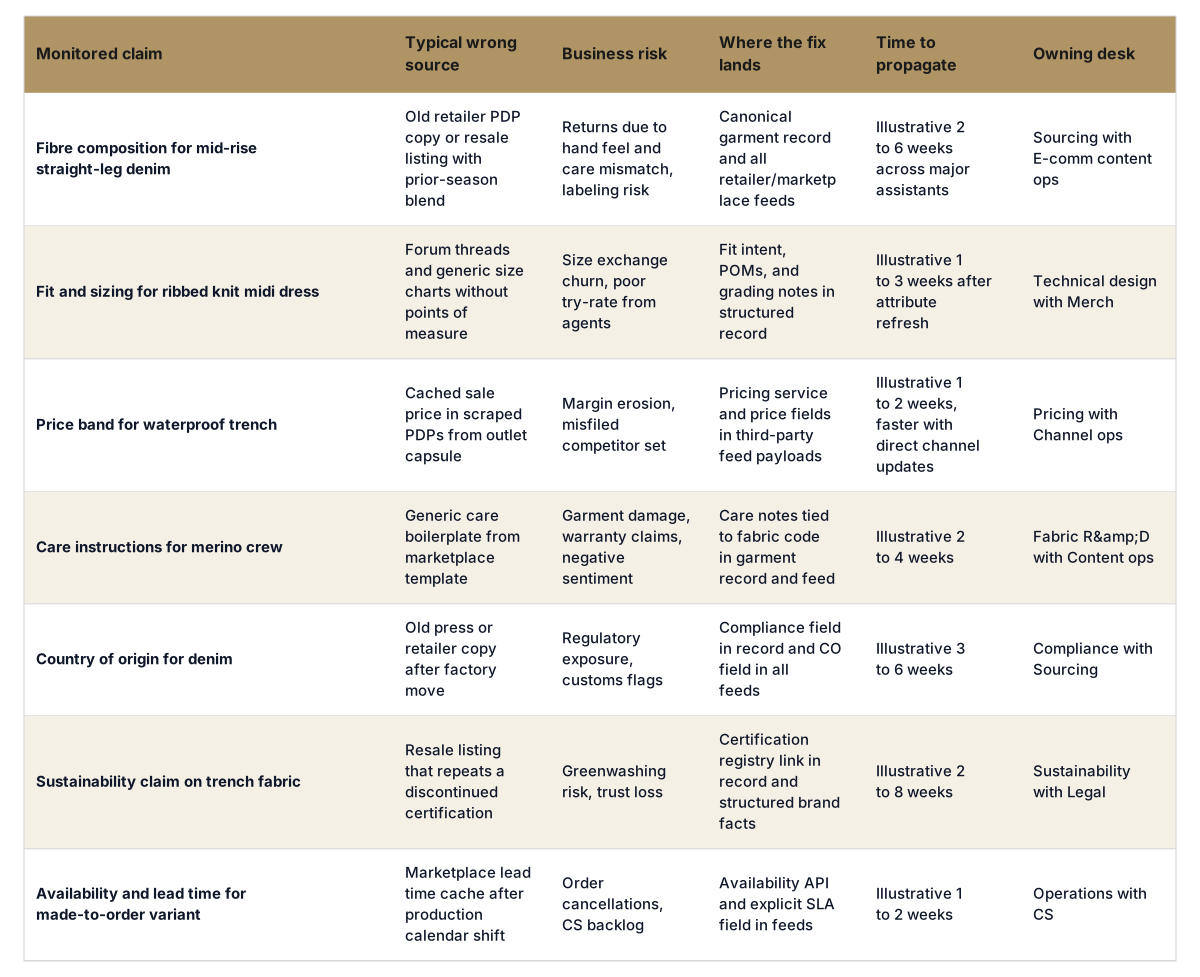
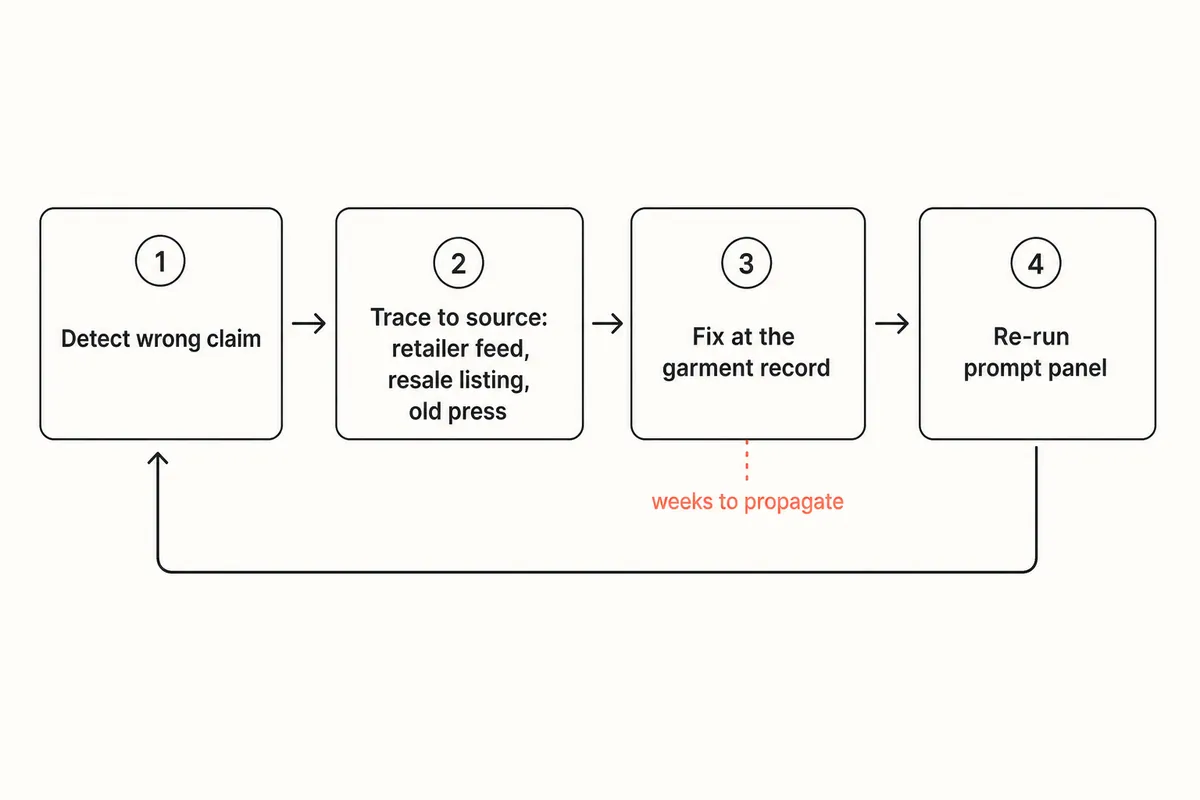
Production-ready AI brand monitoring looks more like a sourcing and merchandising project than a marketing project. Here is the loop that works at scale for a denim and trench capsule:
To make this stick, standardize the record. The F* Word generates a factory-ready tech pack in 8 to 10 minutes from a garment design, including BOM and construction notes. It also generates moodboards as the upstream half of the same workflow. It is not a PLM, a 3D sim tool, or an image generator. It is the validation and orchestration layer that enforces a consistent, machine-readable record from creative direction to pre-production to launch. When tech packs, creative direction decisions, and marketplace content are driven off the same record, assistants have fewer places to get confused.
Treat feeds as code. Version control your retailer and marketplace payloads. Assign ownership for GTIN and UPC alignment. Keep a dictionary for colorway naming that maps house names to standard references. For fit and sizing, publish points of measure with actual numbers, not adjectives. A ribbed knit midi dress marked as fitted without bust, waist, hip, and length details will be reinterpreted by assistants. Align your monitoring with your enterprise data governance so legal, sourcing, and e-comm can approve changes without waiting on campaign timelines.
Set the rules of engagement before peak season:
For designers and creative directors, monitoring is not about policing style. It is about ensuring your intent for the ribbed knit midi dress reads correctly in meaning space. If you call the colorway Midnight Lake but third parties render it as Navy, decide on a standard mapping and ship it with the record. Align with your creative direction workflow so names, tags, and references roll forward cleanly across drops.
Week 1 to 2. Pick two garments with high search value and clear failure exposure. Use the mid-rise straight-leg denim and waterproof trench. Build a prompt panel with 12 questions per garment. Pull source copies of your own PDP, retailer PDPs, key marketplace templates, and top resale listings.
Week 3. Run the panel. Mark wrong assertions by assistant. Cluster by claim type. Expect blend and care to be common misses on denim and trench. Expect price band drift on trench if it has outlet history.
Week 4. Trace the top five misses to sources. Check your feed payloads. Many issues start at home due to stale carryover notes and inconsistent colorway naming.
Week 5. Fix at the record. Update BOM fields, construction notes, POMs, grading, care, and origin. If you build in The F* Word, generate a fresh tech pack in 8 to 10 minutes from the design so sourcing and factories consume the same truth as e-comm. Update moodboards upstream if naming or positioning needs clarity. Push corrected feeds to retailers and marketplaces.
Week 6. Re-run the panel. Note which assistants have changed. If a key assistant did not update, consider a targeted brand facts page with structured fields that the model can cite. This is not a blog post. It is a machine-facing factsheet.
Week 7. Validate variants. If the denim has a cropped inseam or the trench has a removable liner, confirm the answers now include these details correctly across all colorways.
Week 8. Write the runbook and lock the cadence. In season, run weekly. Out of season, run biweekly. Treat country of origin, blend, and care misses as same-week. Treat adjacency and sentiment drift as monthly with a quarterly cleanup.
What monitoring cannot fix: you cannot argue a model out of a claim. You can only change the evidence that supports the claim. If a forum thread is the only visible anchor for a pilling claim on your ribbed knit midi dress, you have to publish structured fabric and care fields and propagate through channels the model trusts. Expect lag. Plan for it. During peak, put a human in the loop to verify assistants right after you push critical feed updates.
Escalation policy for brands over 50 million in revenue, concrete thresholds:
Tie these to the season cadence. Pre-drop, lock the record. In drop, watch price and availability. Post-drop, clean adjacency and archive sources that still cite outdated specs.
Start by auditing your own feeds and records for the denim and trench. If the wrong claim exists anywhere in your payloads, fix there first. Only when your record is clean should you attribute the remaining errors to model inference or third-party drift.
You need clear owners, not necessarily new roles. Assign a lead in sourcing for fibre and origin, a technical design lead for fit and POMs, and a content ops lead for retailer feeds. Give e-comm merchandising the dashboard and the incident clock.
If you rename a colorway or add a liner to the trench, treat it as a record change that flows through creative direction and pre-production. The F* Word keeps the validation layer in sync and propagates the update to feeds, so assistants catch up without rewriting campaign copy.
Assistants map confidence to structured facts. When your tech pack holds BOM and construction notes tied to fabric codes and care, the same data can power marketplace fields. The F* Word generates a factory-ready tech pack in 8 to 10 minutes from a garment design and keeps it linked to the record that assistants read.
Start free at thefword.ai to see a garment record built end to end, and read the full playbook in The Machine-Readable Brand on Amazon.
Related: fashion ecommerce seo
Get The F* Word workflow insights in your inbox.