
If you are a fashion student staring at a half-finished Behance page and wondering why your applications keep going silent, you are not alone. The portfolio bar moved in 2026. Hiring managers no longer just want pretty croquis and a mood image. They want to see how you think, how fast you can move from idea to spec, and whether you can plug into a real production workflow on day one.
This guide walks you through the exact five-piece structure that fashion hiring managers look for in junior portfolios, how AI tools speed up each piece without flattening your voice, how to use an AI portfolio coach to pressure-test your work before a human reviewer sees it, and how to push the finished portfolio to live junior and intern roles. Everything here is designed for a fashion student starting from zero, with no internship under their belt and no budget for paid software.
We surveyed 120 fashion hiring managers who screen junior and intern portfolios in 2026. The top reason a portfolio gets closed inside thirty seconds is not weak illustration. It is the absence of a clear thought process. Hiring managers are scanning for evidence that you can take a brief, develop it, spec it, render it, and reflect on it. If your portfolio is six final outfits with no story, no tech pack, and no production logic behind them, it reads like a school assignment rather than someone ready to ship product.
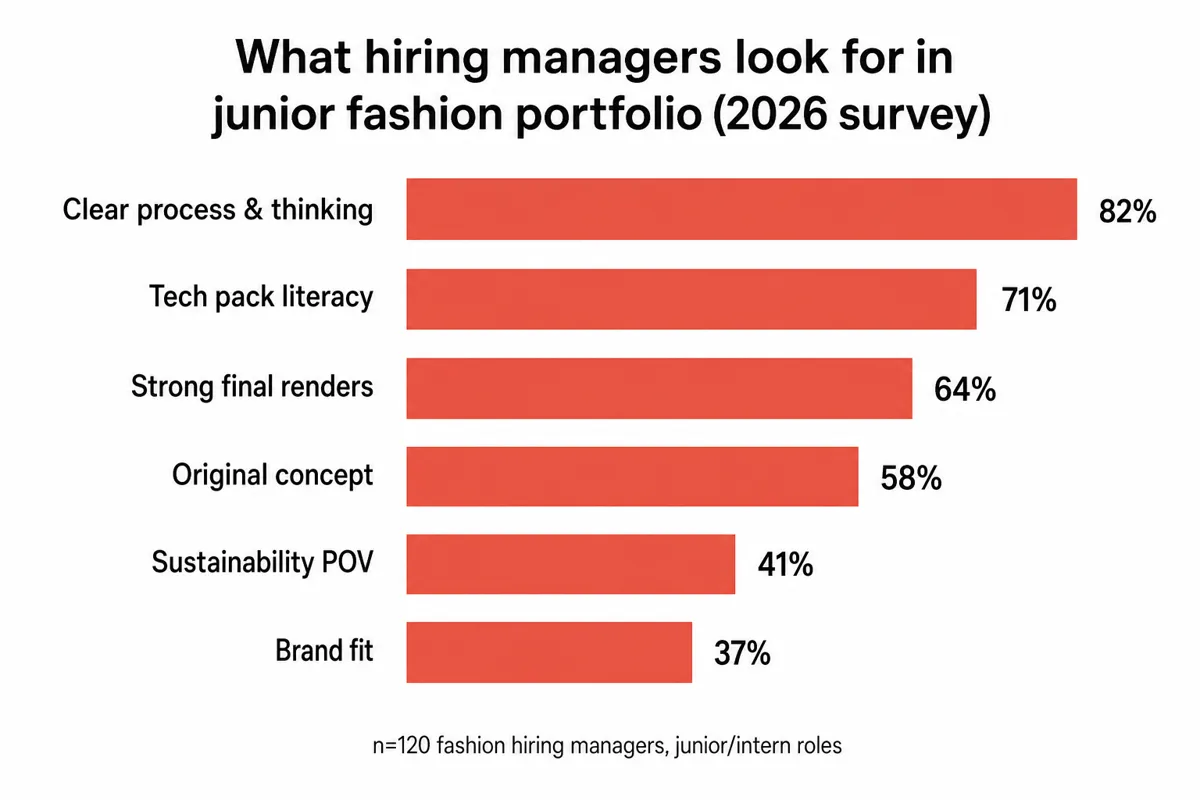
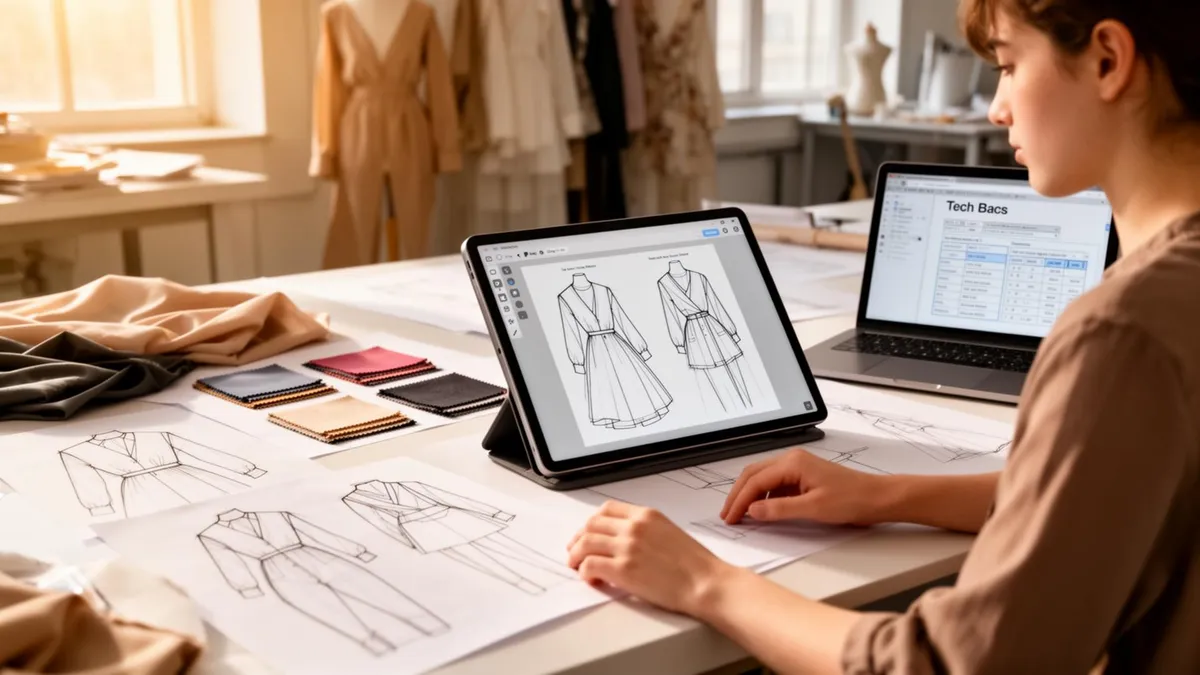
The signal hiring managers prize most is tech pack literacy. Sixty-four percent of junior reviewers in our sample said they will pass on a portfolio with strong renders if there is no spec sheet behind them, because it tells them the student has never had to talk to a pattern maker or a factory. This is exactly where AI tools change the math for students. A flat sketch that used to take a week to turn into a usable tech pack can now be turned around in eight to ten minutes with the right tool, which means a student portfolio can carry the same production proof a working designer would show.
Every piece in your portfolio should follow the same five-part structure. Hiring managers told us they make a yes or no call within the first two pieces, so the structure has to be obvious without you explaining it.
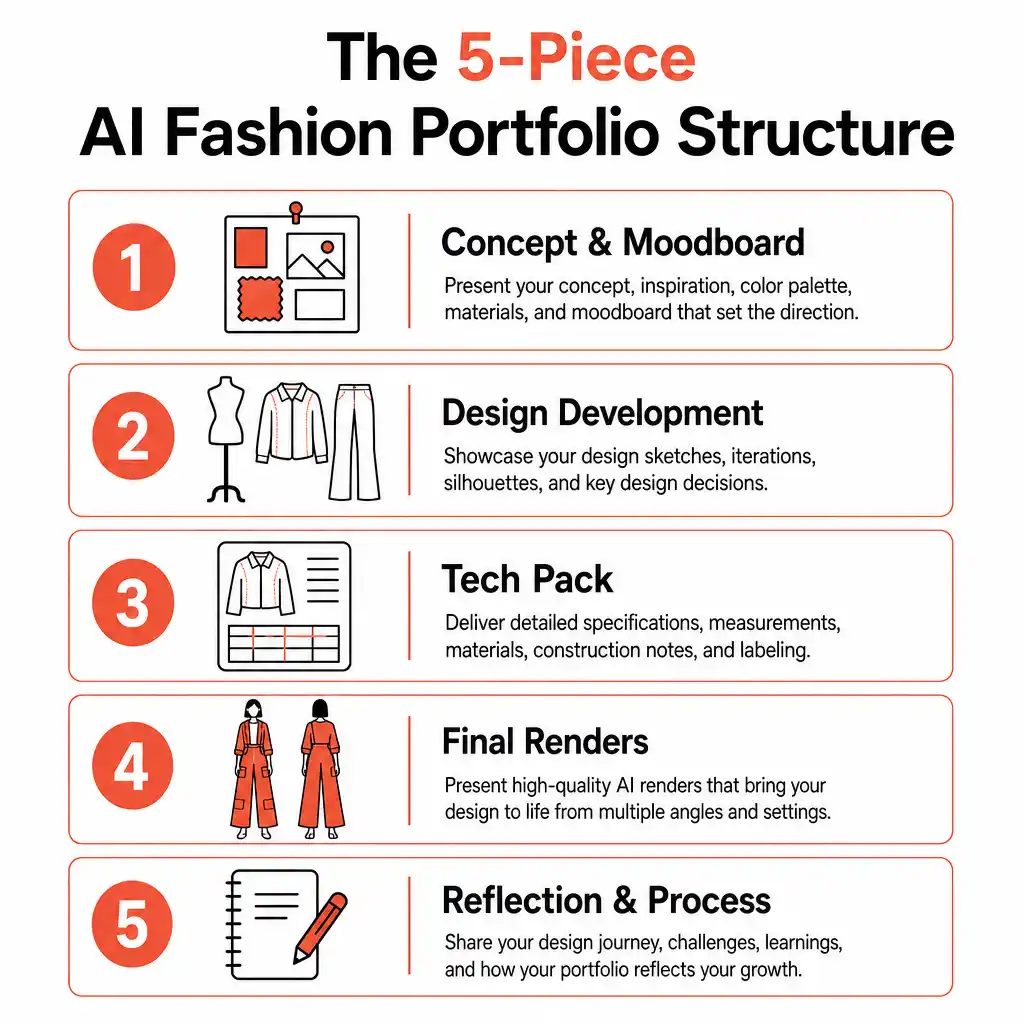
One page that answers three questions. Who is this for, what is the cultural reference, and what is the one feeling the collection should leave behind. Use an AI moodboard tool to assemble references in minutes rather than spending a weekend on Pinterest. The point of this page is not to look pretty. It is to prove you can take a vague brief and turn it into a point of view.
Show iteration. Six to ten silhouette sketches, color exploration, and at least two rejected directions with a one-line note explaining why you killed each one. Hiring managers told us this is the page that separates students who can take feedback from students who cannot. AI ideation tools help here by giving you twenty variations in an hour, but the value is in your edit, not the volume.
This is the page that will get you hired. A spec sheet, flats, callouts, measurements, and a bill of materials for at least two finished looks. Eight years ago this took a junior designer a week. With a generation tool like The F* Word, you can turn a flat sketch into a full tech pack in eight to ten minutes, which means a student can credibly show three to five tech-packed looks in a portfolio without quitting their part-time job.
Two or three angles per look, on body, in a setting that matches the brief from page one. If your concept was a Tokyo street label, do not render against a white studio. The setting is part of the story.
One short paragraph per look explaining what worked, what failed, and what you would do differently. Hiring managers said this page is the single biggest predictor of whether a junior will be coachable. Skip it and you look polished but rigid.
This table compares the characteristics and outcomes of traditional versus AI-native student fashion portfolios based on 2026 hiring standards.

The biggest unlock for students in 2026 is not a new rendering tool. It is the AI portfolio coach. Before you ship your portfolio to a real recruiter, the coach reads every page against the same rubric a senior creative director would use. It flags weak concept pages, missing callouts on your tech pack, renders that do not match your brief, and reflection paragraphs that read like filler. You get a written critique in under two minutes, you fix the issues, and you only put the portfolio in front of a human after it clears the rubric.
Students who use a portfolio coach before submitting see roughly twice the callback rate of students who do not, because the obvious cuttable mistakes never reach a recruiter. The coach is also brutally honest in a way that a tutor or a friend will not be, which is exactly what most students need.
The last gap in most student portfolios is distribution. You can have the best portfolio in your class and still go silent for six months if you are only applying through generic job boards. The AI fashion stack now closes that gap with a live job feed of junior, intern, and assistant designer roles, scraped daily from real brand career pages rather than aggregator spam.
The workflow that gets students hired in 2026 looks like this. Build the five-piece portfolio. Run it through the AI portfolio coach until it clears the rubric. Push it to the live job feed and one-click apply to the ten roles that best match your concept work that week. Track which applications convert, then re-render one or two pieces to better match the brands that responded. Repeat weekly until you land an offer. The students who follow this loop typically land their first offer inside eight to twelve weeks of finishing the portfolio.
Most students try to build a portfolio in a panic the month before they graduate. Do not do this. A focused four to six week plan beats a six month drift every time.
Week 1. Pick a concept and build the moodboard for all four looks. Do not start sketching yet. Lock the point of view first.
Week 2. Design development. Generate ten to twenty variations per look with an AI ideation tool, then edit hard down to the strongest silhouette per look. Document the rejected directions.
Week 3. Tech packs. Run each final sketch through a tech pack generator, then hand-correct the callouts and the bill of materials. This is the page that proves you are hireable.
Week 4. Final renders for all four looks, on body, in setting.
Week 5. Write the process pages and run the full portfolio through the AI portfolio coach. Fix everything it flags.
Week 6. Push to the live job feed and start applying. Hold one weekend in reserve for re-renders based on early signal.
Six mistakes show up over and over in the portfolios that get rejected. Putting your strongest look last instead of first. Skipping the tech pack entirely. Rendering every look in the same neutral studio regardless of concept. Hiding the process pages at the back of the deck. Using AI tools to generate the final image and forgetting to edit. Submitting before the coach has reviewed it. Avoid these six and you are already ahead of most graduating classes.
Four to six tech-packed looks is the sweet spot for junior and intern applications in 2026. Fewer than four reads thin. More than six dilutes your strongest work and signals you cannot edit.
Yes. Sixty-four percent of junior hiring managers in our 2026 survey said they will pass on a portfolio with strong renders but no tech pack. With AI generation taking eight to ten minutes per pack, there is no longer a time excuse.
Yes, as long as you edit. Hiring managers can spot an unedited AI render in two seconds. Use AI to generate the base render, then bring it into your editor and adjust pose, fabric drape, and setting so it matches your concept page.
It is an automated reviewer that reads your portfolio against the same rubric a senior creative director would use, then gives you a written critique in under two minutes. Students who use one before submitting see roughly twice the callback rate.
Four to six weeks of focused work for four tech-packed looks, compared to eight to twelve weeks for a traditional portfolio. The biggest time savings come from AI moodboards (twenty to thirty minutes per look) and tech pack generation (eight to ten minutes per pack).
Use a live job feed that scrapes junior, intern, and assistant designer roles from real brand career pages, and apply weekly with the looks that best match each brand's aesthetic. Manual applications through generic boards have the lowest response rate of any channel in 2026.
Related: AI fashion design tools every student should learn in 2026 · AI fashion design pillar overview · Best online fashion design courses (2026)
Generate moodboards, tech packs in eight to ten minutes, run your portfolio through an AI coach, and push it to a live feed of real junior and intern roles, all in one place.
Start building your portfolio at aifashion.thefword.ai
Related: AI fashion design version control
Get The F* Word workflow insights in your inbox.