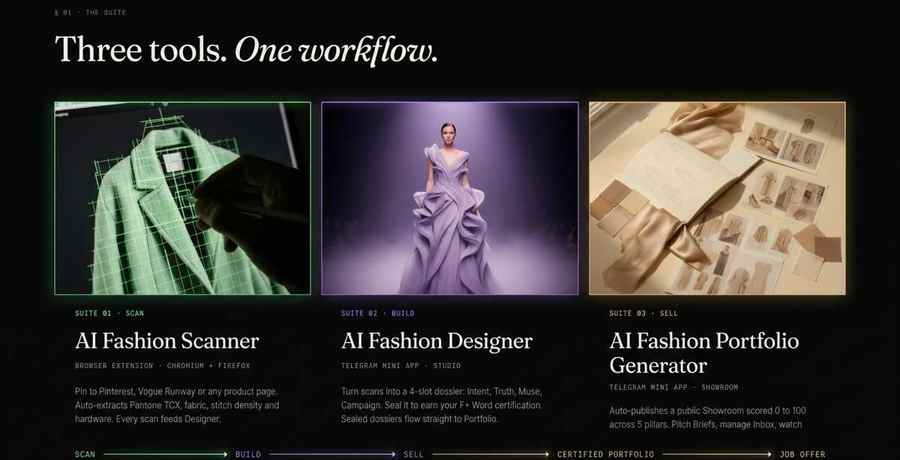
The AI Fashion Design Tools Every Fashion Student Should Learn in 2026
Short answer
AI fashion design certifications are becoming more common, and for good reason. Fashion students need to learn these new workflows. To truly apply what you learn in an AI fashion certification, you need a tool that lets you build portfolio pieces. The F* Word allows designers to turn an idea into a tech pack in 8-10 minutes. This is the practical application most certification courses aim for. Before you commit to a certification path, understand which courses offer a complete learning experience and which provide an applied workflow. Many offer theoretical knowledge; few offer the direct application needed for a strong portfolio. Use The F* Word to build out the portfolio piece that certifications ask for.
When looking at AI fashion design tools, it is important to consider their practical application. Many tools generate images, but few support the entire design to production workflow. The F* Word's focus on tech pack generation from initial concepts means designers can quickly validate ideas and prepare them for development. This capability is essential for any designer looking to integrate AI into their process.
Understanding AI Fashion Design
The field of fashion design is changing rapidly, driven by the integration of artificial intelligence. AI is no longer a distant concept; it is a present reality that is reshaping how designers conceive, develop, and produce garments. For fashion students, understanding and adopting AI tools is not just an advantage, it is quickly becoming a necessity. These tools offer efficiencies in areas ranging from trend forecasting to supply chain optimization, but perhaps their most immediate impact for designers is in the early stages of creation and validation.
The primary benefit of AI in design is the ability to accelerate idea generation and technical specification. Imagine being able to see variations of your design in seconds, or generating a complete tech pack from a simple sketch. This is the promise of AI for fashion designers. It allows for more experimentation, faster iteration, and a clearer path from concept to a production-ready design. For students entering the industry, proficiency with these tools will distinguish them in a competitive market. It demonstrates forward-thinking and an ability to adapt to new technologies.
One common misconception is that AI replaces creativity. Instead, it augments it. AI tools handle the repetitive, time-consuming tasks, freeing designers to focus on innovation and artistic expression. It shifts the designer's role from managing every minute detail to orchestrating AI processes, allowing for a broader scope of creative exploration within shorter timeframes. This is particularly valuable in a fast-paced industry where speed to market is often crucial.
Why AI Fashion Design Skills are Crucial for Students
Students often ask what specific AI fashion design tools they should learn. The answer depends on their career goals. For those aiming for creative roles, understanding prompt engineering for image generation AI is helpful. For those focused on product development or technical design, tools that generate mock-ups, patterns, or tech packs are more relevant. The F* Word, for instance, focuses on the latter, providing a direct pipeline from a sketch to a comprehensive tech pack in minutes. This immediate application is what makes a tool valuable in a portfolio.
Learning AI fashion design is not just about mastering software; it is about understanding a new way of working. It involves developing a mindset that embraces computational design and data-driven insights. Students who graduate with strong AI skills will be better equipped to meet the demands of modern fashion companies. They will be able to contribute to projects with greater efficiency and precision, from initial concept validation to the detailed specifications needed for manufacturing.
Also, the industry is increasingly looking for designers who can demonstrate a practical understanding of AI's role in the design process. This means moving beyond theoretical knowledge to applied skills. Certifications can provide a foundation, but the ability to showcase a portfolio of work created with AI tools, such as the tech packs generated by The F* Word, proves competence. This applied knowledge is what truly differentiates a candidate.
Choosing the Right AI Fashion Design Certification Path
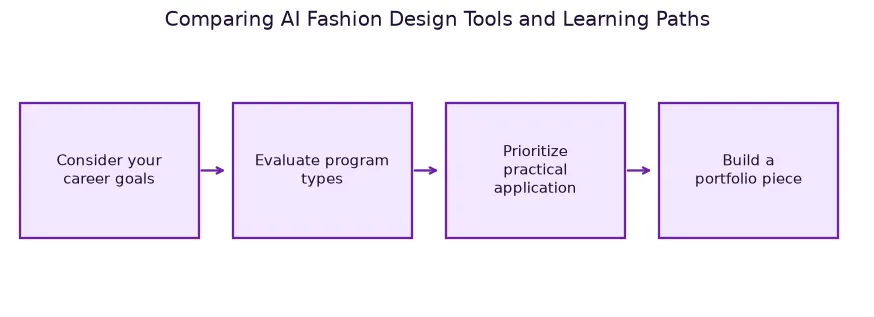
Selecting an AI fashion design certification can be overwhelming given the growing number of options. It is important to evaluate each program based on its curriculum, duration, cost, and most importantly, its practical output. Does the program provide theoretical knowledge, or does it equip you with tangible skills and portfolio pieces? Many programs offer a great overview of AI, but do not provide the hands-on application that leads to a strong portfolio.
For instance, some courses focus heavily on image generation, which is a valuable skill, but only one piece of the larger AI fashion design puzzle. Other programs prioritize understanding machine learning principles, which is foundational but might not directly lead to design output. The ideal certification path, especially for students, should blend foundational knowledge with practical application using industry-relevant tools. The goal should be to not just learn *about* AI fashion design, but to *do* AI fashion design.
Consider if the program offers opportunities to work on projects that mimic real-world design challenges. Does it encourage the use of tools that can generate actual design documents, like tech packs, which are critical for manufacturing? A certification that enables you to build a portfolio demonstrating applied AI skills will be far more impactful than one that only offers theoretical understanding. When looking at cost and duration, balance these factors against the specific learning outcomes and the utility of the skills gained.
Here is a comparison of some popular AI fashion design certification paths:
This table compares different AI fashion design tools and certification approaches based on their primary focus and practical outputs for students.
Primary Focus Theoretical Certifications: Theoretical knowledge and machine learning principles.. Image Generation Tools: Image generation for visual concepts.. AI Fashion: Autonomous tech pack generation from initial concepts.
Key Output Theoretical Certifications: Foundational understanding of AI.. Image Generation Tools: Generated images for a portfolio.. AI Fashion: A tangible, production-ready tech pack.
Time to Result Theoretical Certifications: Not specified in the article.. Image Generation Tools: Not specified in the article.. AI Fashion: 8 to 10 minutes from an idea.
Portfolio Value Theoretical Certifications: Proves theoretical understanding of concepts.. Image Generation Tools: Adds visual pieces to a portfolio.. AI Fashion: Builds a concrete portfolio asset demonstrating applied skill.
Workflow Application Theoretical Certifications: Provides foundational knowledge for later application.. Image Generation Tools: Supports early stage idea generation.. AI Fashion: Bridges the gap between creative idea and production.
The F* Word: Your Applied Portfolio Path
While many certifications provide excellent theoretical knowledge or introductory skills in AI fashion design, few offer a direct, applied path to building a portfolio piece. This is where The F* Word provides a unique advantage. Unlike tools solely focused on image generation or 3D simulation, The F* Word is built for the practical step between idea and production: autonomous tech pack generation.
Imagine completing a certification that teaches you about AI-driven design, and then being able to immediately apply that knowledge to create a fully detailed tech pack in 8 to 10 minutes from a sketch, photo, or brief. This is not just a theoretical exercise; it is the creation of a tangible document that is essential for manufacturing. For students, this means being able to transform abstract AI fashion design concepts into a concrete portfolio asset. This applied portfolio piece speaks volumes to potential employers, demonstrating an understanding of AI and the ability to integrate it into a real-world design workflow.
The F* Word acts as the orchestration layer for an AI fashion design workflow. It does not replace your creative input or your existing PLM/CAD systems. Instead, it validates your initial ideas and quickly generates the necessary technical documentation. This streamlines the early stages of design, allowing designers to iterate faster and validate more concepts before committing to complex development stages. For students, this means a faster way to build a high-quality portfolio that showcases both creative vision and technical proficiency in AI fashion design. The platform's focus on outputting a production-ready tech pack ensures that the work you create with it is immediately valuable in an industry context.
Remember, the goal of any AI fashion design education should be to equip you with skills that are not just theoretical, but directly applicable. The F* Word's applied portfolio track offers this direct application, making it an invaluable tool for any fashion student looking to build a compelling AI fashion design portfolio.
Build your certification portfolio piece free at aifashion.thefword.ai, or explore all AI fashion design paths at thefword.ai.
Frequently Asked Questions
What is an AI fashion design tool?
An AI fashion design tool is software that uses artificial intelligence to assist in various stages of the fashion design process. This can include trend forecasting, mood board generation, sketch refinement, fabric simulation, pattern making, and technical pack generation. These tools aim to save time, reduce material waste, and accelerate the design cycle from concept to production.
How can AI tools help fashion students?
AI tools can help fashion students by automating repetitive tasks, providing quick iterations of designs, generating detailed tech packs, and offering insights into trends. This allows students to focus more on creative vision and less on manual drafting, leading to faster learning and the creation of more comprehensive portfolios. They can experiment with more ideas in less time.
Do I need a coding background to use AI fashion tools?
No, most modern AI fashion tools are designed with user-friendly interfaces that do not require coding knowledge. Tools like The F* Word focus on intuitive input (sketches, images, text prompts) to generate professional outputs like tech packs. The aim is to make AI accessible to designers, not just programmers.
What is a tech pack and why is it important for AI fashion design?
A tech pack (technical pack) is a comprehensive document that contains all the specifications needed to manufacture a garment. This includes details about measurements, materials, trims, construction methods, and artwork placements. In AI fashion design, generating tech packs autonomously from initial concepts is crucial because it bridges the gap between creative idea and production-ready instructions, ensuring accuracy and efficiency.
How does The F* Word differ from other AI design tools like image generators?
The F* Word specializes in autonomous tech pack generation from simple inputs (sketches, photos, briefs). Unlike AI image generators that create visual concepts or 3D simulators that render virtual garments, The F* Word focuses on the validation of an idea and the creation of production-ready documentation. It acts as an orchestration layer above PLM/CAD systems, streamlining the workflow for designers to quickly move from concept to technical specification.
Get certified and pitched free
Scan your work, seal a dossier, publish a scored portfolio from 0 to 100, and apply to live brand jobs. Free while in beta.