Language

AI merchandising uses artificial intelligence to support assortment, inventory, product placement, and content decisions. For fashion brands, the useful test is whether an output helps a buyer connect demand evidence to a specific garment and a feasible production commitment, not whether it makes a forecast look more certain.
A forecast estimates future demand. Evidence records what happened under stated conditions: a product sold at a particular price, a shopper joined a waitlist, or a factory confirmed a material. Merchandising needs both, but they answer different questions. A forecast helps plan exposure; evidence helps you decide which assumptions still deserve that exposure.
New styles do not have their own sales history, yet related products can still inform a forecast. The buyer needs to inspect those relationships. A similar silhouette sold in a different fabric or channel may be a weak comparison. Ask which attributes make the historical product relevant and which changes could alter demand.
Use AI to organize those comparisons, summarize observations, or flag gaps where the chosen tool supports that work. Keep the commercial decision with the merchandising team. The Merchandising & Launch workflow places that decision within the wider path from design approval to launch, where sourcing and production constraints also matter.
A click is not a purchase, and a purchase is not proof of profitable repeat demand. Keep the signal definition visible when reviewing an AI summary. Otherwise, a tool can present unlike observations as a single confidence score that hides the reason to buy or hold.
Table 1: Demand evidence and its limits for a fashion buy.
| What it supports | What still needs checking | |
|---|---|---|
| Historical sales | Observed demand for an existing offer | Stock availability, promotions, returns, and relevance to the new style |
| Search and browsing | Interest in a term, category, or product page | Purchase intent at the planned price |
| Paid click test | Response to a specific creative and audience | Conversion, acquisition cost, and whether the creative represents the garment |
| Waitlist | Willingness to register interest | Duplicate entries, size preferences, and later purchase behavior |
| Preorder | Orders under the stated price and delivery terms | Cancellations, fulfillment feasibility, and demand beyond early buyers |
| Physical sample review | Observed fit and construction of that sample | Bulk consistency and commercial demand |
Do not combine signals without preserving their context. Record the test dates, audience, price, available sizes, and product version. A waitlist collected before the retail price was visible cannot support the same conclusion as an order placed at that price. Ask the reviewer to explain the difference before changing the buy.
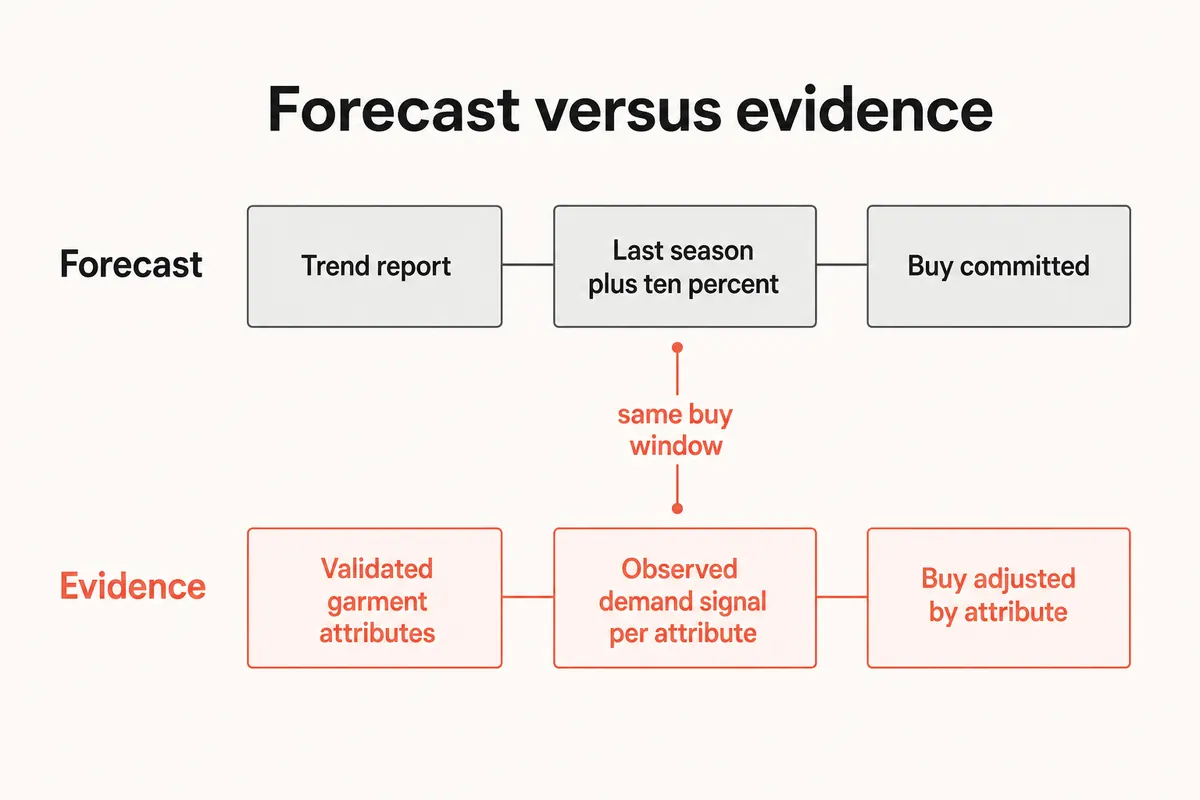
Start with a style reference that design, merchandising, and sourcing recognize. Attach the current design revision, intended category, color, material assumptions, price position, and channel. Keep confirmed fields separate from estimates. If the fabric changes after a demand test, the team should see that the tested offer and the proposed production garment are no longer identical.
Historical data needs similar discipline. Sales without stock availability can make a constrained style look unpopular. Gross orders without cancellations or returns can overstate retained demand. Discounted sales can distort a comparison with a full-price launch. Resolve these issues before asking a model to recommend assortment depth.
Ask for traceable output rather than a recommendation alone. A buyer should be able to identify the source records, see the comparison period, and challenge a missing attribute. If a vendor cannot show how those checks work, consult the vendor's current documentation and test the exported result before relying on it.
Set a decision gate before running a test. Define what would justify moving to sampling, requesting a revised quote, or releasing a purchase order. Use your own margins, minimum order quantities, and calendar to set the conditions. A generic conversion target cannot account for the economics of every garment or channel.
Assign an owner to each condition. Merchandising can review demand and planned exposure; sourcing can confirm material availability and minimums; technical design can review the sample and specifications. Strong interest does not cancel a failed fit review. A technically approved sample does not establish a commercially sound buy.
Write down the next action when evidence is mixed. You might repeat a test with the final price, pause a color, or request a fabric alternative. These are explicit decisions, not automatic model instructions. Retain the reasons so the next range review can distinguish a deliberate hold from an overlooked style.
Buying in stages can limit early exposure, but it is not available on every production route. A supplier may require fabric booking before finished-garment quantities are settled. Dye lots, capacity reservations, and minimums may prevent a small initial order. Confirm which commitments are reversible and what each change costs.
Map the last responsible decision date for fabric, trims, cutting, and delivery. Later demand evidence is useful only if there is still an action you can take. If replenishment would arrive after the selling window, holding back too much inventory can create a different commercial problem. Compare the risk of excess with the risk of missed availability.
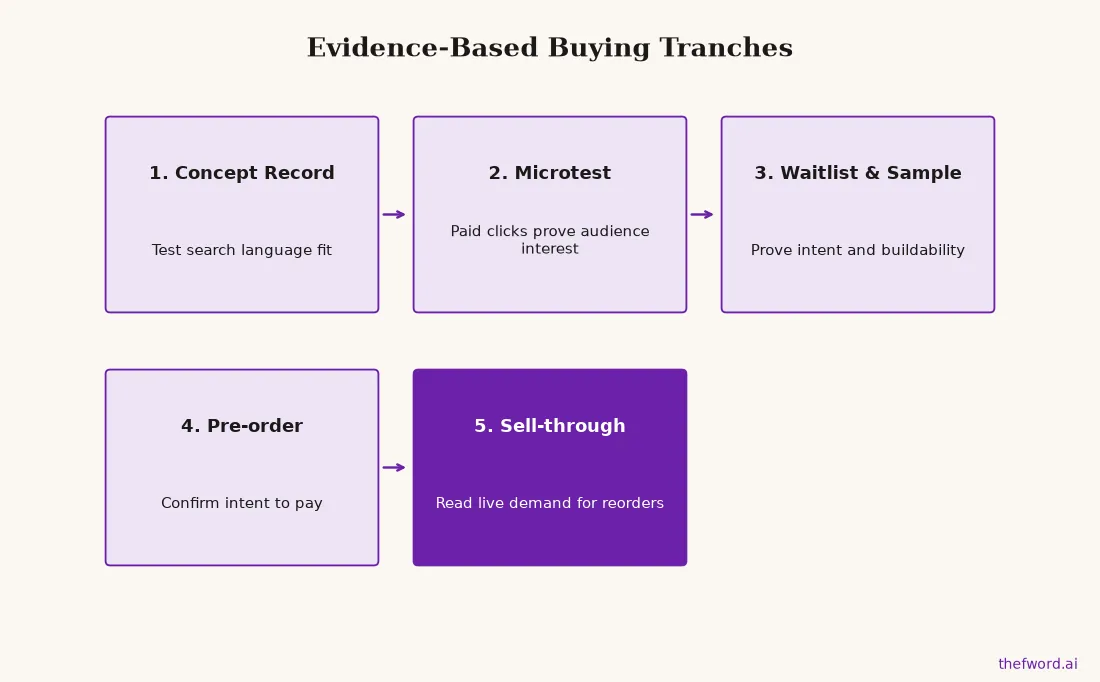
At each gate, record the approved quantity, remaining exposure, supplier confirmation, and unresolved risks. Do not describe an unissued garment order as cash saved if the brand has already committed to its fabric. Finance needs the actual contractual position, including deposits and cancellation charges, to assess the effect.
The F* Word generates moodboards and tech packs from a garment design. Its stated tech-pack generation time is 8 to 10 minutes. That provides a draft for review; it does not establish demand, approve the garment, or confirm that a supplier can meet the planned delivery date.
Use that draft to make the intended garment explicit before asking a factory to quote or sample. The technical designer should review measurements, materials, construction instructions, and unresolved choices in the document. Confirm the information your supplier requires rather than assuming any generated pack is ready for bulk production without review.
The F* Word is not a PLM, a 3D simulation tool, or an image generator. Evaluate it for moodboard and tech-pack work, not as a substitute for assortment planning software or physical sample approval. Keep demand observations linked to the same design revision through your team's chosen records and approval process.
Choose an upcoming decision with accessible source data and enough calendar time to act. Define the manual comparison first: how would the buyer normally select the range or set initial depth? Then test whether the AI-assisted process produces a better-supported decision, with less unresolved information, before the commitment deadline.
Measure review time and the number of corrections required before approval. After launch, compare retained sales, returns, markdowns, and availability with the original assumptions. Treat avoided units cautiously: a reduced order is observable, but the claim that those units would have become excess inventory is a counterfactual, not a confirmed saving.
No. Forecasting remains one planning input. AI can support analysis, but buyers still need to inspect data quality, uncertainty, and commercial constraints. Evidence from tests and sales should inform a forecast rather than be presented as certainty about the next season.
It can support comparisons with related products where the tool provides that capability. Review which attributes connect the products and test the new offer when practical. Differences in price, fabric, channel, or delivery timing may limit what the comparison tells you.
Not by itself. Check whether shoppers saw the intended price, whether entries are valid, and whether size preferences are useful. Pair that interest with margin review, supplier terms, and sample approval before committing inventory. Registration does not create an obligation to purchase.
It supports the design handoff with moodboards and generated tech packs. Review the draft against the approved garment before factory use. The stated 8 to 10 minute generation time excludes designer approval, sourcing confirmation, physical sampling, and the buying decision.
Upload a garment sketch and get a draft tech pack with The F* Word. Review the generated details with your technical designer before using the document for a factory quote or sample request.
Get The F* Word workflow insights in your inbox.