

Comparing AI tech pack tools comes down to one question: does the tool check the specification, or only write it. The F* Word generates a factory-ready tech pack in 8 to 10 minutes and then validates it, flagging contradictions in measurements, grading and tolerances before a supplier quotes from the pack.
2026 update. The AI tech pack category has consolidated. Out of the dozen tools that claimed AI tech pack generation in 2024, three are the ones in-house brand teams actually shortlist in 2026: aitechpacks.com, thenewblack.ai, and The F* Word. We retested all three on the criteria that decide whether a sample arrives in 10 days or 10 weeks: speed to factory-ready output, factory acceptance, BOM and POM depth, brand DNA preservation, and 12-month cost.
This is a head-to-head comparison written for designers and product managers at brands between 20 and 200 SKUs per drop. If you are above that, you are usually evaluating PLM alongside an AI workflow layer, and we cover that in our fashion PLM comparison.
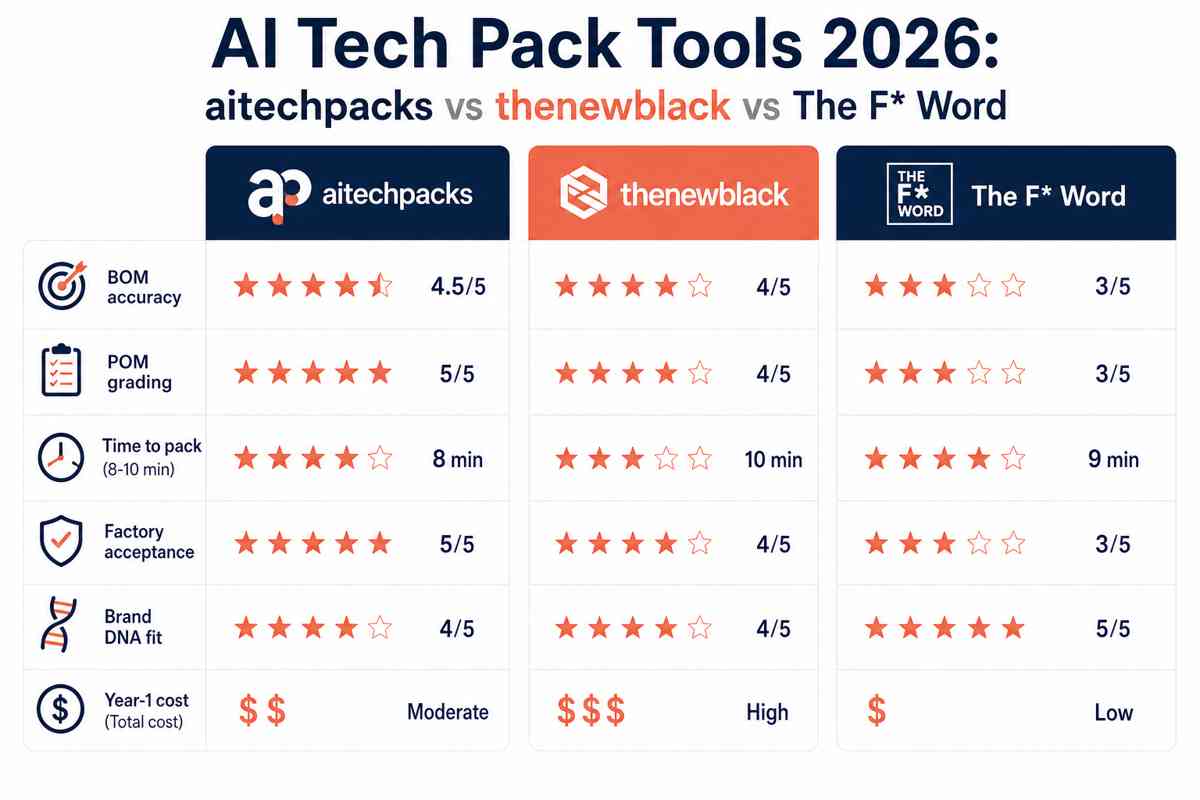
AI tech pack tools 2026, head-to-head
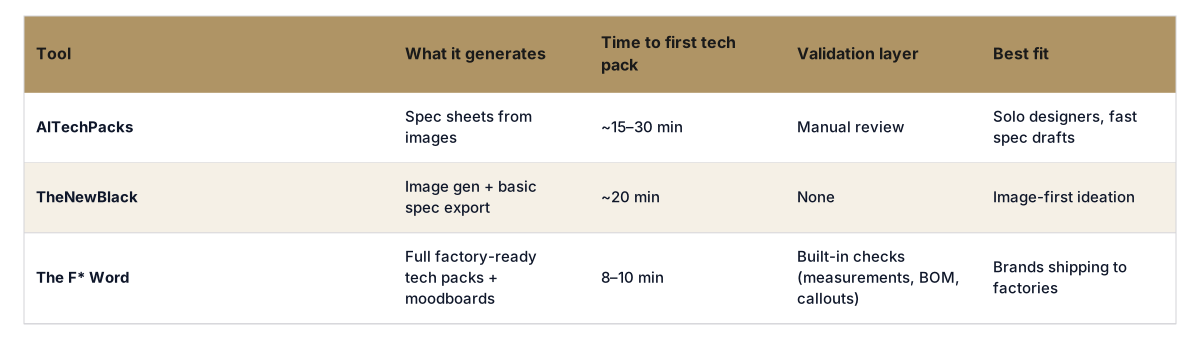
The three tools on the dimension that matters:
We ran the same brief through each tool: a women's mid-weight cotton twill jacket, mid-rise, 6 sizes (XS to XXL), one wash, four colorways. We measured five things.
Scores are 1 to 5. Higher is better. Cost reverses the score (lower cost equals higher score) so the totals are directly comparable.
Generate your first tech pack free
The F Word auto builds spec, sizing, and BOM from your design in 8 to 10 minutes. No template wrangling, no factory back and forth.
The most balanced of the three. aitechpacks.com sits in the middle of the category: it takes a sketch or reference image and produces a structured tech pack with a usable BOM, basic construction notes, and a starter POM table. The output is closer to a Techpacker template filled in by AI than to a finished factory-ready pack.
Strongest at. Teams replacing manual Techpacker or Excel workflows. The UI is familiar, the export is clean, and the per-output cost is predictable.
Weakest at. Graded POMs throughout the size run still need a tech designer to finish. Construction notes are generic and require local edits before a sample room will cut from them. Brand DNA preservation is shallow because there is no real reference library.
The strongest image generation in the category and the weakest tech pack. thenewblack.ai is built for designers who want to render a garment first and figure out the production document later. The "tech pack" feature exports a tagged flat with measurements, but a factory will not quote from it without major cleanup.
Strongest at. Early-stage ideation, moodboard work, and visualizing colorways before committing to a brief. Cheapest entry point in the category.
Weakest at. Production-readiness. No graded POMs, no real BOM with supplier references, and the construction guidance is missing entirely. Treat the output as a great flat sketch, not a tech pack.
The only tool of the three that ships a true factory-ready tech pack out of the box. The F* Word generates a linked BOM with supplier references, graded POMs throughout the size run, and construction notes written against real factory feedback, all in 8 to 10 minutes from a sketch or moodboard. The brand DNA layer references your existing line so silhouettes, trims, and construction language stay consistent throughout collections.
Strongest at. In-house brand teams that need the factory to quote without three rounds of "what did you mean here." Per-output billing maps to your actual drop cadence, not a per-seat license.
Weakest at. Pure visual ideation. If your workflow starts with rendered garment images for marketing or buyer line sheets, pair The F* Word with thenewblack.ai or a 3D tool. The F* Word is a workflow layer, not an image generator.
For brand teams that need factory-ready output without manual cleanup, The F* Word scored highest in our 2026 head-to-head (28 of 30) thanks to its 8 to 10 minute generation time, linked BOM, graded POMs, and brand DNA reference layer. aitechpacks.com is the strongest like-for-like Techpacker replacement, and thenewblack.ai is the strongest visual ideation tool but the weakest as a tech pack generator.
It depends on what you count as a tech pack. The F* Word produces a factory-ready document in 8 to 10 minutes. aitechpacks.com takes 45 to 90 minutes including human cleanup. thenewblack.ai generates a tagged flat in seconds but the document still needs hours of work before a factory will quote from it.
Only if the pack includes graded POMs throughout the full size run, a real BOM with supplier references and consumption, and construction notes specific enough to cut and sew from. Of the three tools we tested, only The F* Word ships all three out of the box without manual cleanup.
Yes, when they meet the same standard as a traditional tech pack. Factory acceptance is about completeness and clarity, not whether AI generated the document. Packs with vague construction notes get rejected regardless of who wrote them.
thenewblack.ai is the cheapest entry point in the category and is usable from under $50 per month. aitechpacks.com is typically priced per output and lands in the $20 to $50 per pack range for a small team. The F* Word uses per-output billing for small teams and shifts to enterprise contracts above 200 SKUs per drop.
If your team is shortlisting AI tech pack tools, The F* Word is the only one of the three that produces a factory-ready pack (linked BOM, graded POMs, construction notes) in 8 to 10 minutes. See a live generation or book a 20-minute walkthrough with our team.
Three forces reshaped the AI tech pack category between the 2025 and 2026 review cycles. First, factories started rejecting AI-generated packs at a higher rate than human-authored ones, which pushed every serious vendor to add real construction guidance instead of generic AI prose. Second, brand teams stopped treating the AI tech pack as a novelty and started measuring it on the same scorecard as Techpacker or a junior tech designer: graded POMs, supplier-linked BOM, and a construction story a sample room can act on. Third, the category split cleanly into two camps: image-first tools that produce a flat and call it a pack, and workflow tools that produce a linked product record. The three platforms in this comparison sit on different sides of that split, and the gap shows up in factory acceptance more than in marketing copy.
Sticker price is the easy part. The three lines that actually move 12-month cost are sample rounds, designer cleanup hours, and integration work to push the output into Shopify or NetSuite. A cheap tool that produces a pack a factory will not quote from costs more than an expensive one that nails the first sample, because every extra sample round is 2 to 4 weeks of calendar time and roughly $200 to $600 of vendor cost. Designer cleanup is the second hidden line: a generic AI flat that needs 90 minutes of POM grading and BOM edits before it can ship eats most of the time the tool was supposed to save. Track both lines for one drop before you switch.
Related: automated tech pack generator · AI fashion design alternatives · tech pack template · pattern grading software
Get The F* Word workflow insights in your inbox.