

2,000 SKUs across roughly 40 intent clusters is 800 measurable cells, and a single blended visibility score collapses those 800 into one digit that you cannot act on. The only number that tells a merchandiser what to fix next is the per intent query per garment score, tracked week over week. This is a method question, not a tool question. Below is the playbook you can run with a ribbed knit midi dress and a waterproof trench as the two garments you carry through the exercise.
Start with intent, not with engines or brand scores. Shoppers ask for garments using need plus constraint plus occasion. When a shopping agent or search interface fields "waterproof trench with removable liner for spring commute," it is deciding which trench belongs in the answer and why. Your job is to see whether your specific waterproof trench shows up, where it appears in the agent's output, whether the attributes are described correctly, and whether the mention can be cited back to your record.
The market is saturated with AI image generators and campaign tools that produce pixels, but a pixel is not machine-readable. An AI shopping agent cannot verify fibre content, lining composition, or size grading from a render. It cannot file your merino crew in the right region of meaning space based on a lookbook image. The F* Word is not an image generator. It is the validation and orchestration layer that produces the structured garment record and the machine placement data that makes an agent confident enough to surface the garment. That distinction underpins the visibility method in this article.
Set the scope. Take two garments you care about this month: a waterproof trench and a merino crew. Build the intent list the way real shoppers talk. Fix the phrasing of each query, vary only the run, and score each cell on presence, position, attribute accuracy, and whether the agent can cite your record. Track the diff each week against what you shipped. That is the unit of change a merchandiser can own.
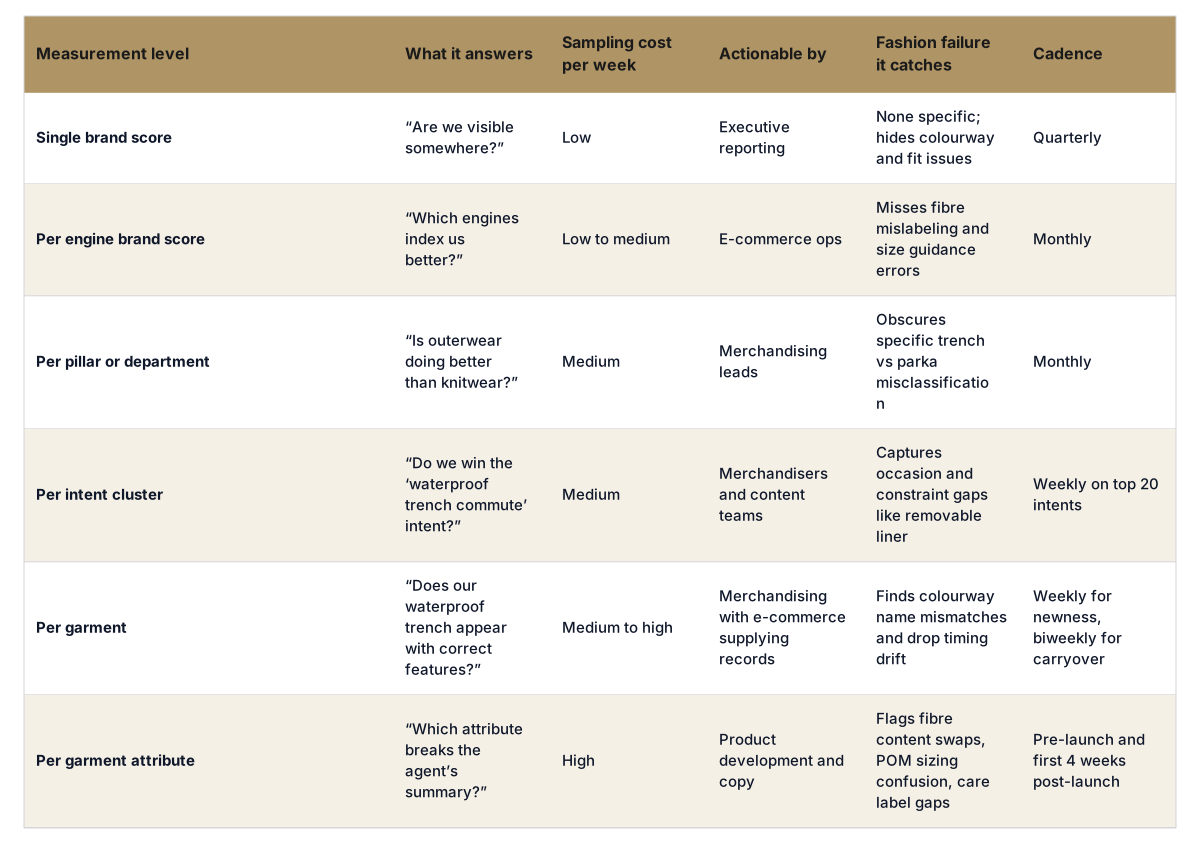
A single "AI visibility" number for the brand is a vanity metric. It hides which intents you win, which garments are invisible, and which attributes break the answer. Even a per engine brand score still collapses catalog nuance into one figure. In apparel, the failure modes are attribute-specific. If an agent calls your merino crew a cotton crew, you got surfaced and still lost the sale. If it lists "sand" as your trench colour when your record calls it "light khaki," the variant mapping fails on a marketplace feed. If the agent drops the removable liner when reciting features, your value proposition disappears.
Fashion's catalog complexity makes a blended score actively misleading. You juggle colourway naming and standard colour references, fibre and blend composition, care and wash instructions, fit intent, seasonal drop cadence, and marketplace feed variants. You also handle size grading and points of measure that determine fit guidance. None of this is visible to a pixel-only workflow. You need measurement that isolates where structure, not imagery, is working or failing.
Position the work inside your calendar. Visibility must be measured on a cadence that matches drops and floorsets, not generic "campaigns." A trench that ships in March should see trench intents spiking in late February and March. A ribbed knit midi dress might ride a "occasion knit dress" intent in April and May. Weekly reads on top intents and monthly reads on the long tail will align to merchandising rhythms.

Comparison of AI visibility measurement levels for fashion operators
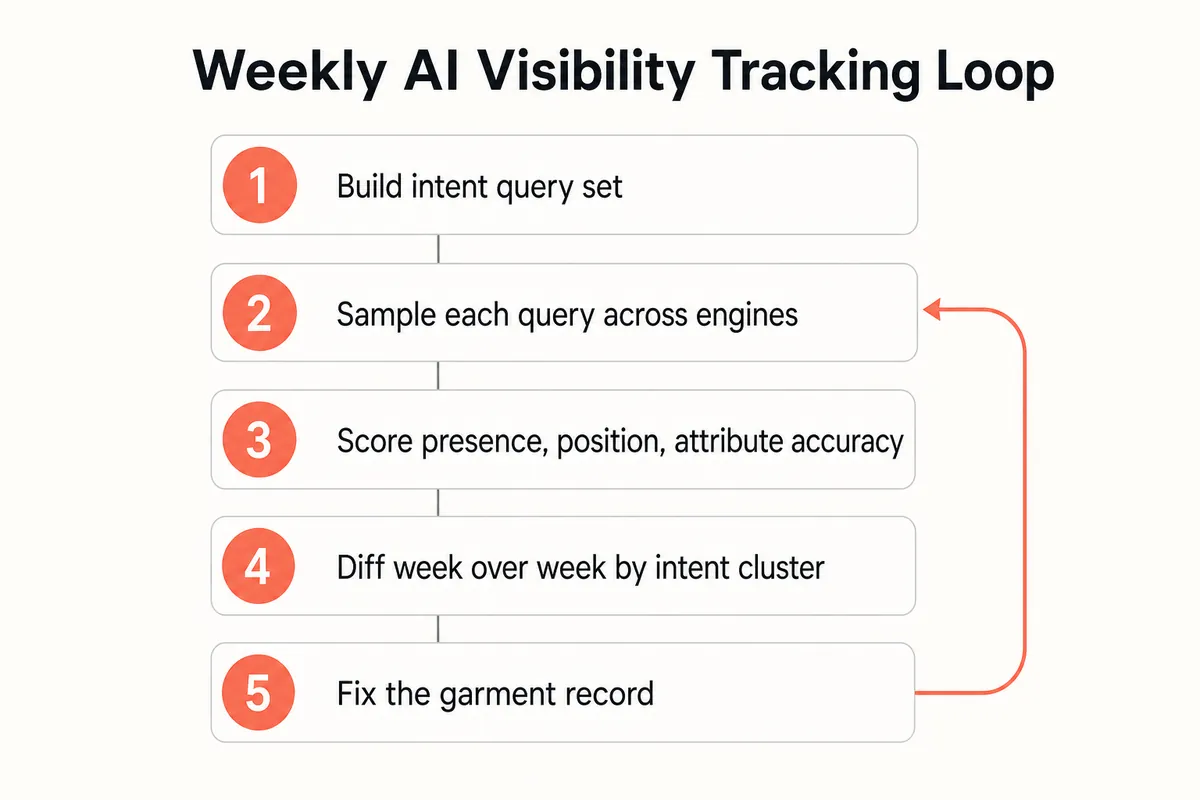
Step one: build the intent query set. Derive it from the way shoppers describe garments, not from a keyword tool. Structure each intent as need plus constraint plus occasion. For outerwear this yields eight to twelve variants of a single trench intent. Examples you can fix and freeze as prompts:
Do the same for knitwear around the merino crew. Include fibre specificity, care, fit intent, and climate. Examples:
Step two: sampling design. Single-run checks are noise. Fix the phrasing of each query and vary only the run. For each intent and engine, run 5 to 7 samples before calling a result stable. That number is illustrative but practical. It smooths transient effects in general-purpose chat engines and shopping assistants. Log the runs and store the raw answers. If an engine has a retail mode that drifts based on session memory, reset state between runs or use a fresh session every time.
Step three: the scoring model. Score each cell on four axes:
Why attribute accuracy matters more in apparel than anywhere else: garments sell on fit, fibre, and finish. An agent that calls your merino crew "cotton" or swaps "light khaki" for "sand" creates returns and mistrust. A ribbed knit midi dress represented as "maxi" will break fit intent. A waterproof trench called "water resistant" downgrades value. Presence without accuracy is costly visibility.
Step four: the diff. Track week over week movement by intent cluster, then read the diff against what you shipped or edited. If you improved care instructions and POM clarity in the merino crew record on Monday, expect attribute accuracy to tick up within 3 to 7 days as agents re-index. If you pushed a new colourway name to "oatmeal" but marketplaces still ingest "stone," expect a temporary dip in citeability and attribute match until feeds settle. Annotate the diff with those changes.
Step five: cadence and ownership. Weekly for the top 20 intent clusters, monthly for the long tail. Owned by merchandising, with e-commerce supplying the record and feeds. Creative and product development support when attribute accuracy flags the need to adjust fibre descriptions, fits, or construction notes. Tie the dashboard review to the same Monday trade meeting where sell-through and returns are read.
Read Yield is the leading input. As defined in The Machine-Readable Brand, Read Yield is the percentage of garment record fields an agent can parse without inference. Aim for 90 percent as a working target. Expect lag. Fixing Read Yield today may take a week to move visibility as agents crawl, cache, and reconcile your updated record across your site and marketplaces.
Where tech packs, creative direction, and pre-production sit in this method: The F* Word generates a factory-ready tech pack in 8 to 10 minutes from a garment design, including BOM and construction notes, and also generates moodboards as the upstream half of the same workflow. It is not a PLM, not a 3D sim, and not an image generator. It is the validation and orchestration layer that ensures the trench's taped seams, removable liner, and storm flap are unambiguous in the record that an agent can parse and cite. For more on upstream orchestration, see Creative Direction workflow and Pre-production workflow.
For workflow buyers: choose the measurement level by decision horizon. Use per intent cluster and per garment weekly for in-season steering, and per garment attribute during pre-production and first four weeks post-launch. Keep per engine brand scores for executive readouts only. If you need to socialize the practice inside a large org, start with three pillars like Outerwear, Knitwear, Denim and report the top five intents in each.
For in-house designers and creative directors: treat visibility failures as briefs. If the ribbed knit midi dress fails on "occasion knit dress for summer wedding," the fix may be material weight or lining notes, not copy alone. If the waterproof trench loses on "fits over a blazer," POM clarifications and fit images matter. Use Read Yield and attribute accuracy as inputs to design reviews. If an agent cannot parse "merino" vs "merino blend," the material story needs a sharper statement in the record and consistent fibre percentages.
For merchandisers: tie ownership to drops. In the first two weeks of a drop, read per garment and per attribute. Once carryover stabilizes, switch to per intent cluster for weekly reads and per pillar monthly. Make go or no-go decisions on incremental content spend based on movement in presence and attribute accuracy. If citeability is low, prioritize feed hygiene and canonical URLs over fresh photography. The images matter for humans, but the record gets you into the machine's short list.
Re-state the positioning clearly: image and campaign generators are commoditized and interchangeable. They produce pixels. Pixels do not move AI visibility unless the garment record is machine-readable, citeable, and accurate. The F* Word is the layer that validates, scores, and orchestrates that record so engines can place your trench or merino crew with confidence. For the full merchandising context, see Merchandising and Launch workflow and AI Fashion workflow software.
Day 1: pick two garments and 10 intents. Use the waterproof trench and the merino crew. Freeze phrasing. Identify the engines you will test and how to reset sessions. Set a sampling plan of 5 runs per query per engine.
Day 2 to 3: run the samples, paste raw outputs into a sheet, and score each cell on presence, position, attribute accuracy, and citeability. Mark attribute errors explicitly: fibre, fit, colourway name, care, construction, POM sizing, marketplace variant mapping.
Day 4: compute averages per intent and per garment. Flag any attribute with a score below 0.75. Cross-check the garment record for gaps: is the colour mapped to a standard reference, is the composition listed as 100 percent or as a blend with exact percentages, are care instructions explicit, are POMs human and machine readable, is the size guidance consistent with grading, are marketplace feeds in agreement.
Day 5: fix the record and publish. Update canonical pages first. Push marketplace feed updates. Annotate the scorecard with the changes and expected lag. Prepare next week's re-run.
Stand up a one-page weekly scorecard before you buy anything. Seven fields are enough:
Keep the sheet simple. Anyone on the merchandising team should be able to read it in 60 seconds and say what to fix next. If you operate at enterprise scale, align this scorecard with your existing trade deck and season gates. For orchestration at scale or to tie visibility to tech pack accuracy and pre-production checkpoints, see Enterprise.
Ten to fifteen per pillar is workable in week one. Pick intents that mix need, constraint, and occasion. For outerwear, include waterproofing, warmth, commute fit, and standard colour mapping. For knitwear, include fibre, care, breathability, and fit descriptions.
That is expected. Your method should report per engine and then average only for trend reading. If Engine A rewards explicit care instructions and Engine B rewards fibre clarity, fix both in the record. Do not change query phrasing to chase a one-week bump.
Only if photos block attribute certainty. If an engine already reads fibre composition, care, and fit from the text record and cites your page, photography is a conversion tool, not a visibility lever. Fix the record first, then refresh imagery to match the attributes you highlight.
Attribute errors often trace back to pre-production documentation. The F* Word generates a factory-ready tech pack in 8 to 10 minutes from a garment design, including BOM and construction notes, and moodboards as the upstream half of the same workflow. Clearing ambiguity at that stage raises Read Yield and lowers the chance of engines mislabeling fibre or fit later.
Start free at thefword.ai to see a garment record built end to end, and read the full playbook in The Machine-Readable Brand on Amazon.
Get The F* Word workflow insights in your inbox.