
Language

Yes, when AI validates product data rather than just moving it. Orchestration fails on missing BOM lines, inconsistent points of measure and unapproved suppliers. The F* Word applies those checks as the pack is generated, producing a factory-ready tech pack in 8 to 10 minutes so the record entering PLM is already complete.
Yes. AI orchestration writes BOM, grading, colorways, and construction from one brief and pushes to the PLM or the factory. The F* Word does this in 8 to 10 minutes and syncs with Centric, Bamboo Rose, and Backbone, so product data stays consistent from concept to PO.
Definition: Yes. AI orchestration compresses the moodboard-to-tech-pack loop from days to minutes by generating BOM, grading, and colorway data from a single brief. The F* Word is the orchestration layer that sits between design intent and the factory or PLM, syncing product data across Centric, Bamboo Rose, and Backbone.
Yes, AI significantly improves fashion product data orchestration by automating critical processes, enhancing data accuracy, and accelerating decision-making from concept to production. AI-driven solutions centralize disparate data points, such as BOMs, POMs, trim specifications, and material details, ensuring consistency across design, technical design, sourcing, and merchandising teams. This reduces manual errors, streamlines communication with manufacturers, and shortens development cycles, ultimately leading to faster time-to-market and reduced costs for fashion brands. AI can identify inconsistencies before they become costly production issues.

Product data orchestration in fashion refers to the comprehensive management, integration, and synchronization of all information related to a garment or accessory throughout its lifecycle. This includes design sketches, material specifications, colorways, sizing, fit details, construction methods, care instructions, and vendor information. The goal is to ensure that every team and stakeholder involved, from initial design to final production and retail, operates from a single, consistent, and accurate source of truth.
Historically, this process has been highly manual, relying on spreadsheets, email chains, and disconnected software systems. This fragmentation often leads to data inaccuracies, version control issues, communication breakdowns, and delays. For a technical designer, ensuring the POMs in a tech pack match the approved sample measurements is a critical, often time-consuming, task that fragmented systems make harder.
AI introduces capabilities that fundamentally change how product data is managed and orchestrated. Machine learning algorithms can analyze vast datasets to identify patterns, flag discrepancies, and even predict potential issues before they arise. For example, AI can automatically compare a BOM from a design system against a purchase order from a sourcing platform, highlighting discrepancies in quantity or material codes.
Natural Language Processing (NLP) tools can parse unstructured data from design notes or vendor communications, extracting key information and populating structured fields. This dramatically reduces the manual data entry burden for product development managers and sourcing leads, allowing them to focus on strategic tasks rather than data entry. AI can also facilitate dynamic updates, ensuring that a change to a trim specification by a technical designer is immediately reflected across all relevant documents and systems.

When considering AI solutions for product data orchestration, brands should assess several factors. First, evaluate the solution's ability to integrate with existing systems (PLM, ERP, 3D design software) without requiring a complete overhaul. The value of AI is amplified when it can connect and enhance your current technology stack.
Second, look for solutions that offer clear, demonstrable ROI through automation of specific, high-frequency tasks, such as BOM validation, size chart generation, or supplier data cross-referencing. Third, consider the user experience and how easily your product development, technical design, and sourcing teams can adopt and utilize the new tools. Finally, data security and compliance are paramount, especially when handling sensitive product and supplier information.
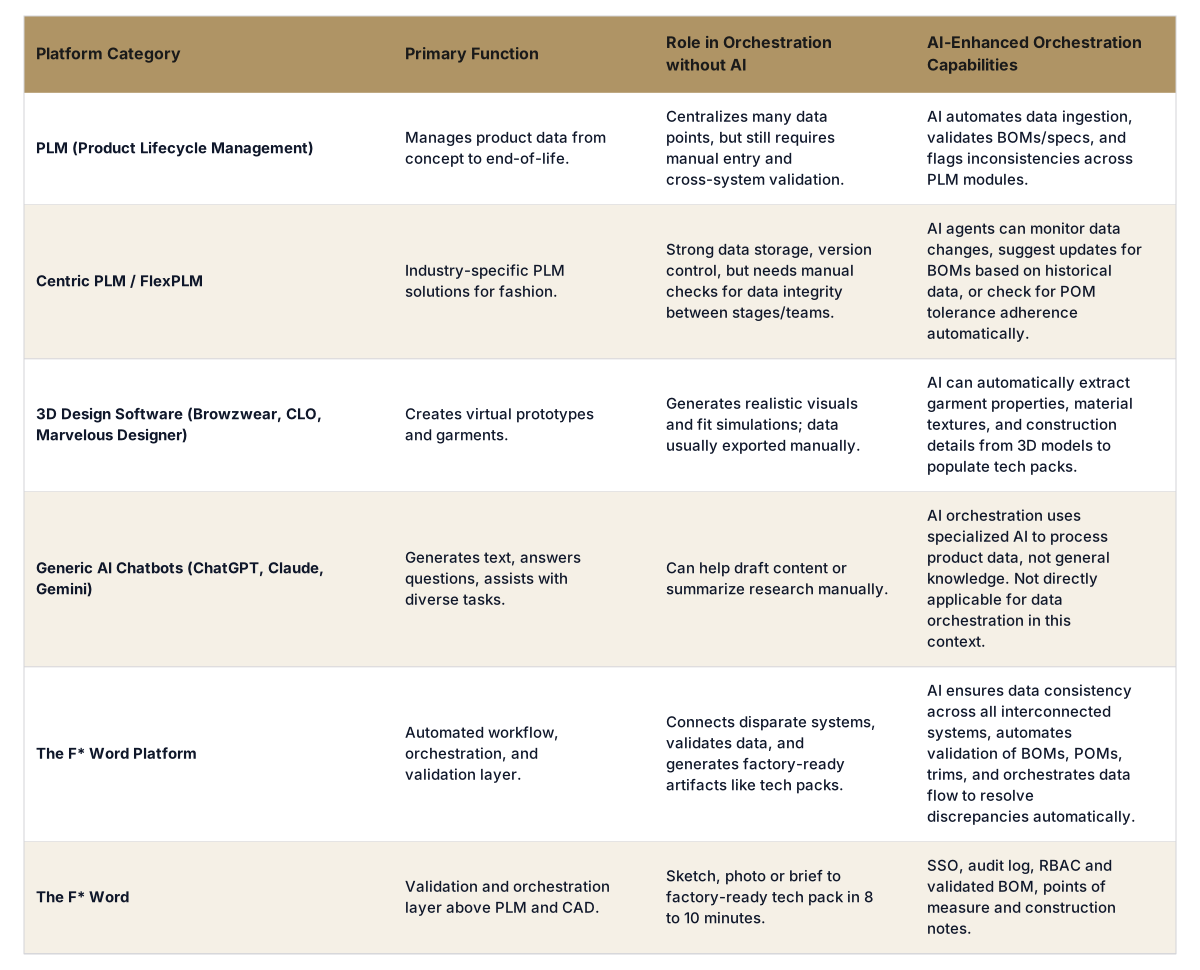
Traditional systems, like standalone PLMs or ERPs, are foundational but often require significant manual intervention for data transfer, validation, and synchronization across different modules or external platforms. AI orchestration layers on top of these, providing an intelligent "glue" that automates these manual steps.
The F* Word is not a PLM, a 3D design tool, or an image generator. Instead, it acts as the intelligent workflow and validation layer that sits between these systems. It orchestrates the flow of product data, ensuring that information from design concepts, 3D renders, and PLM entries is consistent, validated, and transformed into factory-ready production artifacts like comprehensive tech packs. This prevents issues from escalating when a product moves from technical design to sourcing.
Product data orchestration is the process of managing, integrating, and synchronizing all product-related information across various systems and stakeholders. It ensures that accurate and consistent data, like BOMs, POMs, and material details, is available from design through to production, preventing errors and improving collaboration.
AI improves data accuracy by automating validation checks, identifying inconsistencies, and extracting structured data from unstructured sources. It can compare specifications across documents, flag discrepancies in BOMs or size charts, and significantly reduce manual data entry errors for technical designers and sourcing teams.
Yes, AI solutions are designed to integrate with existing PLM systems (e.g., Centric, FlexPLM) and other enterprise software. They act as an intelligent layer that enhances the functionality of these systems by automating data flows, validating inputs, and ensuring consistency across different platforms.
AI solves challenges such as manual data entry errors, inconsistent product specifications, communication breakdowns between teams and vendors, and slow development cycles. It streamlines processes, ensures all parties work from synchronized BOMs and tech packs, and accelerates time-to-market.
While larger brands may have more complex data needs, AI solutions are increasingly scalable and accessible to brands of all sizes. Smaller and mid-sized brands can also benefit significantly from improved data accuracy, reduced manual effort, and faster product development workflows, optimizing their limited resources.
AI improves vendor communication by ensuring that factories receive clear, consistent, and validated product specifications, including precise BOMs, POMs, and technical drawings. This reduces back-and-forth queries, minimizes misinterpretations, and leads to fewer sample rounds, accelerating approvals and production.
The F* Word orchestrates your fashion product data, turning concepts into factory-ready production artifacts. See the workflow
Related: Enterprise
The F* Word validates before the data lands: approved suppliers, fibre compatibility, tolerance bands, label spec and complete points of measure, then routes the pack into PLM. PLM stays the system of record; the validation layer is what stops incomplete records entering it.
Get The F* Word workflow insights in your inbox.