

Yes, AI trend intelligence can significantly reduce overproduction, but only when it is integrated directly into product development and merchandising workflows. The mechanism is not simply better forecasting. Instead, AI provides a quantifiable signal that allows brands to make four specific, risk-reducing decisions: narrowing the assortment to high-conviction SKUs, committing to smaller initial buys with data-driven replenishment triggers, positioning raw material commitments at the fabric platform level instead of finished goods, and identifying fading trends early enough to cancel or adjust late-stage purchase orders. This transforms trend intelligence from a passive report into an active decision-making tool.

Overproduction in fashion is fundamentally a problem of decision quality under uncertainty. For decades, merchandising and design teams have relied on a combination of historical sell-through data, reports from trend forecasting agencies, and professional intuition. While valuable, this approach has inherent limitations. Last year's bestsellers are not a guarantee of future success, and static, six-month-old PDF trend reports offer broad themes, not specific, actionable intelligence on a particular silhouette, color, or detail.
This information gap forces teams to place bets. They widen assortments to avoid missing a potential winner, leading to a long tail of SKUs that require deep markdowns. They commit to large purchase orders (POMs) to meet factory minimum order quantities (MOQs) and secure production capacity far in advance of the selling season. Each of these decisions is a point of risk, baked into the system months before a single customer has a say.
AI trend intelligence changes the equation by providing a continuous, dynamic, and quantifiable signal of market demand. It analyzes millions of data points from social media, e-commerce, and cultural signals to validate design concepts before a commitment is made. This shifts the focus from "what sold well last year?" to "what is the current and projected market appetite for this specific product concept right now?". It allows teams to validate, refine, or kill ideas based on data, improving the quality of decisions at every stage of the product lifecycle.

A primary driver of overproduction is assortment width. To capture every possible trend, brands often develop a wide range of styles, many of which will ultimately underperform. Each SKU in the line plan represents a commitment to development resources, sampling costs, and eventually, inventory. The bottom 20% of these styles are often responsible for the majority of end-of-season markdowns and dead stock.
AI trend intelligence provides a filter to build a more focused, higher-conviction assortment. By scoring individual design concepts, silhouettes, colors, and even specific details (like a certain collar shape or sleeve type) against real-time market data, AI enables merchants to quantify the demand potential for each style in the line plan. This allows for a data-informed culling of lower-potential SKUs before they ever enter the product development pipeline.
Instead of offering ten variations of a blouse hoping two will be hits, a brand can use AI to identify the three variations with the highest probability of success. This reduces the risk of producing unwanted goods and frees up capital and supply chain capacity to invest more deeply in the validated winners. The result is a smaller, more productive assortment with a higher average sell-through and a lower markdown rate.

Traditional buying strategy often involves a large initial "first-cut" order to maximize margins and meet vendor MOQs. This front-loads risk entirely on the brand. If the style fails to resonate with customers, the brand is left with immense inventory liability. The alternative is a "chase" or replenishment model, but this requires speed and certainty, two things that are difficult to achieve with traditional workflows.
AI enables a powerful "test and re-order" strategy. Brands can confidently place a much smaller initial order on a new style that has been validated by AI trend data. This initial inventory serves as a real-world test. As early sell-through data becomes available, it can be cross-referenced with the ongoing AI trend signal. If both indicators are strong, a replenishment order can be triggered with high confidence.
This is where workflow speed becomes critical. A positive signal is useless if it takes six weeks to create and approve a new tech pack for the re-order. Platforms like The F* Word, which can generate a factory-ready, validated tech pack in 8-10 minutes, connect the AI signal directly to production-ready execution. This agility allows brands to feed the factory with winning SKUs in-season, maximizing sales on proven products while minimizing the initial risk on new introductions.
A significant portion of a brand's liability is tied up in finished goods. A commitment to 10,000 units of a floral print dress is a specific, inflexible bet. If that particular print or silhouette fails, the entire inventory is at risk. A more agile approach is to postpone the final decision on the finished good for as long as possible. This is achieved through fabric platforming.
Fabric platforming involves committing to a volume of a core, undyed fabric (greige goods) or a versatile base material that can be used across multiple styles. The final decision about color, print, and finish is made much closer to the selling season, based on the most current demand signals. AI trend intelligence is perfectly suited to this model, as it can provide precise, up-to-the-minute data on which colors and prints are accelerating in popularity.
For example, a brand can secure a large quantity of a specific cotton poplin. As the season approaches, AI trend data might show that "Kelly Green" is spiking while "Lavender" is fading. The brand can then direct its suppliers to dye the majority of the platformed fabric in the high-demand color. This strategy shifts risk from a highly specific SKU to a more flexible raw material, drastically reducing the chances of being stuck with inventory in an undesirable color or print.
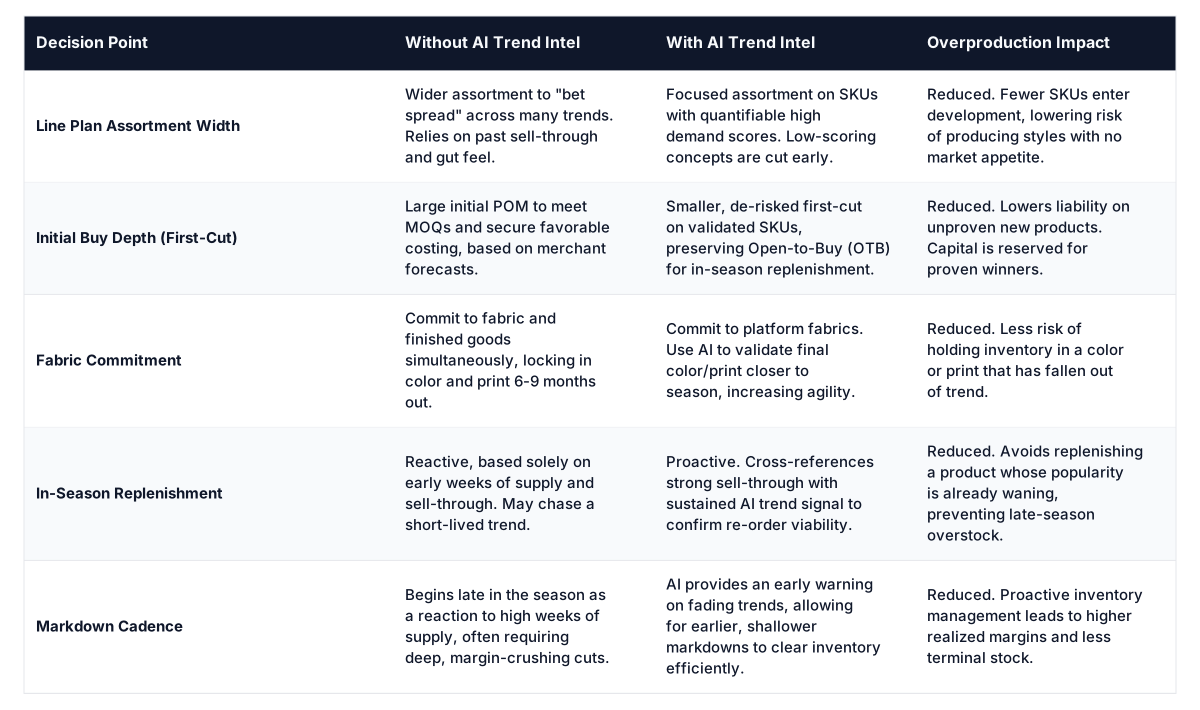
The value of AI trend intelligence is realized when it directly informs key decisions throughout the product-to-market calendar. Abstract insights are not enough; the signal must be wired into the merchandising, design, and sourcing workflows to have a material impact on overproduction. The F* Word's platform ensures this signal is not just a report to be read, but a data point for validation at each stage, from the initial line plan to the final purchase order.
By comparing traditional methods against an AI-integrated workflow, the impact on inventory risk becomes clear. Decisions become less about speculative bets and more about data-validated actions. This operational discipline is the true mechanism for reducing waste.
While AI provides a powerful signal for better decision-making, it is not a silver bullet. Certain deep-rooted industry practices and constraints limit its effectiveness if not addressed in parallel. It is critical for brands to understand that implementing AI trend intelligence requires a corresponding evolution in their operational and incentive structures.
The most significant constraints are vendor-side. Minimum order quantities (MOQs) set by factories can force brands to buy more inventory than demand data justifies, negating the benefit of a smaller, targeted buy. Similarly, long lead times (the time from POM placement to delivery) can make it impossible to act on fast-moving, in-season trends, regardless of how quickly the AI identifies them. Reducing overproduction requires not just better intelligence but also stronger, more flexible partnerships with the supply chain.
Internally, incentive structures can also work against waste reduction. If merchants and buyers are compensated primarily on gross sales volume or a culture of "newness," they are encouraged to create wider assortments and place larger bets. To truly combat overproduction, performance metrics must be rebalanced to reward inventory productivity, sell-through percentage, and realized margin, aligning individual incentives with the company's goal of producing more intelligently.
No. Effective AI trend intelligence is not a static report like those from traditional agencies. It should be an integrated signal within your workflow platform. For instance, on The F* Word, the trend score is a data point attached to a concept on your line plan or a detail on a tech pack. It provides validation or a warning right at the point of decision, rather than being a separate document you need to interpret and manually apply.
Traditional agencies provide high-level, directional, and often qualitative analysis months in advance. AI trend intelligence is specific, quantifiable, and operates in near real-time. Instead of a theme like "Dopamine Dressing," AI can tell you the specific market demand for a "scalloped edge collar on a poplin shirt in lime green." It validates the execution of a trend, not just the abstract concept, allowing for much more granular decision-making.
Absolutely not. AI is a tool for validation and risk assessment, not a replacement for creativity and market expertise. It empowers designers and merchants, giving them data to support their creative instincts. It helps them focus their talents on the concepts with the highest potential for success and provides a safety net against investing heavily in ideas that lack market traction. The final creative and curation decisions remain human-led.
Even with long lead times, AI provides significant value. You can use it much earlier in the cycle to validate your assortment and make better fabric platforming decisions. For in-season reaction, the key is having fast post-decision workflows. Generating a tech pack in 8-10 minutes, for example, shaves weeks off the replenishment process, making it possible to act on a signal even within a tighter production window. The goal is to compress every part of the timeline you control.
A comprehensive AI trend platform analyzes a diverse, global set of data sources. This includes tracking millions of SKUs across e-commerce sites, monitoring the visual conversation on social media platforms like Instagram and TikTok, analyzing runway shows, and processing patterns from search behavior. By synthesizing these varied inputs, the AI can distinguish between fleeting micro-fads and commercially viable, macro trends with staying power, providing a more reliable signal.
While this page focuses on trend-driven overproduction, other AI applications do address fit. AI can analyze returns data, customer reviews, and 3D body scan data to identify patterns in fit issues. This intelligence can then inform technical designers as they create block templates and grade rules, leading to the development of better-fitting garments that are less likely to be returned, which is another significant source of waste and margin loss.
No. The purpose of a workflow platform like The F* Word is to translate complex data science into a simple, intuitive user interface for creative and commercial teams. The output should be a clear score, a validation checkmark, or a simple chart that is immediately understandable to a merchandiser, designer, or product developer. The data science runs in the background, so your team can focus on making product decisions, not interpreting complex algorithms.
Connecting market intelligence directly to your product creation process is the most effective way to reduce overproduction. See how trend signal connects to line plan and tech packs to turn data into smarter, faster, and less wasteful decisions. This integration moves your team from reactive forecasting to proactive, data-validated creation.
Related: State of AI Fashion 2026 report
Get The F* Word workflow insights in your inbox.