

Yes. AI can turn a fashion trend into a factory-ready tech pack. The F* Word does this autonomously in 8 to 15 minutes. The system takes a confirmed trend signal, generates a trend-driven moodboard with canonical references and palette metadata, waits for designer approval of the brief, then produces a complete tech pack with bill of materials, construction notes, measurement spec and callouts. The output passes through a validation gate before it is marked factory-ready.
A trend that clears multi-source confirmation (social velocity plus runway plus search, for example) is surfaced with canonical references, palette hex ranges and silhouette notes. That metadata becomes the seed for a moodboard. The designer or creative director edits the moodboard, sets brand voice constraints, and approves the brief.
Once the brief is approved, AI generates a full spec. Bill of materials with fabric, trim and hardware. Construction notes with stitch type and seam allowance. Measurement spec across the size range with grade rules. Callouts on critical seams and finish requirements. Front, back and detail flats.
Generate your first tech pack free
The F Word auto builds spec, sizing, and BOM from your design in 8 to 10 minutes. No template wrangling, no factory back and forth.
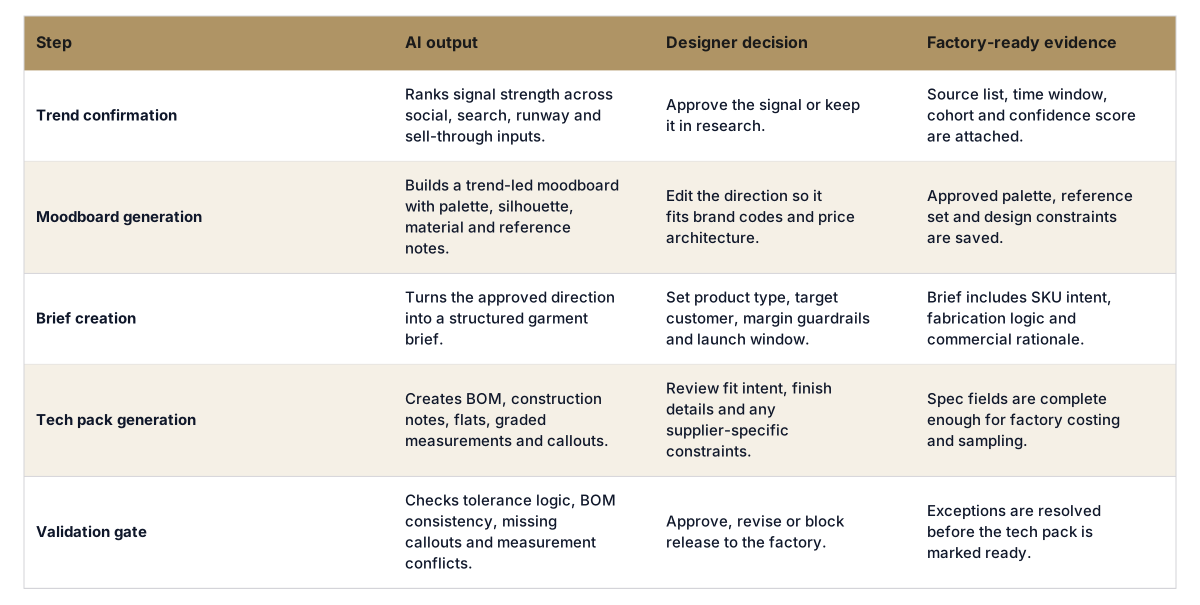
The compression comes from removing handoffs, not from cutting corners. Legacy workflows lose days at each handoff between forecast read, brief writer, sketch artist, tech designer and factory. AI replaces the handoffs with a single continuous flow, and the validation gate catches errors before they reach the factory.
The designer approves the brief, the moodboard and the final spec. AI handles the mechanical work; the designer handles the authorship. Brand voice constraints are set by the designer and enforced by the system on every output.
Yes. Tolerances, internal consistency, bill of materials math and callout completeness are checked before the spec is released.
No. The F* Word generates specs. A PLM stores and routes them. The two are complementary.
Multi-source confirmation reduces false positives, and the designer reviews every brief before tech pack generation runs.
See the full workflow at Trend to Tech Pack in 15 Minutes.
The teams that turn trend-to-tech-pack capability into a measurable revenue lever in 2026 share a small set of operating habits. None of them require a custom data team, and none of them require ripping out the existing planning stack. They do require the discipline to act on a signal inside the window it is actually warm in.
Every signal that reaches a designer should be tagged with a one-line sell-through hypothesis: which cohort, which price point, which window. Signals that cannot carry that tag are research, not product, and should sit in a research column rather than the active board. This single rule kills more bad bets than any model upgrade. For creative directors, it also makes the post-mortem cleaner because each shipped SKU traces back to a written hypothesis from week one.
Treat the active signal board like a portfolio. Once a week, force a trade-off review where any new signal added has to push an existing signal off the board. The cap should be ten, not fifty, and the rule should be enforced by a single owner. The best programs we see treat this meeting like a P+L review, not a brainstorm, and end with named owners and dates for each active signal.
The biggest leak in most trend programs is the handoff from signal to spec. A signal that lives in a dashboard but does not become a tech pack within a week is functionally a research note. The F* Word closes that handoff inside one tool: trend signal in, moodboard within minutes, factory-ready tech pack in 8 to 10 minutes, complete with graded measurements, BOM and construction notes. For creative directors, that handoff is usually the single highest-impact change in the program.
Every source class should have a named owner, a refresh cadence, a license check and a kill rule. Without governance, the source mix drifts into whatever is easiest to scrape, which is rarely the most predictive. A simple quarterly audit (sources in use, license proof, signal-to-decision yield per source) keeps the stack honest and makes audit conversations painless.
Generic velocity is a starter signal. A scoring layer that weights velocity against your customer cohorts, your category mix and your last 12 months of sell-through is what turns a tracker into a competitive advantage. Brands that invest in this layer see precision rise by 10 to 15 points within two quarters, and the gain compounds because the model learns from every shipped SKU.
Most brands buy the ingest, classify and score layers from a vendor and only own the routing and shipping layers. That keeps the headcount footprint to one or two seats: a design ops lead and a part-time analyst. The cost line is software, not salary.
Three signal classes, ten active signals at any time, and a 12-week measurement window. Below that, you do not have enough data to compare against control SKUs and the program cannot prove its own ROI.
Cap the board at ten signals, route only the top three into auto-moodboards, and put the rest in a single weekly digest. Designers should see fewer, sharper signals, not more.
A working program at month 12 has: three to five source classes wired, a brand-specific scoring layer, a closed loop into The F* Word for tech-pack generation, and a quarterly readout that compares tracker-sourced SKUs against control SKUs on sell-through, margin and return rate. Programs that hit those four marks tend to renew. Programs that miss them tend to get cut in the next budget cycle.
The F* Word treats trend-to-tech-pack capability as the input and a factory-ready tech pack as the output. A creative director moves from a ranked signal to a moodboard inside minutes and to a tech pack inside 8 to 10 minutes, with the BOM, flats, graded measurements, construction notes, color story and tolerances already populated. The handoff to the factory then happens the same day rather than the same month. For creative directors, this is the operational change that makes the program payable.
Ready to turn your next confirmed trend signal into a factory-ready spec? The F* Word generates the moodboard, then the tech pack with BOM, graded measurements and construction notes, in 8 to 10 minutes. See how autonomous tech pack generation works.
Get The F* Word workflow insights in your inbox.