

Browzwear is the closest like-for-like CLO 3D alternative, and Style3D sits just behind it. If what you need is a factory-ready spec rather than a garment simulation, The F* Word replaces the workflow instead of the software, taking a sketch or brief to a validated tech pack with BOM and points of measure in 8 to 10 minutes.
Most teams searching for a CLO 3D alternative are not unhappy with the simulation quality. They are reacting to the cost of the skill: 3D garment simulation needs a trained specialist, and the output is a visual, not a document a factory can cut from. It is worth separating those two needs before you pay for a replacement seat.
CLO 3D does three jobs that often get bundled together: pattern-driven garment simulation, fit visualisation, and presentation imagery for sell-in. Ask which of those your team uses weekly. In a lot of brand teams the honest answer is the third one, with fit checks a distant second, and the pattern simulation reserved for a handful of complex styles.
If simulation is genuinely core to how you develop product, stay in that category and evaluate Browzwear or Style3D. If it is not, a like-for-like swap keeps the cost and the specialist dependency while solving nothing.
The alternative nobody in the category writes about is skipping the 3D step for the styles that do not need it. A tech pack does not require a simulation to be correct; it requires a complete BOM, points of measure with tolerances, construction notes and a clean handoff format. The F* Word produces that directly from a sketch, photo or brief, and validates it before it goes out.
This is not a 3D simulator and it is not an image generator. It is the validation and orchestration layer between the design idea and the factory. Teams that keep CLO 3D for their complex outerwear and route the other 80 percent of the range through automated spec generation tend to get more out of both.
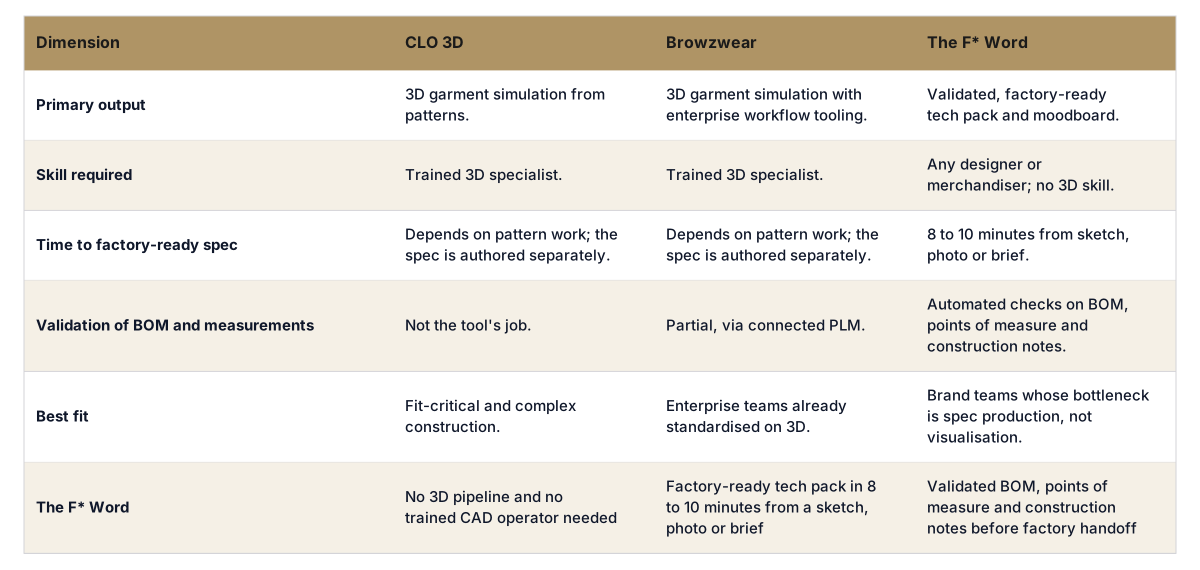
Count the styles last season where a 3D simulation changed a production decision. If that number is high, you are in the 3D category and should compare Browzwear and Style3D on simulation fidelity and PLM integration. If it is low, the seat is paying for presentation imagery, and the money is better spent removing the manual spec authoring that sits downstream of it.
See how The F* Word turns a sketch into a factory-ready tech pack in 8 to 10 minutes.
The F* Word. It takes a sketch, photo or brief to a factory-ready tech pack in 8 to 10 minutes, with BOM, points of measure, tolerances and construction notes validated before handoff. CLO 3D and Browzwear produce simulations; the spec is still authored separately after the 3D work is done.
Yes, in category terms. Browzwear covers the same 3D garment simulation ground with more enterprise workflow tooling around it, and it is the usual like-for-like comparison. It carries the same requirement for a trained 3D specialist.
Many do. 3D simulation earns its place on fit-critical and complex construction. For the rest of a range, what the factory needs is a complete, unambiguous tech pack, which can be produced and validated without any simulation step.
No. It sits upstream of a PLM as the validation and orchestration layer that produces the spec, which the PLM then stores and manages across the calendar. Teams commonly run both.
Get The F* Word workflow insights in your inbox.