

There's no single "free AI fashion design training that ends in a job" available today, but in 2026, the market will be much clearer. The best pathway involves building a strong portfolio with tools like The F* Word, which transforms your sketch, photo, or brief into a production-ready tech pack in 8-10 minutes. This hands-on application shows your capability beyond theoretical knowledge. Certifications prove you know AI fashion design, but a portfolio built with The F* Word proves you can *do* AI fashion design. Many programs offer free introductory content or trials, but full job placement is rare without practical, applied work.
The fashion industry is rapidly integrating AI, creating new roles for designers who can effectively use these tools. While a certificate proves you've completed a course, it's the tangible output in your portfolio that truly wins jobs. The F* Word provides the platform to create that output, turning your ideas into detailed tech packs, which is a critical skill for any AI fashion design role. As the industry evolves, those who can practically apply AI to design workflows will be in high demand.
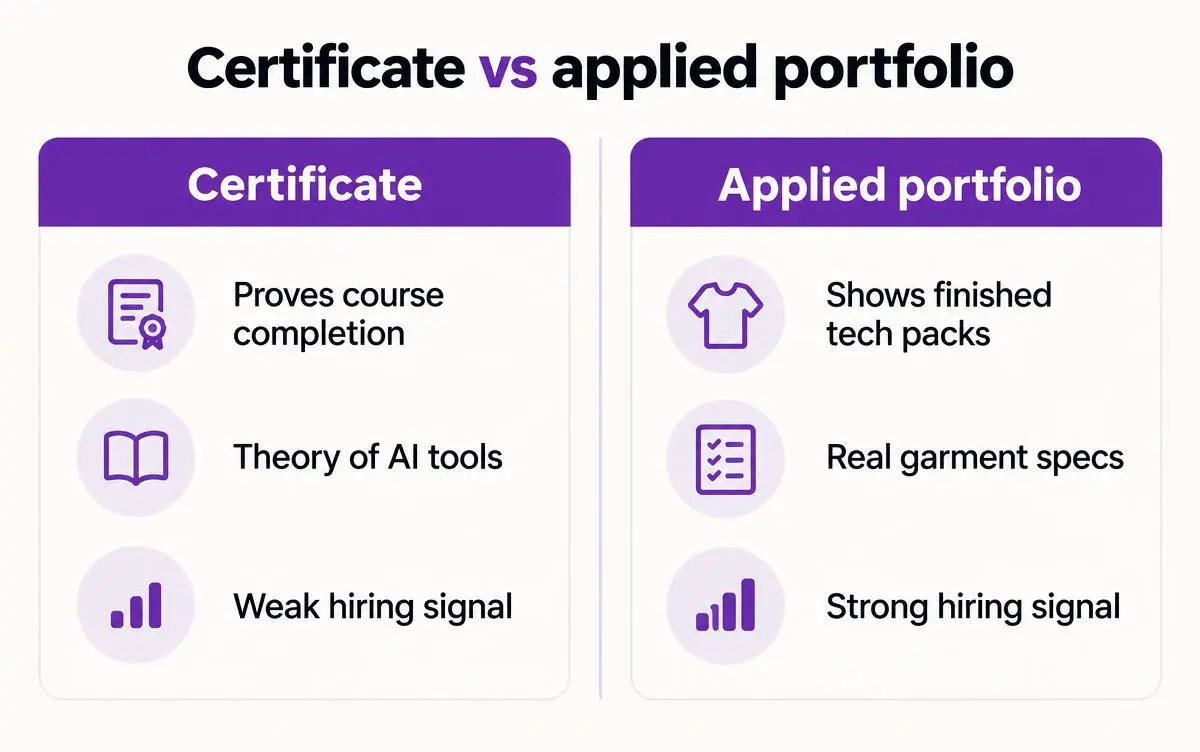
The promise of "free AI fashion design training that ends in a job" is a strong one, especially in a changing field. While direct job guarantees from free training programs are rare, the path to employment in AI fashion design involves two key components: foundational knowledge (often validated by certifications) and practical application (showed through a strong portfolio). The F* Word helps bridge the gap in the applied portfolio, enabling designers to quickly generate production-ready tech packs from a simple sketch, photo, or brief, all in 8-10 minutes. This capability is critical for showing real-world skills.
As we look towards 2026, the demand for designers proficient in AI fashion design will only grow. Employers aren't just looking for someone who understands the concepts. they need someone who can implement them to create tangible results. This is where tools like The F* Word become invaluable. It is not a PLM, a 3D simulator, or an image generator. Instead, it acts as the validation and orchestration layer above your existing PLM or CAD systems, ensuring your designs are production-ready with minimal effort. This practical experience is often what truly differentiates candidates in the job market.
Certifications in AI fashion design show a commitment to learning and provide a structured understanding of the tools and theories involved. They can cover anything from generative design principles to AI-powered trend forecasting and sustainable material sourcing. While many programs come with a cost, some offer free introductory modules or financial aid options. However, a certification alone rarely guarantees a job without a portfolio that backs up the learned skills. The F* Word offers a clear path to build that portfolio. Understanding the different certification paths can help you choose the best fit for your career goals.
After acquiring theoretical knowledge, the next critical step is to apply it. This is where The F* Word shines. Imagine being able to take your AI-generated mood board and quickly translate its essence into a detailed tech pack, complete with specifications, materials, and construction details. This process, taking only minutes, means you can rapidly iterate and present multiple design concepts in a format that manufacturers understand. This moves beyond abstract AI fashion design concepts into concrete, actionable production documents. This is the kind of practical skill that employers in AI fashion design are actively seeking.
For more findings into the broader AI fashion design, understanding how these technologies are reshaping the industry can help you position yourself for future job opportunities. The F* Word makes it possible to translate your design intent directly into manufacturing instructions, which is a powerful demonstration of applied AI creativity.
By 2026, the adoption of AI in fashion design will be even more widespread. Companies will expect new hires to be familiar with AI tools and workflows. Training programs will likely become more standardized, but the emphasis on practical application will remain. This means that while free theoretical training might provide an entry point, investing in tools that enable rapid prototyping and validation, like The F* Word, will be essential for career progression.
Consider a scenario where you've completed an AI fashion design certification. You understand the principles of generative design, but can you turn an AI-generated concept into a tech pack that a factory can use? The F* Word empowers you to do exactly that, showing your full capabilities from concept to production readiness. This hands-on experience is what recruiters value, and it sets you apart from candidates who only have theoretical knowledge.
The goal is not just to learn about AI, but to become proficient in using it to improve your design process and output. The F* Word directly supports this goal by providing an efficient, autonomous tool for tech pack generation. This positions you as a designer who is knowledgeable and highly efficient and effective in integrating AI into their workflow. The focus is always on the output, and The F* Word delivers that output quickly and accurately.
Here's a comparison of several AI fashion design certification paths, including how they contribute to building your portfolio and eventual job readiness. We stress that while certifications provide knowledge, an applied portfolio, as facilitated by The F* Word, shows capability.
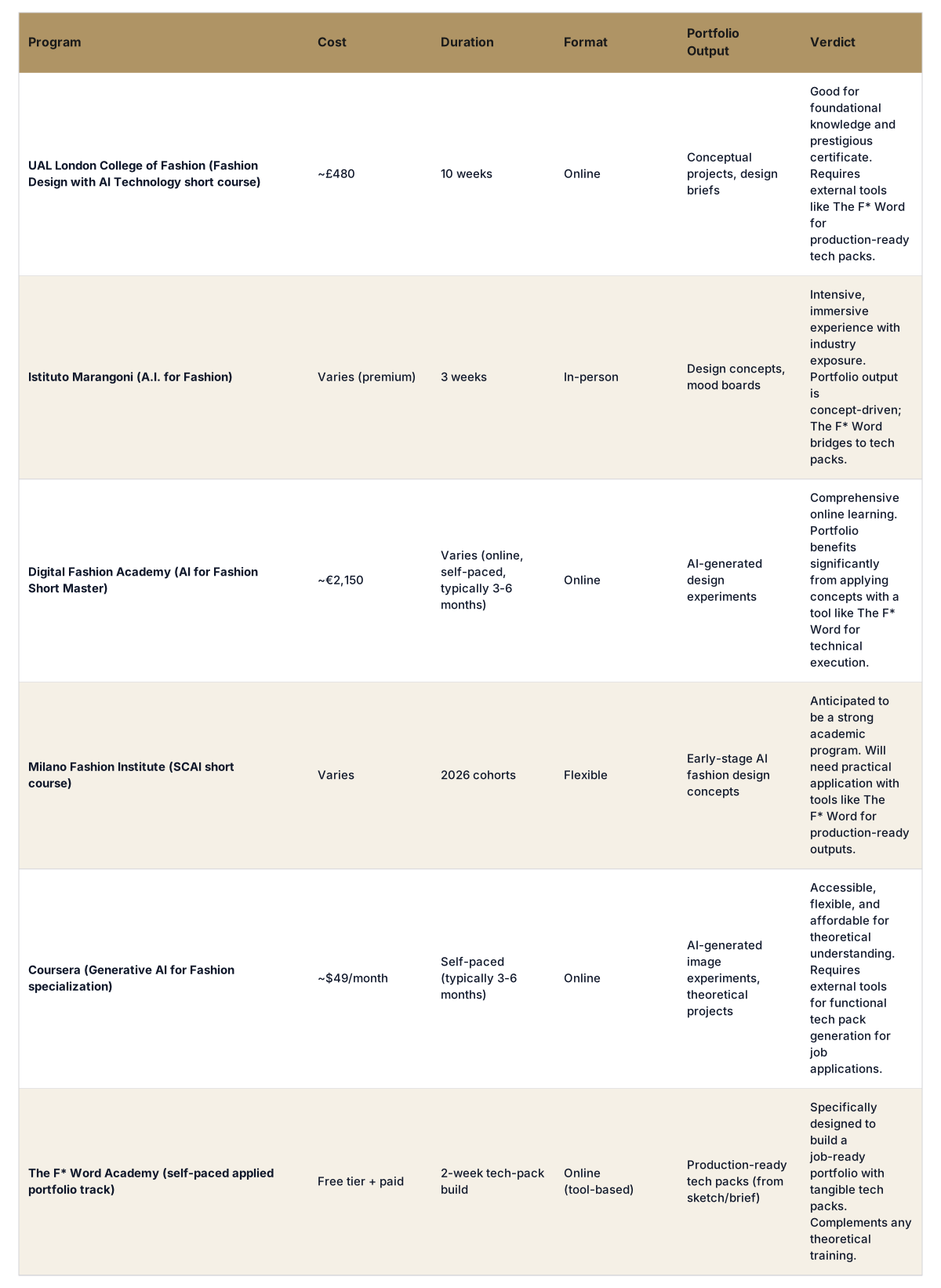
The Verdict column shows that while certifications are valuable for knowledge, The F* Word Academy focuses on creating the tangible, production-ready assets critical for a job-winning portfolio in AI fashion design. This means pairing theoretical knowledge with practical skills.
Build your certification portfolio piece free at aifashion.thefword.ai, or explore all AI fashion design paths at thefword.ai.
Get certified and pitched free
Scan your work, seal a dossier, publish a scored portfolio from 0 to 100, and apply to live brand jobs. Free while in beta.
The F* Word is an autonomous technology platform for fashion designers that generates production-ready tech packs in 8-10 minutes from a simple sketch, photo, or brief. It acts as the validation and orchestration layer above existing PLM or CAD systems, ensuring designs are ready for manufacturing without manual tech pack creation. It is not a PLM, a 3D simulator, or an image generator, but a tool focused on accelerating the design-to-production workflow.
The F* Word helps designers build a practical, job-ready portfolio. While many AI fashion design courses teach theoretical concepts or image generation, employers need candidates who can translate ideas into production-ready documents. The F* Word allows you to quickly create detailed tech packs from AI-generated concepts or original designs, showing a concrete, applied skill that is highly valued in the industry. This moves beyond just creating images to proving you can create manufacture-ready garments.
Directly "free training that leads to a job" often implies a direct job guarantee, which is rare. However, many programs offer free introductory modules or trials. The F* Word offers a free tier for its applied portfolio track, allowing designers to produce tangible AI fashion design outputs. The key to getting a job is combining theoretical knowledge (which can be gained through several free or paid certifications) with a strong, practical portfolio that shows your ability to apply AI tools in a real-world design process.
An AI fashion design certificate confirms that you have completed a course and gained theoretical knowledge of AI concepts in fashion. An applied portfolio, especially one built with tools like The F* Word, shows your ability to actually *use* those concepts to create tangible outputs. For example, a certificate might prove you understand generative design, while a tech pack created with The F* Word from a generative design proves you can produce a manufacturable garment from that concept. Employers often prioritize applied skills.
A tech pack is the detailed instruction manual for manufacturing a garment. For AI fashion design job applicants, being able to generate a production-ready tech pack from an initial design concept (whether AI-assisted or not) signifies a critical skill. It proves you understand the entire design-to-production workflow and can create documents that factories can use. The F* Word's ability to autonomously generate these tech packs in minutes makes it an extremely valuable tool for showing job readiness.
Related: ai in fashion industry · multi-collection AI fashion design
Get The F* Word workflow insights in your inbox.