

Hashtag velocity is the rate of change in mentions of a hashtag over time, and it is the single most predictive social signal for short-cycle fashion trends. Most brands still watch absolute volume, which is a lagging indicator. Velocity is leading, which is exactly what a buy decision needs.
Buyer comparison

A hashtag at one million daily mentions that is flat tells you nothing. A hashtag at fifty thousand daily mentions doubling week over week tells you a product cluster is about to become buyer demand. Volume rewards trends that already won. Velocity rewards trends that are about to. In a category where the average microtrend window is 4 to 12 weeks, that lead time is the entire margin.
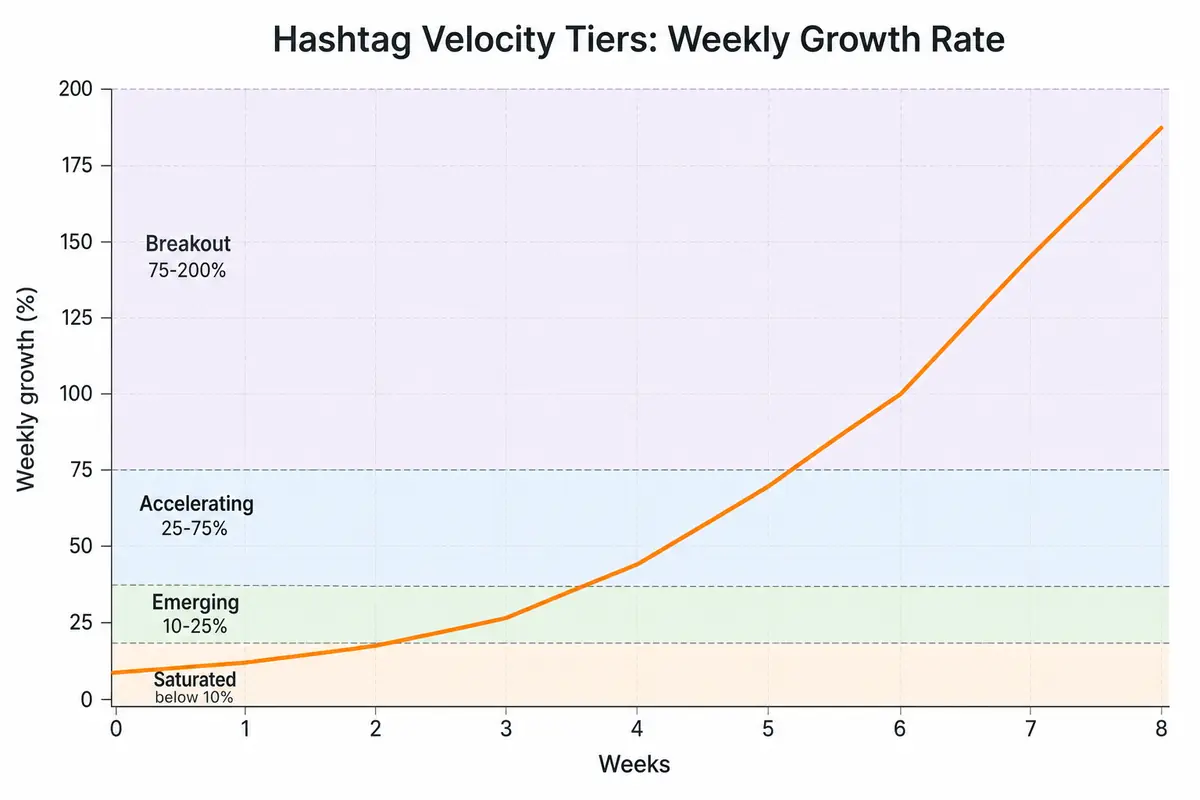

Use a 7-day rolling window, not a 24-hour spike. Single-day spikes are usually press cycles or paid amplification, not organic adoption. Compute growth as (mentions_last_7d minus mentions_prior_7d) divided by mentions_prior_7d. Apply a Laplace smoothing constant to low-volume tags so a jump from 2 to 8 mentions does not register as a 300 percent breakout. Cap the upper bound at 500 percent so coordinated spam does not blow out your scoring.
Velocity without geo is useless for buying decisions. Always layer two filters: (a) geo distribution of the velocity (US East Coast vs Korea vs Brazil) and (b) audience overlap with your customer cohorts. A 200 percent breakout in a market you do not serve is interesting trivia, not a signal.

A contemporary womenswear brand started tracking #buttercreamcoat on January 5. The hashtag had 4,200 mentions in the prior 7 days. By January 12 it sat at 7,100 (+69 percent), by January 19 at 13,800 (+94 percent). The brand routed it into a moodboard on January 14 (Accelerating), generated a factory-ready tech pack via The F* Word on January 16, signed a PO on January 18 and shipped to DTC on March 4. The hashtag peaked in mid-March. The brand sold through 92 percent at full price.
The F* Word ranks emerging and accelerating hashtags by your brand audience overlap, surfaces the underlying garment cluster as a moodboard, and produces a factory-ready tech pack in 8 to 10 minutes. A trend that crosses the 75 percent threshold on a Monday can be a PO on Friday.
Yes. On TikTok and Reels, sounds often lead hashtags by 5 to 10 days. Treat them as a leading indicator on top of hashtag growth.
Start with 200 hashtags throughout your three core categories. The score will cut that to 10 to 20 active ones at any time.
Sustained 75 percent week-over-week growth over a 14-day window, with cross-cohort spread and at least one corroborating signal (search or resale).
Require creator-cohort spread above 0.4 (signal must appear throughout multiple unrelated creator clusters) before promoting from Emerging to Accelerating.
Pick your 200 starter hashtags, wire weekly velocity scoring, and connect the Accelerating tier to The F* Word for moodboard and tech-pack generation. Your first breakout-tier SKU should be in production inside three weeks.
The teams that turn hashtag velocity scoring into a measurable revenue lever in 2026 share a small set of operating habits. None of them require a custom data team, and none of them require ripping out the existing planning stack. They do require the discipline to act on a signal inside the window it is actually warm in.
Esignal that reaches a designer should be tagged with a one-line sell-through hypothesis: which cohort, which price point, which window. Signals that cannot carry that tag are research, not product, and should sit in a research column rather than the active board. This single rule kills more bad bets than any model upgrade. For trend analysts, it also makes the post-mortem cleaner because each shipped SKU traces back to a written hypothesis from week one.
Treat the active signal board like a portfolio. Once a week, force a trade-off review where any new signal added has to push an existing signal off the board. The cap should be ten, not fifty, and the rule should be enforced by a single owner. The best programs we see treat this meeting like a P+L review, not a brainstorm, and end with named owners and dates for each active signal.
The biggest leak in most trend programs is the handoff from signal to spec. A signal that lives in a dashboard but does not become a tech pack in a week is functionally a research note. The F* Word closes that handoff inside one tool: trend signal in, moodboard in minutes, factory-ready tech pack in 8 to 10 minutes, complete with graded measurements, BOM and construction notes. For trend analysts, that handoff is usually the single highest-use change in the program.
Esource class should have a named owner, a refresh cadence, a license check and a kill rule. Without governance, the source mix drifts into whatever is easiest to scrape, which is rarely the most predictive. A simple quarterly audit (sources in use, license proof, signal-to-decision yield per source) keeps the stack honest and makes audit conversations painless.
Generic velocity is a starter signal. A scoring layer that weights velocity against your customer cohorts, your category mix and your last 12 months of sell-through is what turns a tracker into a competitive advantage. Brands that invest in this layer see precision rise by 10 to 15 points in two quarters, and the gain compounds because the model learns from eshipped SKU.
Most brands buy the ingest, classify and score layers from a vendor and only own the routing and shipping layers. That keeps the headcount footprint to one or two seats: a design ops lead and a part-time analyst. The cost line is software, not salary.
Three signal classes, ten active signals at any time, and a 12-week measurement window. Below that, you do not have enough data to compare against control SKUs and the program cannot prove its own ROI.
Cap the board at ten signals, route only the top three into auto-moodboards, and put the rest in a single weekly digest. Designers should see fewer, sharper signals, not more.
A working program at month 12 has: three to five source classes wired, a brand-specific scoring layer, a closed loop into The F* Word for tech-pack generation, and a quarterly readout that compares tracker-sourced SKUs against control SKUs on sell-through, margin and return rate. Programs that hit those four marks tend to renew. Programs that miss them tend to get cut in the next budget cycle.
The F* Word treats hashtag velocity scoring as the input and a factory-ready tech pack as the output. A creative director moves from a ranked signal to a moodboard inside minutes and to a tech pack inside 8 to 10 minutes, with the BOM, flats, graded measurements, construction notes, color story and tolerances already populated. The handoff to the factory then happens the same day rather than the same month. For trend analysts, this is the operational change that makes the program payable.
Related: fashion trend signal scoring · See the related workflow guide · Read the related article · Try The F* Word
Get The F* Word workflow insights in your inbox.