

Direct answer. AI fashion design briefs streamline product development for startups by rapidly generating detailed, data-driven specifications that align with market trends, consumer preferences, and brand identity. This acceleration minimizes research time, reduces subjective errors, and provides clear, actionable parameters for design, technical development, and sourcing. Startups can achieve faster concept-to-prototype cycles, optimize resource allocation, and enhance collaboration across their lean teams, leading to more efficient product launches and a competitive edge in the dynamic fashion market.
Fashion startups often operate with constrained resources, limited personnel, and pressure to quickly bring innovative products to market. Traditional design brief creation is a time-consuming process involving extensive market research, trend analysis, competitive benchmarking, and manual consolidation of design elements. This manual approach is prone to inconsistencies, delays, and misinterpretations, which can derail product development timelines and increase costs.
The absence of precise, comprehensive briefs can lead to multiple sample rounds, communication breakdowns with manufacturers, and garments that miss the target aesthetic or functional requirements. For a startup, each misstep prolongs the development cycle and consumes critical budget, making efficiency in this initial phase paramount.
An AI fashion design brief is a detailed document or set of specifications generated by artificial intelligence. It synthesizes vast amounts of data, including current and emerging fashion trends, historical sales performance, social media sentiment, demographic analyses, material innovations, sustainability considerations, and manufacturing feasibility. The AI processes these inputs to create a structured outline that guides the entire product development process.
Unlike human-generated briefs, AI briefs can identify subtle patterns and correlations in data that might escape manual analysis. They provide specific recommendations for styles, silhouettes, colors (Pantone or similar codes), fabrics, trims, construction details, and target price points. This data-driven approach ensures that designs are aesthetically appealing and commercially viable and aligned with current market demands.
AI design briefs significantly accelerate the initial stages of product development by providing a concrete starting point. Designers receive clear parameters, reducing the time spent on conceptualization and iteration. The brief can specify critical details such as fabric composition, yarn counts, and even initial POM (Point of Measure) guidelines, giving technical designers a head start.
For sourcing teams, an AI brief can recommend suitable suppliers based on material requirements, production capabilities, and ethical certifications. This immediate access to specification-aligned information reduces the back-and-forth communication that often plagues early sourcing efforts. Ultimately, this speeds up the selection of materials and manufacturers, directly impacting lead times and cost efficiencies.
Startups often have small, multidisciplinary teams where individuals wear multiple hats. AI fashion design briefs streamline workflows by providing a centralized, consistent source of truth for all stakeholders. Product development managers, technical designers, and merchandisers can all refer to the same AI-generated brief, minimizing ambiguity and miscommunication.
By automating the data synthesis that underpins the brief, AI frees up valuable human resources from repetitive research tasks. This allows design and product teams to focus on higher-value activities such as creative problem-solving, quality control, and strategic planning. The reduction in sample rounds due to more precise instructions also saves time, material costs, and logistics expenses, crucial for budget-conscious startups.
An effective AI design brief comprises several critical data points that holistically guide the product lifecycle. These elements ensure comprehensive coverage from concept to production:
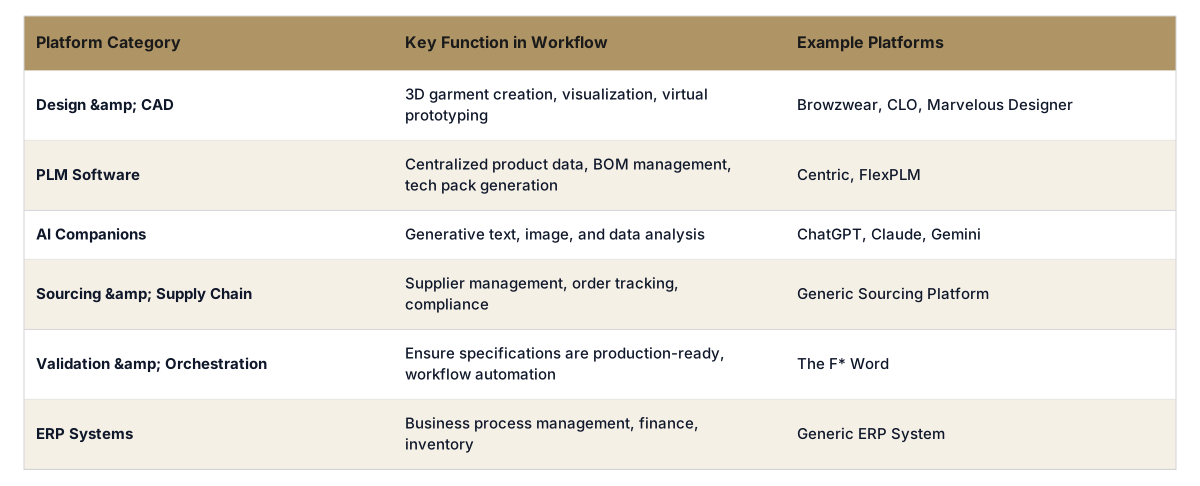
Integrating AI-generated design briefs into a startup's existing technology stack enhances their utility. While AI generates the brief, platforms like PLM systems serve as central repositories for all product data. The data within an AI brief can populate fields in PLM systems, ensuring consistency and accuracy across the product lifecycle.
The F* Word, for instance, acts as an orchestration layer, taking the structured output of an AI brief and validating it against brand standards, material availability, and manufacturing constraints. This ensures that the AI's recommendations are not just creative or trend-driven, but also actionable and compliant with real-world production processes.
AI uses a broad spectrum of data, including historical sales figures, current market trends from social media and fashion publications, consumer demographic data, material innovations, sustainability reports, and competitor analysis. It processes this information to identify patterns and predict successful design elements for a specific target audience and season.
Yes, AI fashion design briefs are highly customizable. Startups can feed the AI their brand's historical design preferences, core aesthetic, sustainability commitments, and target customer profiles. This input trains the AI to generate briefs that not only are trend-aware, but also deeply aligned with the brand's unique identity and values.
AI briefs improve communication by providing highly precise and objective specifications. They can include exact color codes, detailed material compositions, specific POMs, and clear construction instructions. This reduces ambiguity inherent in subjective descriptions, leading to fewer misinterpretations and more accurate initial samples from manufacturers.
AI-generated briefs can detail complex garment designs by breaking them down into precise components and specifications. While the AI may not create the artistic interpretation of a complex design, it excels at defining the underlying technical and functional parameters, such as grading rules for intricate patterns or specific trim requirements, which are crucial for production.
Startups can typically save weeks, if not months, in the early stages of product development. The time required for market research, trend analysis, and initial brief generation can be reduced by 50% or more. This accelerates decision-making and allows design and technical teams to move into execution phases much faster than with traditional methods.
No, AI design briefs do not replace human designers. Instead, they serve as powerful tools that augment human creativity and efficiency. AI handles the data analysis and specification generation, freeing designers to focus on artistic interpretation, creative problem-solving, and emotional aspects of design that only human intuition can provide.
Get The F* Word workflow insights in your inbox.