
Language

Short answer: Fashion products appear in Google AI Overviews when the query has commercial shopping intent, when the garment's structured attributes match the constraints in the query, and when the claim can be verified against a source Google already trusts, which in apparel usually means the brand's own structured product data plus at least one independent reference. The overview is assembled, not ranked; inclusion is about being usable evidence rather than being position one. For merchandisers and product teams, that means building a machine-readable garment record that answers constraint clauses directly and cites them. Brands close the gap at the source: The F* Word generates a structured tech pack and moodboard from a garment design in 8 to 10 minutes, so fibre, fit and construction exist as fields an Overview can quote.
The market is full of AI image tools that output pixels. A pixel is not machine-readable. An AI shopping agent cannot verify fibre content from a render, place a waterproof trench in the right meaning region from a mood shot, or cite your mid-rise straight-leg denim from a lookbook. Inclusion in AI Overviews is a data problem before it is a content problem. The F* Word is not an image generator. It is the validation and orchestration layer that produces the structured garment record that an agent can parse, check, and trust.
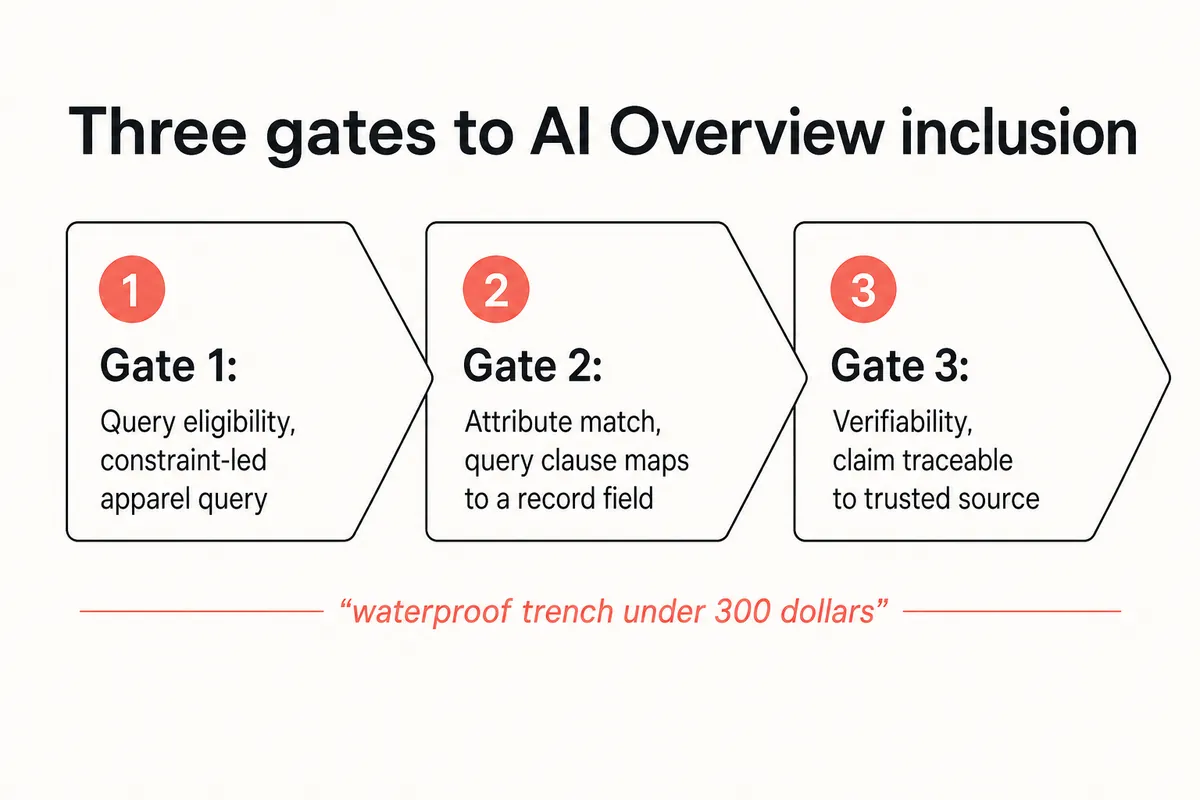
AI Overviews are constructed answers. They pull in sources and products as evidence to satisfy the clauses of a query. Think like a merchandiser building a rack for a brief: the brief sets constraints, the rack holds only pieces that truly fit the brief, and every piece is tagged so a buyer can confirm it belongs.
Expect volatility. If a given apparel query shows an Overview can change week to week. Track inclusion over a rolling window, not a single spot check. An illustrative approach is to measure weekly for 4 to 6 weeks per season and review trend movement, then adjust attributes ahead of your next drop.
Watch the seasonal availability trap. If your beige waterproof trench in size XS is sold out, but your feed does not mark that variant as unavailable, an Overview may surface the sold-out colorway. That is worse than no surface at all. Keep availability by variant current across site, marketplace feeds, and any independent references that act as citations.

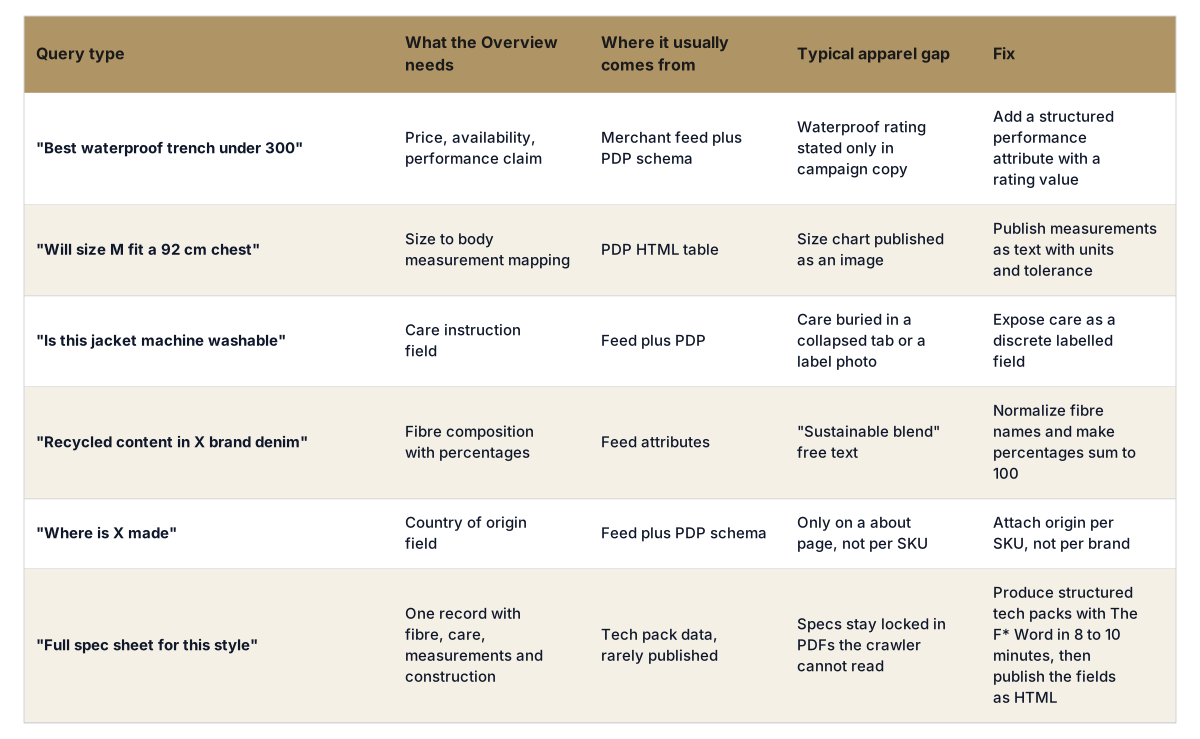
Carry one garment through this: a waterproof trench that your team intends to sell at 279 dollars. Here is what the Overview reads and where it looks for each clause.
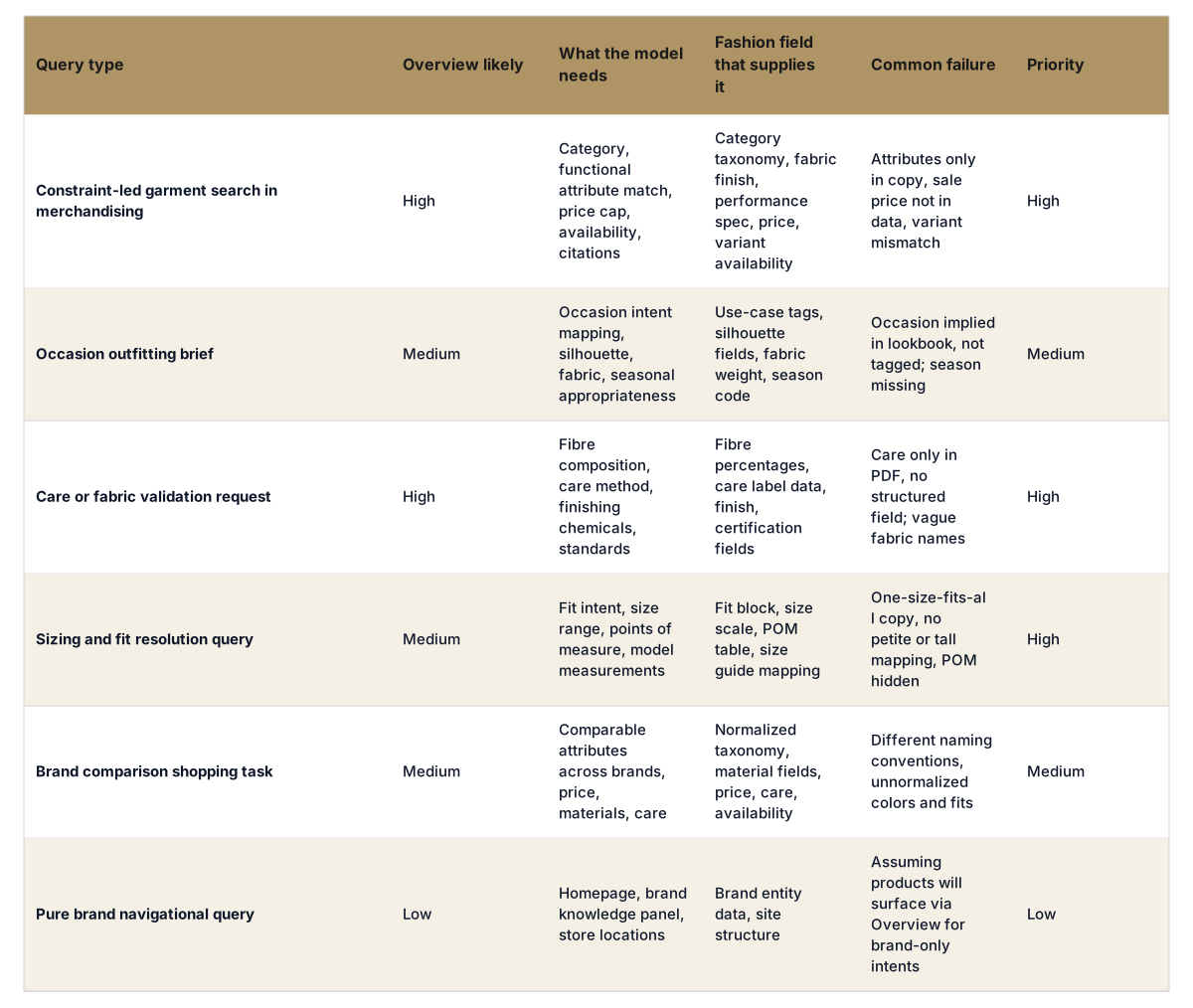
Common apparel-specific failure modes:
For a ribbed knit midi dress, an image shows a silhouette. It does not answer whether the viscose is FSC-certified, whether the rib is 2x2 or 3x3, or whether the dress is machine washable at 30C. For the waterproof trench, a campaign photo cannot prove seam sealing or price. Agents assemble answers from data they can parse and cite. This is why we say pixels do not answer constraints. Structured garment data does.
The F* Word produces that record. It validates design intent, normalizes attributes, and outputs machine placement data that makes agents confident to surface a garment. As part of the same workflow, The F* Word generates a factory-ready tech pack in 8 to 10 minutes from a garment design, including BOM and construction notes, and it also generates moodboards as the upstream half of the same workflow. It is not a PLM, not a 3D sim, and not an image generator. It is the validation and orchestration layer that sits alongside your creative team and your sourcing calendar. See how this links across disciplines at AI fashion workflow software, pre-production workflow for fashion, and creative direction workflow for fashion brands.
Our framework for machine-readable garments is documented in The Machine-Readable Brand by Nitin Kumar, Rosmon Sidhik and Akanksha Lokam. For a summary and field checklist that suits VP Product Development and merchandising leads, see the book page.
Operator note: if your goal is inclusion in AI Overviews for core categories next season, start by pinning the three inclusion gates to your line plan, then set attribute and citation acceptance criteria per garment. We run this as a week 0 to week 3 pre-production step, then recheck close to drop. See how the record gets built at thefword.ai, or read The Machine-Readable Brand on Amazon.
Query type, required data, and the usual apparel gap
Test from a clean browser and neutral location, then log results weekly for 4 to 6 weeks since Overview presence is volatile. Use consistent phrasing that mirrors real shopper behavior such as waterproof trench under 300 dollars or merino crew machine washable. Track which constraints appear in the generated text and which products are cited. Evaluate inclusion rate and citation quality rather than a single screenshot.
Outerwear should prioritize performance fields like waterproof or water resistant, seam sealing, insulation type and weight, and windproof ratings, plus price and color family mapping. Denim should prioritize rise, leg shape, stretch percentage, weight in ounces, and standard washes mapped to a taxonomy. Knitwear should prioritize fibre blend percentages, gauge, rib type, care instructions, and pilling resistance notes. All three categories should normalize size blocks and map editorial colorways to standard color families.
Retailer or marketplace product feeds that carry the same SKU and attributes often act as independent confirmations if they are consistent. Standards and certifications pages can support claims like GOTS-certified cotton or RWS wool. A brand care guide or help page that matches the garment's care label can also help. Keep the data aligned across all endpoints so the agent does not see conflicts.
Expose availability at the variant level and sync it to your PDP, your structured data, and any retailer feeds that might be cited. Retire or deindex seasonal colorways that are fully sold through, or mark them clearly as unavailable in the data. For carryover styles, maintain stable IDs by silhouette and refresh seasonal attributes by color, print, and trim without collapsing attributes that change fit or function. This avoids false positives that damage shopper trust.
Get The F* Word workflow insights in your inbox.