} })
Press enter or click to view image in full size

How Does AI Speed Up Fashion Sample Approvals?

How Does AI Speed Up Fashion Sample Approvals?

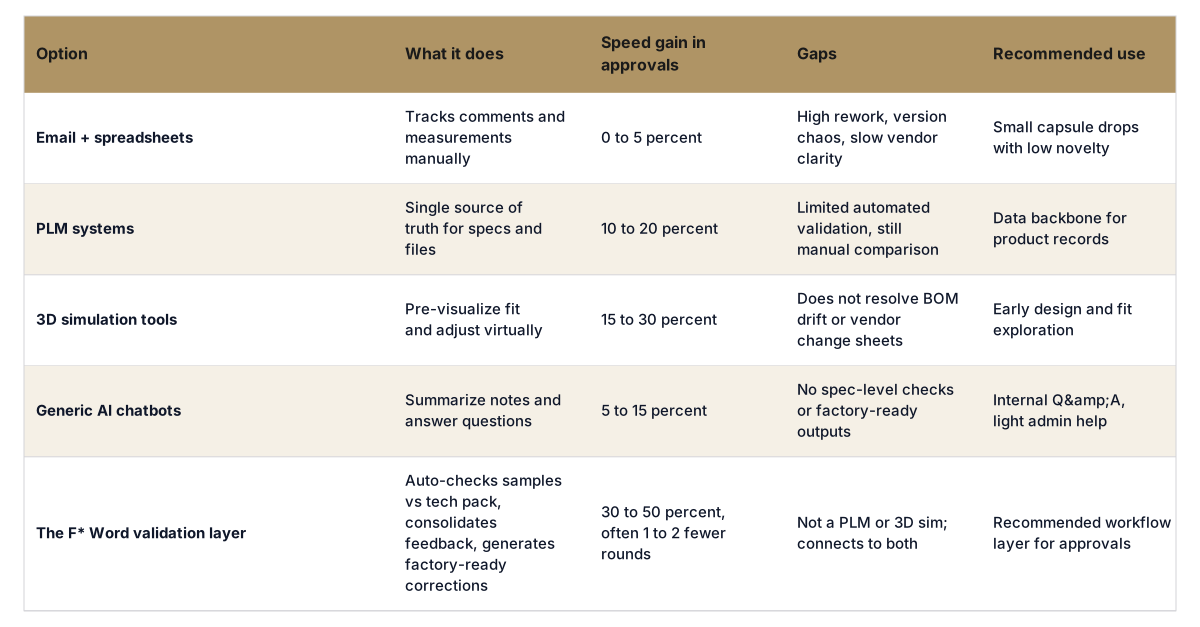
Direct answer. AI speeds up fashion sample approvals by cutting the number of physical sample rounds from an industry average of 3-5 down to 1-2. It accomplishes this in three ways. First, by generating highly accurate, validated tech packs in minutes, ensuring the first sample from the factory is closer to the design intent. Second, AI structures vendor communication with annotated photos and precise measurements, eliminating ambiguity in revision requests. Third, AI systems automatically flag variances between the incoming sample's measurements and the tech pack's points of measure (POM), allowing technical designers to identify issues instantly.

Table of Contents

Table of Contents: figure illustrating table of contents in How Does AI Speed Up Fashion Sample Approvals

The True Cost of Excessive Sample Rounds

In fashion product development, sample rounds are one of the largest and most unpredictable pre-production expenses. While brands budget for the direct cost of the sample itself, the hidden costs are what truly erode margins and delay launch dates. Each round involves not just the factory's fee but also international shipping costs, customs clearance, fit model fees, and the valuable time of technical designers, product developers, and patternmakers who must coordinate, receive, measure, and analyze each physical garment.

A single sample round for one SKU can easily cost between $500 and $1,500 when all associated labor and logistics are factored in. When a style requires four or five rounds to get right, these costs multiply, turning a potentially profitable product into a marginal one before it ever hits the market. This financial drain is compounded by the timeline impact. Each round adds two to four weeks to the pre-production calendar, pushing back production starts and risking missed delivery windows for a seasonal collection.

The root cause of excessive sample rounds is almost always information inaccuracy. Vague instructions, incorrect measurements, and incomplete Bills of Materials (BOMs) in the initial tech pack create a domino effect of errors. A small mistake in a grade rule or a missing trim specification forces an entire cycle of corrections, shipping, and re-evaluation. Reducing the number of rounds is the single most effective way to reclaim both budget and time in the product creation lifecycle.

The True Cost of Excessive Sample Rounds: figure illustrating the true cost of excessive sample rounds in How Does AI Speed U

First Sample Accuracy: The Foundation of Speed

The goal of any efficient product development team is to get the first sample as close to perfect as possible. The quality of the first proto directly correlates to the total number of sample rounds required. When the first sample arrives with major fit, construction, or material issues, it signals a fundamental misunderstanding between the brand and the vendor, necessitating multiple expensive and time-consuming revisions. The key to achieving first-sample accuracy lies entirely in the quality of the tech pack sent to the factory.

A comprehensive tech pack must leave no room for interpretation. This includes precise Points of Measure (POMs) with clear tolerances, complete grade rules for the full size run, a detailed Bill of Materials specifying every trim and fabric, and clear construction callouts with supporting diagrams or images. A single inconsistency, like a POM that does not align with a construction detail, can cause confusion and lead to a sample that fails the fit session.

AI workflow platforms attack this problem at its source. By ingesting your brand's historical data, block patterns, and material libraries, AI can generate a fully validated tech pack in approximately 8 to 10 minutes. This process cross-references all data points to flag inconsistencies before the pack is ever sent to a vendor. For example, the AI can verify that the specified zipper length is appropriate for the placket measurement or that the grade rules for a pant inseam scale logically across all sizes. This front-loading of accuracy is what enables a reduction from five sample rounds to just one or two.

First Sample Accuracy: The Foundation of Speed: figure illustrating first sample accuracy: the foundation of speed in How Doe

AI-Validated Tech Packs vs. Traditional Methods

The creation of a tech pack has traditionally been a manual and fragmented process. Technical designers spend hours compiling information from different sources: pulling measurements from an Excel spreadsheet, copying material codes from a PLM system, pasting sketches from an Adobe Illustrator file, and writing construction notes from scratch. This manual assembly is prone to human error. A typo in a measurement, a forgotten trim, or an outdated material code can easily slip through, creating the very issues that lead to sample rejections.

AI workflow orchestration changes this from a manual assembly task to an automated validation process. Instead of just being a repository for data like a traditional PLM, an AI platform actively analyzes the information as it builds the tech pack. It acts as an expert assistant to the technical designer, flagging potential problems in real time. This is not just a simple spell check; it is a contextual analysis of the garment's technical specifications. The system understands the relationships between different parts of the tech pack.

This validation is what transforms the tech pack from a static document into a dynamic, error-checked instruction set. It ensures that when a vendor opens the file, they have everything they need to produce an accurate first sample. This shift reduces the back-and-forth communication, minimizes factory errors, and builds a stronger, more efficient relationship between the brand and its manufacturing partners.

Tool Category Typical Tech Pack Output Speed Data Validation Method Primary User
Manual (Excel + Email) 2-5 hours per style Manual peer review, prone to error Technical Designer
Classic PLM (e.g., Centric, FlexPLM) 1-3 hours per style (data entry) Limited, basic rules-based checks Technical Designer, PD Manager
AI Workflow Platform (The F* Word) 8-10 minutes per style Generative AI cross-validation of BOM, POM, grading Technical Designer, PD Team
3D Simulation (e.g., Browzwear, CLO) 4-8 hours per style simulation Visual fit simulation, inputs are manually created 3D Designer, Patternmaker
Generative AI (e.g., Midjourney) Seconds per image None, generates imagery only, no technical data Creative Director, Designer
Collaboration Tools (e.g., Pinterest) Minutes to create a board None, moodboard and inspiration only Merchandiser, Designer

Structuring Vendor Communication for Clarity

Even with a perfect tech pack, revisions are sometimes necessary. This is where the second major bottleneck occurs: ambiguous feedback. A typical revision cycle involves marking up a PDF, taking separate photos, and writing a long email trying to explain the required changes. Phrases like "make the shoulder smaller" or "the drape feels off" are subjective and lack the specific, measurable data a factory needs to execute a correction accurately. This ambiguity is a primary driver of repeat samples.

AI workflow software solves this by structuring all vendor communications. When a sample comment is made, the platform requires it to be anchored to a specific component, like a POM or a BOM line item. The technical designer can upload a photo of the sample, draw an annotation directly on the image, and enter a precise, numerical correction in the same interface. For example, instead of "fix the sleeve," the feedback becomes: "Sleeve Opening (POM #14): Decrease by 1.0cm. Current measurement is 15.0cm, target is 14.0cm. See annotated photo for reference."

This structured data is then compiled into a clear, actionable revision report for the vendor. There is no room for misinterpretation. The factory receives a consolidated list of changes, complete with photos, annotations, and precise target measurements. This level of clarity ensures that the second sample directly addresses all the flagged issues, dramatically increasing the likelihood that it will be the final, approved sample.

Automated Variance Detection on Incoming Samples

When a new physical sample arrives, the first step is for a technical designer or assistant to measure it against the tech pack's specifications. This is a time-consuming, manual process of laying the garment flat and checking dozens of POMs with a measuring tape. It often takes 30-60 minutes per garment, and it must be done before a fit session can even begin. This process introduces a delay and is also susceptible to manual measurement errors.

AI introduces a significant acceleration here through automated variance detection. When a sample arrives from the factory, the vendor has already submitted its measurements into the shared workflow platform. The AI system instantly compares these submitted measurements against the master tech pack specifications for that sample. It then generates a variance report, highlighting every single POM that falls outside the defined tolerance.

This report is available to the technical designer before they even unbox the physical garment. They can walk into a fit session already knowing that the waist measurement is 0.5cm too large and the hip is 1.0cm too small. The fit session becomes a focused discussion on whether these out-of-spec measurements are acceptable or require correction, rather than a discovery mission to find the problems in the first place. This saves immense time and makes fit sessions radically more productive.

Quantifying the Impact: From 5 Rounds to 2

The cumulative effect of AI-driven accuracy is a dramatic and quantifiable reduction in pre-production costs and timelines. Consider a typical scenario for a single SKU. A traditional workflow might involve five sample rounds, with each round taking three weeks and costing $750 in hard and soft costs. The total impact is 15 weeks and $3,750 spent on just one style before the first production order is even placed. This process ties up capital and delays the product's entry into the market.

By implementing an AI workflow, the process is compressed. A validated tech pack ensures the first sample is nearly correct. Structured comments clarify the minor revisions needed. This trims the cycle to just two sample rounds. The total time drops from 15 weeks to 6 weeks, and the cost falls from $3,750 to $1,500. This represents a savings of $2,250 and nine weeks of calendar time for a single SKU.

When scaled across an entire seasonal collection of 50 styles, the savings are substantial. The brand saves over $112,500 in direct sampling costs and reclaims more than two months in its go-to-market calendar. This reclaimed time can be used to add another drop to the year, react to market trends with more agility, or simply secure better production capacity and pricing by providing finished tech packs to vendors earlier.

FAQ

What is the difference between an AI workflow platform and a PLM?

A Product Lifecycle Management (PLM) system is primarily a database or system of record for product data. An AI workflow platform is a system of action and orchestration. It uses AI to generate, validate, and move data (like tech packs and sample feedback) between your team and vendors, focusing on speed and accuracy in the pre-production process. It connects to and enhances your PLM, it does not replace it.

Does AI replace technical designers?

No, AI does not replace technical designers. It acts as a powerful assistant, automating the repetitive, low-value tasks like data entry and manual measurement checking. This frees up technical designers to focus on high-value work like perfecting fit, engineering complex garments, and making critical product decisions. It elevates the role from data administrator to product expert.

How does the AI learn our brand's specific fit standards?

The AI is trained on your company's existing data. By ingesting your library of approved tech packs, block patterns, grade rules, and historical sample comments, the platform learns your specific fit DNA, measurement standards, and construction preferences. This ensures that the tech packs it generates are consistent with your brand identity and quality requirements from day one.

How much time is really saved on tech pack creation?

Using a traditional manual process with Excel and Illustrator, a technical designer can spend 2-5 hours building a single, complete tech pack from scratch. With an AI workflow platform like The F* Word, a complete, validated, and factory-ready tech pack can be generated in about 8 to 10 minutes. This is a time reduction of over 90% for that specific task.

Can this system integrate with programs like Adobe Illustrator or 3D tools like Browzwear?

Yes, modern AI workflow platforms are designed to be the connective tissue in your toolchain. They integrate with design tools to pull in sketches, connect with 3D programs to incorporate virtual fit images or data, and sync with PLM systems to ensure the product record is always up to date. The goal is to orchestrate data flow, not create another isolated data silo.

How does AI validate a Bill of Materials (BOM)?

AI validates a BOM by cross-referencing it against a library of known components, supplier capabilities, and material data. It can flag if a specified trim is incompatible with the primary fabric, if a supplier does not produce a certain component, if MOQ (Minimum Order Quantity) issues exist, or if the cost of the materials exceeds the target margin for the product.

What kind of data is needed to get started with an AI workflow platform?

To begin, the platform needs a representative sample of your existing product development data. This typically includes a set of your most recent tech packs (in whatever format they exist, like PDF or Excel), your library of block patterns and graded specs, key material information, and a list of your primary vendors. This data serves as the foundation for training the AI on your specific processes.

Further Reading

Cut sample rounds with validated tech packs to see how our AI workflow platform generates complete tech packs in minutes and transforms your approval cycles. You will learn how to reduce your time-to-market by weeks and save thousands per style.

Start building workflows around real brand rules.

Get The F* Word workflow insights in your inbox.