
Definition: A scanner-led research system is fashion trend analysis in practice: collect live signals, score them, then validate the survivors against price, fabric and factory reality. The F* Word is the validation and specification layer, turning an analysed signal into a factory-ready tech pack in 8 to 10 minutes with bill of materials and points of measure.
Most teams call what they do "trend research" but the actual workflow is a tab graveyard. Pinterest boards, screenshots dropped into Slack, swatch images saved with no source, lookbook PDFs no one re-opens, and a designer somewhere on the team trying to remember which runway show that one sleeve came from. A real fashion trend research system is the opposite of that. It turns the open web into structured evidence, scores that evidence on the same axes every week, and feeds the result directly into design briefs, tech packs and merchandising decisions. The scanner is the front of that system because every other step downstream depends on whether the reference came in clean, tagged and sourced, or as a bare image with no context.
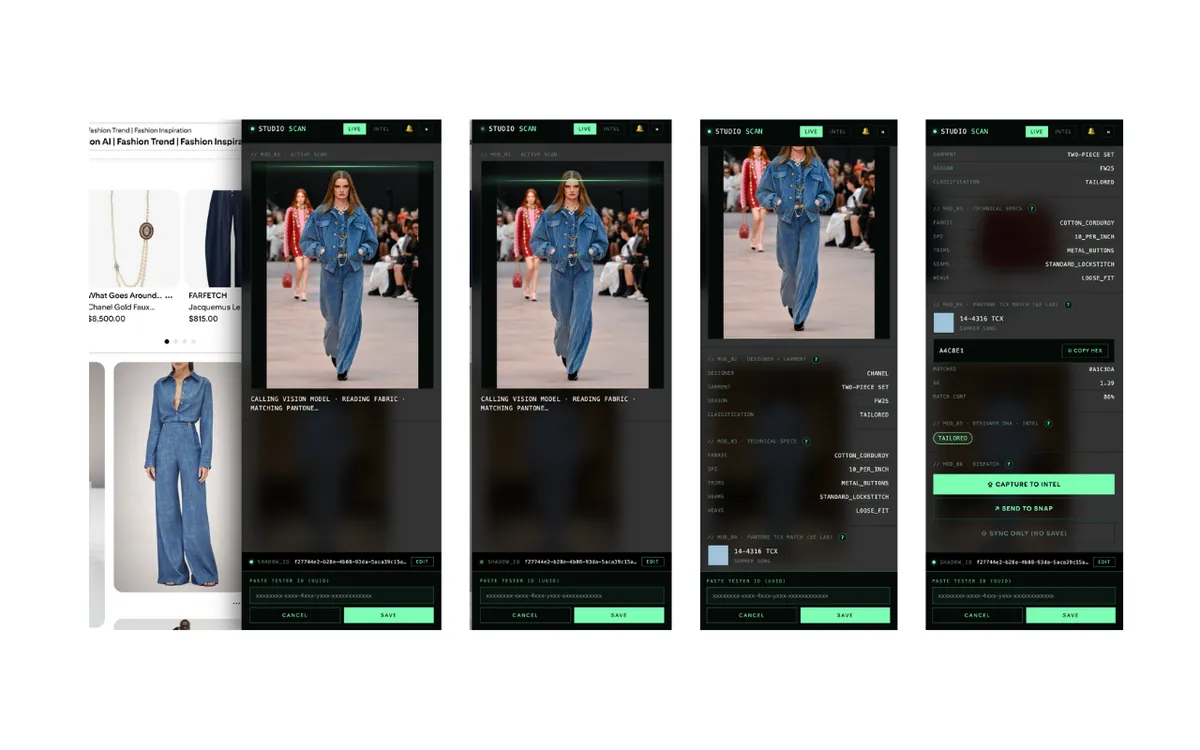
The AI Fashion Scanner sits at the edge of the browser and runs full garment analysis on any image with a single click. Pantone TCX, fabric inference, stitch density, hardware, source URL and timestamp are captured at the moment of attention. That single design choice, capture at click time rather than capture later, is what separates a working trend research system from a folder of forgotten screenshots.
What this looks like in practice: A design director at a mid-sized house spends two hours a day reading Pinterest, Vogue Runway, Moda Operandi, SSENSE and creator content. Without a scanner, that work produces an unstructured screenshot library. With a scanner that captures Pantone TCX, fabric and construction clues, source URL and timestamp at click time, the same two hours produces a queryable trend dataset the team can debate at the next merch meeting and turn into a brief inside the week.
"Scan to trend" is the shortest accurate description of what a modern fashion research system has to do. A designer sees a reference, scans it, and the scan immediately becomes part of a trend story, not a loose file. Today most brands run the inverse workflow. They collect references for weeks, then sit down at the end of the month and try to reverse-engineer themes from a chaotic image dump. By that point the freshest signals are already two seasons old in social-feed time, and the team is forced to argue from memory instead of evidence.
A scan-to-trend workflow flips the order. Each scan is tagged at capture with Pantone direction, fabric family, silhouette, trim type and source. The library auto-clusters references that share signals, and the trend story builds itself in the background while the designer keeps researching. When the merchandiser walks in on Friday and asks what is rising for AW26, the answer is already on screen, with sources attached and the strongest references ready to brief.
This is the loop the Scanner is built for. Pin it to Pinterest, Vogue Runway or any product page, capture in 1.2 seconds at 94 percent average confidence, and watch the archive organize itself by season and signal. The designer never leaves the page they were already reading. The trend story builds while the research happens, not after.
Fashion trend windows have collapsed. Ten years ago a runway look took six months to reach mainstream consumer feeds and a season to reach the high street. Today a Vogue Runway image is on Pinterest in hours, on TikTok in days, and inside a fast retailer's product pipeline inside two weeks. A trend research system that works on a monthly cadence is structurally late. By the time a slow workflow produces a clustered theme, the early-mover brands are already shipping product against it and the signal has been priced in.
Real-time matters for three concrete reasons. First, the buying window. Fabric mills and trim suppliers quote lead times in weeks, not months. Catching a silhouette signal early gives the production team enough runway to source the right base cloth at the right price. Catching it late forces substitutions and margin loss. Second, the creative window. The strongest collections are built around two or three confidently held theses, not twenty late reactions. Real-time evidence gives the creative director enough conviction to commit early. Third, the merch window. Buyers and planners decide depth of order on early signals. A research system that surfaces a rising color or fabric in the first week of its run lets the brand plan inventory ahead of the curve instead of chasing it.
The Scanner is designed around this real-time reality. Every scan is timestamped and source-tagged at capture, so the team can see not just what is trending but when each piece of evidence entered the archive. A signal that appeared across five sources in seven days is a different story from a signal that appeared across five sources in six months. The timestamp is what makes the difference visible.
Hashtag velocity is the rate at which a tag, theme or aesthetic accelerates across social platforms over a defined window. It is one of the cleanest early signals available in fashion because it shows demand-side momentum before that momentum becomes a buying pattern. A tag that grows from 500 to 50,000 posts in fourteen days is telling the brand something different from a tag that has held steady at 100,000 posts for a year. The first is a wave forming. The second is a settled aesthetic, useful for context but no longer a forecasting edge.
A scanner-led research system captures hashtag velocity in two ways. First, by tagging each scanned reference with the platform and source it came from, the archive shows where signals are landing fastest. Pinterest, TikTok and Instagram move at different speeds and serve different audiences, and the source tag preserves that nuance. Second, by timestamping every scan, the system makes it possible to plot the rate of new captures against a given theme. A theme picking up ten new captures a week is rising. A theme picking up one a month is fading. The scanner does not need to invent a separate velocity engine. The capture log already contains the data.
The practical use is simple. When a creative team is choosing between three candidate themes for a capsule, the team that can show which theme has the steepest velocity curve over the past 21 days will pick correctly more often than the team arguing from taste alone. Velocity does not replace judgment. It gives judgment a much better starting position.
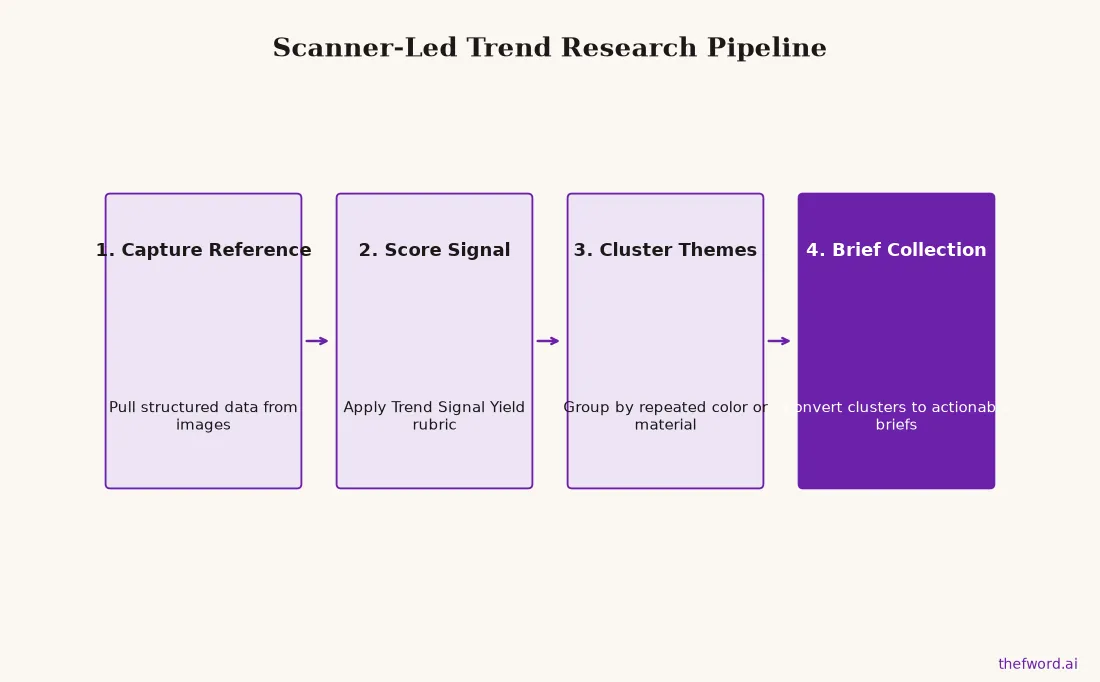
A fashion trend research system is not one tool. It is four jobs done in sequence, with the scanner owning the first job and feeding the rest.
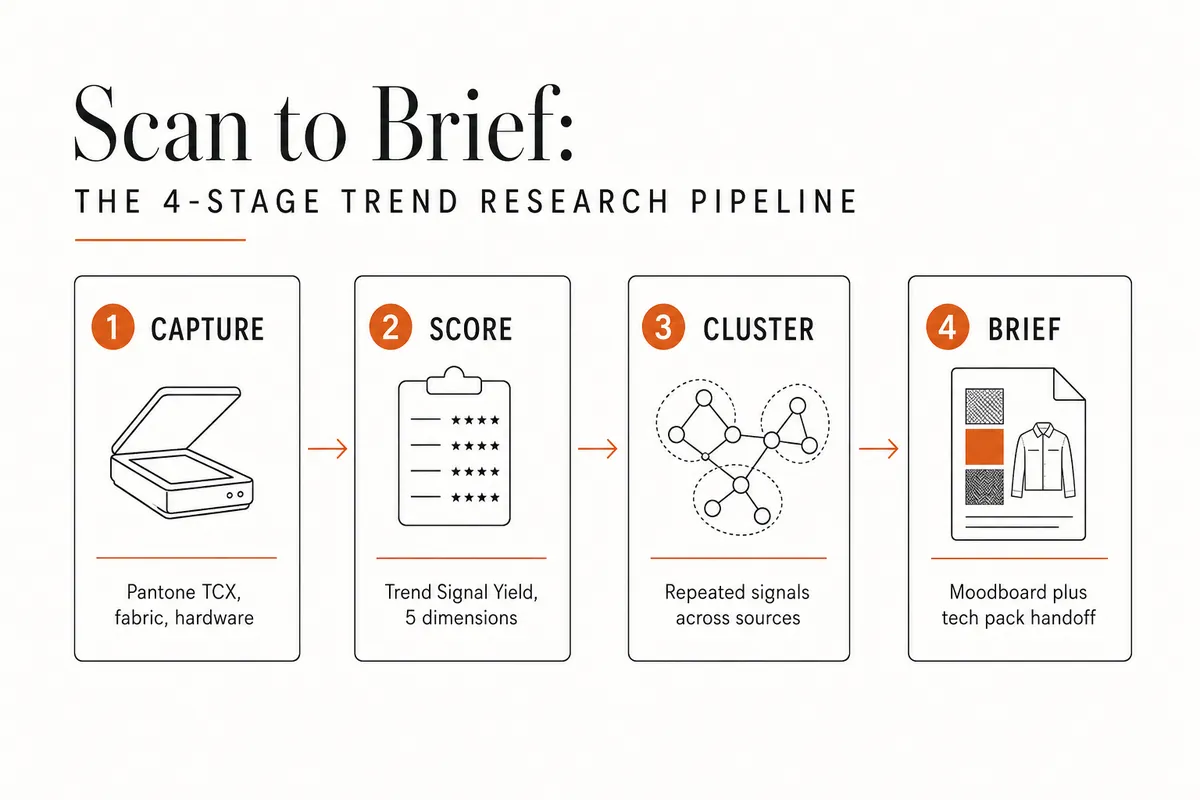
The scan-to-brief pipeline. Each stage produces structured output the next stage can consume.
The Scanner's core strength lies in capturing and organizing trend evidence at the point of attention. Fashion trend analysis depends on the accumulation of repeated signals, the quality of sources, and the designer's judgment. A single image rarely provides a comprehensive insight. Ten references with shared color direction, material language, silhouette rhythm and construction detail begin to form a cohesive story. The AI Fashion Scanner is built to command this initial phase by reading visual references and extracting the attributes a designer would otherwise note manually: Pantone TCX direction, fabric and construction clues, stitch density, hardware, trims, silhouette and source context. With these attributes consistently saved, designers gain a structured foundation to build on, week after week.
What this looks like in practice: In a large brand, a technical designer can use the Scanner to manage a diverse library of trend references. Each image is tagged with detailed attributes so every reference contributes to a broader trend narrative, and the archive stays aligned with the creative direction set by the brand's leadership across multiple seasons.
Trend Signal Yield is the framework that evaluates how much usable trend intelligence a designer can extract from a visual reference. Low-yield references may look attractive but lack structured value. High-yield references are tagged, comparable, explainable and reusable inside design work. Trend Signal Yield is built on five dimensions: color specificity, which measures the tool's ability to define a useful palette beyond basic colors; material inference, assessing the quality of fabric and surface interpretation; construction clarity, identifying seam, stitch, pocket, closure and hardware details; source fidelity, preserving the integrity of the original reference; and pattern resonance, gauging how often a signal recurs across different sources and timeframes.
How to apply Trend Signal Yield: For a fashion merchandiser developing a seasonal collection, applying the framework means scoring each candidate reference against the five dimensions and only briefing from references that score well across at least three. By tagging and evaluating systematically, the merchandiser identifies high-yield references that will guide cohesive and market-ready collections, reduces the risk of misjudging trends, and gives the design team a defensible base for every decision.

This table compares the dominant approaches to fashion trend analysis. Use it to decide which method best fits your team's need for signal speed, evidence quality, and direct connection to your design and production workflow, from initial scan to the final tech pack specification.

Consider a small brand planning a 20-piece capsule collection. The team reviews 300 references across Pinterest, runway shows, ecommerce sites and lookbooks. Each reference takes about four minutes to save, label, describe, source and organize manually, totaling 1,200 minutes, or 20 hours, of basic capture work. If a scanner reduces this to 40 seconds per reference, the same research set takes about 200 minutes, or 3.3 hours. That releases roughly 16.7 hours before synthesis even begins, time the team can spend on strategic trend development rather than admin. Beyond the time saving, a structured archive lifts the quality of trend meetings. Instead of arguing over screenshots, the team evaluates structured trend evidence with source, timestamp and Pantone direction visible on every reference.
Sensitivity variation: If the brand had an additional 100 references to process, the manual method would require 33 extra hours, while a scanner would handle the same load in about 5.5 hours. The scalability gap widens with every additional source the team chooses to monitor, which is why scanner-led systems compound in value the longer they run.
The Scanner's history view acts as a lightweight trend-analysis board. Designers can compare repeated signals across multiple sources, sort by timestamp to see what is accelerating, and filter by Pantone or fabric to test a thesis in seconds. The same archive doubles as evidence in merch meetings and as a referenceable record when the team revisits a season later to learn from it. Over twelve months, that archive becomes one of the most valuable creative assets the brand owns.
Common pitfalls: Over-reliance on automated systems can dull the human eye. The Scanner is built to keep the designer in control of what enters the archive. Every scan is committed manually so the library reflects the team's authored taste, not an unsupervised crawl.
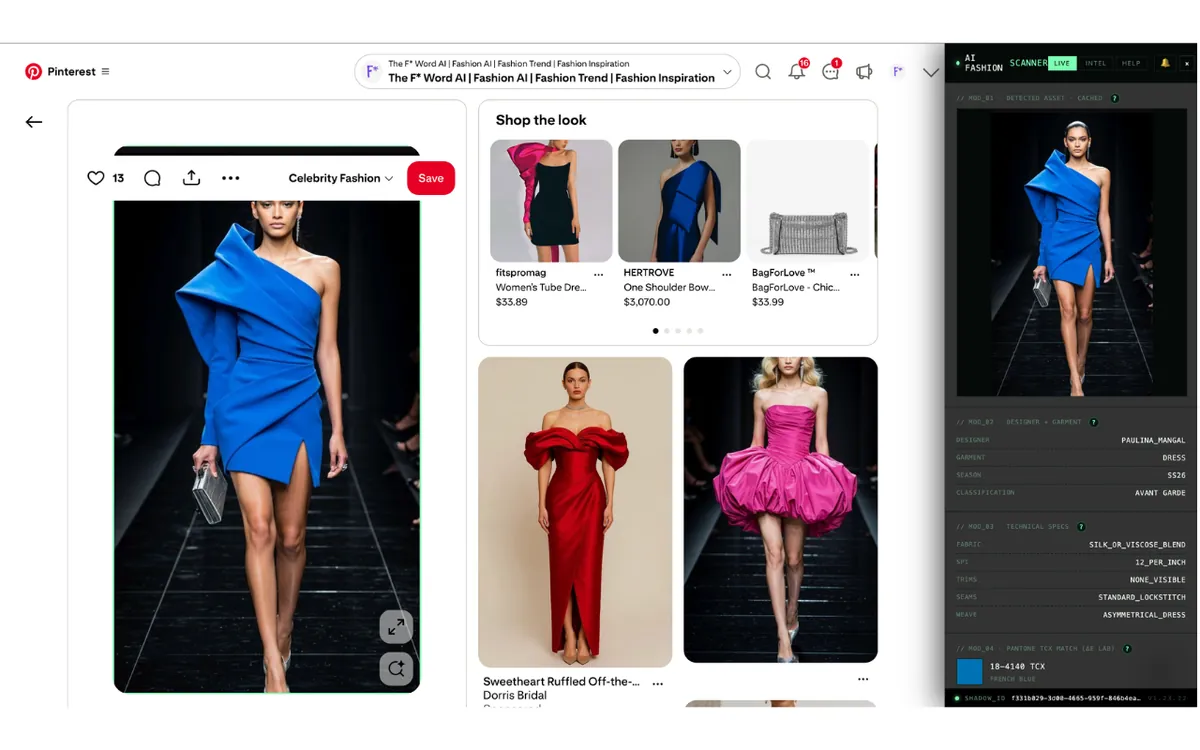
Scanning is the first step, not the whole story. Inside the AI Fashion Suite, scans flow into the AI Fashion Designer, where the strongest references become a 4-slot dossier: Intent, Truth, Muse, Campaign. Sealed dossiers earn an F* Word certification and move into the Portfolio Generator for publication. From there, dossiers connect to The F* Word where they become production tech packs in 8 to 10 minutes. The path from trend signal to factory-ready spec runs end to end inside one workflow, with the Scanner setting the input quality the rest of the chain inherits.
This is why scanner quality compounds. A weak capture layer caps the value of every downstream step. A strong capture layer raises the ceiling on everything that follows, from moodboard to tech pack to the buying decision a merchandiser will make six months from now.
The AI Fashion Scanner is positioned as the practical tool for AI fashion trend analysis because it integrates with the visual sources designers already use. The target keyword extends beyond "AI fashion scanner" into broader commercial territory. Designers, students, brand founders, educators, creative directors and product developers all need efficient trend analysis tools, and the workflow advantage is the same in every case: convert daily browser research into structured trend evidence and feed it forward into briefs, dossiers and tech packs.
What this looks like in practice: A creative director at a contemporary fashion label uses the Scanner to streamline the research phase. By converting unstructured browsing into organized trend insights with source, timestamp and Pantone attached, the director leads the design team with data-backed decisions and ensures the collection ships against signals that are still moving, not signals that already peaked.
Start by scanning trusted sources. Use Pinterest for emerging visual patterns, Vogue Runway for directional fashion language, premium ecommerce for commercial translation, and product pages for construction detail. Tag references around the signals you care about: color, material, silhouette, trim, closure, pocket, print, proportion or styling logic. Review repeated patterns weekly. A trend becomes meaningful when the same signal appears across different sources in a tight time window. A color seen once might be a fluke, but if it recurs across runway, retail and creator content inside three weeks, it is signaling a real pattern.
Common pitfalls: Failing to review captured data on a fixed cadence is how strong archives go stale. Treat trend analysis as a continuous process with weekly reviews, monthly synthesis and quarterly retrospectives, not a one-time exercise at the start of a season.
A credible scanner for AI fashion trend analysis has to exceed consumer outfit apps. It should run where designers actually research, extract fashion-specific attributes, preserve source context, support comparison and integrate into the next workflow steps. The minimum spec covers browser-based scanning across Chromium and Firefox, Pantone TCX color direction, fabric and material inference, stitch and construction clues, trim and hardware detection, full scan history with timestamps, source and trend tagging, and a clear handoff into moodboards and tech packs.
What this looks like in practice: An independent designer evaluating scanner tools should prioritize the ones that fit existing browser habits, score well on color and material accuracy, and connect into a real production workflow at the other end. A scanner that captures well but dead-ends inside its own app stops being useful at the moment the brief has to ship.
An AI fashion trend research system is a structured workflow that uses AI to capture, score, cluster and brief from visual references. The system replaces ad hoc screenshot folders with a queryable archive that connects directly into moodboards and tech packs, so the same evidence supports every downstream decision.
It captures references as designers browse, extracts garment attributes, and saves the scan into a usable archive, making trend signals easier to compare across sources. The structured archive is what makes the research method repeatable across seasons rather than a one-off scramble.
Trend windows have collapsed from seasons to weeks. Real-time capture gives brands enough runway to source the right fabric, commit to a creative thesis early, and place inventory bets ahead of the curve instead of chasing signals that already peaked.
Hashtag velocity is the rate at which a theme or tag accelerates across social platforms inside a defined window. Used alongside scanner-captured visual evidence, it shows which themes have demand-side momentum and which look strong but are already settling. A scanner-led system supports velocity analysis through timestamped, source-tagged captures.
No. Large brands may run enterprise forecasting platforms, but designers, students and smaller brands benefit from turning daily visual research into structured trend evidence. Scanner-led systems are accessible at a startup price point, which is why independent designers are adopting them ahead of the larger houses.
A scanner-led trend research system rewards the teams that capture better references, organize them faster and decide with more conviction. The AI Fashion Scanner is the practical starting point. It turns the open web into a layer of design intelligence and gives the team a structured path from signal to concept to production. Start free with The F* Word AI Fashion Suite and use the Scanner inside the research flow the team is already running.
Related: fashion trend signal scoring · ai fashion trend analysis · hashtag velocity fashion trend signal · fashion trend forecasting blueprint
Get The F* Word workflow insights in your inbox.