

Building an AI fashion trend pipeline is less about picking a model and more about wiring five stages together: ingest, classify, score, route and ship. Brands that get to a working pipeline in eight weeks usually start narrow and add signal classes only after the first one is converting to product decisions. The brands that try to wire everything on day one tend to ship nothing and quietly cancel the project at month four.
Pull signals from TikTok, Instagram, Pinterest, Google Trends, runway image feeds, macro reports and resale platforms. Use official APIs where they exist (Pinterest, Google Trends, TikTok Research API), partner with licensed runway image providers and scrape responsibly only where ToS permits. Store raw signals in object storage with timestamp, source and geo tags. Treat the ingest layer as the long-term data asset; everything else can be rebuilt around it.
Run every image and caption through a vision-plus-language model that outputs structured tags: silhouette, color palette, fabric, print, styling, demographic and region. Fine-tune on your house taxonomy or you will fight generic CLIP tags forever. Most brands need 2,000 to 5,000 manually labeled examples to lift accuracy from acceptable to good. Re-label quarterly as new categories emerge.
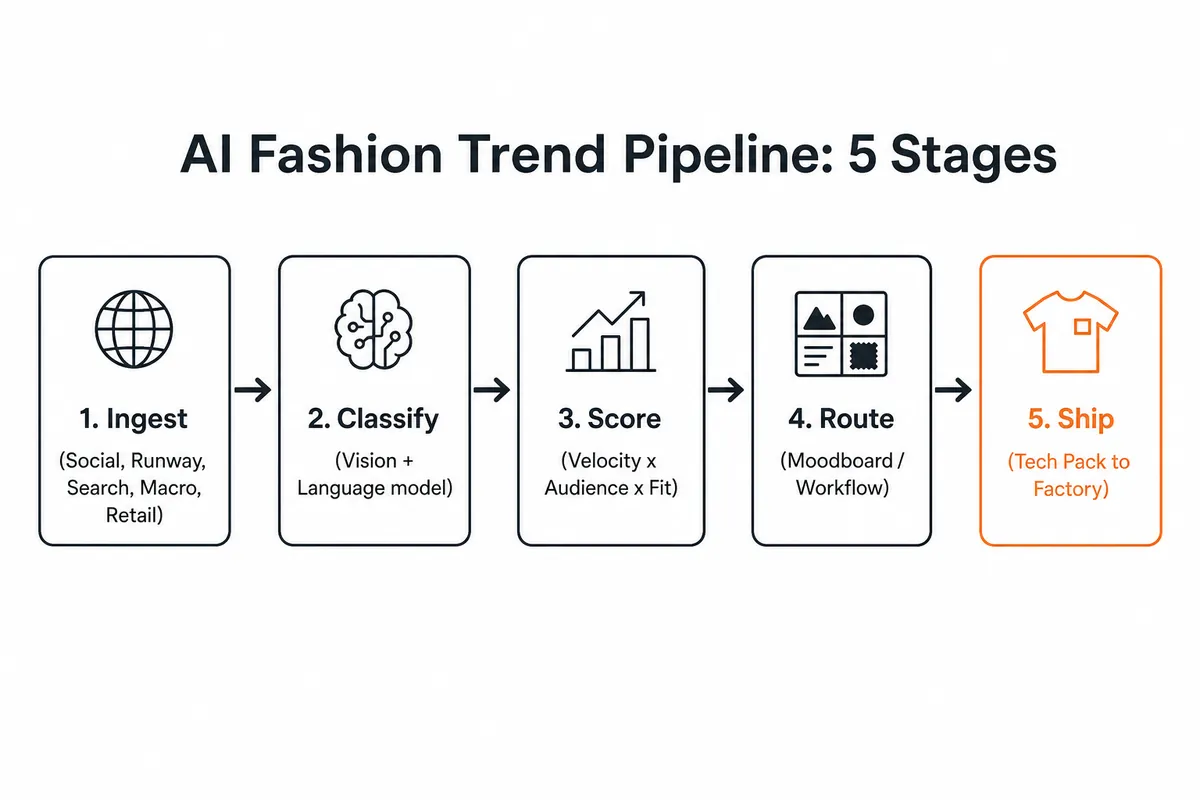
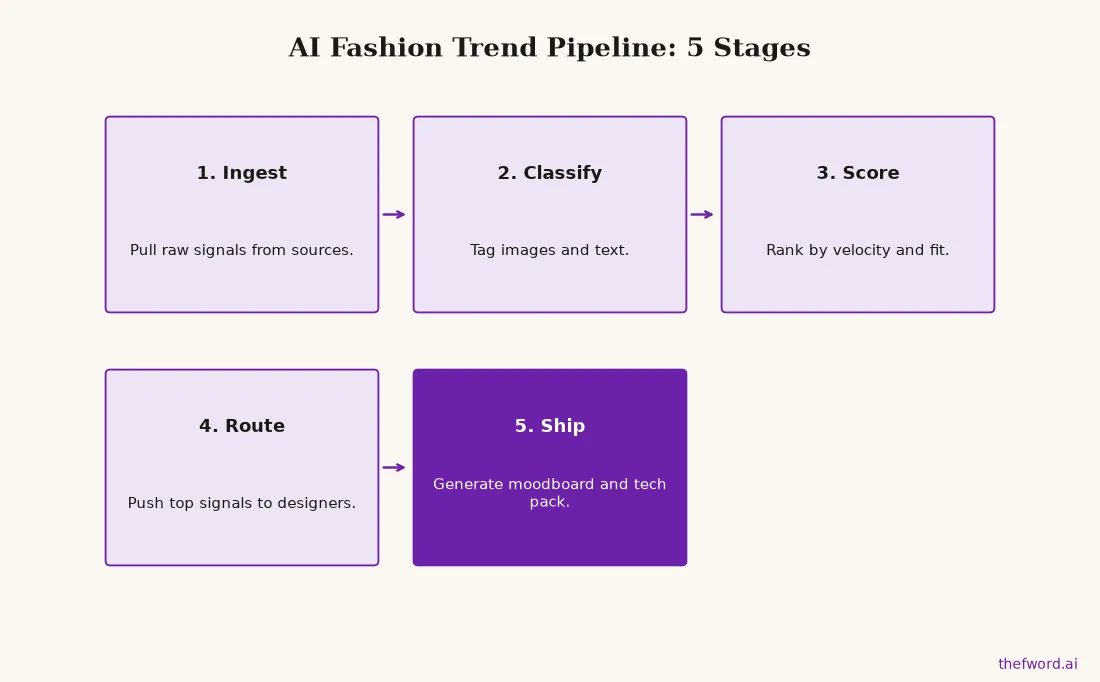
Each signal gets three scores: velocity (rate of mention growth), audience match (overlap with your customer cohorts) and commercial fit (compatibility with your category, price point and lead time). Weight the three to your brand. A streetwear label weights velocity highest; a contemporary brand weights commercial fit. Reweight monthly against sell-through. Without that feedback loop the model freezes around what worked twelve months ago.
Push the top ranked signals into the surface a designer already uses: a moodboard tool, a Notion board or, ideally, the same tool that will produce the tech pack. The biggest pipeline failure mode is signals dying in a dashboard nobody opens. Make the routing rule explicit: top three signals get auto-moodboarded, signals four to ten get a single notification, anything below ten is archived for trend post-mortem only.
A trend signal is only useful if it ends in a SKU. The F* Word turns the selected signal into a moodboard and then a factory-ready tech pack in 8 to 10 minutes. Closing that loop is what separates a trend dashboard from a trend pipeline. Brands that end at stage 4 spend a year wondering why their tracker did not move sell-through. Brands that close stage 5 measure cycle time in hours.
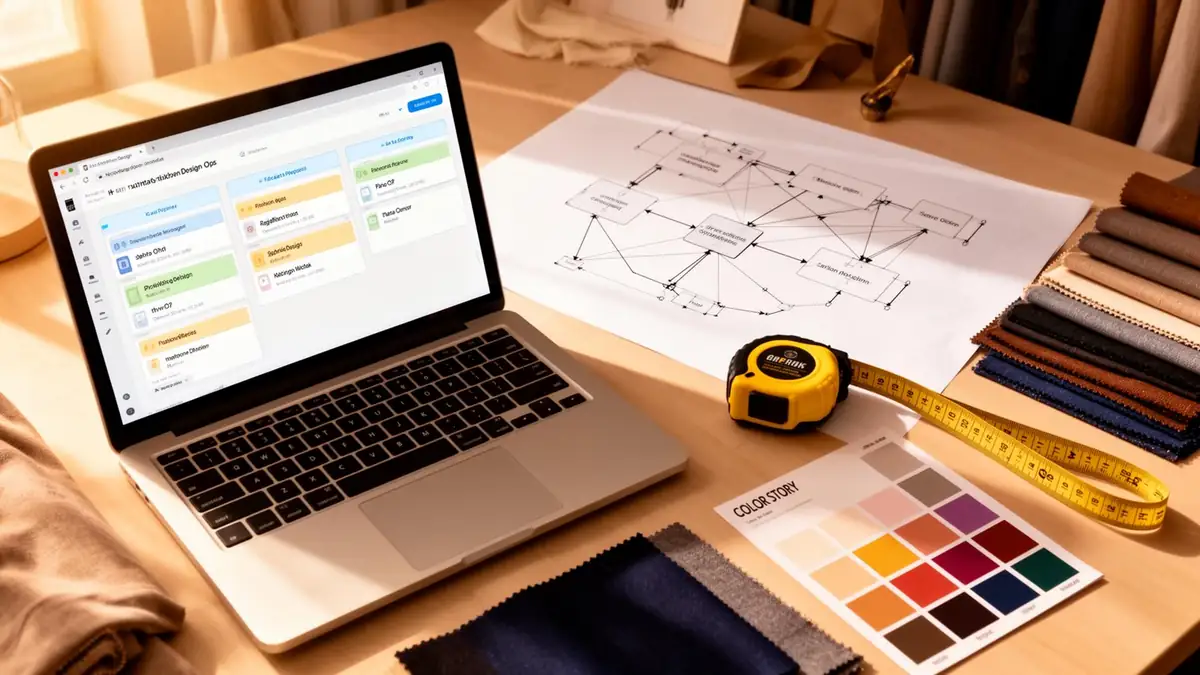

This table compares three primary approaches to trend analysis: traditional reports, social media listening, and a direct workflow tool like The F* Word. Use it to decide which method best fits your team's need for signal freshness, validation, and direct connection to your product creation workflow.

A two-person team (one ML engineer plus one design ops lead) can ship a narrow MVP across three signal classes in 6 to 8 weeks. Costs land between 30,000 and 60,000 USD for the build plus 18,000 to 40,000 USD a year for connectors, storage and the production tool. A full production-grade pipeline with retail and resale signals usually adds another quarter and roughly the same again in spend.
The output from the first three pipeline stages should be more than a simple trend alert. To be useful, it must provide structured data that helps your team translate a signal into a complete design brief. Instead of subjective interpretations, designers can use this data backed guidance to specify the exact components of a new product, ensuring it aligns with market opportunities from the start.
An effective pipeline provides detailed specifications that directly inform the brief. These details should include:
This detailed approach improves commercial outcomes beyond a simple lift in sell through. By creating products with validated demand, brands reduce the risk of overproduction and minimize waste from excess inventory. Better forecasting leads to more accurate production quantities, resulting in fewer markdowns and healthier profit margins. Over time, consistently delivering products that meet specific consumer wants strengthens your brand's position in the market.
A narrow MVP across three signal classes is a 6 to 8 week build for a two-person team. Production-grade with retail and resale adds another quarter.
Only if you build everything in-house. Most brands buy stages 1 to 3 from a vendor and own only stages 4 and 5.
Only if you enjoy paying for dashboards no one opens. The whole point of the pipeline is the SKU at the end.
Pick three signal classes, wire them to a single moodboard board this week, and run them into The F* Word for tech-pack generation. By the end of month one you will have your first tracker-sourced SKU in production.
The teams that turn AI trend pipeline build into a measurable revenue lever in 2026 share a small set of operating habits. None of them require a custom data team, and none of them require ripping out the existing planning stack. They do require the discipline to act on a signal inside the window it is actually warm in.
Every signal that reaches a designer should be tagged with a one-line sell-through hypothesis: which cohort, which price point, which window. Signals that cannot carry that tag are research, not product, and should sit in a research column rather than the active board. This single rule kills more bad bets than any model upgrade. For design ops leads, it also makes the post-mortem cleaner because each shipped SKU traces back to a written hypothesis from week one.
Treat the active signal board like a portfolio. Once a week, force a trade-off review where any new signal added has to push an existing signal off the board. The cap should be ten, not fifty, and the rule should be enforced by a single owner. The best programs we see treat this meeting like a P+L review, not a brainstorm, and end with named owners and dates for each active signal.
The biggest leak in most trend programs is the handoff from signal to spec. A signal that lives in a dashboard but does not become a tech pack within a week is functionally a research note. The F* Word closes that handoff inside one tool: trend signal in, moodboard within minutes, factory-ready tech pack in 8 to 10 minutes, complete with graded measurements, BOM and construction notes. For design ops leads, that handoff is usually the single highest-use change in the program.
Every source class should have a named owner, a refresh cadence, a license check and a kill rule. Without governance, the source mix drifts into whatever is easiest to scrape, which is rarely the most predictive. A simple quarterly audit (sources in use, license proof, signal-to-decision yield per source) keeps the stack honest and makes audit conversations painless.
Generic velocity is a starter signal. A scoring layer that weights velocity against your customer cohorts, your category mix and your last 12 months of sell-through is what turns a tracker into a competitive advantage. Brands that invest in this layer see precision rise by 10 to 15 points within two quarters, and the gain compounds because the model learns from every shipped SKU.
Most brands buy the ingest, classify and score layers from a vendor and only own the routing and shipping layers. That keeps the headcount footprint to one or two seats: a design ops lead and a part-time analyst. The cost line is software, not salary.
Three signal classes, ten active signals at any time, and a 12-week measurement window. Below that, you do not have enough data to compare against control SKUs and the program cannot prove its own ROI.
Cap the board at ten signals, route only the top three into auto-moodboards, and put the rest in a single weekly digest. Designers should see fewer, sharper signals, not more.
A working program at month 12 has: three to five source classes wired, a brand-specific scoring layer, a closed loop into The F* Word for tech-pack generation, and a quarterly readout that compares tracker-sourced SKUs against control SKUs on sell-through, margin and return rate. Programs that hit those four marks tend to renew. Programs that miss them tend to get cut in the next budget cycle.
The F* Word treats AI trend pipeline build as the input and a factory-ready tech pack as the output. A creative director moves from a ranked signal to a moodboard inside minutes and to a tech pack inside 8 to 10 minutes, with the BOM, flats, graded measurements, construction notes, color story and tolerances already populated. The handoff to the factory then happens the same day rather than the same month. For design ops leads, this is the operational change that makes the program payable.
Related: State of AI Fashion 2026 report · The F* Word · ai fashion trend analysis · hashtag velocity fashion trend signal · real time trend data fashion
Get The F* Word workflow insights in your inbox.