
Direct answer. An AI fashion design brief for beginners is a clear, step-by-step document that outlines your creative vision and technical requirements for an AI design assistant. It translates traditional design intent into structured inputs that an AI can process to generate fashion concepts. Key components include defining the collection's theme, target audience, specific garment types, desired aesthetics, and any constraints like materials or color palettes. A well-constructed brief guides the AI efficiently, minimizing iterations and helping you achieve results closely aligned with your initial creative direction, accelerating the design process for those new to AI tools.
An AI fashion design brief serves as your primary communication tool with an AI design system. Unlike traditional briefs for human designers, AI systems require highly structured, explicit instructions. Beginners should focus on precision and clarity, breaking down complex creative ideas into digestible data points. This approach ensures the AI interprets your vision accurately, generating relevant design options.
The goal is to translate abstract concepts, like "bohemian chic," into concrete attributes such as "flowy silhouettes," "earth tones," "natural fibers," and "embroidered details." This methodical breakdown helps the AI understand and synthesize diverse design elements effectively, leading to more satisfactory outcomes even for novice users. It reduces trial and error and speeds up initial design exploration.
Start by identifying the central theme or concept for your collection. This could be anything from a specific historical era to a natural landscape or an artistic movement. For beginners, choosing a theme that is visually distinct and has clear associated aesthetics will simplify the process of translating it into AI-readable inputs.
Gather visual inspiration: mood boards, color palettes, textile swatches, architectural references, or even music videos. These initial inputs, while not directly fed into all AI systems, help you articulate your vision more precisely in textual descriptions. They serve as a foundational reference point for defining specific design elements later in the brief.
Clearly define who will wear your designs and where these garments will be sold. Understanding your target audience (e.g., "Gen Z urban dwellers," "professional women aged 30-45," "eco-conscious consumers") informs choices about style, fit, materials, and price point. This detail helps the AI align design suggestions with consumer preferences and market trends.
Consider the desired market positioning: luxury, mass-market, sustainable, athleisure. These parameters act as filters for the AI, guiding it towards generating designs appropriate for the intended demographic and retail environment. For example, a brief for a luxury eveningwear collection will yield very different AI outputs than one for casual streetwear.
Specify the exact types of garments you want the AI to design. Be as precise as possible, e.g., "a midi-length A-line skirt with pleats," "a slim-fit tailored jacket with peak lapels," or "a relaxed-fit t-shirt with dropped shoulders." Avoid vague terms like "tops" or "bottoms."
Detail specific features such as necklines, sleeve lengths, closures, pocket styles, hemlines, and ornamentation. For example, instead of "a dress," specify "a sheath dress with a V-neck, cap sleeves, and an invisible back zipper." The more granular your descriptions, the better the AI can interpret and execute your creative intent, especially for beginners learning to prompt effectively.
Material choices significantly impact the aesthetic and functionality of a design. Specify fabric types (e.g., cotton twill, silk satin, stretch jersey), their weight, and any desired properties (e.g., breathable, waterproof, structured, draped). If sustainability is a factor, mention organic cotton, recycled polyester, or biodegradable blends.
Provide a clear color palette, using industry-standard names or even Hex codes if your AI tool supports it. For prints, describe the pattern style (e.g., floral, geometric, abstract), scale, and repeat. You can also specify motifs or visual themes for the prints. These details prevent generic outputs and steer the AI towards a cohesive visual identity for your collection.
Include any technical constraints that will influence the design. This can involve parameters related to manufacturing capabilities, cost considerations, or specific sizing requirements (e.g., "must be suitable for smooth knitting," "cost per garment not to exceed $X," "designs must accommodate plus-size grading").
Utilize style modifiers to fine-tune the AI's aesthetic direction. These are descriptive adjectives that guide the overall mood or feeling of the designs.
Category
Example Modifiers
Impact on AI Output
Minimalist, Avant-garde, Bohemian, Classic, Sporty
Determines overall style and silhouette.
Elegant, Playful, Edgy, Sophisticated, Relaxed
Influences detailing, fabrication, and color mood.
Embroidered, Pleated, Ruffled, Deconstructed, Asymmetrical
Guides specific design elements and embellishments.
Durable, Breathable, Lightweight, Multi-functional
Informs material suggestions and construction emphasis.
Even with a detailed brief, the first round of AI-generated designs might not be perfect. View these initial outputs as starting points. Provide feedback to the AI system, highlighting what works and what needs adjustment. For example, "keep the silhouette, but change the neckline to a boat neck" or "explore different print scales within this color palette."
Iterative refinement is crucial. Update your brief or use conversational prompts to guide the AI towards your desired outcome. Beginners should expect to experiment with phrasing and detail levels to discover what yields the best results from their chosen AI tool. Each iteration helps you understand the AI's capabilities and how to communicate more effectively with it.
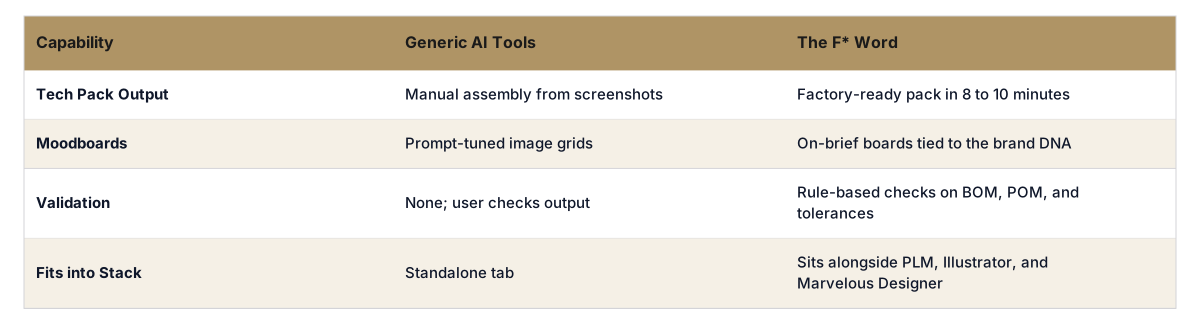
The F* Word is an autonomous fashion workflow layer that produces factory-ready tech packs in 8-10 minutes from a garment design and generates on-brief moodboards for creative direction. It is not a PLM, a 3D simulator, or an image generator: it validates and orchestrates the handoff between creative and production so brands ship on time without adding tools their teams already have.
The purpose of an AI fashion design brief is to provide a structured set of instructions and creative parameters to an AI design tool. It translates human creative vision into machine-readable commands, guiding the AI to generate specific fashion concepts, designs, or modifications that align with the designer's intent. It streamlines the ideation process.
An AI brief requires more explicit, granular, and structured details compared to a traditional human-oriented brief. It often relies on keywords, quantifiable metrics, and specific attributes rather than abstract emotional descriptions. While a traditional brief might inspire a human, an AI brief must instruct a computational system precisely.
Yes, AI design briefs can incorporate technical design elements. While a brief primarily focuses on aesthetics and concept, it can also specify requirements for construction, fit, BOM, POM, and even garment tolerances. Advanced AI systems can interpret these technical details to inform pattern generation or 3D prototyping.
No, you do not need to be a programmer. While some understanding of how AI interprets text can be helpful, most AI fashion design tools are designed for user-friendliness. The briefs primarily involve clear, descriptive language and structured inputs, akin to filling out a detailed form or providing specific prompts.
If the AI doesn't understand your brief, it usually means your instructions are too vague, contradictory, or outside the AI's current capabilities. Refine your brief by breaking down concepts into smaller, more specific details, using clearer language, or providing examples. Experiment with different phrasing and observe how the AI responds.
Yes, including brand guidelines is highly recommended. Details like brand ethos, signature colors, typical silhouettes, target price points, and even existing brand assets (logos, specific patterns) help the AI generate designs that are cohesive with your established brand identity. It ensures the AI becomes a valuable brand extension.
The length of an AI fashion design brief varies depending on the complexity of the project and the AI tool used. For beginners, a concise yet comprehensive brief covering essential elements is best. It should be long enough to convey all necessary details without becoming overly verbose or containing redundant information.
Discover how to optimize your design process from concept to creation. See the workflow.
Get The F* Word workflow insights in your inbox.