

An AI tech pack is a factory-ready specification generated from a design rather than typed by hand. The F* Word produces one in 8 to 10 minutes, with bill of materials, points of measure, tolerances and grading. CLO3D and Browzwear simulate the garment; a PLM stores the record.
A tech pack is the manufacturing blueprint for a single garment. It is the document a fashion brand hands to a factory that tells the factory exactly what to cut, sew, label, and ship. Without a tech pack, no factory will quote you accurately or hit the sample you approved.
Every production-ready tech pack contains the same eight sections, regardless of category:

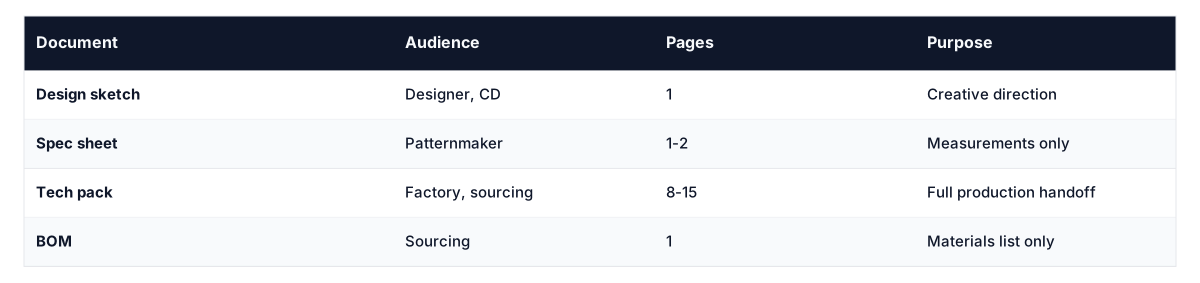
Three documents that get confused, and what each one is actually for.
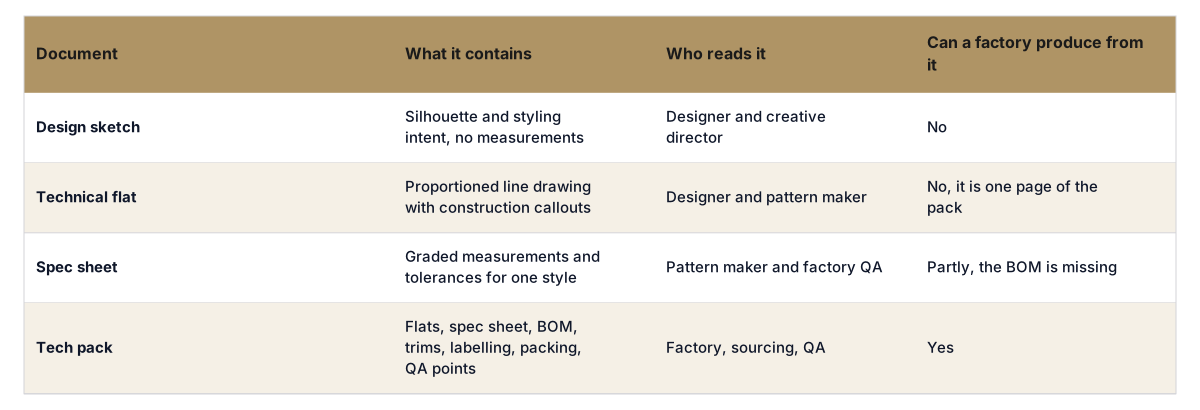
People confuse these constantly. A design sketch is the creative idea. A spec sheet is a one-page measurement chart. A tech pack is the full production document that contains both, plus everything else the factory needs.
Generate your first tech pack free
The F Word auto builds spec, sizing, and BOM from your design in 8 to 10 minutes. No template wrangling, no factory back and forth.
Traditionally, a freelance technical designer or in-house production team builds tech packs in Illustrator and Excel. A single style takes 4-8 hours and costs $150-$600 per garment in freelance fees. For a 20-style capsule, that is a week of work and $3,000-$12,000 before sampling even starts.
AI workflow software like The F* Word now generates a complete, factory-ready tech pack from a flat sketch or moodboard in 8-10 minutes. The system auto-fills the BOM from a brand library, generates POMs from a base block, and runs validation checks (POM math, grading rules, BOM completeness) before the file is exported. The designer reviews and approves, the factory receives a clean PDF.
This is not image generation. It is structured document automation with human-in-the-loop validation. The output is the same format your factory already accepts, usually a PDF plus an Illustrator file.
You need a tech pack the moment you move from sampling with a local maker to producing with an overseas factory, or whenever your order quantity goes above 50 units per style. Below that threshold a detailed spec sheet and a counter-sample often suffice. Above it, the tech pack is what protects you when the bulk run does not match the sample.
No. CAD files are pattern pieces. A tech pack references the pattern but adds construction, BOM, grading, and labeling.
You can, but you will get a sample that interprets the sketch, not one that matches your intent. Quotes will also be 20-40% higher because the factory prices in risk.
8-15 pages for a single garment. Outerwear and tailored pieces run longer because of interlining and construction detail.
The first page a factory engineer opens is the BOM, not the flats. They sort components by lead time, fabric first (8-12 weeks), zippers and hardware next (4-6 weeks), labels and packaging last (2-3 weeks). A tech pack with missing supplier article numbers triggers a clarification email that adds 3-5 days before the factory can even quote. A complete BOM gets a same-week quote.
The second page they read is points of measure. They check tolerances first, a POM table with no ± value is treated as ±0, which is physically impossible to hit and signals an inexperienced brand. The factory either pads the quote or asks for tolerances back, both of which delay sampling.
Before you send the file to a factory, confirm: every flat has a callout to the BOM row; every POM has a tolerance; every colorway has its own trim list; the file is exported as both PDF and the source Illustrator file; the file name includes brand, style number, and version date so the factory tracks revisions cleanly.
Related: AI tech pack generation hub · AI tech pack template vs Excel · Sketch to tech pack with AI
Get The F* Word workflow insights in your inbox.