
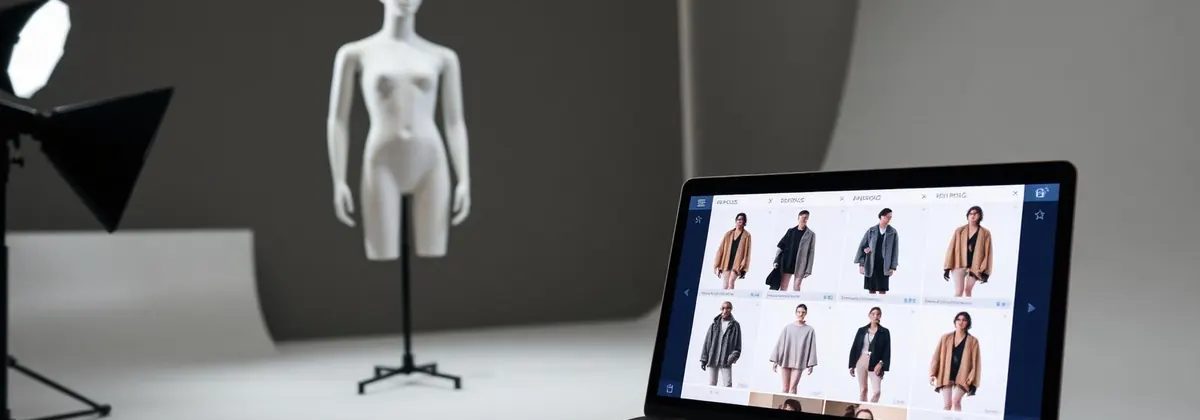
Quick answer: AI fashion photography software generates product and model imagery from a garment reference, prompt, or 3D file, replacing parts of a traditional photo shoot. It fits best for ecommerce catalog shots, lookbooks, and social variants. It does not replace pre-production, tech packs, or moodboards, so brand teams usually pair it with a workflow tool like The F* Word for the design-to-launch side.
AI fashion photography software sits in the imagery layer of a brand's stack. You upload a flat sketch, a garment photo, a 3D file, or a reference image, and the tool renders on-model or on-mannequin shots, backgrounds, and lighting variants. Most tools in the category cover four output types: ghost mannequin shots, AI model try-on, editorial or campaign scenes, and social crops.
The value is speed and unit cost. A photo studio day for a small drop can run several thousand dollars once you factor in models, stylists, location, and post. A software-generated image set for the same drop is closer to a subscription line item, and turnaround drops from days to minutes.
Photography software is a post-design capability. It expects that the garment already exists as a physical sample, a 3D file, or a locked design. That means everything before that step, the brief, the moodboard, the tech pack, the sample review, still has to happen somewhere. Teams that skip that upstream work end up generating polished images of garments that were never spec'd properly, and the errors show up at fitting.
The F* Word handles that upstream half. It generates production-ready tech packs in 8 to 10 minutes from a garment design, produces sealed moodboards, and keeps the creative direction, pre-production, and merchandising steps aligned. Photography software then takes the finalized garment and produces the visual assets for the store, PDP, and campaign.
Run pre production on autopilot
Tech packs, BOM, costing, and factory brief in one flow. Ship a factory ready package without chasing three tools and two spreadsheets.
It pays back fastest for brands that ship many SKUs per month, refresh catalog imagery often, or need localized variants for different markets. Ecommerce and marketplace teams get the most out of it because their image needs are high-volume and repeatable. Editorial-heavy brands with two seasonal campaigns per year get less lift, because the creative value of a physical shoot still dominates.
If your bottleneck is upstream, meaning tech packs that take a week, moodboards stuck in Slack, or samples that come back wrong, photography software does not fix any of that. It will actually amplify the problem by making it faster to publish images of garments that were poorly spec'd. In that case, fix the pre-production layer first.
The clean pattern for most fashion brands looks like this: use a workflow tool for the design, tech pack, and pre-production side, then use AI photography software for the imagery side, then push both into your PIM and ecommerce platform. The F* Word covers the first block, photography software covers the second, and the two do not overlap. That is why brand teams rarely have to choose between them.
For catalog and PDP volume, often yes. For campaign hero images and editorial, usually no. Most brands run a hybrid model where photographers handle two or three shoots a year and software handles the rest.
Most current tools accept 3D exports from CLO, Browzwear, or Style3D as input, in addition to flat sketches and reference photos. Output quality is highest when the input is a clean 3D file.
Yes in most jurisdictions, provided the tool's license permits commercial use and the models are either synthetic or cleared. Check the vendor's terms before shipping.
The F* Word covers the design-to-launch workflow that sits before imagery, tech packs in 8 to 10 minutes, sealed moodboards, and creative direction handoff. It runs alongside your photography tool rather than replacing it.
Priced per image or per subscription tier, most tools land between 1 and 10 dollars per finished image at production volume, versus 30 to 150 dollars per image for a traditional studio shoot at similar volume.
Get The F* Word workflow insights in your inbox.