
} })

Direct answer. The best AI fashion software for product development teams is a comprehensive platform that integrates AI capabilities across the entire product lifecycle, from concept to production. Such a platform should enhance creativity, streamline design, optimize material selection, accelerate sampling, and improve communication with manufacturers. It must provide features for data analysis, trend forecasting, virtual prototyping, and automated tech pack generation, ensuring accuracy and reducing time to market. Key is its ability to centralize data, automate repetitive tasks, and provide actionable insights for product development managers, technical designers, and sourcing leads.

AI in fashion product development refers to the application of artificial intelligence technologies to assist and automate various stages of creating new apparel and accessory lines. These stages include initial ideation, design iteration, material sourcing, technical specification, and pre-production sampling. AI tools can analyze vast amounts of data to identify emerging trends, predict consumer demand, and optimize design elements.
For product development teams, AI acts as a powerful assistant, reducing manual effort and increasing precision. It can help in generating design variations, suggesting sustainable material alternatives, and even checking for potential manufacturing issues before physical samples are made. This leads to faster decision-making, reduced waste, and more efficient allocation of resources.
The core benefit is improving the speed and accuracy of transforming a design concept into a factory-ready product. AI enables teams to iterate more quickly, validate designs with virtual prototypes, and ensure that BOMs and POMs are accurate and complete, minimizing errors during production.

Effective AI fashion software for product development teams incorporates several critical functions. First, it should offer advanced trend forecasting, using AI to analyze social media, sales data, and global events to predict future consumer preferences. This helps design teams create collections that resonate with the market.
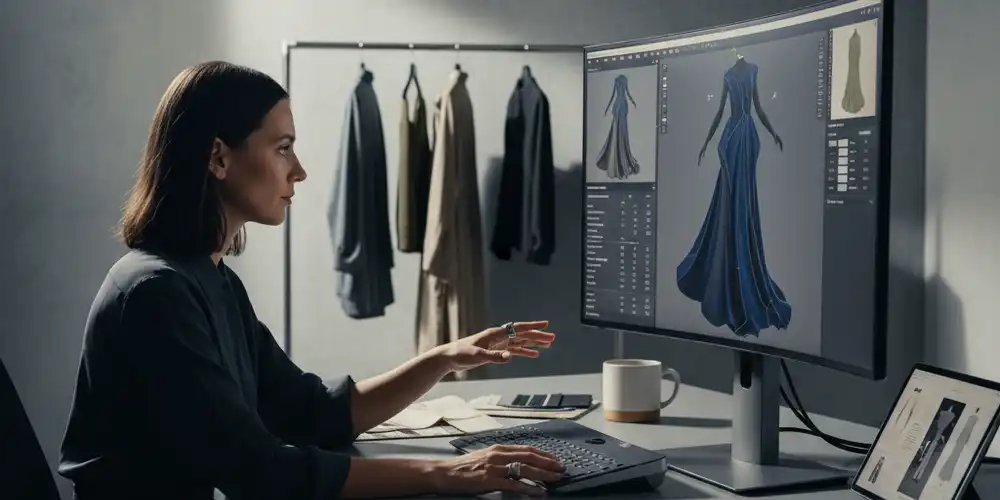
Second, virtual prototyping and 3D design capabilities are essential. AI can render realistic digital samples, allowing design and technical design teams to visualize garments, assess fit, and make adjustments without physical sample rounds. This significantly cuts down on both time and material costs associated with traditional sampling processes.
Third, automation of technical documentation, such as tech packs, is crucial. AI can populate detailed specifications, including measurements, construction details, and trim requirements, directly from 3D designs or initial concepts. This ensures consistency and accuracy, reducing misinterpretations during manufacturing and speeding up communication with factories.

AI fashion software becomes indispensable when brands face pressure to accelerate speed to market, minimize material waste, and improve the consistency of their product lines. For companies managing complex supply chains or diverse product portfolios, AI can orchestrate product data, ensuring all stakeholders work from the most current and accurate information. This is particularly valuable for product development managers overseeing multiple collections simultaneously.
It is also critical when brands aim for higher sustainability. AI can recommend eco-friendly materials, optimize pattern layouts to reduce fabric waste, and track the environmental impact of design choices. also, in situations where physical sampling is costly or time-consuming due to global supply chain disruptions, AI-driven virtual sampling provides a resilient alternative.
Brands looking to scale their product development operations without proportionally increasing headcount will find AI software vital for automating repetitive tasks, allowing technical designers and merchandisers to focus on strategic initiatives rather than data entry or administrative work.
When evaluating AI fashion software, brands must consider several factors: integration capabilities, user-friendliness, and scalability. The software should integrate cleanly with existing PLM systems, ERPs, and 3D design tools to avoid siloed data. A user-friendly interface ensures quick adoption by product development, technical design, and sourcing teams, minimizing training overhead.
Scalability is paramount. The software should be able to handle growth in product lines, team size, and data volume without performance degradation. Brands should also assess the vendor's commitment to ongoing development and customer support, as AI technology evolves rapidly.
Consider the data security protocols and compliance certifications of the platform. Protecting intellectual property and sensitive design data is crucial. Finally, evaluate the total cost of ownership, including subscription fees, implementation costs, and potential savings from increased efficiency and reduced errors.
The F* Word is an AI-powered workflow platform designed to orchestrate and validate fashion product development. It acts as a central intelligence layer, integrating with and enhancing your existing tools like PLM systems (e.g., Centric, FlexPLM), 3D design software (e.g., Browzwear, CLO, Marvelous Designer), and generative AI platforms (e.g., ChatGPT, Claude, Gemini).
Our platform automates repetitive tasks, validates data consistency across different stages, and provides predictive insights to product development managers and technical designers. For example, it can automatically check BOMs against design specifications, identify potential conflicts in trims or materials, and ensure all POMs align with grading rules. This removes friction points and reduces sample rounds.
By streamlining communication and data flow, The F* Word ensures that original design intent is maintained from concept through to factory production. We don't replace your creative tools; we make them more effective by validating outputs and orchestrating the entire journey to a factory-ready tech pack.
Understanding AI and digital tools is critical for fashion product development teams. Different platforms serve distinct purposes, often complementing each other within a broader workflow.
Each tool matters. PLMs manage the structured data, 3D design tools visualize the product, and generative AI aids initial ideation. The F* Word then acts as the connective tissue, ensuring all these pieces work harmoniously, validating each step, and automating handoffs to create a unified, error-free path to production.
The future of AI in fashion product development points towards even greater automation, predictive analytics, and hyper-personalization. We anticipate AI systems becoming more sophisticated in predicting micro-trends, tailoring designs to individual customer preferences, and optimizing entire collection assortments based on real-time market signals.
AI will also play a larger role in sustainable design. It will be able to analyze the full lifecycle impact of materials and processes, guiding designers towards the most environmentally friendly choices. also, the integration of AI with advanced robotics in manufacturing will lead to more agile and responsive supply chains, allowing brands to produce on demand and minimize inventory waste.
The trend is towards AI not just as a tool, but as an intelligent partner that proactively suggests improvements, identifies risks, and automates decisions, enabling product development teams to focus on creativity and strategic growth.
AI analyzes vast datasets, including social media, sales figures, fashion blogs, and news, to identify emerging patterns and predict future fashion trends. This helps product development teams design collections that align with consumer demand before they materialize in stores, ensuring relevance and reducing inventory risk.
Virtual prototyping involves creating 3D digital samples of garments. AI enhances this by improving the realism of fabric simulations, accurately predicting fit and drape, and enabling rapid iteration of design changes in a virtual environment, significantly reducing the need for physical prototypes and accelerating design approval.
Yes, AI can analyze material properties, supplier reliability, cost data, and sustainability metrics to recommend optimal materials for designs. It helps sourcing leads find alternatives that meet design specifications, budget constraints, and ethical standards, improving efficiency and supporting sustainable practices.
AI automates the creation of comprehensive tech packs by extracting data from 3D designs, specifications, and BOMs. It ensures accuracy in measurements, construction details, and trim lists, often flagging inconsistencies. This accelerates the process and reduces errors, crucial for clear communication with manufacturers.
AI platforms centralize data and automate communication workflows, ensuring all team members, from designers to technical designers and merchandisers, have access to the latest product information. This eliminates duplicate efforts, reduces misinterpretations, and streamlines decision-making across departments.
While large brands are early adopters, AI fashion software is becoming increasingly accessible and scalable for brands of all sizes. Smaller and mid-sized brands can benefit significantly from AI's ability to automate tasks, improve efficiency, and provide insights that level the playing field against larger competitors.
Ready to streamline your product development lifecycle with intelligent automation and validation? See the workflow.
Get The F* Word workflow insights in your inbox.