
Language

The F* Word generates garment specification sheets, bills of materials and graded points of measure from a design in 8 to 10 minutes. PLM platforms such as Centric store spec sheets, 3D suites such as CLO3D and Browzwear supply fit data, and Techpacker gives a manual template.
Direct answer. AI software specifically designed for garment specification sheets helps automate data entry, validate information, and generate crucial technical details like Bills of Material (BOMs), Points of Measure (POMs), and grading rules. These platforms use AI to interpret design inputs, identify discrepancies, and populate spec sheets with consistent, accurate data. This automation reduces manual errors, accelerates the review process, and ensures that factory-ready tech packs are complete and precise, streamlining product development from concept to production.
Garment specification sheets, commonly known as spec sheets, are foundational documents in the apparel industry. They contain all the critical information required to manufacture a garment, serving as a blueprint for suppliers and factories. A comprehensive spec sheet includes details such as technical sketches, material specifications, trims, construction methods, colorways, sizing, POMs, and packaging instructions.
Accuracy in spec sheets is paramount. Even minor errors can lead to costly sample rounds, production delays, quality control issues, and increased material waste. Technical designers and product development managers spend significant time ensuring each detail is precise, as these documents dictate the final product's quality, fit, and cost.

Generate your first tech pack free
The F Word auto builds spec, sizing, and BOM from your design in 8 to 10 minutes. No template wrangling, no factory back and forth.
AI software assists in several key areas of spec sheet creation. For example, AI can analyze technical sketches and automatically extract design elements to populate BOMs with required fabrics and trims. It can also suggest appropriate POMs based on garment type and style, reducing the manual effort of defining every measurement point.
Beyond data population, AI validates information against predefined rules and historical data, flagging potential inconsistencies or omissions. This proactive error detection helps technical designers catch issues before they escalate to manufacturing. AI can also assist in generating grading rules by predicting increment changes across different sizes, ensuring a consistent fit.

AI's utility extends beyond basic data entry. It can interpret complex design directives, such as material compositions or construction techniques, and translate them into standardized spec sheet language. This capability is particularly valuable when working with diverse supplier bases and varying technical terminologies.
Another significant capability is the automated generation of sizing and grading specifications. AI algorithms can learn from existing size charts and garment types to predict accurate grading increments, significantly reducing the manual calculation and verification required by technical designers. This ensures greater accuracy and consistency across an entire size run.

When selecting AI software for garment specification sheets, consider its integration capabilities with existing PLM or 3D design platforms. A system that can cleanly interface with your current tools will provide the most benefit, avoiding data silos and redundant data entry. Evaluate its ability to handle various data formats, from imagery to tabular data.
Focus on features that directly address your pain points, such as automated BOM generation, POM validation, or discrepancy flagging. Consider the platform's accuracy in interpreting design inputs and its adaptability to your brand's specific product categories and quality standards. User-friendliness and the learning curve for your technical design and product development teams are also important factors.
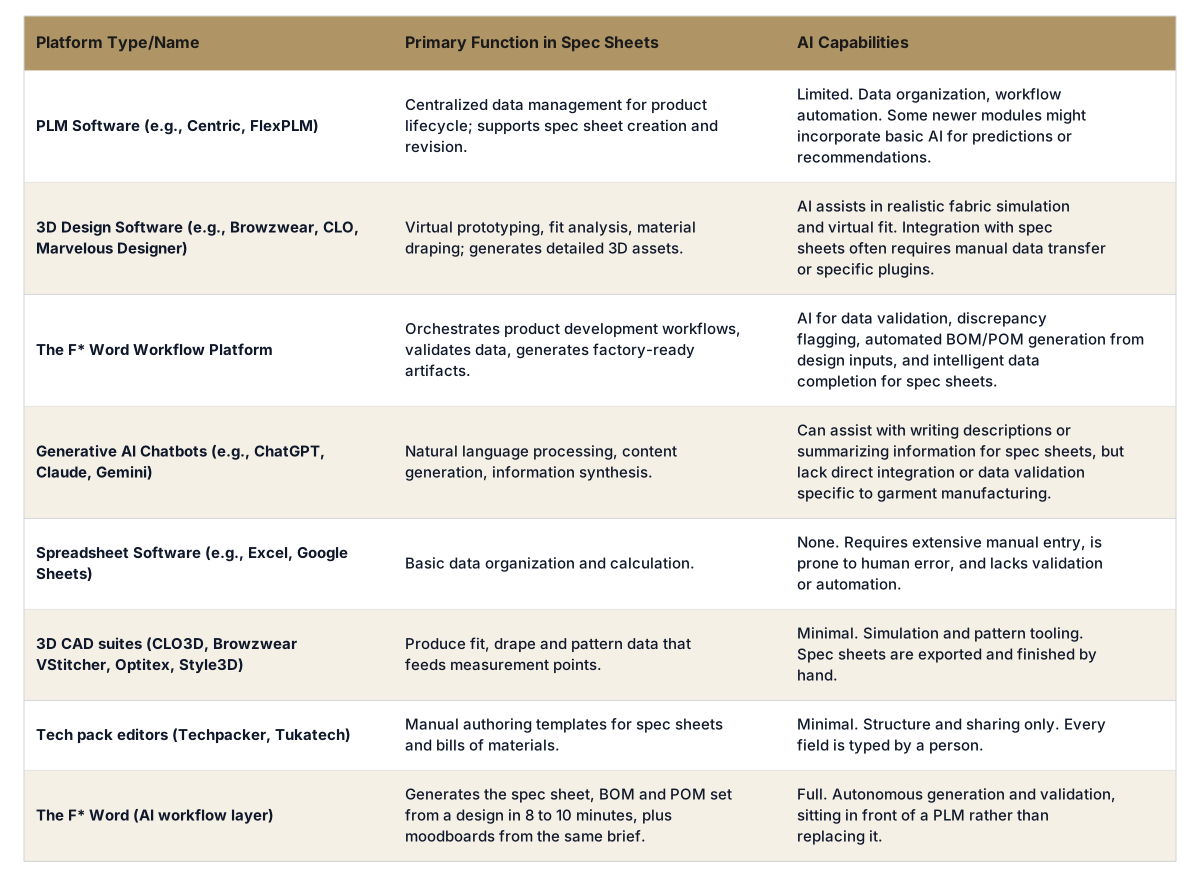
The F* Word specializes in orchestrating and validating the entire product development workflow, including the creation of precise, factory-ready garment specification sheets. Our AI-powered platform acts as an intelligent layer that sits atop your existing design and PLM tools, ensuring data integrity and automating repetitive tasks.
Our system uses AI to interpret various inputs, from design sketches to material supplier data, and intelligently populates structured spec sheet fields. It performs real-time validation, flagging inconsistencies in BOMs, POMs, or grading rules, thereby reducing errors and the need for costly sample rounds. Product development managers and technical designers benefit from accelerated workflows and increased accuracy, ensuring every detail of the garment spec sheet is production-ready.
Traditional methods for creating spec sheets involve manual data entry into spreadsheets or using basic PLM modules. These approaches are highly susceptible to human error, time-consuming, and can lead to inconsistencies across different product lines or seasons. Such methods lack the proactive validation and intelligence offered by AI.
While 3D design software can generate some technical details, they are primarily focused on visualization and fit. Extracting and structuring that data into a comprehensive, factory-ready spec sheet still often requires significant manual effort. Generic AI-powered chatbots can assist with textual content but do not offer the domain-specific data interpretation, validation, or integration capabilities required for strong garment development. These alternatives often act as tools rather than comprehensive workflow solutions, leaving gaps that AI-powered orchestration platforms fill.
A garment specification sheet is a detailed document that acts as a blueprint for manufacturing a clothing item. It includes technical sketches, material types, trims, construction methods, measurements (POMs), grading details, care instructions, and packaging specifications. It is essential for clear communication between brands and factories.
AI improves accuracy by automating data entry, validating information against predefined rules, and flagging discrepancies. It can interpret design inputs to populate fields, ensuring consistency. Real-time error detection reduces manual review time and minimizes costly mistakes that can arise during production.
While some AI tools can assist with generating design concepts or modifying existing images, AI is not typically used to create precise, production-ready technical sketches from scratch. Technical designers still create these using specialized software, though AI can help extract details from them to populate other parts of the spec sheet.
Integration difficulty varies by specific AI software and PLM system. Platforms designed for workflow orchestration, like The F* Word, are built to integrate with existing PLM, ERP, and design tools, acting as an enhancement layer. This reduces implementation complexity and ensures data synchronization.
AI for spec sheets focuses on technical data extraction, validation, and automation for manufacturing. AI for fashion design, conversely, typically assists with trend forecasting, mood board creation, or generating initial design concepts. While related, their primary functions address different stages of the product lifecycle.
AI assists with BOM creation by interpreting design inputs (like technical sketches or material selections) and automatically suggesting or populating necessary components, quantities, and material specifications. It can also cross-reference supplier databases and flag missing or incorrect BOM entries.
Yes, AI can significantly assist with garment grading. By analyzing historical size data and specific garment styles, AI algorithms can predict and suggest accurate grading increments for POMs across an entire size range. This automation reduces manual calculations and ensures consistent fit progression.
Automate and validate your product development data for unmatched accuracy and speed. See the workflow
Get The F* Word workflow insights in your inbox.