
Language
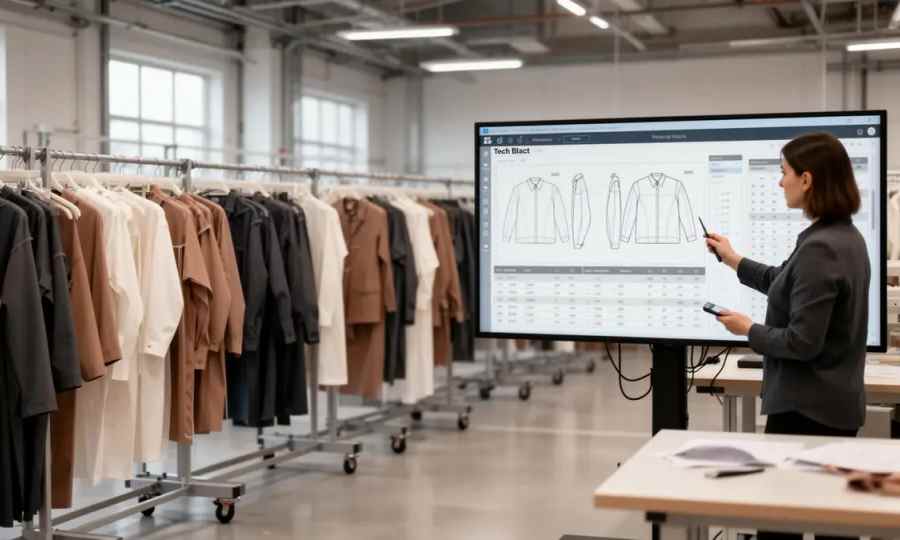

TL;DR. AI apparel production workflow software orchestrates and accelerates the journey from creative concept to factory-ready production. Unlike standalone design tools, it serves as an intelligent workflow layer that autonomously generates critical pre-production assets. For enterprise fashion brands, this means transforming a design idea into a complete, validated tech pack, including the bill of materials, points of measure, and construction details, without manual data entry. Simultaneously, it structures and organizes the visual research into a coherent moodboard, ensuring alignment between creative direction and technical execution. The F* Word accomplishes this by connecting design intent to production reality, dramatically reducing errors, shortening sample rounds, and getting products to market faster.
The apparel industry operates under immense pressure. Demands for speed, personalization, and sustainability are intensifying, placing enormous strain on traditional production timelines. Established workflows, often reliant on spreadsheets, siloed communication channels, and manual data transfer, create major bottlenecks. These legacy processes are prone to error, misinterpretation, and delays, making it difficult for brands to keep pace with market expectations and scale operations efficiently. A delayed tech pack or a miscommunicated design detail can trigger a cascade of costly issues, from incorrect samples to production stalls.
These inefficiencies are no longer sustainable for enterprise brands managing hundreds of styles per season. The gap between initial creative vision and final factory handoff is where immense value is lost. Hours are wasted by technical designers manually creating tech packs, cross-referencing material libraries, and correcting data entry mistakes. Creative directors struggle to ensure their initial concept, captured in a moodboard, is accurately translated into technical specifications. This friction slows down the entire product development lifecycle.
AI apparel production workflow software provides the critical solution. It is not another isolated tool but an orchestration engine designed to optimize the entire design-to-delivery process. By automating the generation of core production documents and validating data throughout systems, this software empowers teams to work faster and with greater accuracy. The F* Word is positioned uniquely in this space. It is not a PLM system of record, a 3D simulation tool, or a simple image generator. It is the intelligent workflow and validation layer that translates creative concepts into factory-ready tech packs and moodboards, autonomously.
Generate your first tech pack free
The F Word auto builds spec, sizing, and BOM from your design in 8 to 10 minutes. No template wrangling, no factory back and forth.
AI apparel production workflow software is a category of enterprise technology designed to automate, orchestrate, and validate the processes between design conception and manufacturing. Its core function is to ingest initial design inputs, such as sketches, inspirational images, or text descriptions, and use AI models to autonomously generate complex, structured documents required for production. This goes far beyond simple task automation. it involves intelligent content creation based on a brand's specific rules, historical data, and technical libraries.
The AI's role extends into several key areas. It provides predictive capabilities, for instance, by suggesting appropriate trims or fabrications based on the design's end use and price point. It enables data-driven decision-making by analyzing past style performance to inform new development. It also offers creative augmentation, not by replacing the designer, but by handling the repetitive, non-creative tasks of documentation. This allows creative directors and designers to focus on innovation while the AI ensures their vision is captured in a technically precise format.
A critical distinction exists between generative AI for creating visual concepts and AI dedicated to process optimization. Tools like image generators are excellent for ideation but produce unstructured images that still require manual translation into a production-ready format. AI apparel production workflow software, like The F* Word, tackles the next, more complex step. It takes the *what* (the design) and autonomously figures out the *how* (the complete tech pack and organized moodboard), ensuring the final artifacts are structured, validated, and ready for factory consumption.
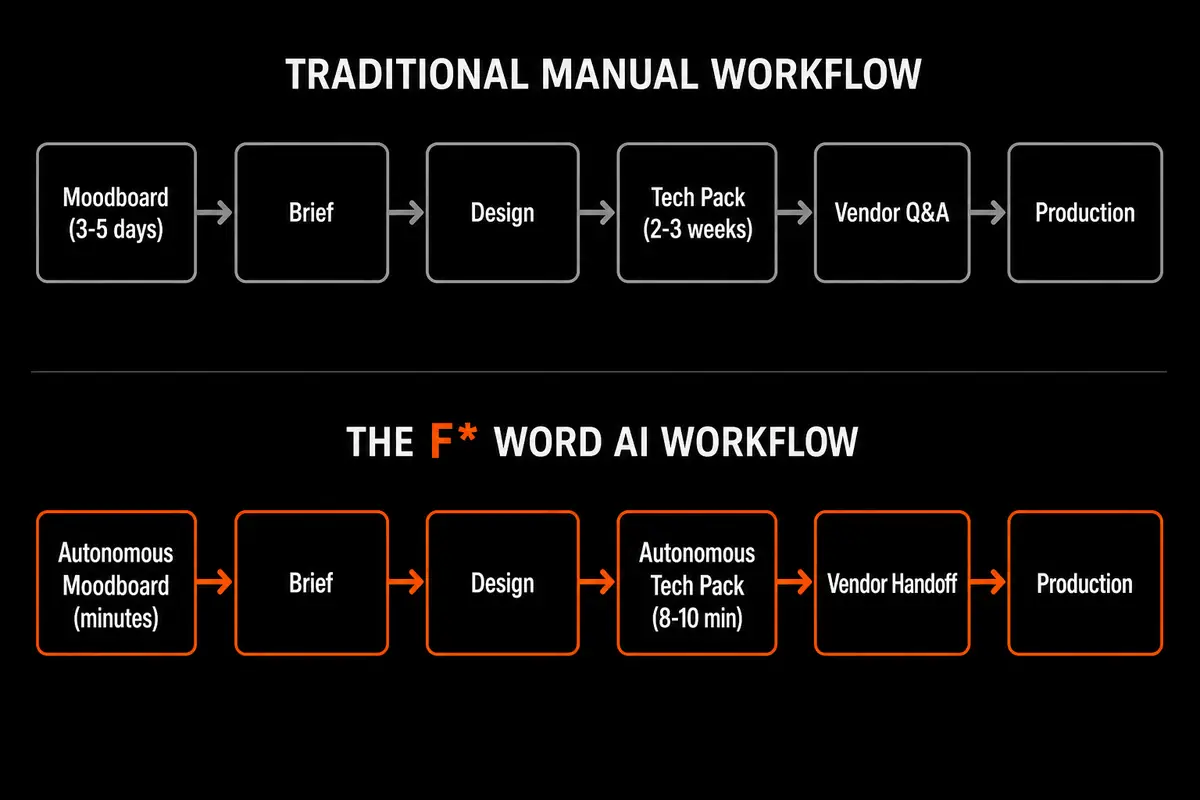
Brands do not start with a tech pack. They start with a moodboard, write a brief from it, design against the brief, then translate that design into a tech pack for the factory. The F* Word automates the two ends of that chain that consume the most calendar time: the moodboard at the front and the tech pack at the back. The middle steps, brief and design, stay where they belong, with creative and product teams.
Moodboard generation runs first. The platform ingests a season theme, a reference set, or a few line items from a merchandising plan and produces a structured moodboard: organized image grids, a tagged color palette, fabric and trim references, and an actionable creative direction summary. This is the artifact a Creative Director hands to designers, and the input a merchandiser uses to lock the brief. Replacing 3 to 5 days of manual research with minutes of output is what unlocks the rest of the calendar.
Tech pack generation runs once the design is locked. The AI analyzes the finalized design to identify silhouette, garment type, fabric details, and intended fit, then cross-references the brand's existing PLM data, block libraries, and grading rules to populate a complete factory-ready document in 8 to 10 minutes. The output includes:
The result is a single, validated chain from moodboard to brief to design to tech pack, with the two longest manual stages compressed into minutes. For a brand managing 500+ styles per season, that compression is what makes faster sample rounds, tighter approval cycles, and consistent execution throughout the collection possible.
The space between a designer's sketch and a factory's first sample is filled with operational challenges that AI is uniquely equipped to solve. One of the most persistent issues is the communication gap between design teams and production partners. Creative language does not always translate directly into technical specifications, leading to misinterpretations that result in incorrect samples and wasted resources. By autonomously generating a complete tech pack from a creative input, The F* Word creates a single, unambiguous source of truth that both sides can understand and execute against.
Manual data entry is another major risk factor. A single misplaced decimal in a POM chart or an incorrect trim code in a BOM can derail a production run. AI workflow software mitigates this risk by automating data population and cross-validating information against established libraries and rules. This ensures that every tech pack is created quickly and is also accurate, reducing the number of sample rounds needed to achieve the correct fit and finish. Fewer sample rounds directly translate to lower costs and faster speed to market.
FINALLY, these optimizations directly impact a brand's ability to compete. Accelerating the product development timeline means brands can react more quickly to emerging trends and bring products to market while demand is at its peak. also, AI contributes to sustainability goals. By optimizing material specifications in the BOM and reducing the number of physical samples shipped back and forth, brands can significantly decrease their material waste and carbon footprint. This transforms the pre-production process from a source of risk into a driver of strategic advantage.
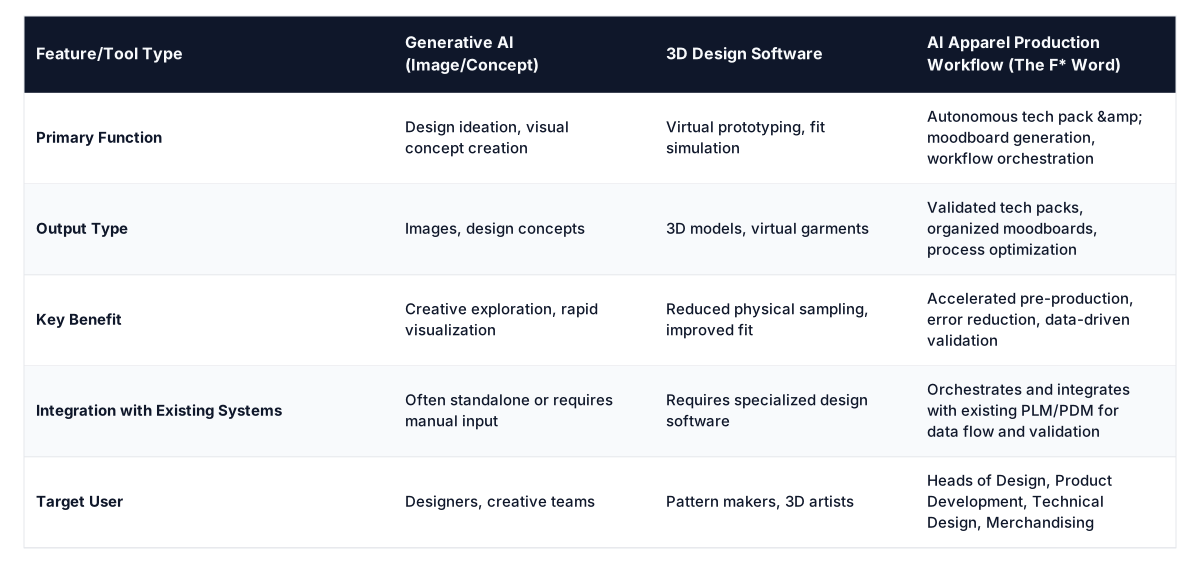
The term "AI in fashion" encompasses a wide array of tools, each targeting a different part of the product lifecycle. For decision-makers, understanding these distinctions is critical to making the right technology investment. The market can be broadly divided into three categories: generative AI for ideation, 3D design software for virtual prototyping, and AI apparel production workflow software for process orchestration and autonomous content generation.
Generative AI tools are focused on the beginning of the creative process. They excel at producing a high volume of visual concepts and moodboard imagery, helping designers explore new ideas rapidly. However, their output is an unstructured image file, which still requires a technical designer to manually interpret and document everything into a tech pack. 3D design software, like Browzwear or CLO, focuses on creating virtual garments. These platforms are powerful for visualizing fit and reducing physical sampling, but they require specialized skills and are primarily a prototyping tool, not a full workflow automation solution.
AI apparel production workflow software, exemplified by The F* Word, operates at a different level. It is not an ideation tool or a 3D modeler. it is the orchestration layer that connects the creative concept to the factory. Its unique value is in autonomously generating the structured, validated content, like a tech pack, that is essential for manufacturing. The following table clarifies the distinct roles these different tool types play in the apparel production ecosystem.
Successfully integrating AI into a large organization's apparel production workflow requires a strategic approach, not a wholesale rip-and-replace of existing systems. The first step is a thorough assessment of your current processes. Map out the entire journey from concept to tech pack handoff, identifying the most major bottlenecks, sources of error, and time-consuming manual tasks. This analysis will show the areas where an AI workflow solution can deliver the most immediate impact.
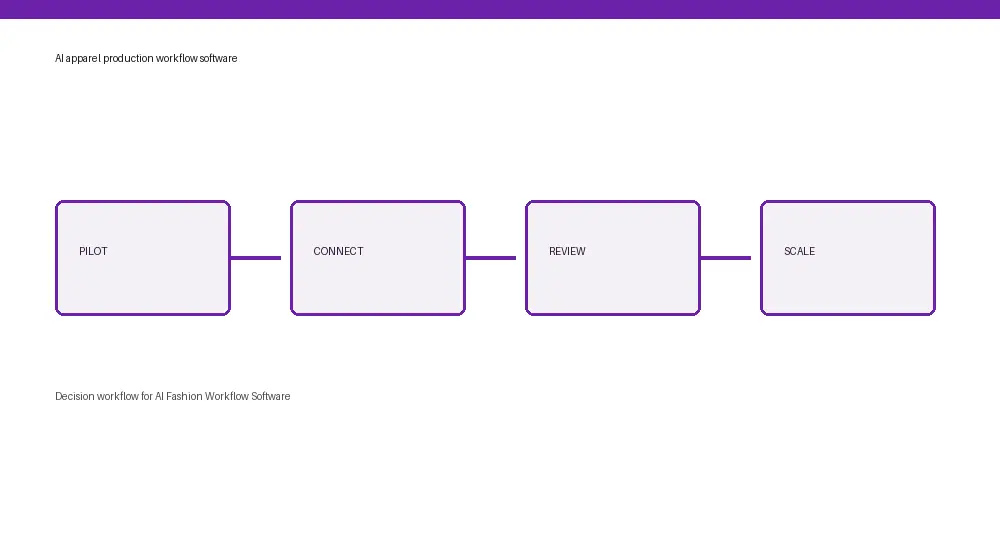
For enterprise brands, a phased implementation is often the most useful strategy. Begin with a pilot program focused on a specific product category or a single team. This allows the organization to learn, adapt, and show value in a controlled environment. The initial phase should focus on integrating the AI platform with your core system of record, such as Centric PLM or an equivalent, to ensure the AI can access block libraries, material codes, and historical data to inform its autonomous generation processes.
Change management and training are critical for adoption. Product development managers, technical designers, and merchandisers need to understand how the AI platform augments their roles, freeing them from repetitive documentation to focus on higher-value activities like fit innovation, quality control, and strategic assortment planning. Finally, establish clear metrics to measure the return on investment. Track key performance indicators like tech pack creation time, number of sample rounds per style, and overall lead time reduction. Use this data to continuously refine your processes and scale the AI implementation throughout the organization.
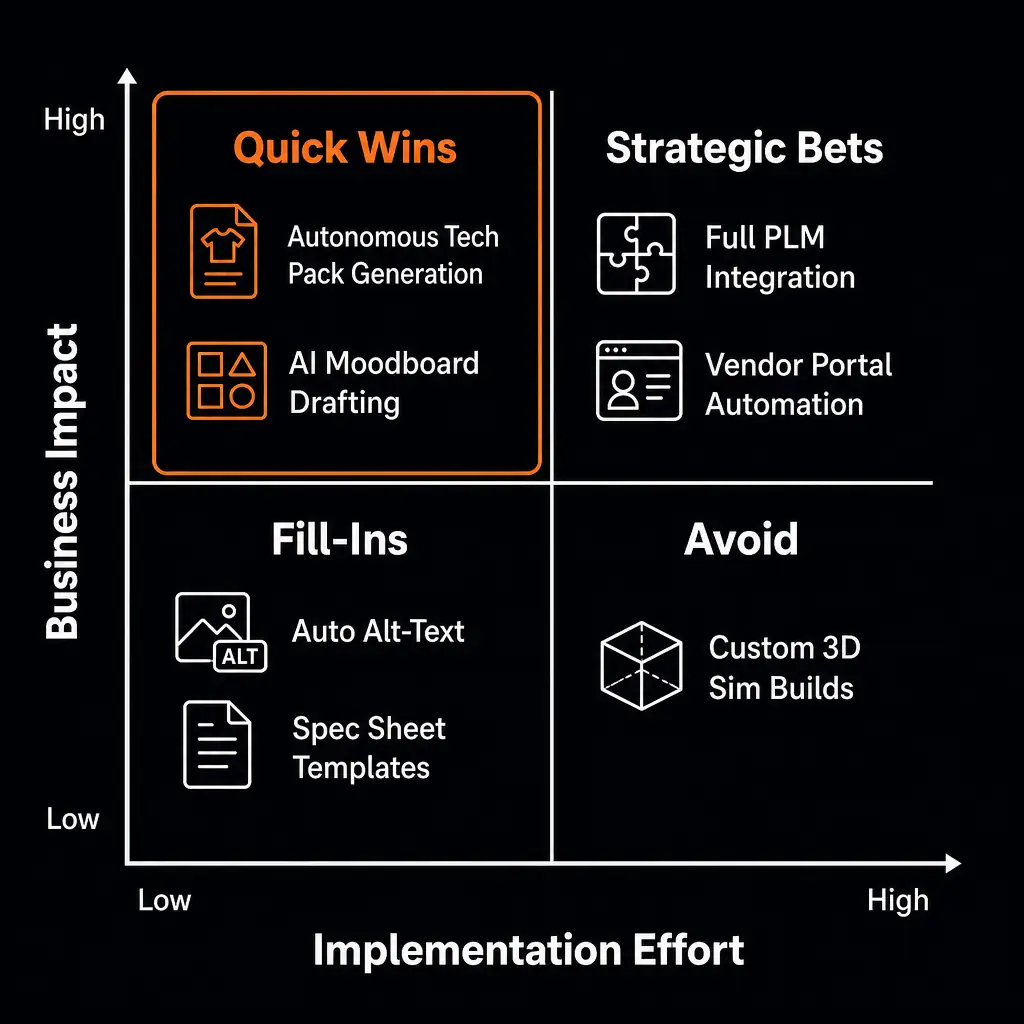
The adoption of AI apparel production workflow software is more than an incremental improvement. it is a foundational shift that prepares brands for the future of the industry. By creating a highly efficient, data-driven engine at the core of product development, companies unlock capabilities that were previously unattainable. This optimized workflow becomes the platform upon which brands can build more advanced, AI-powered strategies for personalization and trend forecasting.
Consider a system where predictive analytics identify a micro-trend, and the AI workflow platform immediately generates a series of production-ready tech packs for a capsule collection to capitalize on it. This level of agility, moving from insight to factory-ready instructions in hours, will define the next generation of fast fashion and responsive retail. It enables personalized design at scale, where product variations can be developed and prepared for manufacturing with minimal human intervention.
Beyond creative applications, this foundation improves supply chain resilience. When the workflow from design to production is streamlined and data is standardized, brands can more effectively communicate with a global network of suppliers. AI can help forecast demand with greater accuracy and match it with production capacity, reducing overstock and minimizing markdowns. For enterprise brands, integrating AI into the production workflow is not just about solving today's problems. It is about building a resilient, agile, and intelligent operational backbone that provides a lasting competitive advantage.
AI image generators create unstructured visual concepts for ideation. AI apparel production workflow software, like The F* Word, takes a concept and autonomously generates structured, factory-ready production artifacts. The key difference is the output: one produces an image, while the other produces a complete and validated tech pack with a BOM, POM, and construction details. Workflow software solves the complex data and process challenges that follow the initial creative spark.
The F* Word is designed as an orchestration layer, not a replacement for your system of record. It integrates with existing PLM and ERP systems (like Centric PLM or FlexPLM) via APIs. This allows it to read essential data such as block libraries, material codes, and grading rules to ensure consistency. It then writes the final, validated tech pack data back into the PLM, creating a clean and efficient data flow without disrupting your core infrastructure.
Yes, significantly. By automating the creation of tech packs, it reduces a multi-day manual process to minutes. This direct time saving accelerates the entire pre-production calendar. Cost efficiency is improved by minimizing human error in specifications, which leads to fewer incorrect samples and fewer costly prototype rounds. Reduced waste and faster cycles mean products hit the market sooner, maximizing their sales window and lowering development overhead.
To operate effectively, The F* Word needs an initial design input (like a sketch, photo, or prompt) and access to your brand's existing data libraries. This includes your library of garment blocks, established grading rules, a full Bill of Materials (BOM) with fabric and trim codes, and any standardized construction methods. By using this existing information, the AI can ensure all autonomously generated outputs adhere to your brand's specific standards.
Accuracy is ensured through a process of data ingestion, validation, and cross-referencing. The platform pulls directly from your brand's trusted sources, such as your PLM system, for material codes, grading tables, and block patterns. It validates inputs against these established rules, flagging inconsistencies before the tech pack is finalized. This removes the risk of manual data entry errors and ensures every tech pack is compliant with your brand's technical and quality standards from the start.
While the scale of large enterprises shows the immediate ROI, emerging and mid-sized brands can also gain a major competitive edge. For smaller teams, AI automation frees up limited resources from tedious documentation, allowing them to focus on design innovation and growth. It helps them establish scalable, error-free processes early on, building a strong foundation for future expansion without needing to hire a large technical design team.
Ready to transform your product development lifecycle from a manual bottleneck into a strategic advantage? See enterprise capabilities and discover how The F* Word can autonomously generate factory-ready tech packs for your brand. Explore more findings on our AI apparel production pillar hub at our enterprise solutions page.
Related: apparel software · Explore the related workflow · Read the related guide · Try The F* Word
Get The F* Word workflow insights in your inbox.