

The 2026 apparel software map. A modern brand at 200 SKUs per drop is running between 9 and 14 different software categories to move a garment from idea to retail. Most teams cannot name half of them. The result is integration fatigue, six-figure SaaS spend, and an "we have a tool for that" answer that nobody can map. This guide is the honest taxonomy: 14 categories of apparel software, what each one does, the vendors that lead each category, and the 3 to 5 categories an AI fashion workflow layer is collapsing into one.
Written for the buyer in charge of vendor consolidation at a brand between 50 and 2,000 SKUs per season. If you are running enterprise (10,000+ SKUs), the map is similar but the consolidation math is different.
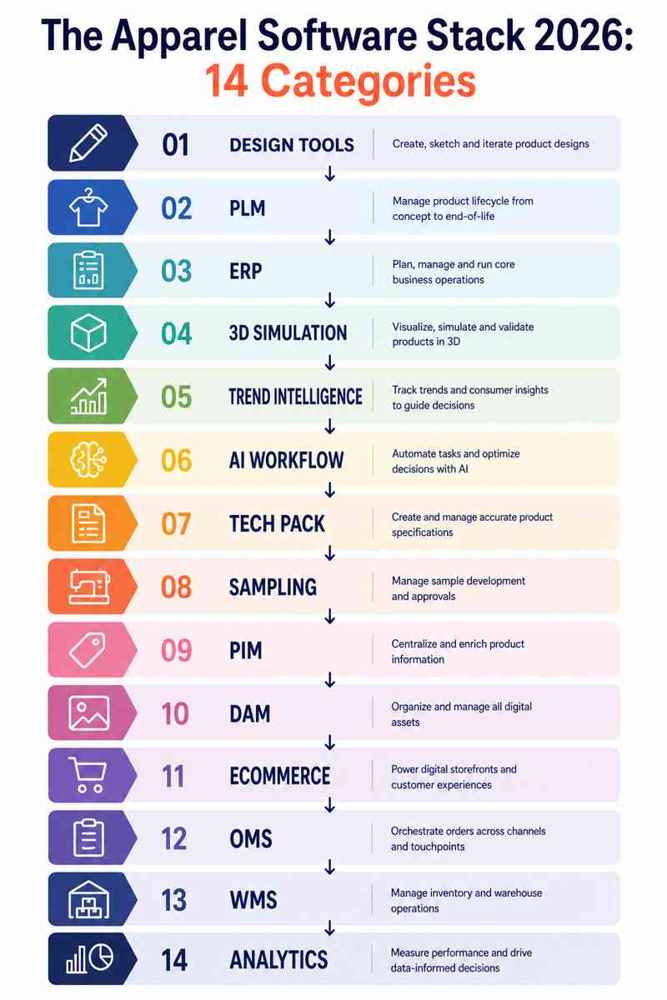
14 apparel software categories, what each layer does
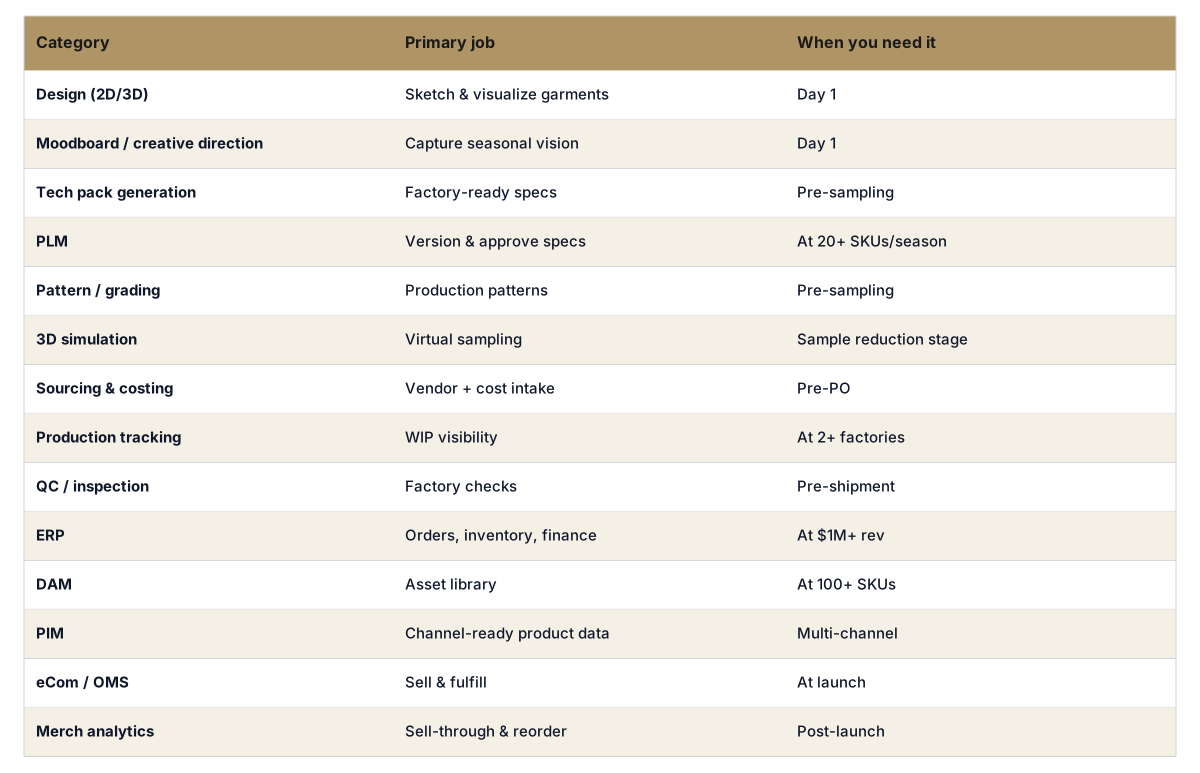
Grouped by where they sit in the lifecycle. Most brands run one tool per category. Some categories are routinely combined inside enterprise PLM or ERP, which is part of why those contracts get expensive.
The first half of the lifecycle is where most of the integration pain lives. A signal in Heuritech becomes a moodboard in Milanote, a sketch in Illustrator, a flat in CLO3D, a pattern in Optitex, a tech pack in Techpacker, and a product record in BeProduct, with five manual handoffs and three rounds of "I cannot open this file." This is the half of the stack AI workflow tools are actively collapsing.
The F* Word sits across categories 2, 3, 6, and partly 7: it generates moodboards, accepts a sketch or reference image as design input, produces a factory-ready tech pack (with linked BOM and graded POMs) in 8 to 10 minutes, and writes the resulting product record back into Shopify, NetSuite, or whichever PLM is downstream. It does not replace 3D simulation (category 5) or true pattern making (category 4) and is not trying to. It collapses the handoffs between them.
Book an enterprise walkthrough
SSO, audit trail, and custom workflows for your brand team. See how The F Word plugs into your PLM and factory stack without a rebuild.
The second half of the lifecycle is harder to collapse and largely still requires dedicated tools. ERP, ecommerce, and analytics are the three you cannot avoid. PIM and DAM is the one most growing brands postpone too long and end up paying for in messy product launches.
The most common vendor consolidation we see in the post-production half is collapsing wholesale (NuOrder or Joor) into ERP or PIM, especially as Shopify B2B has gotten more capable. Costing and pricing increasingly moves out of standalone tools and into either PLM (Centric) or ERP (NetSuite), depending on which is the larger contract.
If you are scoping vendor consolidation in 2026, these are the five categories where an AI fashion workflow layer can credibly remove a separate tool from your stack.
None of this replaces ERP, ecommerce, 3D simulation, sourcing, or analytics. Be skeptical of any vendor that claims it does.
Three rules from the brands we have watched do this well.
Most brands do not buy all 14 layers at once. The practical sequencing for a sub-$5M brand is: start with creative direction and design, layer in AI-generated tech packs (8–10 minutes per garment with The F* Word), add a lightweight PLM when SKU count crosses 20 per season, then bolt on production tracking and QC when you operate across two or more factories. ERP, PIM, and merch analytics come once monthly orders justify the seat cost.
The biggest stack mistake we see is buying enterprise PLM before tech pack quality is solved. PLM stores and versions specs, it does not author them. If your designers still hand-build tech packs in Illustrator and Excel, a PLM rollout just digitizes the bottleneck. Fix authoring first with AI tech pack generation, then add PLM for governance.
Use the table above as a sequencing guide, not a shopping list. Each category has a clear trigger, and most brands operate happily without 4–6 of these layers for years. The right stack is the smallest one that keeps your seasonal calendar on time and your factory hand-offs clean.
Most fashion brands at 50 to 2,000 SKUs per season run between 9 and 14 software categories, including trend intelligence, moodboarding, design, pattern making, tech pack generation, PLM, sourcing, ERP, wholesale, ecommerce, PIM, DAM, and analytics. Leading vendors per category include Centric or Backbone for PLM, NetSuite or ApparelMagic for ERP, Shopify for ecommerce, and Heuritech or EDITED for trend intelligence.
Apparel software is the umbrella term for the 14 categories of tools fashion brands use to move a garment from trend signal to retail. It includes design and pattern tools, tech pack generation, PLM, ERP, sourcing platforms, wholesale, ecommerce, and BI. It is sometimes used interchangeably with "fashion industry software," though the latter often excludes pure pattern and 3D simulation tools.
For brands under 50 SKUs per drop, yes. An AI workflow layer that produces factory-ready tech packs in 8 to 10 minutes and writes back into ERP frequently replaces small-brand PLM entirely. For brands above 500 SKUs per drop, no. The supplier collaboration and multi-brand depth of enterprise PLM (Centric, Lectra) is not replaceable yet.
A growing brand at 200 SKUs per drop running 11 of the 14 categories typically spends $8,000 to $25,000 per month on apparel software (excluding implementation). Enterprise brands routinely run six-figure monthly stacks once Centric, NetSuite, and a tier-1 ecommerce platform are in play.
A sub-30 SKU brand can usually skip PLM (use AI workflow plus Shopify), wholesale platforms (use line sheets in Notion), PIM and DAM (use Shopify metadata), and standalone costing (use Excel). The five you cannot skip are design tools, tech pack generation, sourcing, ERP or ecommerce, and basic analytics.
If you are evaluating vendor consolidation for moodboarding, design ideation, tech pack generation, or small-brand PLM, The F* Word collapses those into one workflow layer with factory-ready outputs in 8 to 10 minutes. See it in action or book a 20-minute walkthrough with our team.
The number every consolidation business case underestimates is integration cost. A modern apparel stack moves data between an average of 9 systems, and each integration is either a paid connector, a custom middleware job, or a manual export-import a junior team member runs weekly. The honest 12-month number for a brand at 200 SKUs per drop is usually $20,000 to $60,000 in integration work, sitting on top of the SaaS bill. Vendor consolidation pays for itself faster than the SaaS savings imply once integration debt is on the same line of the spreadsheet.
Two practical tactics to keep this honest. First, when evaluating a new tool, score it on how many integrations it removes, not how many it adds. Second, draw the data-flow diagram of your current stack before scoping any consolidation. Most teams cannot draw it accurately, which is itself the diagnosis.
Related: fashion production automation software · AI fashion stack · enterprise AI fashion workflow software · how AI improves product data quality for global fashion teams
Get The F* Word workflow insights in your inbox.